
TL;DR:
- Buying a luxury property in Mallorca without verifying legal documents can lead to costly hidden debts and planning violations.
- In addition to core documents like the Nota Simple and Escritura, buyers must check for outstanding taxes and obtain independent legal due diligence.
Buying a luxury property in Mallorca without properly verifying the documents is one of the costliest mistakes an international buyer can make. Hidden debts, unresolved planning violations, and mismatched registry records have derailed transactions worth millions of euros, sometimes after contracts were already signed. For Americans and other non-resident investors, the language barrier and unfamiliar Spanish legal system add another layer of risk. This guide walks you through every critical verification step, from the first document you request to the final legal checks that protect your investment before any money changes hands.
Key Takeaways
| Point | Details |
|---|---|
| Essential documents | Always obtain a Nota Simple, title deed, and confirm registry and cadastral details match. |
| Debt and tax check | Verify that IBI, utilities, and community fees are paid and obtain written proof from official sources. |
| Independent legal help | Hire an English-speaking Spanish lawyer to conduct due diligence and represent only your interests. |
| Cross-border essentials | Use apostille, power of attorney, and understand Golden Visa options when buying from the US. |
| Avoid hidden pitfalls | Always check for planning discrepancies and unresolved debts, especially in luxury or coastal properties. |
What documents do you need to verify?
Before anything else, you need to know exactly which documents to gather and what each one tells you. Spain has a well-structured property registry system, but it only protects buyers who know how to use it properly.
Here are the essential documents every buyer should verify:
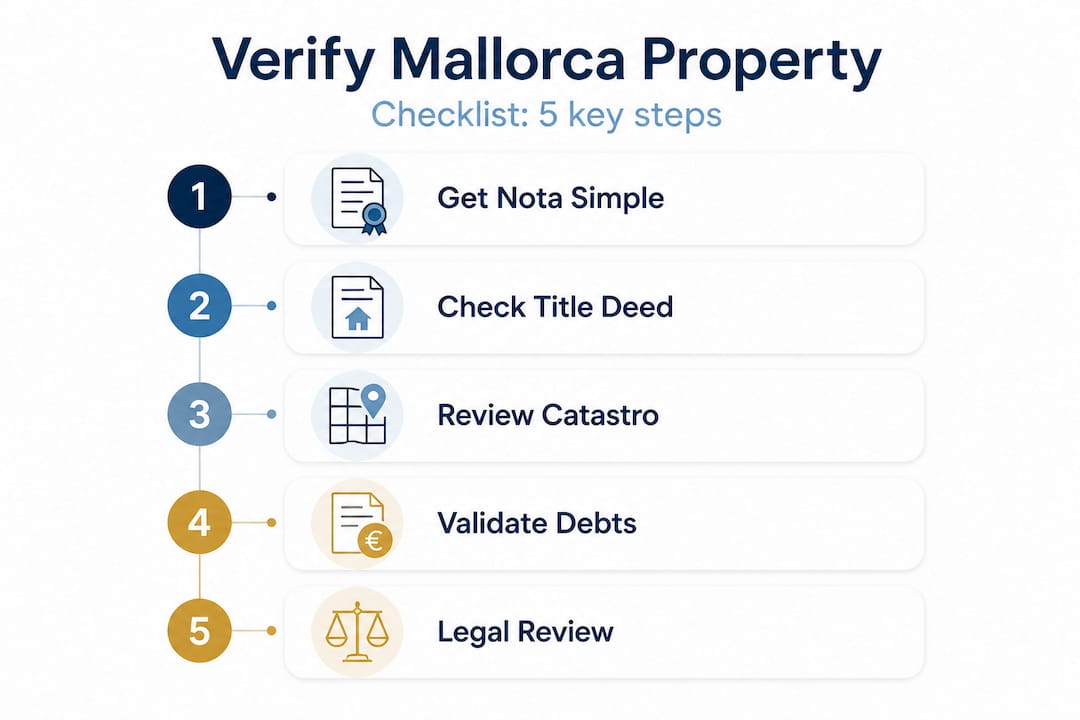
- Nota Simple: A snapshot of the property’s legal status, including the current owner, any mortgages, liens, easements, or legal disputes attached to the title
- Escritura (title deed): The official notarized document proving how and when the property was last transferred, including the purchase price and full legal description
- Certificado energético (energy certificate): Required by law for all sales; indicates the property’s energy efficiency rating
- Certificado catastral (cadastral certificate): Confirms the official surface area, boundaries, and tax reference number at the national land registry (Catastro)
- Licencia de primera ocupación: The first occupation license, proving the property was legally built and approved for habitation
- Comunidad fees certificate: Confirms whether HOA fees are up to date and lists any pending assessments
The Nota Simple is your starting point. You can obtain a Nota Simple from the Registro de la Propiedad to verify ownership, charges, mortgages, and legal status within a few days for a small fee. This single document reveals whether the seller actually owns the property, what debts are secured against it, and whether any legal proceedings could affect your purchase.
The Catastro and the Registro de la Propiedad are two separate registries in Spain. The Catastro focuses on physical dimensions and tax records. The Registro de la Propiedad focuses on legal ownership. Discrepancies between the two are surprisingly common and always need to be resolved before closing.
Check out the full Mallorca property document checklist for a deeper breakdown of each document’s requirements.
| Document | What it confirms | Where to obtain it |
|---|---|---|
| Nota Simple | Ownership, mortgages, liens | Registro de la Propiedad |
| Escritura | Legal title transfer history | Notary or seller’s records |
| Energy certificate | Efficiency rating (A to G) | Registered energy assessor |
| Cadastral certificate | Physical boundaries, tax ref | Catastro (catastro.meh.es) |
| First occupation license | Legal habitability | Local town hall (Ayuntamiento) |
Pro Tip: Always request the most recent version of each document, dated within the last 30 to 90 days. Older documents may not reflect recent changes to ownership, planning status, or outstanding debts.
How to check for debts, taxes, and hidden charges
With your core documents in hand, you must ensure no hidden financial liabilities are attached to the property. In Spain, certain debts follow the property rather than the seller. That means if you buy a home with unpaid taxes or community fees, you could legally become responsible for some of them.
The main financial obligations to verify include:
- IBI (Impuesto sobre Bienes Inmuebles): Spain’s equivalent of property tax, charged annually by the local municipality. Unpaid IBI from the last four years can become the buyer’s liability.
- Tasa de basura: The municipal garbage collection fee, small but worth confirming is current
- Community fees (gastos de comunidad): Monthly or quarterly HOA charges for shared building expenses; unpaid amounts for up to three years can transfer to the new owner
- Utility bills: Water, electricity, and gas accounts should be zeroed out at closing; request the most recent paid invoices
- Plusvalía municipal: A municipal tax on the increase in land value, typically paid by the seller but worth confirming in writing
A thorough set of administrative and tax checks, including IBI, garbage tax, municipal fees, utility debts, and community fees, must include written confirmations from the Ayuntamiento (local town hall). Verbal assurances from sellers or listing agents are not enough.
Here is a clear comparison of what happens when buyers do and don’t conduct these checks:
| Scenario | Without verification | With verification |
|---|---|---|
| Unpaid IBI (4 years) | Buyer inherits debt | Seller clears before closing |
| HOA arrears | Buyer liable for 3 years’ fees | Written clearance certificate obtained |
| Outstanding utility bills | Reconnection costs and disputes | Final bills settled and documented |
| Planning violations | Buyer inherits potential fines | Issues disclosed or remedied before sale |
Avoid the common mistakes with property debts that trip up first-time buyers in Mallorca. They are almost always preventable with the right documentation requests.
Pro Tip: Don’t accept verbal assurances from the seller or their agent. Always request recent official receipts, the latest community fee statement signed by the administrator, and a written certificate from the Ayuntamiento confirming zero outstanding municipal debts.
Independent legal verification: Lawyers, notaries, and due diligence
Now that you’ve checked for financial encumbrances, it’s time to secure professional guidance to spot legal risks others might miss. Many buyers, especially Americans unfamiliar with Spanish law, assume the notary handles all legal protection. This is a critical misunderstanding.
Here is how the legal process should work, step by step:
- Appoint an independent lawyer before signing anything. Your lawyer should be completely separate from the seller, the real estate agency, and the notary.
- Request a full Mallorca property due diligence report. This covers title history, planning permissions, building licenses, and pending litigation.
- Have your lawyer review the private purchase contract (contrato de arras). This deposit agreement is legally binding. Once signed, withdrawing typically costs you the deposit.
- Follow the due diligence timeline to ensure every check is completed before the deposit is paid and before the final deed is signed.
- Instruct your lawyer to liaise directly with the notary. Your lawyer prepares, reviews, and challenges documents. The notary finalizes and authenticates them.
Understanding this distinction is essential:
“The notary’s job is to verify identities and authenticate signatures, not to protect your legal interests. Hiring an independent Spanish lawyer who speaks English is the only way to ensure your due diligence is truly independent and thorough.”
Americans and other non-residents should specifically request an English-speaking lawyer with documented experience in Spanish real estate law and international transactions. If you need help understanding due diligence in Mallorca before your first consultation, reviewing the process in advance puts you in a much stronger negotiating position.
Pro Tip: Never use the seller’s recommended attorney or notary for your own due diligence. Even when offered as a convenience, this creates a direct conflict of interest that can leave serious issues undisclosed.
Special considerations for US/international buyers
With legal checks outlined, international buyers have additional requirements and opportunities to consider for a smooth transaction. Buying from the United States adds logistical and legal complexity that domestic buyers simply don’t face.
Here are the steps that specifically apply to American buyers:
- Obtain an NIE number (Número de Identificación de Extranjero). This is Spain’s foreign tax identification number and is required before you can sign any property deed.
- Apostille your U.S. documents. Any American document used in Spain (such as a passport copy, proof of funds, or corporate paperwork) must be authenticated through the Hague apostille process to be legally recognized.
- Set up a power of attorney (POA) if you can’t travel. A properly notarized and apostilled POA allows your Spanish lawyer to sign documents on your behalf, making remote buying for Americans fully legal and practical.
- Open a Spanish bank account. Most notaries require funds to be transferred from a local account for large transactions.
- Understand the non-resident tax obligations. Even if you don’t live in Spain, owning property creates tax filing requirements under Spanish law.
Key statistic: Property purchases over €500,000 qualify for the Spanish Golden Visa, which grants residency rights to investors and their immediate family. Buying property alone does not grant residency, but this threshold makes Mallorca’s luxury market particularly attractive for Americans seeking a European base.
Additional compliance issues to review for luxury or coastal properties include:
- Coastal law (Ley de Costas): Properties within 100 meters of the shoreline may face restrictions on renovation or expansion
- Protected land zones: Some rural or mountain properties fall under environmental protection that limits development
- Tourism rental licenses: If you plan to rent the property out, verify that a valid vacation rental license is in place or obtainable
- FINCEN and U.S. tax reporting: Americans owning foreign real estate may have FBAR and FATCA reporting obligations; consult a cross-border tax advisor
Always check the Mallorca property laws for U.S. buyers specific to your situation, especially if you plan to purchase through a company or trust structure, which carries its own set of Spanish tax implications.
The overlooked risks and smart shortcuts in Mallorca property verification
After reviewing a complete step-by-step approach, it’s worth stepping back and considering what experienced buyers sometimes still get wrong, even when they follow all the standard advice.
The biggest risk in Mallorca’s luxury segment is not the obvious one. Most sophisticated buyers check the Nota Simple and hire a lawyer. What they often miss is the planning status of the property itself. A villa can have a perfectly clean title and zero debt, while simultaneously sitting on land classified in a way that makes the existing structure technically non-compliant with current regulations. This is more common than you’d expect. Luxury properties in Mallorca often carry complex urban issues, particularly in coastal and protected zones, and discrepancies between registry and cadastral records are a consistent red flag.
Here’s the contrarian view: don’t trust the documents alone. Documents show what was registered, not necessarily what is legal today. Urban planning laws in Mallorca have changed significantly over the past two decades, and some properties were built or expanded under permits that no longer meet current standards. A change in local zoning can affect the value and usability of a property even without changing its title.
Minor mismatches between the registered surface area and the actual cadastral measurement often signal something larger. Maybe a pool was added without a license. Maybe an outbuilding was converted into living space. These additions may not appear in any problem document, but a physical inspection combined with a review of the urban planning office records will catch them.
The smart shortcut? Use a full power of attorney to authorize your lawyer to conduct every check, including in-person visits to the Ayuntamiento, the urban planning office, and the community administrator, while you’re still at home. This is not cutting corners. It’s using the system as it was designed. Follow the top tips for Mallorca buyers to structure your approach before you even book your first viewing trip.
“The single biggest transaction killer in high-value Mallorca deals is not bad titles or unpaid taxes. It’s a discrepancy that appears minor on paper but indicates a deeper planning or construction issue that neither the buyer nor the seller fully understood.”
The luxury market rewards preparation. Buyers who invest two to three weeks in thorough document verification before signing a contrato de arras almost never encounter deal-breaking surprises at the notary. Buyers who rush to lock in a property without this groundwork often find themselves in expensive renegotiations or, worse, legal disputes.

Work with experts for secure luxury property investment in Mallorca
You now have a clear roadmap for verifying property documents in Mallorca, from gathering the core registry documents to navigating cross-border legal requirements as an American buyer. But knowledge alone doesn’t protect your investment. Having the right people in your corner does.
ULI & LISA are independent buyer agents based in Mallorca, specializing in helping American and international clients navigate the full purchase process with confidence. As independent agents, we work exclusively for buyers, never for sellers or developers. Our AI-powered property search covers the full Mallorca market without bias, and our network of English-speaking lawyers, notaries, and tax advisors ensures every document check and cross-border requirement is handled correctly. Learn more about our approach to safe property investment in Mallorca and take the next step toward a secure, fully verified purchase.
Frequently asked questions
What is a Nota Simple, and why is it critical for property verification?
A Nota Simple, obtained from the Registro de la Propiedad, summarizes all legal details about the property including ownership and liens, making it your first line of defense against hidden title issues. No property purchase in Spain should proceed without reviewing a current one.
Who pays outstanding taxes or community fees before a Mallorca property purchase closes?
Sellers must clear all debts before closing, but buyers must demand written confirmations from the Ayuntamiento and community administrators rather than relying on verbal promises. Some debts, like unpaid IBI and HOA fees, can legally follow the property to the new owner.
Can Americans purchase property in Mallorca without residency?
Yes, Americans and other non-residents can buy property in Mallorca freely, but as Spanish property law confirms, ownership alone does not grant automatic residency. However, purchases over €500,000 may qualify for the Golden Visa program.
What legal risks are common with luxury or coastal properties in Mallorca?
Common risks include planning discrepancies, urban restrictions, and mismatches between registry and cadastral records, especially in coastal zones and protected areas. As property due diligence experts note, these issues often go undetected until a thorough planning office review is conducted.
Recommended
- Land Registry in Mallorca: Secure Your Property Investment - ULI & LISA Mallorca Property Blog
- How to Verify Property Documents Mallorca for US Buyers - ULI & LISA Mallorca Property Blog
- How to Secure Mortgage for Mallorca Property Easily - ULI & LISA Mallorca Property Blog
- Complete guide to property registration in Mallorca - ULI & LISA Mallorca Property Blog
- Commercial Property Search Workflow Malta Explained