TL;DR:
- Mallorca’s Land Registry confirms legal ownership, debts, and encumbrances, not just property boundaries.
- Registering property involves notarization, tax payments, and takes two weeks to two months.
- Proper registration ensures enforceable ownership rights and legal protection for buyers.
Buying property in Mallorca feels exciting until you realize that Spain’s legal system works very differently from what American or British buyers are used to. In the US, recording a deed is relatively simple. In the UK, the Land Registry process is largely digital and centralized. In Mallorca, the Registro de la Propiedad (Land Registry) is a deeply structured legal institution that does far more than record a sale. It determines who legally owns a property, what debts are attached to it, and whether you can ever sell or mortgage it again. Understanding this system is not optional. It is the foundation of a safe purchase.
Key Takeaways
| Point | Details |
|---|---|
| Land Registry ensures ownership | It officially secures your property title, rights, and any mortgage or encumbrances. |
| Expect clear costs and timeline | Registration fees and delays are predictable when steps are followed exactly. |
| Legal compliance protects buyers | Proper registry process shields you from future legal and financial surprises. |
| Expert guidance prevents mistakes | Partnering with experienced agents minimizes errors and maximizes investment security. |
What is the Land Registry in Mallorca?
The Registro de la Propiedad is the official public registry for property ownership, mortgages, and legal encumbrances in Mallorca. Every property transaction, every mortgage, and every legal claim against a property must be recorded here to have full legal standing. Think of it as the single source of truth for who owns what.
One of the most common mistakes foreign buyers make is confusing the Land Registry with the Cadastre (Catastro). These are two separate institutions. The Cadastre is a fiscal and administrative record maintained by the government for tax purposes. It tracks the physical dimensions and location of a property. The Land Registry, by contrast, is a legal record. It tells you who owns the property and what legal burdens, such as mortgages, liens, or easements, are attached to it.
Here is why this distinction matters in practice:
- The Cadastre might show a property boundary, but only the Land Registry confirms legal ownership.
- A property can appear in the Cadastre but not be registered in the Land Registry, leaving the owner without full legal protection.
- Mortgages and resales require Land Registry registration. Without it, banks will not lend, and future buyers cannot verify clean title.
For foreign buyers, the Land Registry offers something invaluable: transparency. Before you sign anything, you can request a document called a Nota Simple, which summarizes the property’s registered owner, its description, and any encumbrances. This is your first line of defense against fraud or hidden debts.
Key insight: Possessing a property is not the same as owning it legally. In Spain, registered title in the Land Registry is what gives you full, enforceable ownership rights.
Our property registration guide goes deeper into how registration protects your investment at every stage of ownership.
Step-by-step: The land registration process in Mallorca
Understanding its function, let’s walk through exactly how the land registration process unfolds in Mallorca. The process has clear stages, and knowing each one helps you avoid delays.
- Gather your documents. You will need the property deed (escritura pública), your passport, your NIE (Número de Identificación de Extranjero, the tax ID required for all property transactions in Spain), proof of tax payments including Transfer Tax (ITP) or VAT depending on the property type, and any mortgage documentation if applicable.
- Sign before a notary. The purchase deed must be signed before a Spanish notary. The notary verifies the identities of all parties, confirms the property details, and ensures the transaction complies with Spanish law. This step is non-negotiable.
- Pay the applicable taxes. Before filing with the Land Registry, you must settle taxes. For resale properties, this is typically the ITP (Impuesto de Transmisiones Patrimoniales), currently around 8% in the Balearic Islands. For new builds, VAT applies instead.
- File with the Land Registry office. In Palma, the main office is located at Alfons el Magnànim 2. Your notary or legal representative typically handles the filing, submitting the signed deed along with tax receipts and identification documents.
- Wait for processing. Registration typically takes two weeks to two months. Complex transactions, missing documents, or high office volume can extend this timeline.
- Receive your Nota Simple and registration confirmation. Once registered, you receive confirmation and can request an updated Nota Simple showing you as the legal owner.
Pro Tip: Ask your legal representative to request a “asiento de presentación” (entry of presentation) the moment your documents are filed. This timestamp protects your priority as buyer even before full registration is complete.
For a broader look at what happens before and after this process, our guide to the Mallorca closing process and tips on verifying property documents are worth reading before you sign.
Costs and timelines: What buyers should expect
Once you know the procedure, it is essential to anticipate costs and timelines to avoid surprises. Spanish registration fees are regulated by law, which means there is no negotiating them, but they are generally reasonable compared to US closing costs.

| Cost item | Estimated amount |
|---|---|
| Nota Simple | €3 to €9 |
| Full registration fee | 0.5% to 1% of purchase price |
| Notary fees | €600 to €2,500 (varies by price) |
| Transfer Tax (ITP) | ~8% of purchase price (resale) |
| VAT (new builds) | 10% of purchase price |
| Stamp Duty (AJD) | ~1.5% (new builds only) |
The Nota Simple costs €3 to €9, and full registration fees typically run 0.5% to 1% of the purchase price. On a €1,000,000 luxury property, that means €5,000 to €10,000 in registration fees alone, before taxes and notary costs.
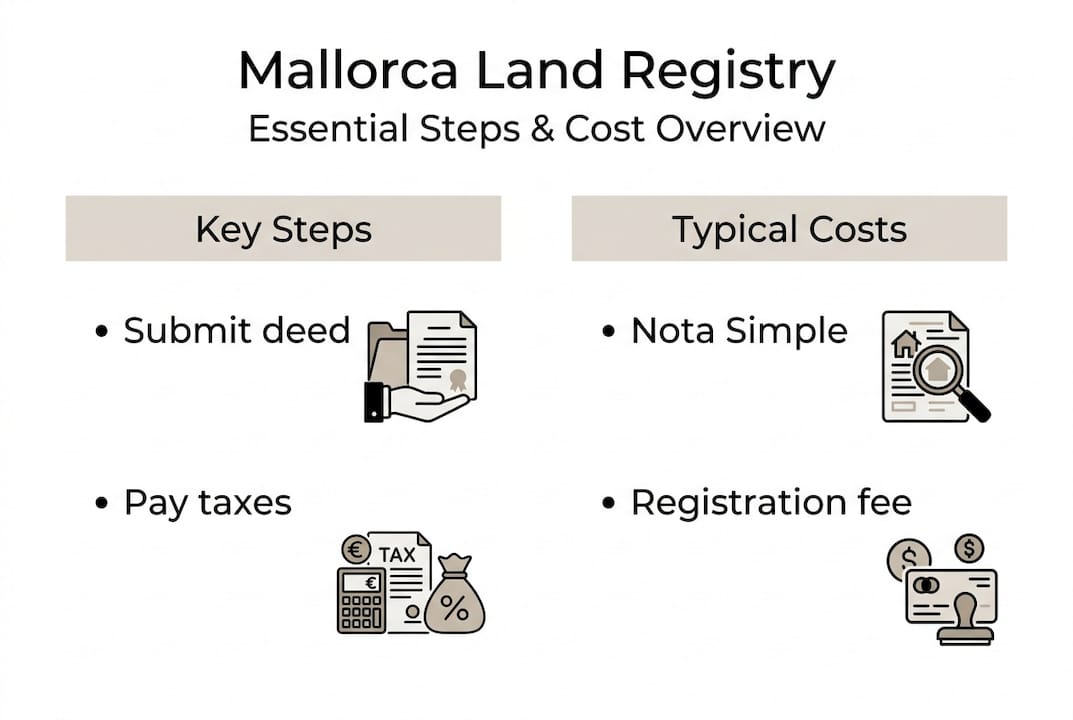
Compared to the US, where closing costs can reach 2% to 5% of the purchase price and include a long list of lender fees, Spanish registration fees are actually quite transparent and predictable. The UK’s Land Registry fees follow a tiered scale and are generally lower, but Spain’s system adds more legal weight to the registration itself.
Delays happen most often when tax payments are not processed before filing, when documents have errors or missing translations, or when the registry office is managing a backlog. Summer months in Mallorca can slow things down.
Pro Tip: Budget for all registration costs before signing the purchase agreement. Your legal team should provide a full cost breakdown, including taxes, notary fees, and registration charges, so there are no surprises at closing. Our guide to luxury property buying steps includes a detailed cost checklist.
Legal compliance and cross-border considerations
Registration is only part of the journey. Legal compliance is essential for avoiding pitfalls and protecting your investment, especially when you are buying across borders.
For American buyers, Spain does not restrict foreign ownership of property. However, there are compliance layers that require attention:
- NIE number: Every foreign buyer must obtain a NIE before completing a purchase. Without it, you cannot sign a deed, open a bank account in Spain, or pay taxes.
- FATCA and FBAR reporting: American citizens who own foreign real estate and hold Spanish bank accounts may have reporting obligations under US tax law. Consult a cross-border tax advisor before closing.
- Anti-money laundering checks: Spanish notaries and banks are required to verify the source of funds for all transactions. Large cash transfers from the US require documentation.
For European buyers, the process is more streamlined, but compliance still matters. EU citizens benefit from simplified NIE processing and no currency exchange complications if buying in euros.
Legal encumbrances and ownership rights are recorded in the Land Registry, securing foreign buyers’ claims against third-party disputes or fraudulent sellers. A registered title is legally enforceable in Spanish courts, which is a protection that mere possession or an unregistered deed simply does not provide.
| Protection type | Registered title | Unregistered possession |
|---|---|---|
| Legal ownership | Fully protected | Not guaranteed |
| Mortgage eligibility | Yes | No |
| Future resale | Straightforward | Legally complex |
| Fraud protection | High | Vulnerable |
Our property law guide explains these protections in detail for US buyers navigating Spanish law for the first time.
Common pitfalls and practical tips for successful registration
Finally, knowing where buyers commonly go wrong can save you significant time and money. The Mallorca land registry process is well-structured, but it leaves little room for error.
The most frequent mistakes include:
- Paperwork errors: Incorrect names, wrong property descriptions, or mismatched NIE numbers cause immediate rejection and restart the clock on processing time.
- Skipping certified translations: All foreign documents, including passports and financial statements, must be officially translated into Spanish by a sworn translator. Using uncertified translations is a common and costly mistake.
- Missing encumbrances in the Nota Simple: Buyers sometimes request a Nota Simple early in the process and then fail to request an updated one before closing. Encumbrances can be added between your initial check and the final signing.
- Paying taxes late: The Land Registry will not accept your filing until taxes are paid and stamped. Delays in tax payment directly delay registration.
- Not using a local legal representative: Some buyers try to manage the process remotely or through a general lawyer unfamiliar with Balearic property law. This is where deals fall apart.
Minor errors in registration can delay closing or lead to legal disputes that take months or years to resolve. The cost of fixing a registration error is almost always higher than the cost of getting it right the first time.
Pro Tip: Always request a fresh Nota Simple within 24 to 48 hours before your signing appointment. This confirms that no new encumbrances have appeared since your initial due diligence check.
For a complete checklist of what to do before, during, and after signing, our guide to essential buying steps is a practical resource.
The real key to safe property investment: Beyond the paperwork
Here is something most articles on this topic miss: the Land Registry is not just a bureaucratic formality. For sophisticated buyers, it is actually one of the most powerful assets in a Mallorca property transaction.
We have seen buyers rush through the registration process, treating it as a checkbox. Then, years later, they discover an unresolved encumbrance or a boundary dispute that was never properly recorded. Resolving these issues after the fact costs far more in legal fees, time, and stress than a thorough process would have.
The buyers who have the smoothest experiences are those who treat registration as a strategic step, not an afterthought. They engage experienced local lawyers, verify every document twice, and understand that why buy in Mallorca is only a meaningful question if the purchase is legally airtight. Registration is what makes your investment real, enforceable, and transferable. Everything else is just paperwork.
Expert support: Secure your Mallorca purchase with confidence
Navigating the Mallorca Land Registry process is manageable with the right team beside you. As independent buyer agents, ULI & LISA specialize in guiding American and European buyers through every legal and logistical step of purchasing luxury property in Mallorca. From your first Nota Simple request to final registration confirmation, we coordinate with notaries, lawyers, and the registry office so nothing falls through the cracks. Explore our luxury real estate services or learn how we approach safe property investment for international buyers who want confidence, not surprises.
Frequently asked questions
What documents are needed to register property in Mallorca?
You need the property deed (escritura), your passport, NIE number, and proof of tax payments. Registration documents must include a deed and valid identification for all parties.
How long does Mallorca property registration take?
The process takes about 2 weeks to 2 months depending on documentation completeness and office workflow. Registration benchmarks confirm this range is standard across the Balearic Islands.
How much does it cost to register property in Mallorca?
Expect to pay €3 to €9 for a Nota Simple and 0.5% to 1% of the purchase price for full registration, plus notary and tax costs.
Is registration at the Land Registry mandatory when buying property in Mallorca?
Yes, registration is mandatory for full legal protection. Land Registry records are required for legal protection and are essential for any future sale or mortgage of the property.
Recommended
- Complete guide to property registration in Mallorca - ULI & LISA Mallorca Property Blog
- Mallorca Investment Tips: Maximize ROI and Navigate Rental Laws - ULI & LISA Mallorca Property Blog
- Mallorca Investment Property Checklist: Legal Essentials - ULI & LISA Mallorca Property Blog
- Reasons to Invest in Mallorca: Luxury Returns and Security - ULI & LISA Mallorca Property Blog