Owning a luxury villa in Mallorca sounds like a dream, but for American investors and retirees, the path from interest to closing involves layers of Spanish property law, cross-border tax rules, and documentation requirements that can catch even experienced buyers off guard. The good news is that U.S. citizens can legally own property in Mallorca, and with the right preparation, the process is far more manageable than it first appears. This guide walks you through every critical stage, from understanding local ownership rules to staying compliant with both Spanish and U.S. tax authorities, so you can move forward with confidence rather than guesswork.
Key Takeaways
| Point | Details |
|---|---|
| Know legal basics | Understand ownership structures and property law essentials to navigate Spanish regulations confidently. |
| Plan for taxes | Coordinate Spanish and U.S. tax obligations to avoid double taxation and costly errors. |
| Follow the right steps | Use a clear, structured process with local experts for a smooth property purchase experience. |
| Avoid common mistakes | Steer clear of legal, financial, and tax pitfalls by learning from frequent buyer errors. |
| Work with professionals | Partnering with specialized agents and advisors is crucial for cross-border compliance and peace of mind. |
Understanding Mallorca property laws for U.S. buyers
Spain welcomes foreign buyers, and Americans face no blanket restrictions on purchasing residential or commercial property in Mallorca. However, the legal framework is meaningfully different from what you know back home, and the distinctions matter.
The first thing to understand is your status as a non-resident buyer. Most Americans purchasing a Mallorca property will be classified as non-residents for Spanish tax purposes unless they spend more than 183 days per year in Spain. This classification affects how you are taxed, what you must report, and which ownership structures make the most sense for your situation.
When it comes to property types in Mallorca, you have a wide range of options: freehold villas, apartments, rural fincas, and new-build developments. Each carries different legal considerations, particularly around land classification and building licenses.
| Ownership structure | Best for | Key consideration |
|---|---|---|
| Personal name | Primary or vacation use | Simpler setup, U.S. estate tax exposure |
| Spanish S.L. (LLC equivalent) | Rental investment | Corporate tax rules apply, more complex |
| U.S. LLC or trust | Estate planning focus | Requires Spanish legal review |
Key legal points every American buyer should know:
- Non-residents can own property outright with no special permit (except near military zones)
- Spain does not restrict foreign ownership based on nationality
- Luxury properties above certain thresholds may trigger additional due diligence
- Corporate ownership through a Spanish entity can offer tax and estate planning advantages
“U.S. citizens report worldwide income including Spanish rental income and capital gains. The U.S.-Spain tax treaty allows a Foreign Tax Credit to avoid double taxation on property gains, with Spain taxing non-residents first at 19%. Foreign accounts must be reported via FBAR and FATCA.”
Understanding these basics before you start shopping protects you from costly structural mistakes that are difficult to unwind after closing.
Essential requirements before you buy in Mallorca
With the legal landscape in mind, you’re ready to gather the essentials required for any successful property transaction in Mallorca. Think of this stage as building your foundation before the first offer is made.
The single most important document you need is the NIE (Número de Identificación de Extranjero), Spain’s foreigner identification number. Without it, you cannot sign contracts, open a Spanish bank account, or pay taxes. Apply through the Spanish consulate in the U.S. or in person at a Spanish police station once you arrive.

| Requirement | Where to obtain | Timeline |
|---|---|---|
| NIE number | Spanish consulate or police station | 2 to 6 weeks |
| Spanish bank account | Local Spanish bank | 1 to 2 weeks |
| Proof of funds | Your U.S. bank, certified | Before offer |
| Local attorney | Referral or buyer agent | Before search |
Here is what else you need to have in place before making an offer:
- Proof of funds or mortgage pre-approval, since Spanish sellers expect fast-moving buyers
- A local Spanish attorney who specializes in property law and understands U.S. buyer needs
- A notary (required by Spanish law to complete the sale)
- A property surveyor for structural assessments, especially on older fincas
- A cross-border tax advisor familiar with both Spanish and U.S. obligations
For a deeper look at living and ownership rights, the Mallorca residency guide covers visa options and long-term planning. If this is your first purchase abroad, the first-time buyer guide is a practical starting point.
Pro Tip: Assemble your legal and tax team before you start viewing properties. Deals in Mallorca’s luxury market move fast, and having advisors ready means you can act decisively without cutting corners on due diligence.
Structuring ownership to minimize U.S. estate tax exposure is one of the most overlooked steps at this stage. A cross-border tax advisor can help you choose the right ownership vehicle from day one, saving significant costs later.
Step-by-step process: Navigating your Mallorca property purchase
Having your requirements lined up, you’re ready to follow a proven, step-by-step pathway to avoid common pitfalls.
- Make an offer and sign the reservation contract. This document takes the property off the market and typically requires a deposit of 1% to 3% of the purchase price. It is legally binding, so have your attorney review it first.
- Conduct full due diligence. Your attorney checks the property registry for debts, liens, and encumbrances. A surveyor inspects the structure. This step is non-negotiable for luxury properties.
- Sign the deposit agreement (Contrato de Arras). This is the main pre-sale contract. You typically pay 10% of the purchase price here. If the seller pulls out, they owe you double. If you pull out, you lose the deposit.
- Complete at the notary. Both parties sign the public deed (Escritura) in front of a notary. Payment is made, usually via bank transfer or certified check. The notary registers the deed with the Spanish Land Registry.
- Pay all applicable taxes. Transfer tax (ITP) for resale properties runs 8% to 13% in the Balearic Islands depending on price. New builds attract VAT (IVA) at 10% plus stamp duty.
For guidance on finding the right professional, the property buyer agent guide explains what to look for. For a full breakdown of costs, Mallorca real estate taxes covers every line item.
Pro Tip: Work with a buyer agent who has direct experience with U.S. clients. They understand FATCA reporting timelines, can coordinate with your U.S. attorney, and know which local lawyers are genuinely bilingual in legal terms, not just conversational English.
Spain taxes non-resident capital gains at 19%, and you must also report the gain on your U.S. return. Planning the transaction structure before closing can reduce your combined tax burden significantly.
Tax implications: What U.S. buyers must know about Mallorca property
Because taxes often surprise new property owners, here is how U.S. and Spanish rules interact and how to avoid costly missteps.
Spain taxes non-resident property owners in several ways:
- Imputed income tax: Even if you do not rent your property, Spain assumes a notional rental income and taxes it annually
- Rental income tax: Actual rental income is taxed at 19% for non-residents from EU/EEA countries and the U.S.
- Capital gains tax: Non-residents pay 19% on gains when selling, and Spain withholds 3% of the sale price upfront as a security deposit against this liability
- Wealth tax (Impuesto sobre el Patrimonio): Applies to assets held in Spain above certain thresholds
On the U.S. side, the IRS requires you to report all worldwide income, including Spanish rental income and capital gains from a Mallorca sale. The U.S.-Spain tax treaty provides a Foreign Tax Credit mechanism, meaning the taxes you pay in Spain can offset your U.S. tax liability on the same income, preventing true double taxation.
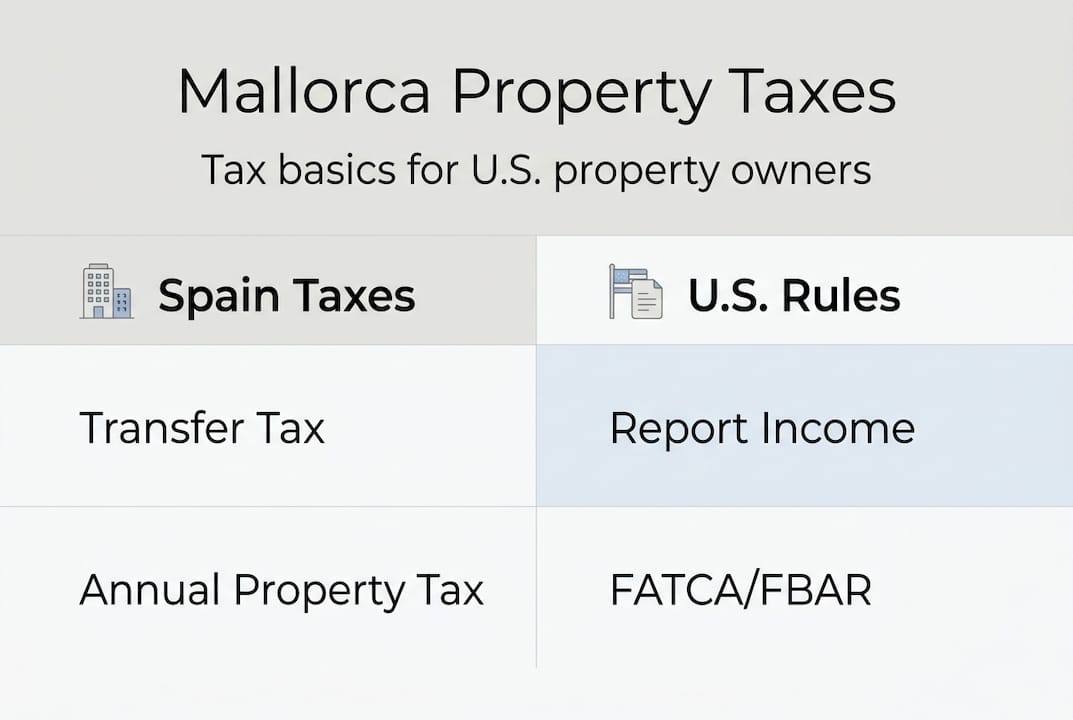
FATCA and FBAR compliance is mandatory. If your Spanish bank account or property-related accounts exceed $10,000 at any point during the year, you must file an FBAR. FATCA thresholds for reporting foreign financial assets are higher but still apply to many luxury property investors.
Consulting a cross-border tax advisor for treaty benefits and FATCA compliance is not optional for serious investors. It is the difference between a well-structured investment and an expensive compliance problem.
For a complete breakdown, Mallorca property taxes for U.S. buyers covers every obligation in plain language. Also worth reading: mistakes foreign buyers make in Mallorca, many of which are tax-related.
After closing: Common pitfalls and essential compliance for U.S. owners
Once you’ve secured your Mallorca property, smart compliance and regular review are crucial to protect your investment long term.
Annual obligations for U.S. owners include:
- Filing Spanish non-resident income tax returns (Modelo 210) each year
- Reporting rental income to both Spanish tax authorities and the IRS
- Paying local property tax (IBI) annually to the Mallorca municipality
- Maintaining FBAR and FATCA filings if account thresholds are met
- Reviewing your ownership structure as Spanish tax law evolves
Estate planning is where many American owners get caught off guard. Spanish inheritance law does not automatically follow U.S. wills or trusts. Without proper planning, your heirs could face Spanish inheritance tax on top of U.S. estate tax. Structuring ownership to minimize estate tax exposure from the start is far easier than restructuring after the fact.
Two red flags that create serious problems: underreporting rental income to either tax authority, and ignoring changes in Spanish property regulations, particularly around short-term rental licenses in the Balearic Islands, which have tightened considerably in recent years.
Pro Tip: Schedule an annual review with your Spanish attorney and cross-border tax advisor. Laws change, thresholds shift, and your personal situation evolves. A one-hour annual check-in can prevent years of compliance headaches.
For a practical list of what to avoid, top mistakes foreign buyers make in Mallorca is essential reading for every new owner.
Partner with experts for a smooth Mallorca property journey
Navigating luxury property deals in Mallorca is significantly less risky when you have an independent buyer agent on your team from day one. At ULI & LISA, we specialize in helping American investors and retirees find the right property, avoid legal surprises, and connect with trusted attorneys and cross-border tax advisors who understand both sides of the Atlantic. Our AI-powered search tools give you unbiased access to Mallorca’s full market, while our personalized guidance keeps your purchase on track at every stage. Whether you are just starting to explore or ready to make an offer, learn more about safe property investment in Mallorca or connect directly with our Mallorca buyer agents to take the next step.
Frequently asked questions
Can Americans legally own property in Mallorca?
Yes, U.S. citizens can own property in Mallorca directly as residents or non-residents, with the only notable restriction being land near military zones, which requires special authorization.
What are the main taxes Americans pay on Mallorca property?
U.S. buyers pay Spanish transfer tax, annual property tax, and 19% capital gains tax on sale proceeds, and must also declare all Spanish income to the IRS, using the U.S.-Spain tax treaty to claim foreign tax credits and avoid double taxation.
Do American buyers need a special visa or residency to buy in Mallorca?
No residency is required to purchase property, but staying more than 90 days in any 180-day period requires a visa, such as Spain’s non-lucrative visa or the Golden Visa for qualifying investment amounts.
How can Americans minimize double taxation when selling Mallorca property?
By claiming foreign tax credits for Spanish taxes paid on your U.S. return and working with a cross-border tax advisor who understands both the U.S.-Spain treaty and FATCA reporting requirements.
What are common mistakes U.S. buyers make when purchasing in Mallorca?
Rushing to sign contracts without legal due diligence, ignoring cross-border tax rules, and failing to structure the property purchase with estate planning in mind from the very beginning.
Recommended
- Buying Property in Mallorca: Key Steps for Americans - ULI & LISA Mallorca Property Blog
- Property Types in Mallorca – What U.S. Buyers Should Know - ULI & LISA Mallorca Property Blog
- Coastal Property Regulations Mallorca: What U.S. Investors Need - ULI & LISA Mallorca Property Blog
- Mallorca Real Estate Taxes – What U.S. Buyers Need to Know - ULI & LISA Mallorca Property Blog
- Purchase A New Property - Miracle Financial