Buying luxury property in Mallorca represents a significant investment, but many international buyers overlook a critical step that protects their ownership rights. Without proper registration at the Land Registry, your property purchase remains vulnerable to legal challenges, resale complications, and mortgage restrictions. This comprehensive guide walks you through the entire registration process, from signing the Public Deed to final municipal compliance, ensuring you secure your investment and avoid costly mistakes that could jeopardize your Mallorcan property.
Key Takeaways
| Point | Details |
|---|---|
| Land Registry registration | Registering the Public Deed at the Land Registry is essential to protect ownership and prevent challenges or mortgage restrictions. |
| Tax differences by property type | Resale properties incur Property Transfer Tax ITP of 8 to 11 percent, while new constructions pay IVA of 10 percent plus AJD of 1.2 percent, all due within 30 days. |
| NIE required for non residents | Non residents must obtain a NIE before the notary stage to proceed with the purchase. |
| Processing timeline and fees | Registration generally takes two to six weeks, with longer times for rural properties or complex cases, and notary plus registry fees range from 0.1 to 0.5 percent of the price. |
| Hire a lawyer or gestor | Using a licensed lawyer or gestor to manage filing remotely helps maintain compliance and progress while you are away. |
Understanding the initial steps after signing the deed
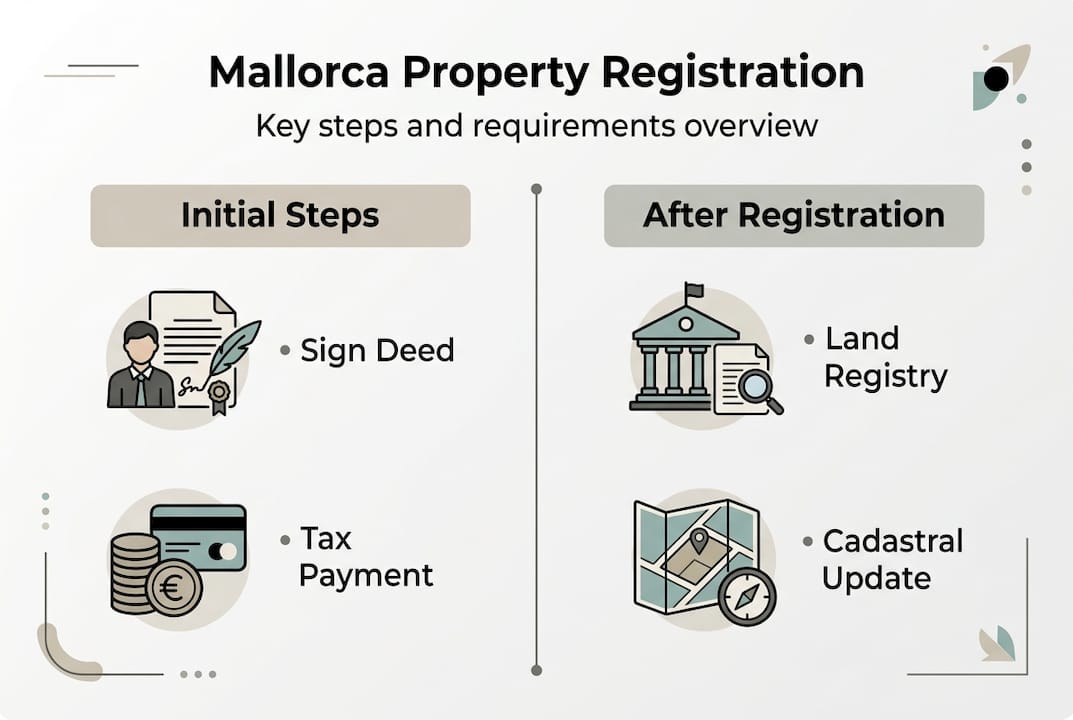
The property registration process in Mallorca begins after signing the Escritura Pública at a notary office. This Public Deed represents the official transfer of ownership from seller to buyer, witnessed and authenticated by a Spanish notary. The notary verifies identities, confirms payment terms, and ensures both parties understand their obligations before executing the transfer.
Once you sign the Public Deed, immediate tax obligations follow. For resale properties, you pay the Property Transfer Tax (Impuesto de Transmisiones Patrimoniales or ITP), which ranges from 8% to 11% of the declared property value depending on the purchase price. New construction purchases trigger different taxes: Value Added Tax (IVA) at 10% plus Stamp Duty (Actos Jurídicos Documentados or AJD) at 1.2%. These payments must be completed within 30 days of signing to avoid penalties.
Non-resident buyers face an additional requirement before reaching the notary stage. You must obtain a Número de Identificación de Extranjero (NIE), a Spanish tax identification number essential for any property transaction. Without this number, notaries cannot process your purchase. The NIE application typically takes two to four weeks, so start this process early in your buying timeline.
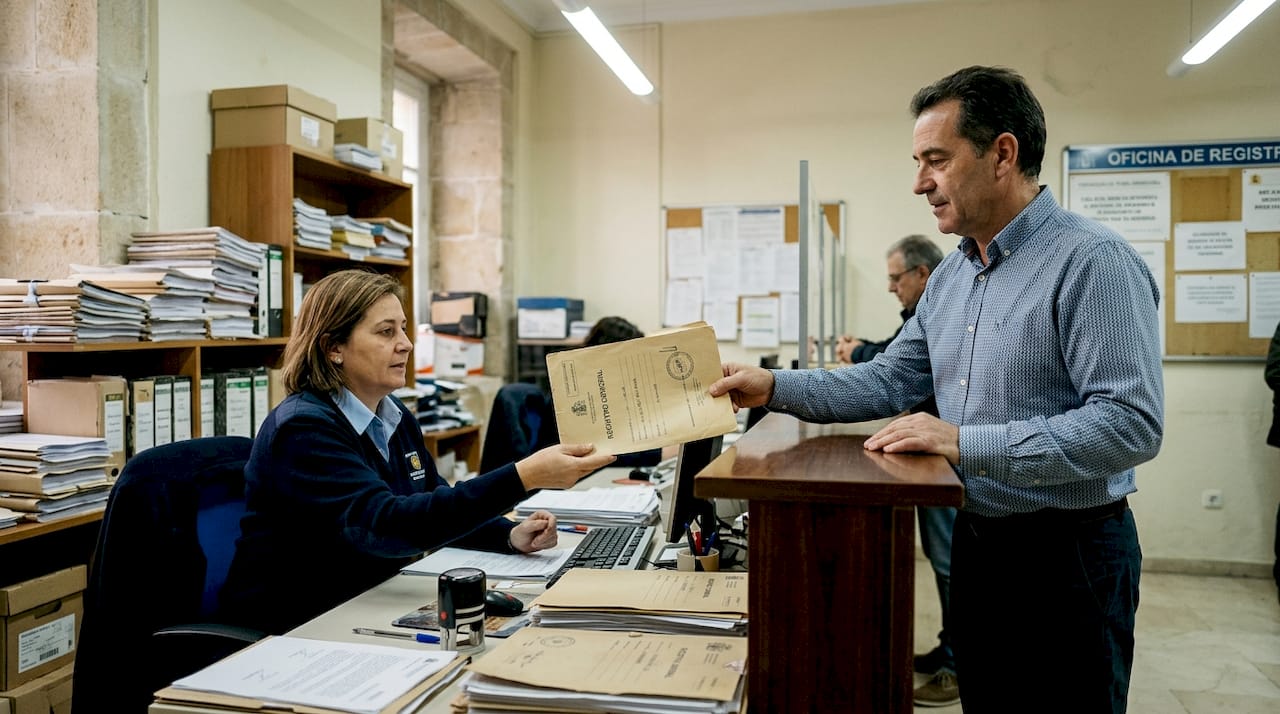
After completing tax payments, submit the signed Public Deed along with payment receipts to the Land Registry (Registro de la Propiedad). This submission officially records your ownership in public records, protecting your rights against third-party claims. The registry verifies the deed’s legality, confirms tax compliance, and checks for existing encumbrances or debts attached to the property.
Pro Tip: Hire an independent lawyer or gestor with power of attorney to manage the registration process remotely. This allows you to return home while your representative handles bureaucratic requirements, ensures compliance with Spanish property law, and monitors registration progress without requiring your physical presence.
Follow this checklist for initial registration:
- Sign the Public Deed at the notary office
- Obtain official copies of the signed deed
- Pay applicable transfer taxes within 30 days
- Collect tax payment receipts and official stamps
- Submit deed and receipts to the Land Registry
- Provide NIE number and identification documents
- Pay registry and notary fees
For detailed guidance on the complete Mallorca real estate closing process, review the full transaction timeline including pre-signing requirements and post-closing obligations.
Timelines, fees, and official confirmation of registration
Registration at the Land Registry typically takes 2-6 weeks, though this timeline varies based on registry workload and property complexity. Urban properties with clear title history process faster than rural fincas requiring additional documentation. Summer months often see longer processing times due to increased transaction volume from international buyers.
Registry fees and notary costs typically range from 0.1% to 0.5% of the purchase price, depending on property value and complexity. Higher-value luxury properties generally fall toward the lower percentage, while smaller properties or those requiring special registration procedures incur higher relative costs. These fees cover the notary’s services, registry processing, and issuance of official ownership documents.
Upon completing registration, you receive a Nota Simple, the official document confirming updated property ownership in the Land Registry. This certificate shows your name as the registered owner, lists any mortgages or encumbrances, and provides the property’s legal description. Request certified copies for your records and future transactions.
Pro Tip: Request a preliminary Nota Simple before finalizing your purchase to detect existing debts, mortgages, or legal restrictions. This document reveals unpaid community fees, tax liens, or usage limitations that could affect your ownership rights or property value.
Delayed registration creates serious complications for property owners. Without completed registration, you cannot legally resell the property or use it as collateral for financing. Banks refuse mortgage applications on unregistered properties because they cannot establish clear ownership or secure their lien position. Some buyers discover this limitation only when attempting to sell years later, facing urgent registration requirements that delay transactions and create negotiating disadvantages.
| Fee Type | Percentage Range | Basis | Payment Timing |
|---|---|---|---|
| Notary fees | 0.2-0.5% | Purchase price | At signing |
| Land Registry | 0.1-0.3% | Purchase price | With submission |
| Gestor services | 0.3-0.8% | Purchase price | Upon completion |
| Nota Simple | Fixed €9-15 | Per certificate | At request |
The registration confirmation process involves multiple verification steps. Registry officials review the Public Deed for legal compliance, verify tax payment completion, check property boundaries against cadastral records, and confirm no competing claims exist. Any discrepancies trigger requests for additional documentation, extending the timeline.
Many international buyers underestimate the importance of timely registration, assuming the notarized deed provides sufficient protection. Spanish property law, however, prioritizes registered ownership. If two parties hold deeds to the same property, the first to register gains legal ownership regardless of signing order. This makes prompt registration essential for protecting your investment.
Avoid common pitfalls by understanding the top mistakes foreign buyers make in Mallorca, including registration delays and documentation oversights that compromise ownership security.
Municipal requirements and special cases for rural and unregistered properties
Non-residents must update the Cadastral Registry post-registration for IBI tax assessment and property valuation purposes. The Catastro (Cadastral Registry) maintains separate records from the Land Registry, focusing on physical property characteristics, boundaries, and tax assessment values. Update your cadastral information within 60 days of completing Land Registry registration to ensure accurate property tax bills.
Rural fincas and older properties present unique registration challenges. Many rural properties in Mallorca lack prior Land Registry entries, having transferred through private contracts or inheritance without formal registration. These properties require inmatriculación, a first-time registration process involving boundary surveys, neighbor notifications, and extensive documentation proving ownership history.
The inmatriculación process demands significantly more time and expense than standard registration. You must provide historical ownership documents, conduct professional surveys establishing exact boundaries, notify adjacent property owners of your registration intent, and potentially resolve boundary disputes. This process can extend six months to over a year, depending on documentation availability and neighbor cooperation.
Without completed registration, properties face severe limitations. You cannot obtain building permits for renovations or additions, secure mortgages using the property as collateral, or confidently resell to buyers requiring clear title. Insurance companies may refuse coverage or charge premium rates for unregistered properties due to ownership uncertainty.
Pro Tip: Conduct thorough due diligence on property status and encumbrances via Nota Simple before purchase. For rural properties, verify whether prior registration exists and assess inmatriculación requirements early in your buying process to avoid unexpected costs and delays.
Key differences between urban and rural property registration:
- Urban properties typically have existing registry entries requiring only ownership updates
- Rural fincas often need complete first-time registration with boundary surveys
- Urban registration completes in 2-6 weeks; rural inmatriculación takes 6-18 months
- Urban properties face standard fees; rural registration costs include surveying and legal expenses
- Urban zoning allows straightforward habitability certificates; rural properties require additional permits
| Property Type | Registration Complexity | Timeline | Additional Requirements |
|---|---|---|---|
| Urban apartment | Low | 2-4 weeks | Standard documentation |
| Urban villa | Low to Medium | 3-6 weeks | Habitability certificate |
| Registered rural | Medium | 4-8 weeks | Cadastral verification |
| Unregistered rural | High | 6-18 months | Survey, inmatriculación |
Rural properties also face zoning complications affecting registration. Mallorca distinguishes between urban (urbano) and rustic (rústico) land classifications. Rustic properties have building restrictions, require special permits for construction, and may prohibit certain commercial uses. Verify zoning classification before purchase, as changing classifications involves lengthy administrative procedures with uncertain outcomes.
Older properties, whether urban or rural, may lack habitability certificates (cédula de habitabilidad) required for legal occupancy. Obtaining these certificates involves building inspections, compliance with current safety standards, and potential renovation requirements. Budget additional time and expense for securing habitability certification alongside registration.
For comprehensive guidance on document verification, explore how to verify property documents in Mallorca to ensure all paperwork meets legal requirements before initiating registration.
Expert advice and practical tips for international luxury buyers
For HNWI buyers, use independent lawyer or gestor for power of attorney to handle registration remotely. This professional representation proves vital for navigating Spanish bureaucracy, communicating with registry officials, and ensuring compliance with complex legal requirements. Your representative acts on your behalf, signing documents, making payments, and resolving issues without requiring your presence in Mallorca.
Power of attorney arrangements require careful structuring. Grant specific powers limited to property registration tasks rather than broad authority over all legal matters. Spanish law recognizes different POA types: general powers covering multiple transactions versus special powers restricted to single property purchases. For registration purposes, special POA provides adequate authority while limiting your representative’s scope.
Understand and comply with zoning and habitability certificate requirements, particularly for rural or older properties. Urban properties must meet building codes, safety standards, and occupancy regulations before receiving habitability certificates. Rural properties face additional restrictions on building size, usage, and environmental compliance. Verify all certificates exist and remain current before completing your purchase.
Common pitfalls threaten successful registration:
- Incomplete documentation delaying registry acceptance and extending timelines
- Ignoring existing encumbrances like unpaid community fees or utility debts
- Tax miscalculations resulting in penalties and registration rejection
- Assuming notarized deeds provide sufficient ownership protection
- Skipping preliminary Nota Simple review before purchase
- Using seller’s lawyer instead of independent representation
Expert representation navigates complex legal and tax obligations, ensuring secure title transfer and protecting your investment. Independent lawyers verify seller ownership, confirm debt clearance, review purchase contracts for unfavorable terms, and coordinate with notaries, registry officials, and tax authorities. This professional oversight prevents costly mistakes that could compromise your ownership rights.
“For high-net-worth international buyers, independent legal representation isn’t optional, it’s essential. Spanish property law contains nuances that differ significantly from American or European systems. Without expert guidance, buyers risk incomplete registration, undiscovered liabilities, or legal disputes that can take years and substantial expense to resolve. Protect your investment by engaging qualified professionals from the start.”
Pro Tip: Verify your lawyer or gestor maintains professional indemnity insurance and belongs to recognized legal associations. Request references from previous international clients and confirm their experience with luxury property transactions in Mallorca specifically.
Post-purchase documentation checklist:
- Original signed Public Deed with notary seal
- Tax payment receipts for ITP or VAT/AJD
- NIE number documentation
- Power of attorney grant (if applicable)
- Land Registry submission confirmation
- Nota Simple showing updated ownership
- Cadastral Registry update confirmation
- Habitability certificate (for residential properties)
- Community of owners documentation
- Utility transfer confirmations
International buyers benefit from understanding Spanish property law differences. Unlike common law systems where possession creates ownership presumptions, Spanish civil law requires formal registration for legal ownership. This fundamental distinction explains why registration carries such importance in protecting your property rights.
Tax compliance extends beyond initial transfer taxes. Non-resident property owners face annual obligations including wealth tax (Impuesto sobre el Patrimonio) on properties exceeding certain values, non-resident income tax (IRNR) on imputed rental income even if you don’t rent the property, and local property tax (IBI) based on cadastral values. Your lawyer or gestor can establish systems ensuring timely payment and compliance.
For specialized assistance navigating the registration process, learn why using a buyer agent in Mallorca provides crucial advantages for international luxury buyers. Professional buyer representation coordinates all aspects of your purchase, from initial property search through final registration, ensuring seamless transactions and secure ownership. Understanding the complete Mallorca real estate closing process helps you anticipate requirements and prepare documentation efficiently.
Secure your property investment with expert buyer agents in Mallorca
Navigating Mallorca’s property registration process requires specialized knowledge of Spanish legal requirements, tax obligations, and bureaucratic procedures. Working with independent buyer agents for property in Mallorca provides the expertise needed to ensure smooth registration, avoid costly mistakes, and protect your investment. Our team offers comprehensive support including legal coordination, power of attorney management, and thorough due diligence on complex property titles.
We specialize in helping American and European buyers secure luxury properties with complete legal compliance. Our independent luxury real estate agent services in Mallorca include registration oversight, tax planning, and ongoing property management coordination. Using advanced AI-powered tools combined with personalized guidance, we identify potential issues before they become problems and ensure your ownership rights remain fully protected.
Partner with professionals who understand international buyer needs and Mallorca’s unique property market. Discover how our comprehensive approach creates safe property investment opportunities in Mallorca through expert due diligence, legal verification, and seamless transaction management from initial search through final registration.
FAQ
What documents are required for registering property in Mallorca?
You need the notarized Public Deed, your NIE number, receipts proving transfer tax payment, and valid identification documents. After Land Registry completion, you must also update the Cadastral Registry with ownership transfer documentation. Your lawyer or gestor typically handles document submission and verification. For complete details on the closing documentation process, review the Mallorca real estate closing process guide.
How long does the property registration process usually take?
Land Registry processing generally takes 2 to 6 weeks depending on registry workload and property complexity. Urban properties with clear title history process faster than rural fincas requiring additional verification. Additional municipal steps including Cadastral Registry updates may extend the final completion timeline by several weeks. Summer months often see longer processing times due to increased transaction volume.
What special considerations apply to rural or unregistered properties?
Rural fincas or older properties may require first registration through inmatriculación, a complex process involving boundary surveys, neighbor notifications, and extensive ownership documentation. Unregistered properties cannot be legally resold or mortgaged until registration completes. Undiscovered debts, zoning restrictions, or unclear boundaries can significantly impact resale capabilities and property values. Always conduct thorough due diligence before purchasing rural or unregistered properties.
Can I complete the registration process remotely from the USA or Europe?
You can manage registration remotely by granting power of attorney to an independent lawyer or gestor based in Mallorca. Your representative handles all bureaucratic requirements, communicates with registry officials, and ensures compliance without requiring your physical presence. This arrangement proves particularly valuable for international buyers who cannot remain in Spain throughout the registration timeline. Ensure your POA document specifies registration authority and limitations.
What happens if I don’t register my property after purchase?
Without completed registration, you lack legal ownership protection under Spanish property law. You cannot resell the property, obtain mortgages using it as collateral, or confidently defend against third-party ownership claims. Banks refuse financing on unregistered properties, and buyers will not proceed with purchases lacking clear registered title. Registration delays also complicate inheritance planning and create tax compliance uncertainties that expose you to penalties.
Recommended
- Complete Guide to Mallorca Property Search - ULI & LISA Mallorca Property Blog
- ULI & LISA | Independent Luxury Real Estate Agent Mallorca
- Mallorca Property Buying Guide: Everything Explained - ULI & LISA Mallorca Property Blog
- How to Finance Property in Mallorca: A Step-by-Step Guide - ULI & LISA Mallorca Property Blog