How do I get a mortgage in Spain to buy a property in Mallorca?
To get a mortgage in Spain for a Mallorca home, obtain an NIE, open a Spanish bank account and compare offers from several banks or an independent mortgage broker. Non-residents can usually borrow 60-70% of the value, so expect a 30-40% deposit plus 10-15% purchase costs. Banks require income proof, tax returns, bank statements and a valuation, and approval usually takes several weeks.
Purchasing a luxury property on Mallorca is more than just choosing the right villa—it starts with a clear understanding of your financial standing and the unique challenges of cross-border financing. For high-net-worth American professionals, the process means assessing readiness with tools like mortgage qualification calculators that measure annual income, debt, and down payment expectations. Financial preparedness and literacy are crucial before diving into the Spanish property market, ensuring that you approach your investment with confidence and clarity.
Quick Summary
| Key Point | Explanation |
|---|---|
| 1. Assess Financial Readiness | Understand your finances by evaluating income, debts, credit score, and savings before applying for a mortgage. |
| 2. Choose a Suitable Lender | Research Spanish lenders experienced with international buyers to find competitive rates and necessary support. |
| 3. Gather Necessary Documentation | Collect essential documents like identification and income verification to present your financial credibility to lenders. |
| 4. Navigate Legal and Tax Requirements | Be aware of property tax obligations and legal requirements, and consider hiring a local expert to ensure compliance. |
| 5. Finalize Mortgage Approval | Thoroughly review loan terms, maintain open communication with your lender, and be prepared for additional requirements during the approval process. |
Step 1: Assess your financial readiness
Understanding your financial readiness is a critical first step in securing a mortgage for your Mallorca property. This process involves carefully evaluating your current financial situation to determine whether you’re prepared for a significant international real estate investment.
Start by conducting a comprehensive financial assessment using mortgage qualification calculators that help you estimate your borrowing potential. These tools analyze key factors like your annual income, existing debts, potential down payment, and monthly payment capabilities. Your goal is to establish a clear picture of what you can realistically afford in the Mallorca real estate market.
Here are the critical components to evaluate:
- Annual Income: Calculate your total yearly earnings from all sources
- Current Debt Obligations: List all existing loans, credit card balances, and monthly payments
- Credit Score: Check your credit rating, aiming for a score above 720
- Savings and Down Payment: Determine how much liquid capital you have available
- Debt-to-Income Ratio: Spanish banks generally want all monthly debt payments, including the new mortgage, to stay around 30-35% of net income
Understanding your financial literacy and preparedness is key to successfully navigating international property investments.
Additionally, financial literacy assessments reveal that thorough preparation can significantly reduce risks associated with mortgage commitments. Consider consulting with a financial advisor who specializes in international real estate investments to refine your strategy.
Pro tip: Request a comprehensive financial pre-approval before seriously searching for properties to understand your exact borrowing capacity and strengthen your negotiating position.
Step 2: Select the right Spanish lender
Selecting the appropriate Spanish lender represents a critical milestone in securing your Mallorca property mortgage. This step requires strategic research and careful comparison of financial institutions that understand international real estate investments.
Your mortgage journey begins by exploring multiple lending options across Spanish banks, credit unions, and specialized mortgage providers. The goal is to find a lender who not only offers competitive rates but also demonstrates expertise in international property financing for American buyers.
Key considerations when evaluating potential lenders include:
- Interest Rates: Compare fixed and variable rate offerings
- Loan Terms: Assess flexibility in repayment periods
- Down Payment Requirements: Understand international buyer specifications
- Language Support: Confirm availability of English-speaking representatives
- International Transaction Experience: Verify prior work with non-Spanish buyers
Foreign property investments require lenders with specialized cross-border financing knowledge.
In Spain, mortgage brokers play a crucial intermediary role by connecting international buyers with appropriate lending institutions. These professionals understand local regulatory landscapes and can significantly streamline your mortgage application process.
Consider working with brokers who have demonstrated success with American clients purchasing property in Mallorca. They can help navigate complex documentation requirements and identify lenders most receptive to international investments.
Pro tip: Request detailed loan estimates from at least three different lenders to ensure you’re getting the most competitive terms for your Mallorca property investment.
Here’s a comparison of typical mortgage processes in Spain for international buyers versus domestic buyers:
| Process Step | International Buyers (e.g., Americans) | Domestic Spanish Buyers |
|---|---|---|
| Document Translation | Required for all non-Spanish documents | Not required |
| Down Payment Requirements | Typically 30-40% (banks usually lend non-residents 60-70%) | Typically around 20% (up to about 80% financing) |
| Lender Selection Criteria | International specialization preferred | Standard local lenders |
| Tax & Legal Complexity | High, requires specialized advisor | Moderate, familiar system |
| Approval Timeline | Longer due to cross-border checks | Shorter, streamlined review |
Step 3: Gather essential documentation
Compiling the right documentation is a crucial step in securing your Mallorca property mortgage. This phase requires meticulous organization and preparation of financial records that demonstrate your creditworthiness to Spanish lenders.

Your documentation journey begins with comprehensive mortgage underwriting requirements that go beyond typical domestic loan applications. International buyers must be prepared to provide an extensive portfolio of financial evidence that proves their ability to invest in Mallorca real estate.
Essential documents you’ll need to collect include:
- Identification Documents: Valid passport, residency permits
- Income Verification: Tax returns for past 2-3 years
- Bank Statements: Last 6 months of personal and business account statements
- Employment Verification: Official employment letters, contract details
- Asset Documentation: Investment portfolios, retirement account statements
Thorough documentation is your passport to a successful international property investment.
For property-specific requirements, you’ll need to obtain official property registry documents such as the ‘nota simple’ that confirms the property’s legal status. Remember that all non-Spanish documents typically require certified translations to be acceptable to Spanish financial institutions.
Prepare digital and physical copies of each document, ensuring they are current and clearly readable. Consider creating a dedicated folder or digital file system to track your documentation progress.
Pro tip: Create a comprehensive digital and physical document checklist, and consider working with a bilingual legal advisor to ensure all paperwork meets Spanish mortgage application standards.
Step 4: Navigate legal and tax requirements
Navigating the legal and tax landscape for your Mallorca property investment requires careful planning and expert guidance. This critical step involves understanding the complex regulatory environment that governs international real estate transactions in Spain.
Your journey begins with understanding property tax obligations that differ significantly from standard US tax structures. Non-resident property owners must comply with specific Spanish tax regulations that impact your investment’s financial profile.
Key legal and tax considerations include:
- Property Registration: Verify ownership transfer with local Property Registry
- Tax Identification: Obtain Spanish tax identification number (NIE)
- Transfer Taxes: Budget for transfer tax: on resale homes in the Balearic Islands it is progressive from 8% to 13%; new builds from a developer carry 10% VAT plus stamp duty instead
- Annual Property Taxes: Understand non-resident property tax requirements
- Inheritance and Capital Gains: Review tax implications for future transactions
International property investments require meticulous legal and tax planning to ensure compliance.
For precise property ownership verification, you’ll need to register your purchase with the local Property Registry. This process confirms your legal rights and protects your investment against potential future claims.
Consider engaging a local legal expert specializing in international property transactions. They can help you navigate the intricate Spanish legal system, ensuring all documentation and tax obligations are properly managed.
Pro tip: Allocate budget for professional legal and tax consultation, as expert guidance can save significant money and prevent potential compliance issues in the long term.
Step 5: Finalize and verify your mortgage approval
The final stage of your Mallorca property mortgage journey involves carefully reviewing and confirming all loan details. This critical phase requires meticulous attention to ensure you fully understand and agree with the financial commitment you’re about to make.
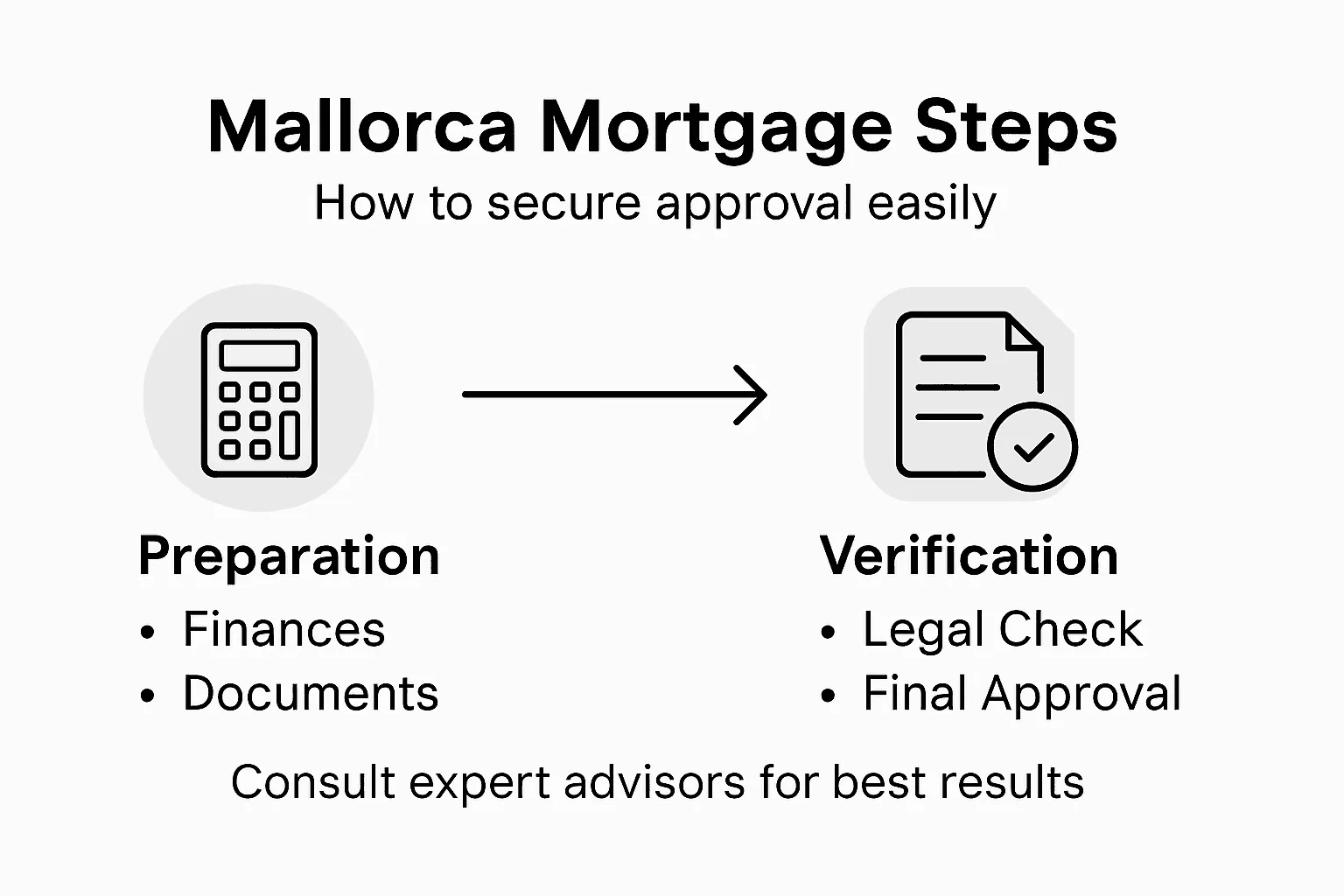
Your mortgage approval process centers on understanding conditional loan requirements that Spanish lenders impose on international property buyers. Each condition must be systematically addressed to transform your preliminary approval into a final mortgage commitment.
Key steps in finalizing your mortgage approval include:
- Loan Estimate Review: Carefully examine all financial terms and conditions
- Documentation Verification: Submit any additional requested documents promptly
- Property Appraisal: Confirm the property meets lender valuation requirements
- Final Credit Check: Maintain stable financial status during approval process
- Closing Disclosure: Thoroughly review final loan terms before signing
Precision and attention to detail are your most valuable assets in completing your mortgage approval.
To ensure a smooth process, maintain open communication with your lender and be prepared to respond quickly to any additional requests. International property purchases often require extra scrutiny, so patience and thoroughness are crucial.
Remember that the final approval is contingent on maintaining your current financial profile. Avoid making significant purchases or changing employment during this critical period, as these actions could jeopardize your mortgage application.
Pro tip: Create a dedicated email folder and document tracking system to ensure you can instantly access and respond to any lender communications during the final approval process.
Below is a summary of key professionals involved at each mortgage stage and their main contributions:
| Stage | Key Professional | Main Contribution |
|---|---|---|
| Financial Assessment | Financial Advisor | Clarifies real borrowing capacity |
| Lender Selection | Mortgage Broker | Connects with suitable Spanish lenders |
| Documentation Gathering | Bilingual Attorney | Reviews and translates legal documents |
| Legal & Tax Compliance | Local Tax Expert | Ensures full regulatory compliance |
| Final Approval | Mortgage Processor | Coordinates closing and communication |
Simplify Your Path to Securing a Mallorca Mortgage with Expert Guidance
Securing a mortgage for your Mallorca property can feel overwhelming, especially when navigating financial assessments, lender selections, and complex legal requirements from abroad. If you are an American buyer facing challenges like understanding international lending criteria or gathering extensive documentation, you are not alone. Key hurdles such as managing high down payments, deciphering property tax laws, and finalizing mortgage approvals demand trustworthy support.
ULI & LISA is an independent buyer’s agent in Mallorca that works only for buyers. We search the whole market for properties that fit your approved budget and work alongside your mortgage broker or bank, your independent lawyer and your tax advisor, who give the lending, legal and tax advice. Ready to discover how to secure your dream home with confidence? Visit ULI & LISA now and explore how our expertise can transform complex mortgage steps into a clear plan. Take control of your Mallorca investment today by contacting us for a personalized consultation and start making informed decisions with trusted professionals on your side.
Recommended
- Mallorca Property Due Diligence Guide - ULI & LISA Mallorca Property Blog
- Mallorca Residency Guide for Property Buyers - ULI & LISA Mallorca Property Blog
- Property Search Agents in Mallorca - ULI & LISA Mallorca Property Blog
- International Schools in Mallorca - ULI & LISA Mallorca Property Blog
Frequently asked questions
What are the requirements for a mortgage in Spain as a non-resident?
Spanish banks typically ask for an NIE, passport, the last two years of tax returns, recent payslips or business accounts, six months of bank statements, a credit report and details of existing debts. Foreign documents may need certified translation and an apostille. Banks also order an official valuation (tasación) of the property and usually lend non-residents 60-70% of the lower of price or valuation.
How long does it take to get a mortgage approved in Spain?
Plan for roughly four to eight weeks from a complete application to a binding offer, longer if documents need translation or the valuation raises questions. Spanish law also requires a reflection period: you must receive the loan documents (FEIN) at least ten calendar days before signing and attend a free session with the notary to confirm you understand the terms.
Should I use a mortgage broker in Spain?
A broker can be useful if you are a non-resident, self-employed or have income in dollars, because some Spanish banks handle these cases far better than others. Check that the broker is registered with the Bank of Spain as a real estate credit intermediary, ask how they are paid and compare their offer with at least one bank you approach directly.