TL;DR:
- American investors pay the highest prices per square meter in Mallorca’s luxury market.
- Proper legal, tax, and due diligence support is essential for safe property ownership.
- Trust independent buyer agents to navigate Mallorca’s complex cross-border real estate process.
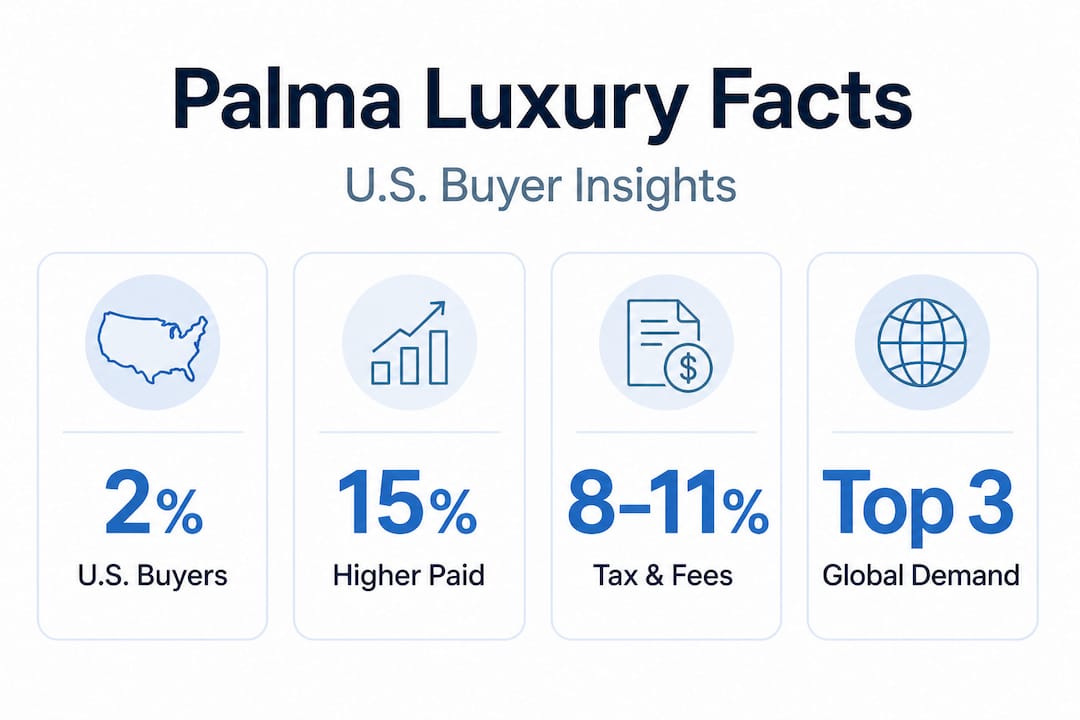
American investors represent just 2% of foreign real estate transactions in Mallorca, yet they consistently pay the highest price per square meter among all foreign buyers. That single data point tells you everything about who is winning in Palma’s luxury market right now. This guide cuts through the noise to explain exactly why Palma commands this premium, what the buying process involves, how it compares globally, and what cross-border compliance really looks like for American investors who want to do this right.
Key Takeaways
| Point | Details |
|---|---|
| Palma outpaces global markets | Palma offers high appreciation, exclusive listings, and is favored by US luxury buyers. |
| Legal compliance is critical | NIE, Spanish bank accounts, and tax filings are non-negotiable for Americans investing in Palma. |
| Independent support is essential | U.S. buyers should engage separate legal and tax experts, not rely on seller agents. |
| Cross-border taxes must be managed | Owners face Spanish and U.S. reporting; advanced planning prevents costly mistakes. |
Why Palma appeals to high-net-worth American buyers
The short answer is performance. The Balearic Islands delivered price growth of 14.87% year over year in Q4 2025, outpacing virtually every comparable luxury coastal market in Europe. That is not a bubble driven by speculative noise. It reflects genuine supply constraints in a market where buildable land near Palma’s best neighborhoods is essentially exhausted, strict environmental protections limit new development, and demand from global buyers continues to climb.
What draws Americans specifically is a combination that few markets match. Palma offers:
- Mediterranean lifestyle with over 300 days of sunshine annually, world-class dining, sailing culture, and a vibrant arts scene
- Global connectivity through Palma de Mallorca Airport, with direct flights to major European hubs and growing connections to the US through connecting routes
- Genuine privacy unlike Monaco or Marbella, where exclusivity has largely been commoditized
- Currency diversification for dollar-denominated wealth holders seeking euro-denominated hard assets
- Capital appreciation backed by structural scarcity in premium neighborhoods like Son Vida, Santa Catalina, and the Old Town
The lifestyle argument is real but secondary for sophisticated buyers. The primary driver is that Palma delivers what other markets promise but rarely deliver: consistent appreciation, a functioning legal framework, and assets that hold value even when broader European sentiment softens. Understanding the investment benefits of buying in Mallorca helps clarify why institutional and family-office capital is increasingly flowing into this market alongside private buyers.
Corporate purchases in the Balearics rose 15% recently, which is a signal that institutional players are validating what private buyers have known for years. When corporations start buying in volume, individual investors who move first capture the best inventory at the most favorable prices. The real estate advantages that make Mallorca compelling for private buyers are the same ones drawing institutional attention, and that convergence tends to accelerate price appreciation over the medium term.
What Americans must know about buying property in Palma
Here is the good news: Spain places no ownership restrictions on American citizens. You can buy freely without residency, without corporate structures, and without navigating EU citizenship requirements. The process, however, involves specific steps that differ from a US real estate closing, and skipping any one of them creates risk.
The buying process, step by step:
- Obtain your NIE (Número de Identificación de Extranjero): This is your Spanish tax identification number and is required for any legal or financial transaction in Spain. You can apply at a Spanish consulate in the US or in person in Spain.
- Open a Spanish non-resident bank account: Required to transfer purchase funds, pay taxes, and handle ongoing ownership costs. Most major Spanish banks offer non-resident accounts, though documentation requirements are thorough.
- Engage independent legal counsel: Not the seller’s lawyer, not a dual agent. Your own independent attorney who reviews title, checks for encumbrances, verifies urban planning status, and confirms no outstanding debts on the property.
- Conduct full due diligence: This includes a property registry search (Nota Simple), verification of community fees and HOA status, confirmation of energy certificates, and review of any rental license requirements.
- Sign the Arras contract (private purchase agreement): Typically involves a 10% deposit that commits both parties. Withdrawing after this point costs you the deposit. The seller withdrawing costs them double.
- Notarization and final deed (Escritura Pública): Signed before a Spanish notary, this is the legal transfer of ownership.
- Register at the Land Registry: The final step that makes your ownership legally recognized and protected.
Following a thorough step-by-step buying process is essential for American buyers because even minor procedural gaps can create complications at closing or during future resale. Using a comprehensive buying checklist before you start helps you gather documents proactively instead of scrambling mid-transaction.
Buying costs and fees in Palma: what to budget
| Cost item | Approximate amount |
|---|---|
| Property Transfer Tax (ITP) for resale properties | 8–11% of purchase price |
| VAT (IVA) for new-build properties | 10% of purchase price |
| Notary fees | 0.1–0.5% |
| Land Registry fees | 0.1–0.25% |
| Legal fees (independent lawyer) | 1–1.5% |
| Mortgage arrangement (if applicable) | 1–2% |
| Total estimated buying costs | 11–15% above purchase price |
Pro Tip: Budget conservatively at 15% above the agreed purchase price for total transaction costs. Palma’s luxury segment often involves properties with complex ownership histories, and thorough due diligence occasionally surfaces items (outstanding community fees, urban planning queries) that require resolution before closing, adding time and cost if not anticipated.
Understanding the closing process guide for Mallorca transactions helps American buyers set realistic timelines. Unlike US closings that can move in days, Spanish property transactions typically take 4 to 12 weeks from offer to notarization, depending on complexity and financing.
Comparing Palma to other global luxury property markets
American high-net-worth investors evaluating Palma rarely do so in isolation. They are comparing it against Monaco, Miami, Dubai, and similar markets. Here is how Palma stacks up on the dimensions that matter most:
| Market | Avg. luxury price per m² | Buyer taxes/fees | Annual property tax | Residency option | Rental yield potential |
|---|---|---|---|---|---|
| Palma, Mallorca | €5,000–€18,000 | 11–15% | Moderate (varies) | Golden Visa (investments >€500k) | 3–6% gross |
| Monaco | €45,000–€100,000 | 6–7% | Very low | Residence permit required | 2–4% gross |
| Miami, USA | $8,000–$25,000 | 2–4% | High (1.5–3% annually) | N/A (domestic) | 3–5% gross |
| Dubai | $5,000–$20,000 | 4% registration | Zero | Golden Visa (investments >AED 2M) | 5–8% gross |
“Americans pay the highest prices among foreigners in Mallorca’s luxury segment, which reflects not just purchasing power but strategic intent. These buyers are selecting prime assets with long-term value protection in mind.”
What the table does not capture is the qualitative edge. Palma’s luxury market offers genuine scarcity in a way Dubai and Miami do not. New supply in Dubai is essentially unlimited. Miami’s condo market faces hurricane risk, insurance cost escalation, and HOA fee volatility that is reshaping the economics of ownership. Monaco is prohibitively priced even for many ultra-high-net-worth buyers.
Palma sits in a sweet spot: meaningful capital appreciation, a functioning legal system embedded in EU frameworks, lifestyle quality that genuinely enhances quality of life, and entry prices that still represent value relative to comparable Mediterranean locations. Reviewing investment tips for Mallorca gives buyers a clearer picture of which neighborhoods and property types are delivering the strongest returns within Palma specifically.
Key reasons sophisticated buyers choose Palma over competing markets:
- Structural scarcity: Geography and regulation cap new supply permanently
- EU legal framework: Spanish property law is transparent and well-established
- Currency diversification: Euro-denominated assets hedge dollar risk over long time horizons
- Lifestyle premium: Palma’s quality of life is legitimately world-class, not aspirationally marketed
Navigating legal, tax, and compliance challenges
This is where many American buyers underestimate the complexity. Owning property in Spain as a US citizen creates obligations in two jurisdictions simultaneously, and the penalties for non-compliance in either one are significant.
Spanish tax obligations for non-resident owners:
- Imputed rental income tax (Modelo 210): Even if you do not rent your property, Spain taxes the notional rental value at 19% to 24% of 1.1% of the cadastral value annually. If you do rent the property, actual rental income is taxed at the same rate.
- Wealth tax: Spain’s annual wealth tax applies to net assets above €700,000 at rates up to 3.45%. Each autonomous region applies this differently, and the Balearics applies a solidarity surcharge for high-value assets.
- Modelo 720: Required for Spanish residents who hold foreign assets above €50,000. If you relocate to Spain and become tax-resident, this form is mandatory.
US reporting obligations:
- FBAR (FinCEN Form 114): Required if your Spanish bank accounts exceed $10,000 in aggregate at any point during the year. Filed annually with the Financial Crimes Enforcement Network.
- FATCA (Foreign Account Tax Compliance Act): Spanish financial institutions report US account holders to the IRS. Form 8938 is required if foreign financial assets exceed specified thresholds.
- Foreign income reporting: Rental income from your Palma property is taxable in the US, though foreign tax credits can offset Spanish taxes already paid.
Pro Tip: Hire a US-based CPA who specializes in expat and cross-border taxation alongside your Spanish tax advisor. The two advisors need to coordinate on credits, timing, and reporting obligations. A gap between their advice is where costly mistakes happen. Do not assume your domestic CPA understands FBAR thresholds or that your Spanish gestoria understands FATCA reporting.
Independent legal and tax advisors are not optional expenses in cross-border Spanish transactions. They are the difference between a smooth ownership experience and a compliance headache that costs multiples of what the advisory fees would have been. The most common pitfall is American buyers who work with the seller’s legal team to save money, then discover post-closing that due diligence was insufficient or that their tax position was poorly structured. Reviewing a solid Mallorca property law guide gives you a foundation before those conversations with advisors begin.
What most American investors miss about Palma property
After working with American buyers across different price points in Palma, one pattern stands out clearly. The investors who struggle are not the ones who picked the wrong neighborhood or paid a few percentage points too much. They are the ones who trusted the wrong people at critical moments in the transaction.
The real estate market here has a structural conflict of interest that most buyers from the US do not initially recognize. Many agents in Mallorca operate under a dual-agency model, representing both buyer and seller in the same transaction. In the US, this triggers mandatory disclosure and often legal limitations. In Spain, it is common practice, and buyers who do not explicitly seek independent representation can find themselves without a genuine advocate at the negotiating table or during due diligence.
Off-market inventory is another reality that changes the equation. The most compelling properties in Palma’s luxury segment, particularly in Son Vida, the Old Town, and the southwest coastline, rarely appear on public portals. They move through trusted networks of independent agents who have cultivated relationships with sellers over years. A buyer approaching the market through listing platforms alone is seeing the inventory that nobody else wanted, priced accordingly.
The buyers who consistently win in Palma are the ones who treat this like a business decision rather than an aspirational lifestyle purchase. They retain independent counsel from day one. They build relationships with agents who work exclusively for buyers. They engage US-Spain compliant tax advisors before signing anything. And they view the key advantages of Mallorca real estate not as marketing language but as a framework for evaluating specific assets against their portfolio objectives.
Conventional shortcuts in cross-border real estate consistently cost more than the savings they appear to offer. Thorough, independent support is not overhead. It is the investment that protects every other investment you make.
Next steps: Secure your Palma advantage with independent buyer representation
The gap between a confident cross-border investment and a stressful, costly mistake in Palma often comes down to one decision: who you trust to guide you. As independent buyer agents who work exclusively for American and international buyers, Uli & Lisa provide AI-powered property searches across Mallorca’s full market alongside the personalized legal, compliance, and negotiation support that a transaction of this scale demands. Whether you are evaluating your first Palma property or expanding an existing European portfolio, our team coordinates the due diligence, legal, and US-Spain tax advisory relationships that protect your capital and your peace of mind. Explore how safe property investment works in practice, and contact us to start your search with full independent representation from day one.
Frequently asked questions
Can US citizens own property in Palma, Mallorca without restrictions?
Yes, Americans can freely own property in Palma with no ownership restrictions. They must obtain an NIE and open a Spanish bank account to complete the transaction.
What taxes do American non-residents pay when owning Palma property?
American non-resident owners pay Spanish imputed rental tax and wealth tax annually and must separately report foreign accounts and income to the IRS under FBAR and FATCA requirements.
What is the main risk for American buyers in Palma?
The main risk is skipping independent legal and due diligence support, which exposes buyers to compliance failures, overpayment, or hidden property defects that surface only after closing.
Why do Americans pay more per square meter in Palma than other foreigners?
US buyers target prime Palma inventory and prioritize asset quality over price negotiation, willingly paying a premium for properties that offer the strongest long-term appreciation and lifestyle value.
Is it safer to buy through a seller’s agent or independent representation?
Always choose independent buyer representation to eliminate conflicts of interest and ensure your due diligence, negotiation, and compliance are handled by someone whose only obligation is to you.
Recommended
- Mallorcan real estate investment guide for U.S. buyers - ULI & LISA Mallorca Property Blog
- Buying Property in Mallorca: Key Steps for Americans - ULI & LISA Mallorca Property Blog
- Choosing the Right Area Mallorca: Guide for US Buyers - ULI & LISA Mallorca Property Blog
- Mallorca Property Market – Key Insights for U.S. Buyers - ULI & LISA Mallorca Property Blog
- Why international property investment boosts your portfolio