
Many U.S. investors overlook Mallorca’s luxury real estate market because they assume European property taxes will mirror America’s high rates. The reality surprises most: Spanish holding costs often run lower than comparable U.S. properties, with annual property taxes averaging just 0.4-1.1% of cadastral value. However, Spain’s unique regulatory framework, dual taxation considerations, and wealth tax thresholds create complexity that demands careful planning. This guide clarifies the essential tax obligations, ownership structures, and strategic approaches that help high-net-worth American investors maximize ROI while navigating Spanish regulations confidently.
Key Takeaways
| Point | Details |
|---|---|
| Property tax rates | Annual IBI taxes for foreign owners range from 0.4 to 1.1 percent of cadastral value, and imputed income tax applies to properties that do not generate rental income. |
| Ownership structure planning | Choosing the right ownership structure and planning across Spanish and U.S. tax rules is essential to maximize ROI and avoid double taxation. |
| Cross border tax treaties | Spain U.S. tax treaties can help mitigate double taxation and optimize the overall tax position, but the rules are complex. |
| Market ROI drivers | Proximity to international schools, marinas, or golf can boost rental yields by 15 to 20 percent compared with less amenity rich locations. |
Understanding the Mallorcan luxury real estate market
Mallorca has emerged as a premier destination for American luxury property investors seeking Mediterranean lifestyle combined with solid financial returns. The island offers year-round sunshine, pristine beaches, world-class marinas, and a sophisticated international community that makes integration seamless for U.S. buyers. Beyond lifestyle appeal, Mallorca attracts expats and investors because of its stable political environment, established legal frameworks for foreign ownership, and growing demand for high-end properties.
Luxury properties in Mallorca typically fall into several categories that appeal to different investment strategies. Waterfront villas in Puerto Portals and Port Adriano command premium prices but offer exceptional rental yields during peak season. Historic fincas in the Tramuntana mountains attract buyers seeking authentic Mallorcan character with renovation potential. Modern penthouses in Palma’s Old Town provide urban sophistication with strong year-round rental demand from business travelers and cultural tourists. Each location presents distinct ROI characteristics based on seasonal demand patterns, maintenance requirements, and local amenities.
Market trends show consistent appreciation in luxury segments, with properties above €2 million experiencing particularly strong demand from international buyers. The post-pandemic shift toward remote work has accelerated interest in Mallorca as a primary or secondary residence for American professionals who can work from anywhere. Supply constraints in prime coastal areas continue driving values upward, while infrastructure improvements like the expanded airport and upgraded marinas enhance the island’s appeal to high-net-worth individuals.
Pro Tip: Properties within walking distance of international schools, marinas, or golf courses typically generate 15-20% higher rental yields than comparable properties in less amenity-rich locations. Consider proximity to these features when evaluating investment potential.
Key factors influencing Mallorcan luxury property ROI include:
- Seasonal rental demand peaks from May through October, with shoulder seasons offering opportunities for longer-term corporate rentals
- Property management costs typically run 15-20% of gross rental income for full-service arrangements
- Renovation potential in historic properties can add 30-40% to resale value when executed with proper permits
- Coastal properties face stricter building regulations but command premium pricing that justifies the compliance costs
Navigating Spanish real estate regulations and tax implications
Spanish property ownership comes with a distinct tax structure that differs significantly from U.S. real estate taxation. Understanding these obligations before purchase prevents costly surprises and enables strategic planning that optimizes your overall tax position. The primary ongoing taxes include IBI (Impuesto sobre Bienes Inmuebles), which functions similarly to U.S. property tax but at substantially lower rates, and imputed income tax for properties not generating rental income.
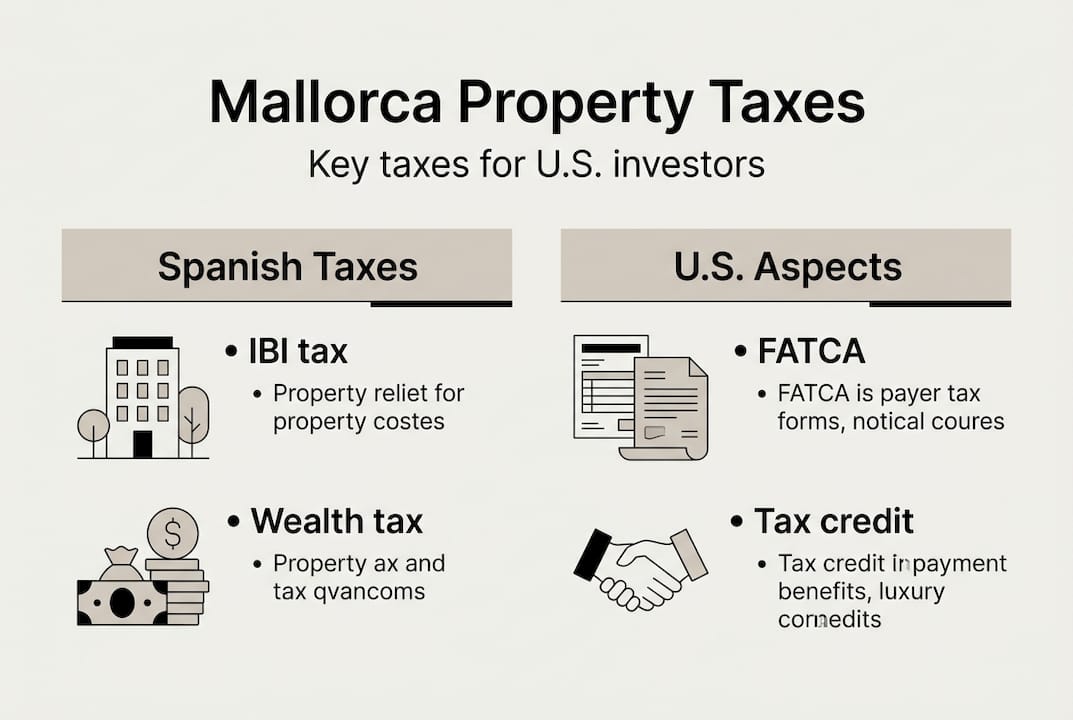
The annual taxes for foreign property owners include IBI ranging from 0.4-1.1% of cadastral value depending on municipality, imputed income tax at 19% for EU residents or 24% for non-EU residents applied to 2% of cadastral value, and wealth tax with thresholds and rates varying by autonomous community. These rates create a predictable annual cost structure that savvy investors factor into their ROI calculations from the outset.
Filing requirements extend beyond just paying taxes. The IRNR (Impuesto sobre la Renta de No Residentes) declaration must be filed annually by all non-resident property owners, even when the property remains vacant throughout the year. This declaration reports the imputed income that Spanish tax authorities assume you receive from owning the property, regardless of actual use. Missing this filing triggers penalties that can exceed the tax owed, making compliance essential.
“Spanish property holding costs average 60-70% lower than comparable luxury properties in major U.S. markets, but the regulatory framework requires meticulous attention to filing deadlines and documentation standards that differ substantially from American practices.”
Ownership structure decisions significantly impact your total tax burden. Joint ownership between spouses allows each owner to claim separate wealth tax exemptions, potentially reducing or eliminating wealth tax liability on properties valued below €1.4 million. Corporate ownership through Spanish entities offers different advantages for certain investors but introduces additional compliance requirements and corporate tax obligations that may outweigh benefits for single-property holdings.
Pro Tip: Structuring ownership correctly at purchase saves substantially more than attempting to restructure later, as property transfers trigger transaction taxes of 8-10% that make post-purchase optimization prohibitively expensive.
Key Spanish tax obligations for U.S. luxury property owners:
- IBI paid annually to local municipality, typically in two installments
- IRNR filing deadline falls on December 31 for the prior tax year
- Wealth tax declarations due by June 30 when total Spanish assets exceed thresholds
- Capital gains tax of 19-24% applies to sale proceeds for non-residents
U.S.-Spain tax considerations and mitigating double taxation
U.S. citizens face worldwide taxation on all income regardless of source, which means your Mallorcan property income and imputed income fall under IRS jurisdiction even though Spain also taxes these amounts. This creates potential double taxation that the U.S.-Spain tax treaty specifically addresses through Foreign Tax Credit mechanisms. Understanding how these credits work proves essential for accurate tax planning and avoiding overpayment to either jurisdiction.
The U.S. and Spanish tax treaty provisions allow U.S. investors to credit Spanish taxes paid against their U.S. tax liability using Form 1116, which calculates the allowable credit based on foreign taxes paid and the proportion of foreign-source income to total income. This prevents double taxation by ensuring you pay the higher of the two countries’ tax rates rather than both rates combined. Most U.S. investors find Spanish property tax rates lower than U.S. rates, meaning the credit typically eliminates Spanish tax burden from their U.S. calculations.
Compliance requires filing in both jurisdictions with careful coordination of timing and documentation. You must maintain detailed records of all Spanish tax payments, including receipts for IBI, IRNR filings, and wealth tax payments. These documents support your Form 1116 calculations and provide evidence if IRS questions your foreign tax credit claims. Many investors discover that professional tax preparation fees increase substantially when adding foreign property to their returns, but this cost pales compared to penalties for incorrect filings.
Pro Tip: Engage a cross-border tax specialist before your first Spanish tax filing to establish proper documentation systems and identify optimization opportunities that become difficult to implement retroactively.
The sequential tax filing process for U.S. owners of Mallorcan real estate follows these steps:
- Pay Spanish IBI to local municipality by the local deadline, typically in spring and fall installments
- File IRNR declaration by December 31 for the prior calendar year, calculating and paying imputed income tax
- Gather all Spanish tax payment receipts and convert amounts to U.S. dollars using appropriate exchange rates
- Complete Form 1116 as part of your U.S. tax return, claiming Foreign Tax Credit for Spanish taxes paid
- File U.S. tax return by April 15 (or October 15 with extension), including all foreign property schedules
- Maintain seven years of documentation for both Spanish and U.S. tax authorities
Timing considerations matter significantly. Spanish tax deadlines differ from U.S. deadlines, and you must pay Spanish taxes before claiming them as credits on your U.S. return. This sometimes requires filing U.S. extensions to ensure Spanish payments clear before finalizing your Form 1116 calculations. Currency exchange rate fluctuations between payment dates and filing dates can create small discrepancies that require careful documentation to satisfy both tax authorities.
Additional U.S. reporting requirements include FBAR (FinCEN Form 114) if your foreign financial accounts exceed $10,000 at any point during the year, and Form 8938 for specified foreign financial assets exceeding threshold amounts. While your Mallorcan property itself doesn’t trigger these forms, any Spanish bank accounts used for property management, rental income collection, or expense payments likely do. Understanding property tax obligations helps you maintain compliance across all reporting requirements.
Structuring ownership and financing for optimal returns
Choosing the right ownership structure and financing approach dramatically impacts your net returns from Mallorcan luxury real estate investment. The decision between sole ownership, joint ownership, or corporate ownership involves weighing tax implications, estate planning goals, liability protection, and operational complexity. Each structure offers distinct advantages depending on your total net worth, investment timeline, and overall tax situation.
Sole ownership provides simplicity and direct control but exposes you to full wealth tax liability if your property value exceeds regional thresholds. Joint ownership between spouses or partners splits the property value for wealth tax calculations, potentially keeping each owner below taxable thresholds. This structure works particularly well for properties valued between €1.4-2.8 million, where splitting ownership eliminates wealth tax entirely. Corporate ownership through a Spanish SL (Sociedad Limitada) offers liability protection and potential estate planning benefits but introduces corporate tax obligations and additional compliance costs that typically make sense only for portfolios exceeding €5 million.

U.S. citizens buying Spanish property benefit from lower Spanish holding costs compared to equivalent U.S. properties, with joint ownership structures recommended specifically for wealth tax optimization. The table below contrasts typical annual costs for a €2 million luxury property in Mallorca versus a comparable $2.2 million property in a high-tax U.S. state:
| Cost Category | Mallorca (Joint Ownership) | U.S. (High-Tax State) | Annual Difference |
|---|---|---|---|
| Property Tax/IBI | €8,000-€12,000 | $22,000-$28,000 | Save $12,000-$18,000 |
| Imputed Income Tax | €7,600 (if vacant) | N/A | Cost €7,600 |
| Wealth Tax | €0 (below threshold) | N/A | Neutral |
| Insurance | €2,500-€3,500 | $3,500-$5,000 | Save $1,000-$2,000 |
| Filing Complexity | Moderate (dual jurisdiction) | Simple (domestic only) | Higher professional fees |
Financing options for American buyers include Spanish mortgages, U.S. home equity lines, and offshore private banking facilities. Spanish banks typically offer non-resident mortgages up to 60-70% loan-to-value for luxury properties, with interest rates currently ranging 3.5-4.5% for well-qualified borrowers. These mortgages require Spanish tax identification numbers, proof of income, and often demand larger down payments than domestic U.S. mortgages. U.S. home equity lines provide familiar terms and potentially lower rates but create currency exchange risk and complicate your cross-border tax picture.
Pro Tip: Joint ownership structures reduce wealth tax exposure by an average of €3,000-€8,000 annually for properties valued €1.5-€3 million, paying for decades of professional tax advice within the first few years of ownership.
Criteria for selecting your optimal ownership and financing structure:
- Total net worth and existing wealth tax exposure in Spain or home jurisdiction
- Estate planning goals and intended beneficiaries for the property
- Rental income expectations and whether you plan active property management
- Liability concerns related to rental operations or property condition
- Currency preference for debt service and whether you want euro or dollar exposure
- Timeline for ownership and potential exit strategies
Successful investors typically model multiple scenarios before finalizing their structure, calculating total costs over 10-year holding periods under different appreciation and rental income assumptions. This analysis reveals which structure delivers the best after-tax returns given your specific situation. Working with advisors who understand both Mallorca property investment strategies and U.S. tax implications ensures you capture all available optimization opportunities from the start.
Refinancing considerations differ substantially from U.S. markets. Spanish lenders view refinancing less favorably than American banks, often charging prepayment penalties and requiring full reunderwriting as if purchasing a new property. This makes initial financing decisions more consequential than in U.S. markets where borrowers routinely refinance every few years. Plan your initial financing to accommodate your entire anticipated holding period, or at minimum the first 7-10 years before refinancing economics improve.
The relationship between ownership structure and working with buyer agents becomes apparent during due diligence. Experienced agents identify properties where ownership structuring delivers maximum advantage, such as properties just below wealth tax thresholds or those with rental income potential that justifies corporate ownership complexity. Their market knowledge helps you avoid properties where structural issues, title complications, or location factors would undermine even the most tax-efficient ownership approach.
Work with expert independent buyer agents for safe Mallorca investments
Navigating Mallorca’s luxury real estate market as a U.S. investor involves coordinating Spanish property law, dual-jurisdiction tax compliance, currency exchange, and local market knowledge that few investors possess independently. Independent buyer agents in Mallorca specialize in representing your interests exclusively, without conflicts that arise when agents represent both buyers and sellers. This representation proves particularly valuable for international transactions where language barriers, unfamiliar legal processes, and distance create vulnerabilities.
Expert buyer agents provide comprehensive luxury real estate services including AI-powered property searches across Mallorca’s entire market, detailed due diligence on property titles and building permits, coordination with English-speaking attorneys and tax advisors, and negotiation expertise that accounts for local market customs. Their fee structures typically save you multiples of their cost through better purchase prices, avoided legal problems, and optimized ownership structures that reduce decades of tax payments.
The complexity of cross-border real estate investment means that attempting to navigate independently often costs substantially more than professional guidance. One missed wealth tax optimization opportunity or improperly structured ownership can cost €50,000-€100,000 over a typical holding period. Safe property investment in Mallorca requires local expertise combined with understanding of U.S. investor needs, a combination that specialized buyer agents deliver consistently.
FAQ
What are the main taxes I must pay owning luxury property in Mallorca?
You’ll pay IBI (property tax) ranging 0.4-1.1% of cadastral value annually, plus imputed income tax at 19-24% on 2% of cadastral value if you don’t rent the property. Wealth tax applies when your total Spanish assets exceed regional thresholds, typically €700,000-€1 million depending on the autonomous community. You must file IRNR declarations annually even if the property remains vacant throughout the year.
How does the U.S.-Spain tax treaty help me avoid double taxation?
The treaty allows you to claim Foreign Tax Credit on your U.S. tax return for Spanish taxes paid on the same income. You calculate this credit using Form 1116, which offsets your U.S. tax liability dollar-for-dollar up to the amount of foreign taxes paid. This prevents paying full tax rates to both countries, instead ensuring you pay only the higher of the two rates.
What ownership structure is best for reducing wealth tax in Mallorca?
Joint ownership between spouses typically provides the greatest wealth tax savings for properties valued €1.4-€2.8 million. This structure splits the property value for wealth tax calculations, potentially keeping each owner below the taxable threshold and eliminating wealth tax entirely. Joint ownership also offers flexibility for estate planning and allows each owner to claim separate exemptions and deductions.
Do I have to file taxes in Spain if I don’t rent out my property?
Yes, Spanish law requires all non-resident property owners to file annual IRNR declarations reporting imputed income, regardless of whether you rent the property or leave it vacant. Spanish tax authorities calculate this imputed income as 2% of your property’s cadastral value and tax it at 19% for EU residents or 24% for non-EU residents. Missing this filing triggers penalties that often exceed the actual tax owed, making annual compliance essential even when the property generates no rental income.
Recommended
- Buying Vacation Homes in Mallorca: Smart Steps for American Investors - ULI & LISA Mallorca Property Blog
- Mallorca Property Market – Key Insights for U.S. Buyers - ULI & LISA Mallorca Property Blog
- Buying Property in Mallorca: Key Steps for Americans - ULI & LISA Mallorca Property Blog
- Mallorca Real Estate Market 2025 – Key Trends for U.S. Buyers - ULI & LISA Mallorca Property Blog
- How to Safeguard Rental Investment: A Step-by-Step Guide - Rental Income Insurance