
TL;DR:
- Mallorca’s luxury market remains stable, but the Golden Visa route closed in 2025, requiring new residency strategies.
- U.S. investors now mainly pursue non-lucrative or income-based visas, with careful attention to tax obligations.
- Successful relocation combines legal, tax, and property planning, emphasizing expert guidance and strategic preparation.
Many high-net-worth American investors have Mallorca on their radar, yet the path from dream to deed has gotten more complicated. Spain’s Golden Visa real estate route closed in 2025, tax obligations now span two countries, and residency rules demand careful planning before you book a flight. The good news: Mallorca’s luxury property market remains one of Europe’s most stable, and the right strategy still delivers both lifestyle and returns. This guide walks you through the visa landscape, dual-country tax rules, and a step-by-step investment roadmap so you can move forward with clarity and confidence.
Key Takeaways
| Point | Details |
|---|---|
| Golden Visa ended | Luxury property no longer grants automatic residency in Mallorca after 2025. |
| Choose visa wisely | Select the right visa route based on your investment type, income, and lifestyle plans. |
| Understand dual taxes | U.S. investors must comply with both IRS and Spanish tax rules, with some relief via treaty credits. |
| Plan ahead for compliance | Early legal and financial planning prevents audit issues and ensures smooth relocation. |
| Expert guidance pays off | Partnering with local buyer agents streamlines the complex process and protects your investment. |
Understanding Mallorca’s investment landscape in 2026
Mallorca continues to attract serious capital from the U.S. for good reasons. The island combines Mediterranean climate, strong rental demand, world-class infrastructure, and a luxury property market that has shown consistent price resilience even during broader European slowdowns. Prime areas like Puerto Andratx, Palma’s Old Town, and the Serra de Tramuntana foothills regularly see transactions well above €2 million, with demand outpacing supply in the top tier.
The biggest structural shift investors need to understand is the end of the Golden Visa property route. Spain’s Golden Visa real estate option (€500k property investment) ended April 3, 2025. This means buying a villa no longer automatically puts you on a residency track. Alternatives now require either a capital investment of €1 million or more in financial instruments, or qualifying through income-based visas.
Here’s a quick comparison of investor profiles and what matters most to each:
| Investor type | Primary goal | Preferred visa route | Key consideration |
|---|---|---|---|
| Passive income seeker | Rental yield + lifestyle | Non-Lucrative Visa | Must not work in Spain |
| Active entrepreneur | Business + residency | Beckham Law or Startup Visa | Spanish income taxed at 24% flat |
| Capital investor | Wealth preservation | €1M+ financial investment | No real estate path post-2025 |
| Family relocator | Full lifestyle move | NLV with dependents | Income proof per dependent |
Key reasons U.S. investors still favor Mallorca:
- Stable demand: Tourism and expat rental markets keep occupancy rates strong year-round
- Legal security: Spain’s property laws protect foreign buyers with clear title and notarial processes
- EU access: Residency opens travel and banking across the Schengen zone
- Lifestyle premium: Quality of life, healthcare, and international schools rank among Europe’s best
Compliance is no longer optional. Getting your Mallorca investment smart moves right from the start protects both your residency status and your return on investment. Understanding Mallorca real estate taxes before you sign anything is equally critical.
Choosing your residency path: Key visa options for U.S. investors
With market context clear, your next decision is which residency route aligns with your investment goals and lifestyle. The post-Golden Visa era offers several credible paths, but each comes with specific financial thresholds and lifestyle implications.
The Non-Lucrative Visa (NLV) is the most common route for Americans who want to live in Spain without working locally. The NLV requires €28,800/year in passive income for the primary applicant, you must apply from the U.S., and you must spend at least 183 days per year in Spain. Passive income sources can include dividends, rental income from U.S. properties, retirement distributions, or investment portfolios.
The Beckham Law regime suits investors who will have active income from Spanish sources, such as a business, consulting role, or executive position. It offers a flat 24% tax on Spanish income for up to six years, a significant advantage over Spain’s progressive rates that can reach 47%.
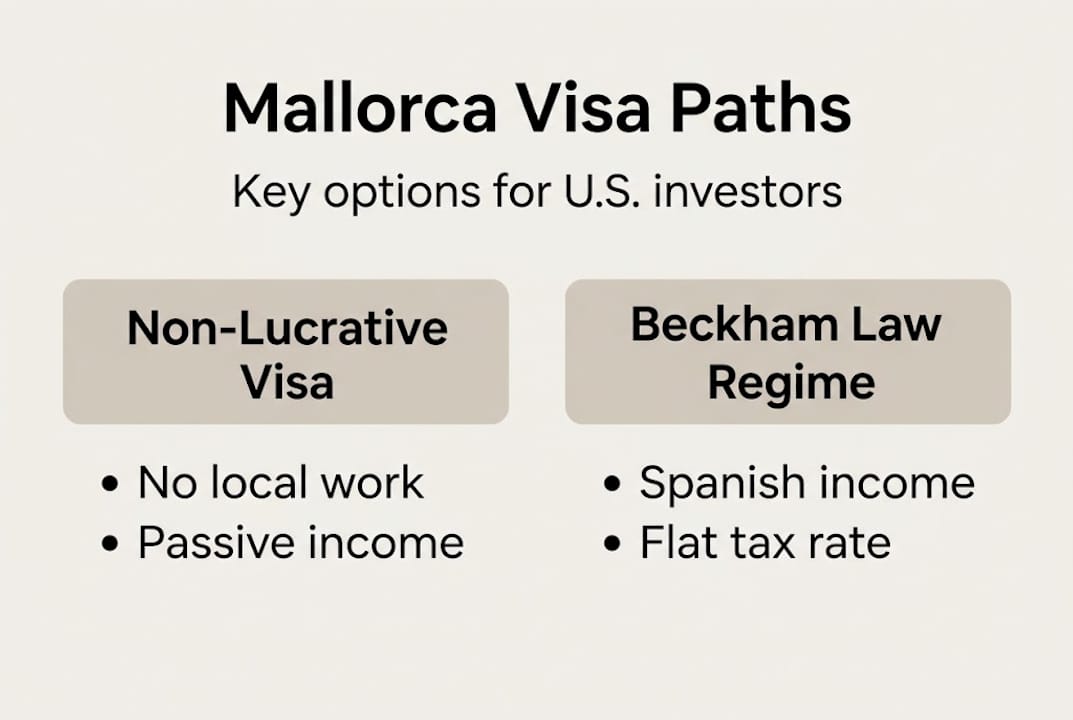
Here’s a side-by-side look at the main options:
| Visa / regime | Income requirement | Work allowed | Tax treatment | Best for |
|---|---|---|---|---|
| Non-Lucrative Visa | €28,800/yr passive | No | Progressive Spanish rates | Retirees, passive investors |
| Beckham Law | Active Spanish income | Yes | 24% flat on Spanish income | Executives, active entrepreneurs |
| Digital Nomad Visa | €2,646+/month remote | Yes (foreign clients) | Reduced rate for 4 years | Remote workers |
Steps to secure your NLV:
- Gather 12 months of bank statements proving passive income
- Obtain a criminal background check (apostilled)
- Complete a medical certificate and health insurance proof
- Apply at the Spanish Consulate in your U.S. state
- Enter Spain and register at your local ayuntamiento (town hall) within 30 days
One edge case worth knowing: if you previously held a Golden Visa that has since expired, you may be able to switch to NLV without leaving Spain. This is a valuable exception that avoids the consulate queue.
Pro Tip: If you have dependents, budget an additional €7,200 per person per year in demonstrated passive income. Plan this before applying, not after, because underdocumented applications are routinely rejected. For a deeper look at relocation for property buyers, we’ve outlined the full process step by step.
Navigating Spanish and U.S. tax rules for investors
Securing your visa is just the start. Understanding your tax obligations as a dual-country resident is critical, and this is where many investors make expensive mistakes.
The U.S. taxes its citizens on worldwide income regardless of where they live. That means even as a Spanish tax resident, you still file with the IRS every year. Spain also taxes worldwide income for residents. The saving grace is the U.S.-Spain tax treaty: U.S. citizens report worldwide income to the IRS and meet Spanish obligations, but the treaty avoids double taxation through foreign tax credits. You also must file Modelo 720 for foreign assets exceeding €50,000 if you are a Spanish tax resident.
Here’s what that looks like in practice:
- NLV holders are taxed on worldwide income at Spain’s progressive rates (19% to 47%), which means your U.S. dividends and rental income are included in your Spanish return
- Beckham Law participants pay a flat 24% on Spanish income and are exempt from foreign income and wealth taxes for six years
- Modelo 720 is a mandatory declaration of overseas assets. Missing or late filings have historically triggered large penalties
- FBAR and FATCA filings with the IRS are still required for U.S. citizens holding foreign accounts above $10,000
The Beckham Law is not a loophole. It is a legitimate Spanish tax incentive designed to attract international talent and capital. Used correctly, it can save high earners hundreds of thousands of dollars over six years.
Pro Tip: Hire both a U.S. expat tax specialist and a Spanish gestor (licensed tax advisor) before you establish residency. Trying to coordinate both tax systems retroactively is far more costly than getting it right from day one. For a full breakdown of U.S. and Spanish taxes for investors, our dedicated guide covers every filing scenario.
Step-by-step: How to relocate and invest in Mallorca
With legal and tax groundwork in place, you’re ready to put your relocation plan into action. The sequence matters. Doing things out of order, like buying property before confirming your visa path, creates legal and financial complications that are hard to unwind.

Note that NLV requires applying from the U.S. and confirming sufficient passive income before entry. Property investment no longer grants residency post-2025, so your visa application must stand on its own financial merits.
Here is the recommended sequence:
- Months 1 to 3: Consult a Spanish immigration attorney and U.S. expat tax advisor. Determine your visa type and tax regime. Begin gathering financial documentation.
- Months 3 to 6: Apply for your visa at the Spanish Consulate. Simultaneously, begin your property search with a local buyer agent guide so you’re ready to act when the visa is approved.
- Month 6 to 7: Obtain your NIE number (Spain’s foreigner ID, required for all property transactions). Open a Spanish bank account.
- Month 7 to 9: Sign a reservation agreement and instruct a Spanish property lawyer for due diligence. Review the property buying checklist to ensure nothing is missed.
- Month 9 to 12: Complete the purchase via notarial deed. Register at the Land Registry. File Modelo 720 if applicable. Review the real estate closing guide for final steps.
Key documents you will need throughout this process:
- Last three years of U.S. tax returns
- Bank statements showing passive income (12 months minimum)
- Apostilled criminal background check
- Private health insurance policy valid in Spain
- NIE number and passport copies
Pro Tip: Do not underestimate the value of working with buyer agents who represent only you, not the seller. In Mallorca’s luxury market, off-market listings account for a significant share of premium transactions, and only well-connected local agents can access them.
A smarter approach to investing and relocating: What most miss
Here’s the uncomfortable truth most articles skip: the investors who struggle most in Mallorca are not the ones who lacked money. They are the ones who treated this as a transaction instead of a strategy.
We’ve seen buyers arrive with a clear budget and a vague plan, only to discover their U.S. trust structure is incompatible with Spanish inheritance law, or that their chosen visa route triggers a tax bill they didn’t model. These are not edge cases. They are common outcomes when planning starts with the property search instead of the legal and tax architecture.
The counterintuitive move is to spend the first three months doing nothing visible. No property viewings, no offers. Just building the right team: a Spanish immigration lawyer, a cross-border tax advisor, and a genuinely independent buyer agent who has worked with American clients specifically. That preparation phase is where the real investment happens.
Lifestyle and compliance are not separate tracks. The investors who thrive long-term in Mallorca are those who treat their residency as a business decision, not just a quality-of-life upgrade. That means annual reviews of your tax position, proactive Modelo 720 filings, and staying current on Spanish regulatory changes. Our buyer agent guide outlines exactly how to build this kind of support structure from the start.
Get expert help for a seamless Mallorca investment move
Mallorca’s luxury property market rewards investors who move with precision. At ULI & LISA, we work exclusively as independent buyer agents, which means our loyalty is entirely to you, not to developers or listing agents. We specialize in helping American investors navigate the full journey: from identifying the right property using AI-powered market tools to coordinating with legal and tax professionals who understand both U.S. and Spanish requirements. Whether you’re exploring independent buyer agents for the first time or ready to review luxury agent services, we’re here to make your investment move straightforward and safe property investment a reality.
Frequently asked questions
Does buying property in Mallorca grant residency in 2026?
No. Since the Golden Visa property path ended in 2025, purchasing real estate alone no longer qualifies you for residency. You must apply through an income-based visa such as the NLV or Beckham Law route.
What is the minimum income required for a Non-Lucrative Visa?
You must show at least €28,800 per year in passive income for the primary applicant, plus €7,200 per dependent, based on 2026 IPREM thresholds.
How does the Beckham Law benefit U.S. investors?
It provides a flat 24% tax rate on Spanish-source income for six years and exempts foreign income and wealth from Spanish taxation, making it highly advantageous for active earners.
Do I need to declare my U.S. assets to Spanish authorities?
Yes. As a Spanish tax resident, you must file Modelo 720 for any asset category exceeding €50,000 held outside Spain, including U.S. brokerage accounts, real estate, and retirement funds.
Can I work or run a business in Mallorca on an NLV?
No. The NLV permits passive income only and strictly prohibits working in Spain. If you plan to run a business or earn active income, the Beckham Law or Digital Nomad Visa are the appropriate alternatives.
Recommended
- Choosing the Right Area Mallorca: Guide for US Buyers - ULI & LISA Mallorca Property Blog
- Mallorcan real estate investment guide for U.S. buyers - ULI & LISA Mallorca Property Blog
- Buying Property in Mallorca: Key Steps for Americans - ULI & LISA Mallorca Property Blog
- How to Finance Property in Mallorca: A Step-by-Step Guide - ULI & LISA Mallorca Property Blog