
Most American investors are surprised to learn that Mallorca property purchases can carry taxes as high as 11% of the value before annual costs are even considered. These added layers of local, regional, and cross-border tax rules mean buying your luxury vacation property in Mallorca is far more complex than in the United States. With premium estates at stake, expert guidance on real estate taxes and tight legal compliance helps safeguard both your lifestyle and your financial interests.
Key Takeaways
| Point | Details |
|---|---|
| Understanding Tax Structure | American investors must navigate a range of taxes in Mallorca, including Property Transfer Tax and VAT, which differ from U.S. tax laws. |
| Capital Gains Tax Implications | U.S. investors should prepare for a flat 19% capital gains tax rate on property sales, differing from variable rates in the U.S. |
| Legal Compliance Requirements | Obtaining a Spanish Identification Number and fulfilling annual tax declarations are critical for compliance as a non-resident property owner. |
| Budgeting for Hidden Costs | Investors should anticipate additional transaction costs, including notary fees and potential annual taxes, beyond the initial property purchase price. |
Mallorca Real Estate Taxes Explained
Understanding Mallorca’s property tax landscape is essential for American investors seeking premium real estate opportunities. Property taxes in this Spanish region involve multiple layers of taxation that differ significantly from United States tax structures, requiring careful navigation and professional guidance.
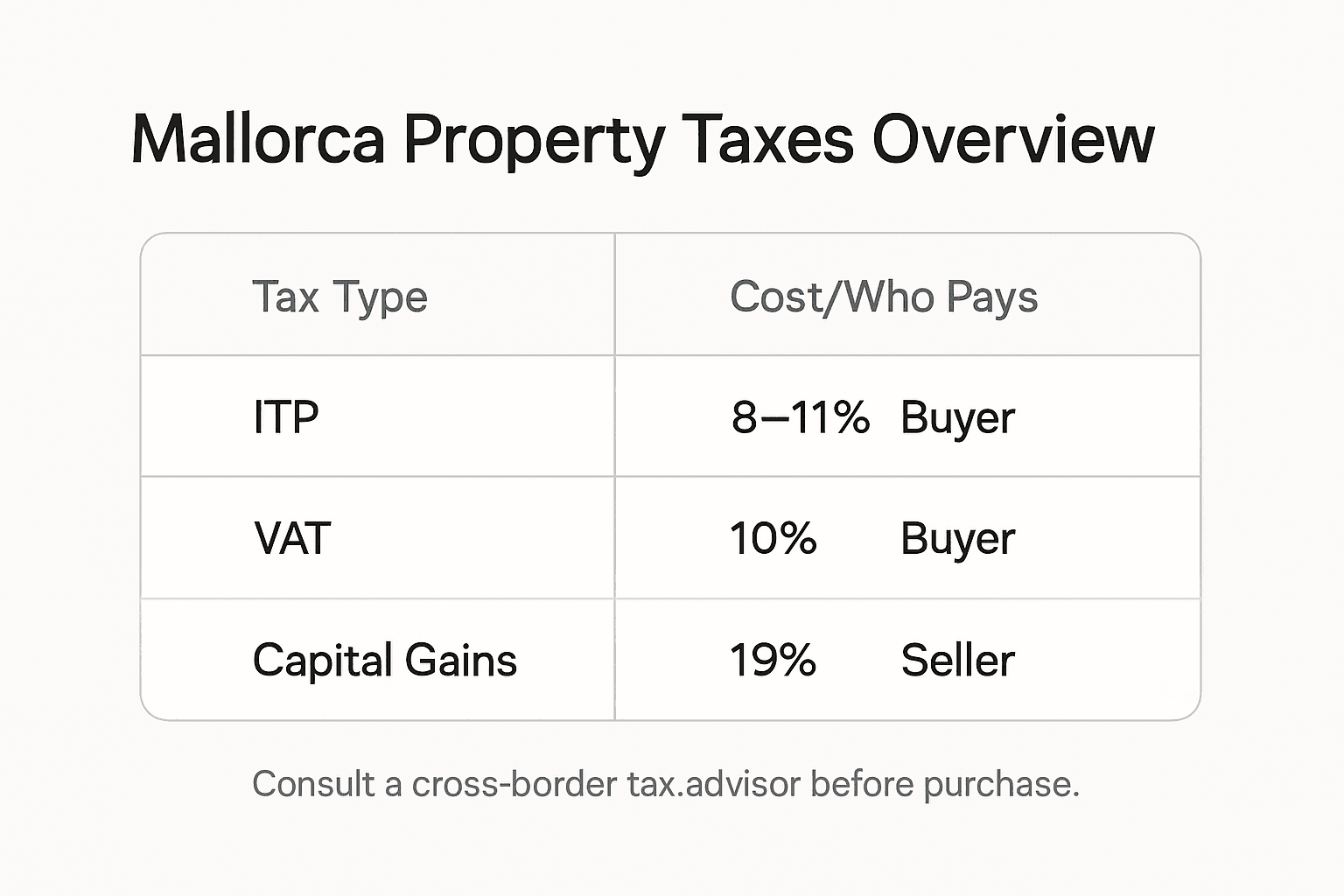
The primary taxes U.S. buyers encounter include Property Transfer Tax (ITP) for resale properties, Value Added Tax (VAT) for new constructions, and annual municipal property taxes. For resale properties, the ITP ranges between 8% to 11% depending on the property’s purchase price, with higher percentages applied to more expensive real estate. New construction properties are subject to 10% VAT, plus an additional documented legal acts tax of 1.5%.
Capital gains tax is another critical consideration for American investors. Non resident property owners are taxed at a flat 19% rate on any profit realized from property sales, which is significantly different from U.S. capital gains tax structures. This tax applies to the entire gain amount and must be calculated precisely to ensure compliance with Spanish tax regulations.
Pro tip: Work with a specialized tax advisor who understands both United States and Spanish tax codes to accurately calculate your potential tax liabilities and optimize your investment strategy.
Types of Taxes on Mallorca Property
Mallorca’s property tax system presents a complex landscape for American investors, with multiple taxation layers that require careful understanding and strategic planning. Property tax structures in this Spanish region vary significantly based on property type, purchase status, and ownership circumstances.
The primary tax categories American buyers must navigate include:
- Property Transfer Tax (ITP): Applies to resale properties, ranging from 8% to 11% depending on the property’s value
- Value Added Tax (VAT): Set at 10% for new construction properties, with an additional 1.5% documented legal acts tax
- Municipal Property Tax (IBI): An annual local tax calculated based on the property’s cadastral value
- Non Resident Income Tax: A mandatory annual tax for foreign property owners not permanently residing in Spain
Capital gains tax represents another critical consideration for U.S. investors. Non resident property owners face a flat 19% tax rate on profits from property sales, which differs substantially from U.S. capital gains tax structures. This tax applies to the entire gain amount and requires precise calculation to ensure full compliance with Spanish tax regulations.

Pro tip: Consult with a specialized international tax professional who understands both American and Spanish tax codes to develop a comprehensive tax strategy that minimizes your potential liability and maximizes investment efficiency.
Here’s a concise summary of major Mallorca real estate taxes for U.S. investors:
| Tax Type | Who Pays It | Typical Rate/Cost | Main Consideration |
|---|---|---|---|
| Property Transfer Tax | Buyer of resale property | 8% to 11% of purchase price | Rate increases with property value |
| Value Added Tax | Buyer of new construction | 10% of purchase price | Only on new builds |
| Legal Acts Tax | Buyer of new construction | 1.5% of purchase price | Applies alongside VAT |
| Municipal Tax (IBI) | All property owners | Varies by cadastral value | Payable annually |
| Non Resident Income Tax | Non resident property owners | Annual, rate varies | Tax residency status critical |
| Capital Gains Tax | Seller who is non resident | 19% on sale profit | Flat rate on total gain |
Legal Obligations for U.S. Property Owners
U.S. property owners in Mallorca face a complex web of legal requirements that extend far beyond traditional ownership responsibilities. Legal frameworks for foreign property owners demand meticulous attention to multiple regulatory environments, including Spanish national and regional regulations as well as United States reporting standards.
Key legal obligations for American buyers include:
- Obtaining a Spanish Identification Number (NIE): A mandatory identification number required for property transactions
- Registering the property with local Spanish authorities
- Completing annual tax declarations for non resident property owners
- Reporting foreign property ownership to the United States Internal Revenue Service (IRS)
- Maintaining compliance with both Spanish property laws and international tax reporting requirements
Beyond standard ownership documentation, U.S. investors must navigate additional cross border reporting mechanisms. This includes potential Foreign Bank Account Report (FBAR) filing requirements and potential obligations under the Foreign Account Tax Compliance Act (FATCA), which mandate detailed reporting of foreign financial assets to the United States government.
Pro tip: Engage a specialized international tax attorney with expertise in both Spanish and American property regulations to ensure comprehensive compliance and minimize potential legal complications.
Cross-Border Taxation and Reporting Rules
U.S. investors purchasing property in Mallorca encounter a sophisticated landscape of cross-border taxation that demands strategic financial planning and precise reporting. Tax obligations for international property owners require comprehensive understanding of both Spanish and American regulatory frameworks.
The primary cross-border taxation considerations include:
- Non Resident Income Tax in Spain for property owners
- Foreign Bank Account Report (FBAR) filing requirements
- Foreign Account Tax Compliance Act (FATCA) reporting
- Double Taxation Treaty provisions between the United States and Spain
- Worldwide Income Reporting obligations for U.S. citizens
U.S. property owners must be particularly attentive to reporting deadlines and potential tax liabilities. The Internal Revenue Service requires detailed disclosure of foreign financial assets, while Spanish tax authorities mandate specific annual declarations for non resident property owners. These overlapping reporting requirements create a complex compliance environment that demands precise documentation and timely submissions.
Compare how Mallorca real estate tax rules differ from U.S. property tax norms:
| Tax Aspect | Mallorca Approach | U.S. Approach | Key Difference |
|---|---|---|---|
| Transfer Tax | Paid by buyer at purchase | Typically paid by seller | Higher cost for buyers |
| VAT on Property | Only new constructions | Not applied to property sales | Added tax for new builds |
| Capital Gains Tax | 19% flat for non residents | Variable, often lower for long term | No bracketed rates in Spain |
| Municipal Property Tax | Based on cadastral value | Based on market or assessed value | Calculation methods vary |
| International Reporting | Mandatory for U.S. citizens | Only applies to certain assets | More complex for U.S. owners |
Pro tip: Develop a comprehensive tax compliance calendar that tracks both Spanish and American reporting deadlines, and consider working with a cross-border tax specialist who can synchronize your international tax obligations.
Major Costs and Common Pitfalls for Investors
Investors considering Mallorca real estate must navigate a complex financial landscape with multiple hidden expenses and potential regulatory traps. Property investment costs in Mallorca extend far beyond the initial purchase price, requiring sophisticated financial planning and expert guidance.
Key financial considerations and potential pitfalls include:
- Purchase Taxes: Ranging from 8% to 11% for resale properties
- Notary and Registration Fees: Typically 1-2% of property value
- Annual Municipal Property Tax (IBI): Calculated based on property’s cadastral value
- Non Resident Income Tax: Mandatory annual tax for foreign property owners
- Capital Gains Tax: 19% on profits from property sales
Common investor mistakes often stem from underestimating ongoing expenses and misunderstanding tax implications. Non resident investors frequently overlook the Plusvalía municipal tax when selling properties, which can result in unexpected financial burdens. Moreover, failing to account for precise tax residency status can trigger significant penalties and complicate future property transactions.
Pro tip: Allocate an additional 15% to 20% above the purchase price for transaction costs, taxes, and potential renovation expenses to create a realistic and comprehensive investment budget.
Simplify Mallorca Property Taxes with Expert Guidance
Navigating complex tax challenges like Property Transfer Tax, Non Resident Income Tax, and Capital Gains Tax can be overwhelming when buying Mallorca real estate. American investors often face hidden costs and intricate reporting requirements that complicate their investment goals. Understanding terms like Spanish Identification Number (NIE) and cross-border tax obligations is crucial but can feel intimidating without the right support.
At ULI & LISA, we specialize in assisting U.S. buyers through every step of the Mallorca property journey. Our advanced AI-powered property search tools combined with expert knowledge about local tax structures ensure you find your ideal luxury or investment home with confidence. Avoid common pitfalls by working with trusted agents who know how to optimize your purchase and keep compliance stress low. Start your seamless buying experience by visiting ULI & LISA to explore exclusive listings and gain personalized advice. Don’t wait until tax complexities slow you down. Reach out today to secure expert help tailored to your unique investment needs.
Discover how we can help you master Mallorca’s real estate taxes and make your American buyer goals a reality with Uli & Lisa’s Property Services. Let us guide you smoothly through Mallorca’s dynamic market and tax landscape with confidence and clarity.
Frequently Asked Questions
What are the main taxes that U.S. buyers need to pay when purchasing real estate in Mallorca?
U.S. buyers need to pay several taxes, including the Property Transfer Tax (ITP), which ranges from 8% to 11% for resale properties, and the Value Added Tax (VAT) at 10% for new constructions. Additionally, buyers should be aware of annual municipal property taxes and capital gains taxes upon selling the property.
How is the capital gains tax structured for non-resident property owners in Mallorca?
Non-resident property owners in Mallorca face a flat capital gains tax rate of 19% on any profit realized from property sales. It’s important to accurately calculate the total gain to ensure compliance with Spanish tax regulations.
What legal obligations must U.S. property owners fulfill in Mallorca?
U.S. property owners are required to obtain a Spanish Identification Number (NIE), register their property with local authorities, complete annual tax declarations for non-residents, and report their foreign property ownership to the IRS. Compliance with both Spanish laws and U.S. reporting requirements is critical.
How can American investors minimize their tax liabilities when investing in Mallorca real estate?
To minimize tax liabilities, American investors should engage a specialized tax advisor knowledgeable in both U.S. and Spanish tax codes. This professional can help accurately calculate potential tax liabilities and develop a comprehensive tax strategy that optimizes investment efficiency.
Recommended
- Property Types in Mallorca – What U.S. Buyers Should Know - ULI & LISA Mallorca Property Blog
- Buying Property in Mallorca: Key Steps for Americans - ULI & LISA Mallorca Property Blog
- Buying Vacation Homes in Mallorca: Smart Steps for American Investors - ULI & LISA Mallorca Property Blog
- Advantages of Buying in Mallorca: Complete Guide - ULI & LISA Mallorca Property Blog