
TL;DR:
- Mallorca enforces strict short-term rental laws through regional and municipal authorities, requiring proper licensing and registration. Investors must conduct address-specific due diligence on zoning, license transferability, and municipal restrictions before listing or purchasing property. Non-compliance can lead to steep fines, listing delistings, and legal complications, making expert local guidance essential.
Mallorca surprises even experienced property investors. Many assume that renting their villa for a few weeks each summer sits in a legal gray area, something too minor to attract official attention. That assumption is wrong, and it can be expensive. The Balearic Islands have built one of Europe’s most rigorous short-term rental enforcement frameworks, and authorities apply it consistently. Whether you’re acquiring a luxury estate in Pollença or a coastal apartment in Palma, understanding the rules before you buy, not after, is the single most valuable thing you can do to protect your investment.
Key Takeaways
| Point | Details |
|---|---|
| Legal compliance essential | Even occasional rentals require full compliance with Mallorca’s strict tourist accommodation laws. |
| Registration now mandatory | State-level registration (NRUA) is required for all digital listings, with risk of platform delisting for non-compliers. |
| Zoning is address-specific | Investor success depends on precise due diligence regarding local zoning and capacity regulations. |
| Enforcement is real | Municipal inspections and sanctions regularly penalize unpermitted rentals, with fines reaching tens of thousands of euros. |
| Expert guidance recommended | High-net-worth investors benefit from personalized, address-specific legal advice that goes beyond generic checklists. |
Core framework for short-term rental law in Mallorca
Short-term rental regulation in Mallorca operates across two layers: the Balearic regional government and local municipalities. Neither acts in isolation. Together, they create a framework where the rules can shift depending not just on the island, but on the specific street where your property sits.
The foundational instrument is Ley 3/2022, the regional law that governs tourist accommodation in the Balearic Islands. This law introduced the concept of plazas (tourist bed capacity quotas) and created mechanisms for suspending new tourist rental authorizations in areas deemed to have reached maximum capacity. Critically, the law frames short-term rentals not simply as a transactional matter but as a territorial planning issue. That framing matters because it gives the government broad powers to freeze or restrict new permits based on population density, infrastructure load, and sustainability targets.
Here is a simplified breakdown of the key regulatory actors:
| Authority | Role | Enforcement tool |
|---|---|---|
| Balearic government | Sets regional law, manages plazas | Capacity suspensions, law-making |
| Local municipalities | Approve/deny permits, inspect properties | Fines, injunctions, delisting |
| National government | Digital platform regulation via NRUA | Mandatory registration database |
Municipal enforcement has real teeth. Inspectors conduct property visits, respond to neighbor complaints, and actively monitor digital listing platforms like Airbnb and Vrbo. Sanctions for non-compliant tourist rentals are not theoretical. Cases across the Balearic Islands show fines reaching tens of thousands of euros, and authorities have shown no reluctance to pursue foreign property owners.
Key points to keep in mind about the regional framework:
- New tourist rental authorizations can be suspended in municipalities that have exhausted their plazas quota
- The Balearic government can alter capacity limits through decree, meaning the legal landscape can shift during your ownership
- Both landlords and tenants can face penalties if a rental operates without proper authorization
- Violations can trigger mandatory cessation of rental activity, not just fines
Understanding holiday rental license rules in detail is essential before you market or list any property. Equally, if you are purchasing near the coast, coastal property regulations layer additional zoning considerations on top of tourist rental law.
“Capacity containment and plazas mechanics are central to Balearic tourist accommodation policy. Temporary suspensions directly affect Mallorca, creating municipality-specific restrictions on new permits.” — Ley 3/2022
Licensing requirements and registration mechanics
Once you understand which authorities govern short-term rentals in Mallorca, the practical question becomes: which license do you need, and how do you get it? The answer depends on your property type and intended rental model.
Mallorca recognizes several distinct tourist accommodation license modalities:
- ETV (Estancia Turística en Vivienda) — The standard tourist rental license for residential properties. Applies to most standalone villas and houses.
- Unifamiliar (single-family residential) — A modality specifically for detached homes, which must meet particular size, infrastructure, and zoning requirements.
- Limited-day rentals — Some municipalities allow limited annual rental days as an alternative route for properties that don’t qualify for a full ETV license.
Each modality carries different requirements around minimum room sizes, parking, accessibility features, complaint handling, and insurance. Assuming the wrong modality is one of the most common and costly early mistakes investors make.
Layered on top of this regional licensing system is a new national requirement. Spain now mandates a single national rental register called the NRUA (Registro Único de Arrendamientos) for any property advertised on digital platforms. This means Airbnb, Vrbo, Booking.com, and similar sites are legally required to display your NRUA registration number. If the number is missing or invalid, platforms must delist your property.
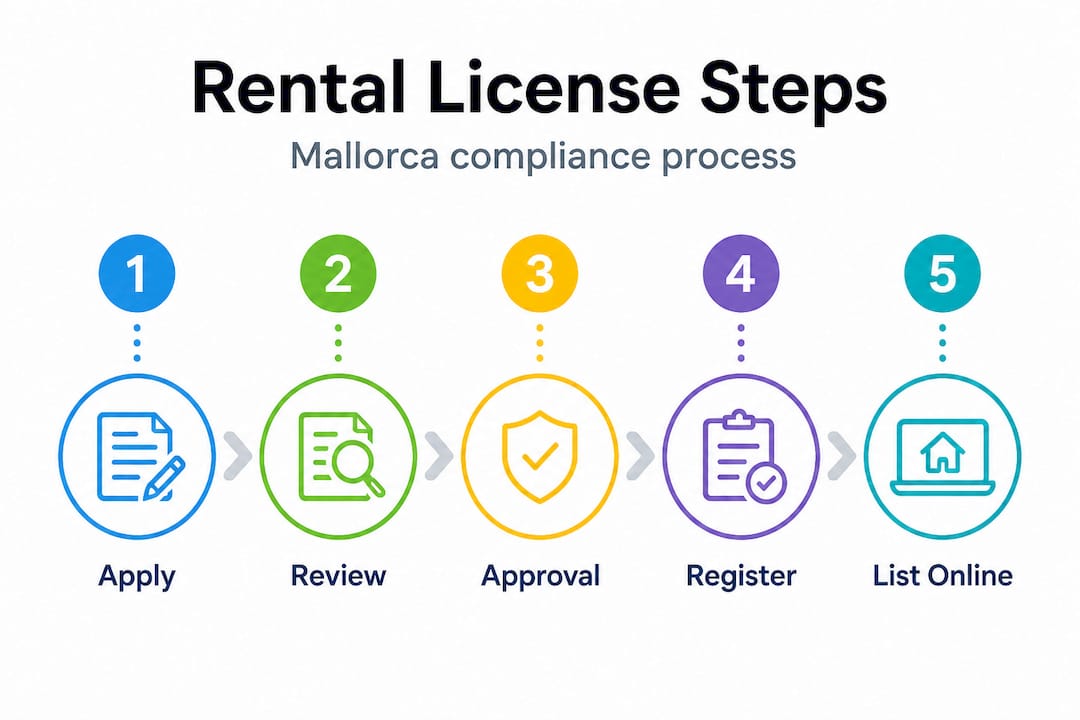
The practical steps for compliance look like this:
- Confirm zoning eligibility — Verify that your property’s address falls within a zone where tourist rentals are permitted. This is not a formality; many addresses are ineligible.
- Identify the correct license modality — Work with a local legal advisor familiar with Balearic law to determine whether your property qualifies for ETV, unifamiliar, or a limited-day format.
- Submit your tourist registration application — The application goes through the regional tourism authority (Govern de les Illes Balears), not the municipality, though municipal sign-off on planning compliance is often required.
- Obtain your NRUA registration number — Once your regional license is confirmed, register with the national database to receive your NRUA number.
- Update all digital listings — Add the NRUA number to every platform listing before marketing the property publicly.
The holiday rental license process involves tighter timelines than many investors expect, particularly during peak application periods. Also, investment property legal essentials for Mallorca buyers always include licensing status as a primary due-diligence item.
Pro Tip: If you’re acquiring a property that already has an active tourist rental license, confirm whether that license transfers with the sale or must be reapplied for. In many cases, licenses are tied to the individual owner, not the property itself, which can reset your compliance clock entirely.
Insular capacity planning and zoning: Address-specific pitfalls
Zoning and insular planning frameworks represent the most underestimated area of short-term rental law for foreign buyers. Many investors arrive in Mallorca having done solid financial analysis but with a dangerously simplified view of zoning. They assume that if a property is advertised as a “tourist villa,” it must already be compliant. That assumption fails regularly.
The PIAT (Plan Insular de Ordenación del Territorio) and PTI frameworks divide Mallorca into planning zones with strict rules about land use, building density, and tourist accommodation. A property just a few hundred meters from an eligible address can sit in a zone where tourist rentals are completely prohibited. This is not a loophole or a technicality. It is hard law, and it is enforced.

Zoning and insular capacity planning make outcomes highly municipality-specific and even address-specific. The same property type in two different zones can have completely different licensing outcomes. This reality has caught investors who relied on broad generalizations about Mallorca’s tourist rental market rather than granular address-level checks.
Common pitfalls to avoid:
- Assuming seller compliance — Sellers may have operated without a license, or with a license that lapsed or was never fully formalized
- Ignoring recent municipal suspensions — Several municipalities have suspended new tourist rental authorizations entirely; check the current status before any purchase
- Overlooking apartment restrictions — Horizontal property law (communities of owners) can ban short-term rentals even when zoning technically permits them
- Missing the distinction between urban and rustic land classifications — Rural properties on rustic land face entirely different rules under Balearic agricultural and environmental law
A thorough due-diligence checklist for investors in Mallorca should include:
- Confirm the property’s cadastral classification and planning zone
- Verify current municipal stance on new tourist rental authorizations
- Check whether an active license exists, and whether it is transferable
- Review community of owners statutes if the property is in a complex
- Assess whether any capacity suspension is in effect for that municipality
The investment tips for rental compliance available from experienced local advisors provide real guidance on making these checks effectively, not just theoretically.
Pro Tip: Request a formal certificate from the relevant municipality confirming the property’s current tourist rental eligibility status. This certificate creates a documented baseline that protects you if regulations change after your purchase.
Enforcement and compliance risks: What happens if you get it wrong?
Short-term rental enforcement in Mallorca is active, coordinated, and increasingly data-driven. Municipal inspectors no longer rely only on physical inspections and neighbor complaints. They cross-reference digital platform listings against the official license registry, identifying unlicensed properties in bulk. This approach dramatically increases enforcement reach.
The consequences of non-compliance escalate quickly:
- Initial inspection and warning notice — Inspectors document the violation and issue a formal notice requiring cessation of rental activity.
- Administrative fine — Fines are calculated based on the severity and duration of the violation. Minor procedural violations attract lower penalties, but operating without a license entirely triggers major sanctions.
- Mandatory delisting — Authorities can instruct platforms to remove your listing, cutting off rental income immediately.
- Property seizure orders (in extreme cases) — Repeated or egregious violations can result in court orders that restrict your ability to use the property for any commercial purpose.
Municipal enforcement has levied fines of up to €37,000 for unregistered tourist rentals across the Balearic Islands in recent cases. This figure reflects major sanctions, but even smaller fines in the €5,000 to €15,000 range are common for first-time violations involving unlicensed operations.
“Even occasional rentals marketed to tourists require full compliance and registration under Balearic law. There is no de minimis exemption for infrequent rental activity.” — Diario de Mallorca
This point catches many buyers off guard. If you rent your Mallorca home to tourists for just two weeks during peak summer, advertise it on any digital platform, and lack a valid license and NRUA number, you are in violation. Frequency is irrelevant. Intent and marketing channel matter. Renting to a long-term tenant under a regular lease is governed by different law entirely. The moment you market for short stays to tourists, tourist rental law applies.
Platform enforcement adds another layer. If your listing on Airbnb or Vrbo lacks a valid NRUA registration number, the platform can delist your property without warning. Reinstatement requires demonstrating compliance, which can take weeks. For high-value rentals generating significant seasonal income, that interruption has real financial cost.
Understanding legal terms for U.S. buyers in the Spanish and Balearic regulatory context helps decode official notices and sanction documentation when they arrive, which is far better than encountering these terms for the first time in a fine letter.
Our take: Why traditional advice fails in Mallorca’s rental landscape
After working with high-net-worth investors from the United States and across Europe, we have seen a clear pattern. Buyers arrive with thorough financial models, solid tax planning, and sometimes even prior experience owning rental property in other markets. But they underestimate how different Mallorca’s regulatory environment is from markets they know.
Generic legal advice, the kind that covers “European vacation rental laws” in broad strokes, consistently misses the granular details that determine whether a specific property in a specific Mallorcan municipality can legally generate rental income at all. We’ve seen investors purchase what appeared to be a fully compliant tourist villa, only to discover that the prior owner’s license was tied to their personal registration and could not be transferred. The new owner faced a complete reapplication process in a municipality that had since suspended new authorizations.
The most dangerous assumption is that someone else has already done the hard work. Prior ownership, active listings on rental platforms, and even a previous rental history do not guarantee that a property is currently licensed and eligible for tourist rentals. Regulations have tightened significantly since 2022. Properties that operated legally under older frameworks may no longer qualify under current rules.
What actually works is granular, address-specific due diligence before any offer is signed. Not a checklist completed after the fact, but verified confirmation of zoning eligibility, current municipal status, license transferability, community of owners position, and NRUA compliance as conditions of purchase. We treat this not as a box-checking exercise but as a foundational part of every property search we conduct for our clients.
An investment property legal checklist can point you in the right direction, but it needs to be applied with real local knowledge, not used as a substitute for it. The investors who navigate Mallorca’s rental landscape successfully are those who treat legal due diligence as a front-end investment, not a back-end formality.
How we help you navigate Mallorca’s rental laws
Compliance in Mallorca requires more than downloading a checklist. It requires local expertise, relationships with municipal offices, and the ability to interpret rapidly evolving regulations at the address level. That is exactly what we provide at ULI & LISA. As independent buyer agents in Mallorca, we combine AI-powered property search with personalized legal and compliance guidance for high-net-worth clients from the U.S. and Europe. From confirming tourist rental eligibility before you make an offer, to navigating NRUA registration and zoning verification, we manage every step so that your investment is protected from day one. Explore our full range of luxury real estate services and see how we structure our support to make compliance part of the buying process, not an afterthought.
Frequently asked questions
Is renting my property occasionally considered a short-term tourist rental for compliance purposes in Mallorca?
Yes. If you market your property for short stays to tourists through any digital platform, Balearic law applies regardless of frequency. Even occasional tourist rentals require a valid license and national NRUA registration.
What are the most common reasons short-term rental registrations get rejected in Mallorca?
Most rejections stem from zoning ineligibility, active municipal capacity suspensions, or applying under the wrong license modality. Confirming eligibility and license modality at the address level before applying prevents the most common rejections.
How much can fines for illegal tourist rentals in Mallorca cost?
Penalties vary by severity, but sanctions have reached €37,000 or more for operating unregistered tourist rentals across the Balearic Islands.
How does digital platform listing enforcement work for short-term rentals?
Platforms like Airbnb and Vrbo must display a valid NRUA registration number for every listing. The national NRUA requirement gives platforms the legal basis to delist properties that cannot demonstrate current registration compliance.
What is the first step for high-net-worth buyers seeking to comply with Mallorca rental law?
Confirm your specific property’s eligibility for tourist rental use, then identify the correct license modality before submitting any application. Address-specific zoning checks are the essential starting point, not a late-stage formality.
Recommended
- Mallorca Investment Property Checklist: Legal Essentials - ULI & LISA Mallorca Property Blog
- Complete Guide to Mallorca Property Search - ULI & LISA Mallorca Property Blog
- Holiday Rental Licenses Mallorca – Key Rules for Investors - ULI & LISA Mallorca Property Blog
- Mallorca Investment Tips: Maximize ROI and Navigate Rental Laws - ULI & LISA Mallorca Property Blog
- Checklist gestione proprietà in affitto: riduci rischi