
Surprisingly, over 60 percent of American luxury home buyers in Spain encounter legal challenges due to unfamiliar real estate terms. For high-net-worth American professionals, Mallorca represents a world of exclusive opportunities, but the unfamiliar Spanish legal system can derail even the most carefully planned property acquisition. This guide clarifies the critical differences between Mallorca real estate law and American expectations, offering expert strategies for those investing in Spanish luxury properties.
Key Takeaways
| Point | Details |
|---|---|
| Understand Local Legal Terms | Familiarize yourself with key terms like Escritura Pública and Catastro to navigate Mallorca’s real estate landscape effectively. |
| Engage Legal Specialists | Always consult with local Spanish legal professionals to interpret legal documents and contracts accurately before any purchase. |
| Acknowledge Tax Obligations | Be aware of both Spanish and US tax requirements related to property ownership to ensure compliance and optimize your tax strategy. |
| Conduct Thorough Due Diligence | Perform comprehensive property inspections and verify necessary permits to avoid potential legal and financial pitfalls. |
Defining Mallorca Real Estate Legal Terms
Navigating the complex world of Mallorca real estate requires understanding key legal terminology that differs significantly from American property law. Real property definitions provide a critical foundation for international investors seeking to purchase property in Spain.
In Mallorca, several unique legal terms distinguish property transactions from standard US practices. Escritura Pública represents the official public deed transferring property ownership, which must be signed before a Spanish notary and registered in the local property registry. Another crucial term is Catastro, the official property cadastre that defines property boundaries, usage classification, and tax assessment values. American buyers must understand that this document differs substantially from US property tax records.
The Spanish real estate legal framework includes specific classifications that impact property rights. Propiedad Horizontal describes properties with multiple owners, like condominiums or apartments, where shared spaces and maintenance responsibilities are legally defined. Usufructo represents a unique legal concept allowing someone to use and derive benefit from a property without technically owning it – a complex right that can significantly affect property transactions.
Pro tip: Always engage a local Spanish legal specialist familiar with Mallorca real estate regulations to translate and interpret these complex legal terms before finalizing any property transaction.
Here’s a concise comparison of major real estate documents in Mallorca vs. the US:
| Document Type | Spain (Mallorca) Example | US Example | Key Difference |
|---|---|---|---|
| Title Deed | Escritura Pública | Warranty Deed | Requires notary; registry compulsory |
| Property Registration | Catastro Registry | County Recorder | Catastro defines usage, value |
| Ownership Structure | Propiedad Horizontal | Condo Ownership | Spanish law governs shared spaces |
| Right of Use | Usufructo | Life Estate | Usufruct can pass to third party |
Essential Contract Types and Clauses
Understanding the nuanced landscape of Spanish real estate contracts requires careful examination of specific contract law principles. American investors must recognize that Mallorca property transactions involve distinct legal frameworks that differ substantially from US practices.
In Mallorca, the primary contract type for property purchases is the Contrato de Compraventa (Purchase and Sale Agreement), which legally binds both buyer and seller. This document must include critical elements such as precise property description, agreed purchase price, payment schedule, and specific transfer conditions. Unlike US contracts, Spanish agreements often require a Arras clause - a preliminary contract with a significant deposit (typically 10% of the property value) that serves as a commitment from both parties.

Key contract clauses that American buyers must scrutinize include Condiciones Suspensivas (suspensive conditions), which allow contract termination under specific circumstances like failed property inspections or financing challenges. Another crucial element is the Escritura de Compraventa, the final public deed that officially transfers property ownership and must be authenticated by a Spanish notary. These contracts frequently include complex provisions regarding property taxes, potential liens, and inheritance considerations that differ markedly from standard US real estate transactions.
Pro tip: Hire a bilingual Spanish real estate attorney specialized in international transactions to review all contract documents and ensure comprehensive understanding of every clause before signing.
Property Rights and Land Classifications
Mallorca’s real estate landscape presents unique challenges for American investors, particularly in understanding complex property rights structures. The Spanish legal system categorizes land and property ownership with nuanced classifications that differ significantly from US property law.
In Mallorca, property rights are divided into several key classifications. Suelo Urbano represents land within city limits with full development rights, typically the most valuable and regulated category. Suelo Rústico refers to rural land with strict development restrictions, often requiring special permits for construction or modifications. Another critical classification is Suelo Urbanizable, which represents potential development land that can be converted to urban use under specific municipal planning guidelines.
Foreign investors must navigate additional layers of property rights unique to Spain. The Derecho de Superficie allows landowners to grant building rights to another party for a specified period, enabling complex ownership arrangements. Coastal properties are particularly regulated, with the Ley de Costas (Coastal Law) imposing strict limitations on construction and land use within certain maritime zones. These regulations can significantly impact property values and potential development, making thorough legal research essential for American buyers seeking to invest in Mallorca real estate.
Pro tip: Consult a local Spanish real estate attorney specializing in international property rights to fully understand the nuanced land classifications and potential restrictions before making any investment decisions.
Below is a summary of critical property classifications in Mallorca and their investment impact:
| Land Type | Investment Potential | Main Restrictions | Legal Considerations |
|---|---|---|---|
| Suelo Urbano | High | Strict zoning regulations | Easier to develop |
| Suelo Rústico | Limited | Rural development controls | Permits often required |
| Suelo Urbanizable | Variable | Subject to municipal plans | Conversion approval needed |
| Coastal Property | Moderate | Coastal Law applies | Limited modifications |
Taxation and Financial Obligations
American investors in Mallorca must navigate a complex landscape of international taxation requirements that significantly impact real estate investments. Understanding both Spanish and US tax obligations is crucial for successful property ownership and financial planning.
In Spain, property owners face several key tax obligations. The Impuesto sobre Bienes Inmuebles (IBI) is an annual property tax calculated based on the property’s cadastral value, typically ranging from 0.4% to 1.1% depending on the municipality. Plusvalía Municipal, a local tax on property value increases, must be paid when selling a property, with the tax burden typically split between buyer and seller. Non-resident property owners also face the Impuesto sobre la Renta de No Residentes (Non-Resident Income Tax), which applies even if the property is not generating rental income.
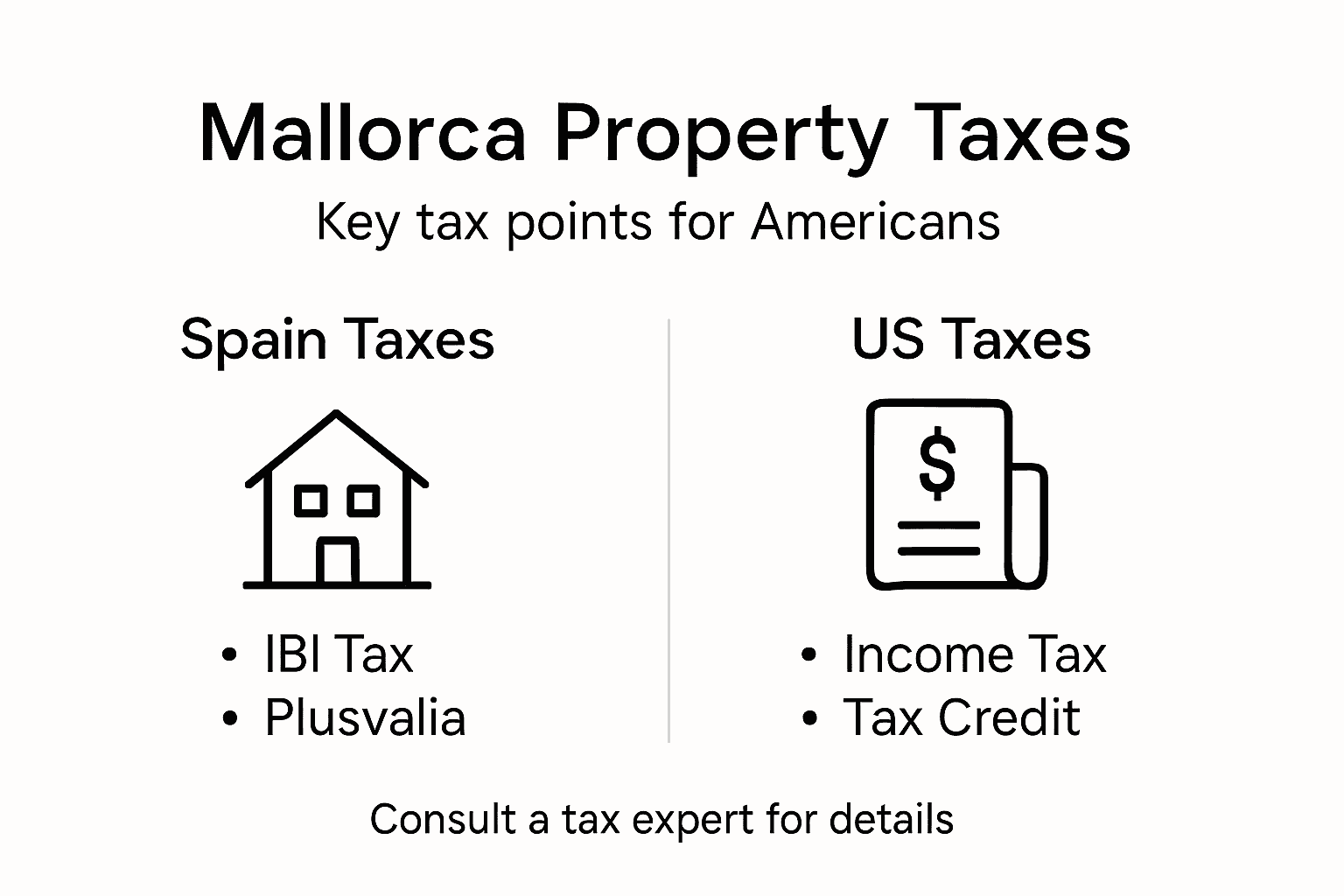
US citizens face additional complexity through Foreign Earned Income Exclusion and Foreign Tax Credit provisions. American property owners must report foreign asset holdings through FBAR (Foreign Bank Account Report) and potentially file Form 8938 for Statement of Specified Foreign Financial Assets. Rental income from Mallorca properties must be declared on US tax returns, with potential credits available for taxes paid in Spain to avoid double taxation. The intricate interplay between Spanish local taxes, national taxes, and US federal reporting requirements demands careful financial planning and professional guidance.
Pro tip: Engage a cross-border tax specialist with expertise in both Spanish and American tax law to ensure complete compliance and optimize your tax strategy for Mallorca property investments.
Risks, Restrictions, and Common Mistakes
American investors must carefully navigate real estate sector risks when purchasing property in Mallorca. The most critical errors stem from inadequate due diligence and misunderstanding of local regulatory environments.
Mallorca presents several unique restrictions that frequently catch foreign buyers off guard. Coastal zone regulations impose strict limitations on property modifications within 100 meters of the maritime domain, potentially rendering significant renovation plans impossible. The Ley de Costas (Coastal Law) can restrict property improvements, subdivisions, and even limit inheritance transfer rights. Foreign buyers often mistakenly assume US property rights apply, overlooking critical Spanish legal nuances such as mandatory municipal approvals for structural changes, specialized zoning classifications, and complex environmental protection statutes.
Common mistakes include underestimating transaction costs, failing to secure proper permits, and neglecting comprehensive property inspections. American investors frequently overlook hidden expenses like Plusvalía municipal taxes, notary fees, and registration costs that can add 10-15% to the total purchase price. Moreover, many buyers fail to verify rental license requirements, potentially risking significant financial penalties. Zoning classifications can dramatically impact property utility, with Suelo Rústico and Suelo Urbano designations carrying vastly different development potential and legal restrictions that directly influence property value and usage options.
Pro tip: Engage a local real estate attorney specializing in international transactions to conduct a comprehensive due diligence review, identifying potential legal and financial risks before finalizing any Mallorca property purchase.
Simplify Your Mallorca Property Journey with Trusted Experts
Understanding complex Mallorca real estate legal terms can be overwhelming for American buyers, especially when facing unique concepts like Escritura Pública, Usufructo, and the intricacies of Suelo Urbano versus Suelo Rústico. These challenges can lead to costly mistakes or missed opportunities without clear guidance. If you want to avoid surprises related to contracts, property rights, or local tax obligations, expert support is essential.
At ULI & LISA, we specialize in guiding international buyers through Mallorca’s luxury and investment property market with clarity and confidence. Our AI-powered tools provide comprehensive and unbiased property searches while our local knowledge ensures you fully grasp critical legal terms and potential risks. Discover how our tailored approach can help you navigate Mallorca real estate smoothly and securely.
Ready to take the next step with reliable advice and personalized service Visit ULI & LISA today to explore how we can assist you. Learn more about how our expertise aligns with your goals on our main landing page and get started on your worry-free Mallorca property purchase now.
Frequently Asked Questions
What is an Escritura Pública in Mallorca real estate transactions?
Escritura Pública is the official public deed that transfers property ownership in Mallorca. It must be signed before a Spanish notary and registered in the local property registry, making it a crucial document in real estate transactions.
What does Usufructo mean in terms of property rights in Mallorca?
Usufructo is a legal concept in Mallorca that allows someone to use and benefit from a property without being the owner. This unique right can significantly impact property transactions and ownership structures.
What are the key differences between property registration in Mallorca and the US?
In Mallorca, the Catastro Registry defines property boundaries, usage classifications, and tax assessment values, whereas in the US, property records are maintained by county offices. The Catastro provides specific information not typically found in US property tax records.
What should American investors be aware of regarding taxation when buying property in Mallorca?
American investors must navigate both Spanish and US tax obligations. Key taxes include the Impuesto sobre Bienes Inmuebles (IBI), Plusvalía Municipal, and Impuesto sobre la Renta de No Residentes. It’s essential to engage a tax specialist to ensure compliance with both countries’ tax laws.
Recommended
- Mallorca Real Estate Terminology – What Investors Need to Know - ULI & LISA Mallorca Property Blog
- Buying Property in Mallorca: Key Steps for Americans - ULI & LISA Mallorca Property Blog
- Property Types in Mallorca – What U.S. Buyers Should Know - ULI & LISA Mallorca Property Blog
- Buying Vacation Homes in Mallorca: Smart Steps for American Investors - ULI & LISA Mallorca Property Blog