Over 60% of American buyers interested in Mallorca luxury coastal homes face unexpected legal hurdles due to strict Spanish property regulations. Understanding these local rules is vital for anyone seeking a seamless, profitable investment along Mallorca’s prized shoreline. This guide uncovers precise legal obligations, zoning requirements, and current ownership restrictions that shape every American investor’s real estate strategy in this exclusive Mediterranean market.
Key Takeaways
| Point | Details |
|---|---|
| Understanding Coastal Regulations | U.S. investors must familiarize themselves with the Ley de Costas, as it defines critical protection zones affecting property rights and development opportunities in Mallorca. |
| Importance of Due Diligence | Conduct thorough research, including obtaining an urbanistic certificate, to avoid legal complications and ensure compliance with local property regulations. |
| Navigating Tourist Rental Regulations | New regulations effective April 2025 require community approval for tourist rentals, making it essential to assess community dynamics before property investment. |
| Tax and Fees Awareness | Be prepared for various tax obligations and additional fees, emphasizing the need for professional financial guidance to navigate U.S. and Spanish tax requirements effectively. |
What Coastal Property Regulations Mean in Mallorca
The Ley de Costas (Spanish Coastal Law) establishes comprehensive regulations governing coastal property ownership and development in Mallorca, presenting critical considerations for U.S. investors. This complex legal framework aims to protect Spain’s coastal environments while balancing private property rights and public access needs. Coastal protection regulations create intricate zones that significantly impact property use and potential investments.
Under these regulations, Mallorca’s coastline is divided into three primary protection zones: the Public Maritime-Terrestrial Domain, Protection Easement, and Right of Way Easement. Each zone imposes specific restrictions on construction, renovation, and property modifications. The Public Maritime-Terrestrial Domain represents public property where private use is effectively prohibited, while the Protection Easement restricts new construction within a designated coastal buffer zone. Property owners must obtain explicit approval from the Coastal Authority before implementing any modifications or development projects.
U.S. investors must conduct thorough due diligence when considering coastal properties in Mallorca. Property compliance requirements necessitate obtaining an urbanistic certificate to verify a property’s alignment with coastal regulations. This document clarifies existing restrictions, potential renovation limitations, and ensures investors understand the precise legal constraints associated with their potential purchase. Some key restrictions include prohibitions on new residential construction near shorelines and significant limitations on refurbishment projects within protected zones.
Here is a summary comparing the main coastal protection zones and their investment impact in Mallorca:
| Zone Type | Core Restrictions | Typical Permitted Uses | Impact on Investment Potential |
|---|---|---|---|
| Public Maritime-Terrestrial Domain | No private ownership or construction allowed | Public access, conservation | Severely limits private property value |
| Protection Easement | Strict limits on new builds and renovations | Limited modifications, no new homes | Reduces flexibility, complicates sales |
| Right of Way Easement | Regulates access paths and minor works | Access pathways, landscaping | May affect privacy and land use options |
Pro tip: Always request a comprehensive urbanistic certificate and engage a local real estate attorney specializing in coastal property regulations before finalizing any Mallorca coastal property investment.
Zoning and Building Restrictions Explained
Mallorca’s zoning and building regulations form a complex framework that U.S. investors must carefully navigate to successfully develop or renovate coastal properties. Building regulation guidelines mandate comprehensive planning permissions for any significant construction or renovation projects, requiring meticulous documentation and expert navigation of local legal requirements.

The regulatory process involves multiple critical steps for property development. Investors must submit detailed architectural plans and environmental assessments to local authorities, a procedure that can extend from several weeks to months depending on project complexity. Key considerations include strict adherence to land use regulations, precise building size limitations, mandatory energy efficiency standards, and preservation of local architectural heritage. These regulations aim to protect Mallorca’s unique environmental and cultural landscape while ensuring sustainable development.
Specific zoning restrictions significantly impact property investment strategies. Different municipal zones impose varying construction requirements, with coastal areas subject to additional environmental protections. Residential zones often have specific height restrictions, setback requirements, and architectural style guidelines that can dramatically influence potential property modifications or new construction. U.S. investors must understand these nuanced regulations to avoid potential legal complications and ensure compliance with local building codes.
Pro tip: Engage a local architect and legal professional specializing in Mallorca real estate to conduct a comprehensive pre-investment regulatory assessment and prevent potential compliance issues.
Private Ownership and Tourist Rental Limitations
U.S. investors targeting Mallorca’s real estate market must navigate increasingly complex regulations surrounding private property ownership and tourist rentals. New rental regulations introduced under Organic Law 1/2025 significantly transform the landscape for property owners seeking to generate income through short-term tourist rentals.
Starting April 2025, property owners in Mallorca will be required to obtain explicit approval from their building’s community of owners before converting their property into a tourist rental. This substantial regulatory change mandates securing consent from three-fifths of property owners within the same community. Additionally, homeowners associations can now impose up to 20% higher fees on properties designated for tourist rentals, creating a more challenging environment for investors looking to maximize rental income.
The new regulations reflect broader efforts to address concerns about noise, overcrowding, and housing availability for local residents. While existing licensed rentals will be grandfathered in, new investors must carefully evaluate the potential challenges of securing community approval and managing increased administrative and financial requirements. U.S. investors should conduct thorough due diligence, including comprehensive assessments of building community dynamics and potential rental restrictions before finalizing any property investment.
Pro tip: Consult with a local real estate attorney to fully understand the nuanced community approval process and potential financial implications of tourist rental regulations before making your investment.
Tax Duties, Fees, and Compliance for US Buyers
U.S. investors purchasing property in Mallorca must carefully navigate a complex landscape of tax obligations and financial requirements. The initial property acquisition involves several critical tax considerations, including the Property Transfer Tax, which ranges from 8% to 11.5% for resale properties, and additional VAT and Stamp Duty for new construction projects.
Annual tax responsibilities extend beyond the initial purchase, with property owners required to manage ongoing fiscal obligations. The Property Tax (IBI) is calculated at approximately 0.445% of the property’s cadastral value, while rental income is subject to specific tax reporting requirements. Fortunately, the Double Taxation Treaty between the United States and Spain provides mechanisms to prevent double taxation, offering some relief for American investors navigating these complex financial landscapes.
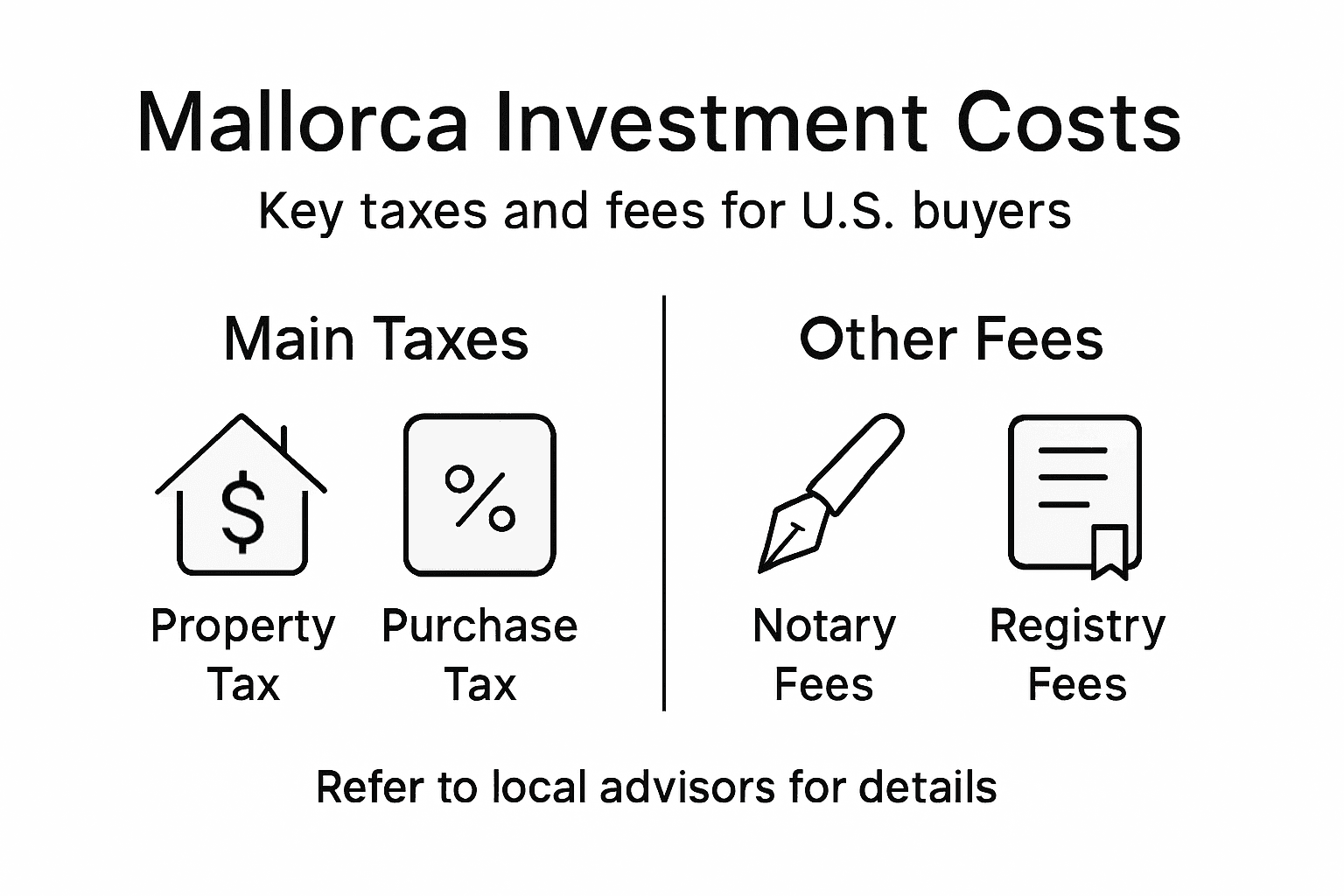
Beyond direct property taxes, U.S. buyers must also account for additional fees including notary costs, registry expenses, and legal consultation fees. These can substantially impact the total investment cost and require careful financial planning. Compliance becomes particularly critical, with potential penalties for incorrect reporting or failure to meet Spanish tax regulations. American investors should prioritize working with specialized tax professionals who understand both U.S. and Spanish tax systems to ensure comprehensive and accurate financial management.
Here is a quick reference for major taxes and fees U.S. buyers face when purchasing Mallorca property:
| Expense Type | When Incurred | Typical Rate or Range | Notes for Investors |
|---|---|---|---|
| Property Transfer Tax | On resale purchase | 8%–11.5% of sale price | Varies by property value, location |
| VAT and Stamp Duty | On new purchases | VAT: 10%, Stamp Duty: 1.2% | Applies only to new developments |
| Annual Property Tax | Each year | ~0.445% cadastral value | Paid even if property vacant |
| Legal/Notary/Registry | At closing | €2,000–€6,000+ typical | Depends on property complexity |
Pro tip: Engage a bilingual tax attorney specializing in international property investments to develop a comprehensive tax strategy that addresses both U.S. and Spanish reporting requirements.
Common Legal Traps and How to Avoid Them
U.S. investors in Mallorca’s real estate market must be acutely aware of the potential legal pitfalls inherent in property purchases. These risks extend far beyond simple transactional complexities, encompassing intricate issues of property ownership, municipal regulations, and historical documentation that can derail even the most carefully planned investments.
Critical legal challenges often emerge from unresolved property details that are not immediately apparent. Common problems include properties with outstanding debts, unclear ownership histories, unregistered building modifications, and non-compliance with urban planning restrictions. Buyers might unknowingly inherit legal complications such as pending municipal fines, unauthorized construction work, or inheritance disputes that can significantly impact property value and ownership rights. Thorough due diligence becomes paramount, requiring comprehensive investigations into the property’s complete legal and administrative background.
Mitigating these risks demands a strategic approach involving professional legal expertise. U.S. investors should prioritize engaging local lawyers specialized in Mallorcan real estate who can conduct exhaustive title searches, verify property registry status, and validate all necessary permits and documentation. Requesting a detailed certificate of occupancy, understanding the complete chain of property ownership, and comprehensively reviewing all municipal and urban planning records can prevent potentially expensive legal entanglements that could compromise the entire investment.
Pro tip: Invest in a comprehensive legal audit from a bilingual Mallorcan real estate attorney before finalizing any property purchase, ensuring complete transparency and legal security.
Navigate Mallorca’s Coastal Property Challenges with Expert Guidance
Buying coastal property in Mallorca comes with complex hurdles like strict Ley de Costas regulations, zoning restrictions, and new tourist rental rules that can overwhelm U.S. investors. Understanding terms such as the Public Maritime-Terrestrial Domain or the Protection Easement is essential to avoid costly legal pitfalls and investment mistakes. Many buyers struggle with compliance, community approvals, and knowing exactly what modifications are permitted.
ULI & LISA specialize in assisting American buyers to overcome these challenges confidently. Using advanced AI-powered tools, we conduct comprehensive, unbiased property searches tailored to Mallorca’s unique legal landscape while offering personalized support through every step of the buying process. Our expertise ensures you receive a full regulatory and tax compliance overview and connect with trusted local legal advisors.
Experience a smoother, safer investment journey by partnering with experts who truly understand Mallorca’s coastal property regulations. Start by exploring our trusted services at ULI & LISA. Ready to find your perfect property and navigate these complex rules without guesswork Get in touch today to secure your future in Mallorca’s luxury real estate market.
Frequently Asked Questions
What are the main coastal property protection zones in Mallorca?
The main protection zones in Mallorca include the Public Maritime-Terrestrial Domain, the Protection Easement, and the Right of Way Easement. Each zone has distinct restrictions on construction and property modifications.
What is required for U.S. investors before purchasing coastal property in Mallorca?
U.S. investors need to conduct thorough due diligence, which includes obtaining an urbanistic certificate to understand a property’s compliance with coastal regulations and any potential limitations on renovations or new constructions.
How can U.S. investors navigate building regulations in Mallorca?
Investors must engage local professionals to help with architectural planning, environmental assessments, and adherence to local building codes and land use regulations. This process often involves submitting detailed plans and could take several weeks to months for approval.
What are the new regulations for tourist rentals in Mallorca affecting U.S. investors?
Starting in April 2025, U.S. investors will require approval from their building’s community of owners before converting properties into tourist rentals. This involves securing consent from three-fifths of property owners and may also include higher fees imposed by homeowners associations.
Recommended
- Property Types in Mallorca – What U.S. Buyers Should Know - ULI & LISA Mallorca Property Blog
- Buying Vacation Homes in Mallorca: Smart Steps for American Investors - ULI & LISA Mallorca Property Blog
- Buying Property in Mallorca: Key Steps for Americans - ULI & LISA Mallorca Property Blog
- Complete Guide to Investment Property Tips Mallorca - ULI & LISA Mallorca Property Blog