
TL;DR:
- Mallorca has strict laws favoring licensed short-term rentals, increasing property value and investment security.
- Obtaining a rental license involves multiple requirements, zoning checks, and ongoing compliance costs.
- Regulatory enforcement makes licensed properties a safer, more profitable choice for US investors.
Airbnb removed over 8,000 illegal listings in Mallorca by April 2026, and fines for illegal rentals can reach €500,000. For US investors eyeing Mallorca’s vacation rental market, this is not background noise. It is the single most important fact shaping your investment strategy right now. Properties with a valid rental license command a 15 to 25% price premium, and that gap is widening. This guide walks you through everything you need to know about Mallorca’s rental laws: which licenses are required, how to apply, what the tax picture looks like, and how to position yourself for real, sustainable returns.
Key Takeaways
| Point | Details |
|---|---|
| Licensing is essential | Short-term rentals require an ETV license and strict compliance for legal, high-ROI operation in Mallorca. |
| Strict enforcement | Non-compliance risks delisting and fines as high as €500,000, with over 8,000 illegal listings removed in 2026. |
| Premium on legal rentals | Licensed properties trade at a 15-25% premium and offer safer, more lucrative long-term returns for US investors. |
| Tax and zone limits | Tourist rentals face VAT, tourist tax, and income tax; some zones have rent caps and strict licensing bans. |
Why Mallorca’s rental laws changed and why it matters for investors
Mallorca did not wake up one morning and decide to make life difficult for foreign investors. The regulatory shift is the result of years of pressure from local residents, housing advocates, and municipal governments pushing back against over-tourism and housing shortages. The result is a legal landscape that rewards prepared investors and punishes those who cut corners.
“Regulations tightened to combat over-tourism, with moratoriums limiting supply of new vacation rental licenses across many zones.”
Here is what changed and why it matters:
- Moratoriums on new licenses: Several municipalities, including Palma, have frozen new short-term rental licenses in urban and multi-family zones. Supply is artificially capped, which increases the value of existing licensed properties.
- National digital registry: Spain’s new NRUA (National Registry of Urban Accommodation) requires all short-term rental operators to register nationally and display a unique identifier on every listing.
- Platform enforcement: Airbnb delisted over 8,000 illegal rentals in Mallorca in 2026. Vrbo and Booking.com followed with similar purges.
- Fines up to €500,000: Regional authorities now actively investigate unlicensed rentals, with penalties that can wipe out years of rental income.
For a US investor, this shift is actually good news if you go in properly. Scarcity of legal supply means higher nightly rates, stronger occupancy, and a defensible asset. Licensed properties are becoming the safe-haven assets of Mallorca’s real estate market, much like rent-stabilized apartments in Manhattan before deregulation. The Mallorca investment tips that worked five years ago no longer apply. Today, compliance is not just a legal formality. It is your competitive edge.
Rental types, zones, and license basics: What laws actually say
Not all Mallorca properties can be legally rented short-term, and not all that can are equally profitable. Understanding the distinctions before you buy is essential.
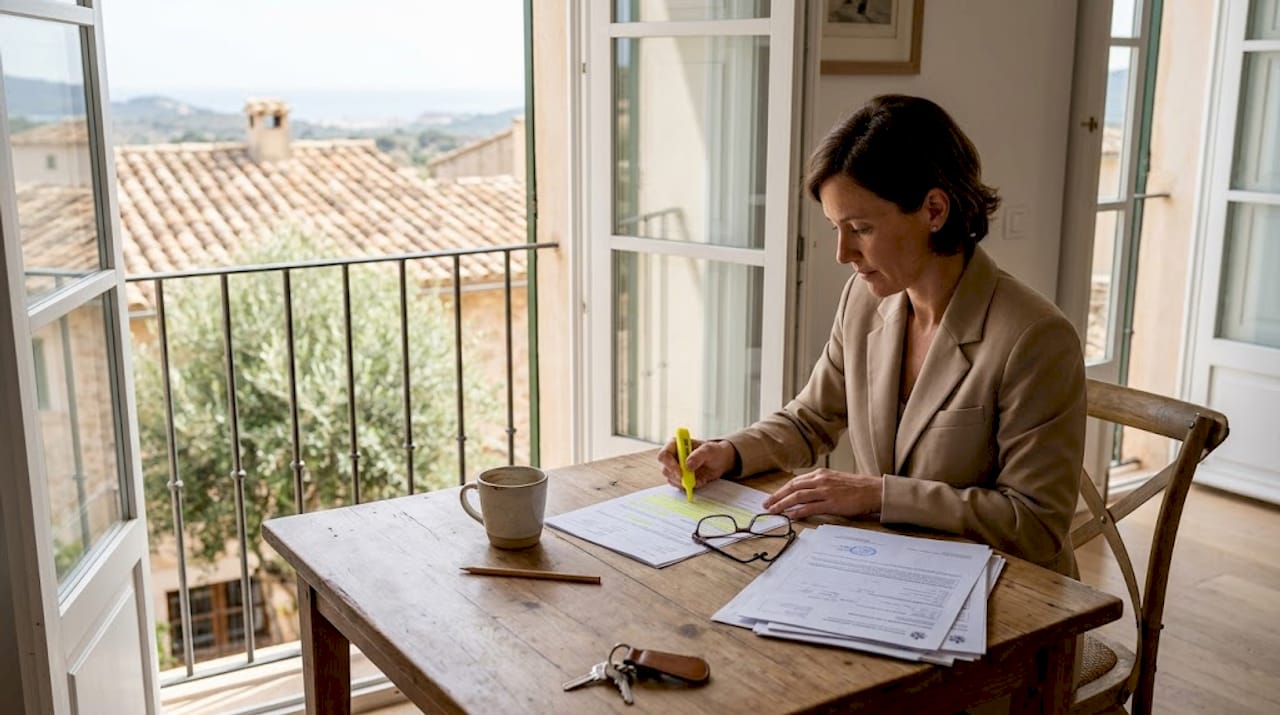
Short-term vs. long-term rentals work under entirely different legal frameworks. Short-term vacation rentals (under 30 days) require an ETV license (Estancia Turística en Vivienda). Long-term rentals (over 30 days) do not require an ETV but have their own rules, including rent caps in designated “stressed zones.”
Short-term vacation rentals require an ETV license; licenses are property-specific and non-transferable, meaning they cannot be moved to a different property or automatically passed to a new buyer.
What is and is not allowed by zone:
- Single-family villas and detached homes: Generally eligible for ETV in most zones, including rural and coastal areas.
- Urban apartments: Heavily restricted. Palma banned new short-term rental licenses for apartments in 2018, and that moratorium remains in force.
- Multi-family buildings: Community of owners must approve short-term rental use, which is increasingly rare.
- Rustic and protected land: Subject to additional regional oversight; holiday rental license rules vary by municipality.
| Feature | Short-term vacation rental (ETV) | Long-term rental (30+ days) |
|---|---|---|
| License required | Yes, ETV mandatory | No ETV needed |
| Rental duration | Under 30 days | Over 30 days |
| Zones allowed | Selected zones, villas preferred | Broadly available |
| ROI profile | Higher nightly rate, seasonal | Lower rate, more stable |
| Price premium | 15 to 25% for licensed property | Minimal premium |
| Rent cap risk | Low | High in stressed zones |
One nuance worth knowing: properties licensed before 2025 may hold grandfathered status, meaning they were approved under older, less restrictive rules. These are rare and command a significant premium. Always check via the investment property checklist before making any offer.
Pro Tip: Single-family villas in permitted zones offer the most flexibility for US investors looking for immediate, legal ROI. Focus your search there before exploring apartments or multi-family options.
How to secure and maintain a legal Mallorca rental license
Once you know what is legally permitted, the next step is navigating the actual application process. It is more involved than most investors expect, but it is entirely manageable with the right preparation.
Steps to obtain an ETV license:
- Confirm zoning eligibility: Verify with the local municipality that the property’s zone allows short-term vacation rentals.
- Obtain a habitability certificate: This proves the property meets minimum living standards under Balearic law.
- Get an energy performance certificate: Required for all rental properties across Spain.
- Submit the DRIAT: The Declaració Responsable d’Inici d’Activitat Turística is the formal declaration you file with the Balearic Tourism Authority to start rental activity legally.
- Community approval (for apartments): If the property is in a multi-unit building, a community of owners vote is required, and most communities now vote against it.
- Register nationally under NRUA: National NRUA registration is mandatory for all short-term rentals in 2026. You must display the NRUA number on every listing platform.
Ongoing compliance requirements:
- Annual reporting to the Balearic Tourism Authority
- Guest registration within 24 hours of arrival (digital platforms now integrate this)
- Maintaining ETV display on all booking platforms
- Paying the Ecotasa (tourist tax) and remitting it to regional authorities
Common pitfalls to avoid:
Owning more than 3 licensed vacation rental properties triggers additional restrictions under Balearic law, treating you as a professional operator subject to stricter rules. Incomplete paperwork is the fastest route to delisting. And as noted, getting a holiday rental license for a property without confirmed zoning approval is wasted time and money.
Pro Tip: Always confirm grandfathered license status and zoning classification before signing any purchase agreement. This single step can save you six figures in lost opportunity costs.
The scale of the 2026 enforcement action underlines just how serious authorities are: over 8,000 Mallorca properties were delisted in a single year. That number will not decrease.
ROI, tax, and compliance: Making Mallorca rentals work for you
Legal status alone does not generate returns. You need to understand where the money actually comes from, and where it quietly disappears.
Top rental areas and performance benchmarks:
| Area | Est. monthly revenue (peak) | Avg. occupancy (season) | ADR (nightly) | License premium |
|---|---|---|---|---|
| Alcúdia | €8,000 to €14,000 | 78 to 88% | €220 to €380 | 15 to 20% |
| Pollença | €10,000 to €18,000 | 75 to 85% | €260 to €450 | 18 to 25% |
| Palma (licensed) | €9,000 to €16,000 | 80 to 90% | €240 to €420 | 20 to 25% |
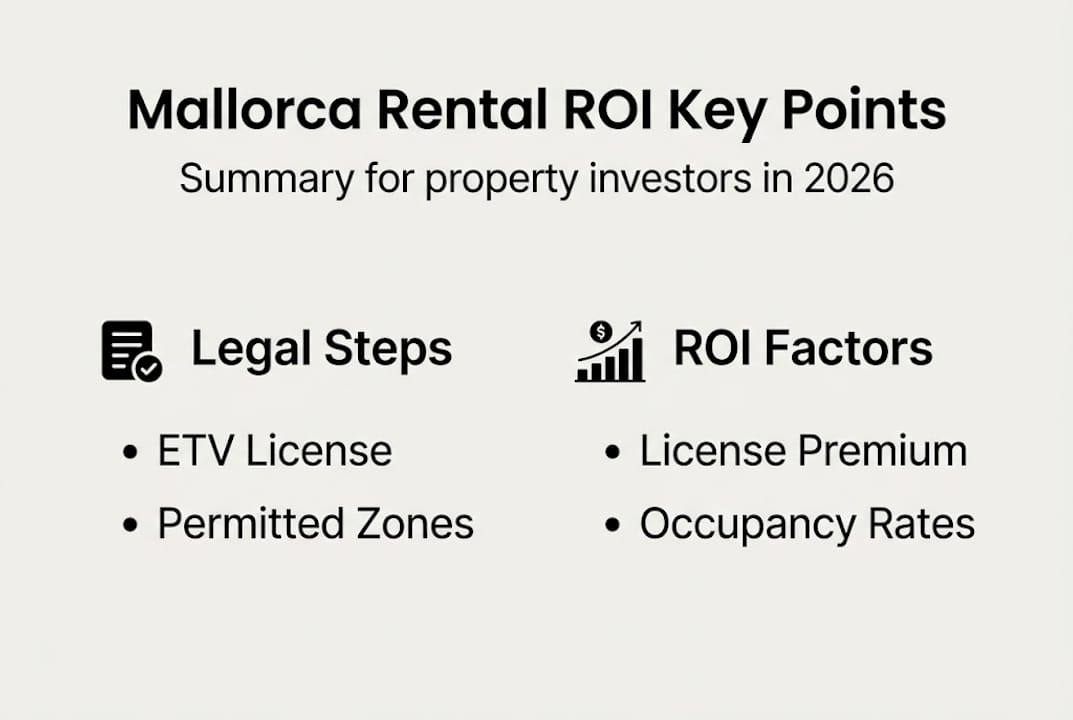
These figures reflect licensed properties commanding a 15 to 25% premium over comparable unlicensed homes, a gap that has grown as enforcement tightened.
Tax obligations for US investors:
Tourist rentals are subject to 10% VAT if ancillary services (cleaning, breakfast, concierge) are included, plus the Ecotasa (Mallorca’s tourist tax, currently €4 per person per night in peak season), and Spanish non-resident income tax on rental profits at 19% for EU residents or 24% for non-EU residents including Americans. Long-term rentals in officially designated stressed zones are also subject to rent caps under Spain’s 2023 Housing Law.
Factors that impact your net yield:
- ETV license acquisition cost and legal fees (typically €2,000 to €5,000)
- Annual compliance and reporting costs
- Platform fees (15 to 20% on Airbnb and Vrbo)
- Vacancy during shoulder season (October to April)
- Tourist tax remittance obligations
- Property management fees if you are managing remotely
For a full breakdown of ownership costs, the Mallorca real estate taxes guide covers the non-resident tax picture specific to US buyers.
Pro Tip: Always check whether your projected ROI accounts for Ecotasa, non-resident income tax, and any rent caps in Palma. Gross yield figures look very different from net yield once all three are factored in.
The real advantage: What seasoned US investors know that newcomers miss
Here is the uncomfortable truth most articles skip: chasing a bargain in Mallorca’s unlicensed market is not a strategy. It is a gamble with terrible odds. We have seen US investors buy properties at a 10% discount because they lacked an ETV license, convinced they could get one afterward. In most cases, they could not, because the zone was capped or the property type was ineligible. The discount evaporated in legal fees, and the asset sat idle.
Seasoned investors think differently. They treat the 15 to 25% premium on licensed properties not as an extra cost but as an entry fee to a protected market. Regulatory tightening will almost certainly continue. Each new moratorium, each enforcement campaign, makes existing licenses more valuable, not less. The investors who bought licensed villas in Pollença five years ago are now sitting on assets that are nearly impossible to replicate at any price.
What veterans also do differently is build local legal partnerships before they buy, not after. A local gestor (administrative agent) who knows the Balearic Tourism Authority’s current requirements can identify issues in days that an offshore legal team might miss in months. Use the investment property legal checklist as a starting framework, but rely on boots-on-the-ground expertise to validate every detail.
The bottom line: certainty and income continuity are worth more than a discount that evaporates the moment enforcement arrives.
Confidently invest in Mallorca rentals with expert support
Navigating Mallorca’s rental laws as a US investor requires more than a checklist. It requires access to licensed properties before they hit the open market, local legal expertise, and a buyer’s agent who understands both American investor expectations and Balearic compliance realities. At ULI & LISA, we specialize in exactly that: connecting US buyers to vetted, licensed investment properties across Mallorca, with full due diligence on ETV status, NRUA compliance, and realistic ROI projections. Whether you are looking for a villa in Pollença or a Palma property with an active license, our safe property investment support approach ensures you never buy blind. Read our property buyer agent guide to understand how independent buyer representation protects your investment from day one.
Frequently asked questions
Can a US investor buy a Mallorca property and get an ETV rental license in 2026?
Yes, but only for eligible properties such as villas or apartments in permitted zones, with proper certifications and regulatory approval. Supply is capped and competition for licensed assets is strong, so buying an existing licensed property is often faster and safer than applying for a new license.
What happens if I rent my Mallorca property illegally?
You risk platform delisting and fines reaching €500,000, plus potential non-resident tax penalties and asset devaluation if authorities flag the property.
Are licenses transferable if I sell my Mallorca investment property?
Licenses are non-transferable between owners or properties, so buyers must verify the license status and eligibility for re-application before completing any purchase transaction.
How much extra do properties with legal rental licenses cost?
Licensed properties trade at a 15 to 25% premium over comparable unlicensed homes, reflecting the scarcity of available licenses and the income certainty they provide.
Recommended
- Mallorca Investment Tips: Maximize ROI and Navigate Rental Laws - ULI & LISA Mallorca Property Blog
- Holiday Rental Licenses Mallorca – Key Rules for Investors - ULI & LISA Mallorca Property Blog
- Why Invest in Mallorca Holiday Rentals for ROI - ULI & LISA Mallorca Property Blog
- Mallorca Investment Property Checklist: Legal Essentials - ULI & LISA Mallorca Property Blog