TL;DR:
- Mallorca residency options include visas and permits designed for different income sources and lifestyle needs. Selecting the correct pathway before arrival, completing NIE and empadronamiento processes, and early tax planning are crucial for legal residence and benefits. Proper guidance from a gestor and tax attorney can prevent delays and ensure successful integration on the island.
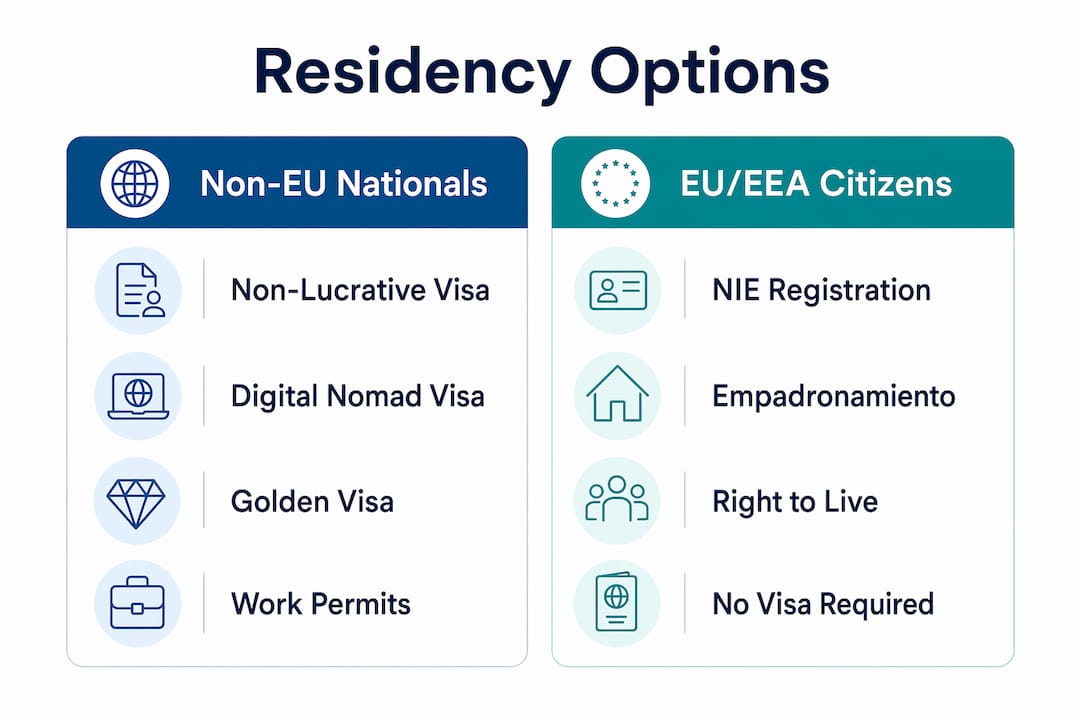
Mallorca residency options are the legal permits, registrations, and visa pathways that determine how non-EU and EU nationals may lawfully live on the island for more than 90 days. The main categories are the Non-Lucrative Visa, the Digital Nomad Visa, the Golden Visa, and the EU/EEA right of residence, each with distinct financial thresholds, documentation requirements, and lifestyle consequences. Understanding which pathway fits your situation before you arrive is the single most important step in a successful relocation. This guide breaks down every route, the administrative steps behind each one, and the tax and lifestyle implications that most families only discover after they have already moved.
What are the main mallorca residency options for non-EU nationals?
Non-EU nationals have four primary legal pathways to establish residency in Mallorca, and choosing the wrong one creates costly delays.

1. Non-Lucrative Visa (NLV)
The Non-Lucrative Visa is the most common route for retirees and financially independent individuals. Applicants must prove passive income of €28,800 per year for a single person and €36,000 for a couple, alongside private health insurance with full Spanish coverage and a clean criminal record. This threshold is not negotiable, and consulates reject applications that rely on employment income. The visa prohibits working in Spain, which disqualifies remote employees unless they qualify under a separate category. Renewal is annual for the first two years, then biennial.
2. Digital Nomad Visa
Spain’s Digital Nomad Visa, introduced under the Startup Act, allows remote workers employed by non-Spanish companies to live legally in Mallorca. The income threshold is lower than the NLV, and crucially, holders can work for Spanish clients up to 20% of their total income. This visa is the right choice for freelancers and remote employees who would be disqualified under the NLV’s work prohibition.
3. Golden Visa
The Golden Visa grants residency through investment, historically tied to real estate purchases above €500,000. Spain announced plans to close the real estate route in 2025, so buyers pursuing this pathway should verify current regulations with a licensed Spanish immigration attorney before committing capital. Alternative investment routes through business creation or government bonds may still apply.
4. Work permits and family reunification
Standard work permits require a Spanish employer to sponsor the application. Family reunification allows spouses and dependent children of legal residents to apply for their own residency cards once the primary applicant holds a valid permit.
Visa processing times range from two weeks to three months depending on the consulate and application volume. Once you arrive in Spain, the Tarjeta de Identidad de Extranjero (TIE) card must be applied for within one month. The TIE takes three to six weeks to process and serves as your physical proof of legal residence.
Pro Tip: Book your TIE appointment at the Palma Foreigners’ Office (Oficina de Extranjería) online before you fly. Appointment slots fill weeks in advance, and missing the one-month window creates a legal gap in your residency status.
How do EU and EEA citizens register for residency in Mallorca?
EU and EEA nationals hold the right to live and work in Spain without a visa, but that right is not self-executing. You must complete two separate administrative steps to be legally recognized as a resident.
The first step is obtaining your NIE (Número de Identificación de Extranjero), a tax identification number required for virtually every financial transaction in Spain, from opening a bank account to signing a property deed. The NIE is not a residency document. It is a fiscal identifier, and many families confuse it with proof of residence.
The second step is empadronamiento, the municipal registration that places you on the local padrón (census). EU nationals must complete empadronamiento to establish official proof of residence, even though no visa is required. The padrón is what unlocks access to the Spanish public healthcare system, local schools, and municipal services.
Key facts about empadronamiento in Mallorca:
- Registration requirements vary significantly between Palma, Calvià, Llucmajor, and Manacor. Each municipality sets its own document requirements and appointment procedures.
- You will need your passport or national ID, proof of address (a rental contract or property deed), and in some municipalities, a completed application form obtained from the local town hall (Ajuntament).
- Registration must reflect your actual residential address. Municipalities conduct address verification, and discrepancies cause rejections.
- Once registered, you receive a certificate of empadronamiento, which you will use repeatedly for school enrollment, healthcare registration, and administrative filings.
Empadronamiento is not a formality. It directly determines your access to health, schools, and municipal services, and errors in the process create cascading problems across every other registration step.
Pro Tip: Check the specific Ajuntament website for your municipality before preparing documents. Palma’s requirements differ from Calvià’s, and arriving with the wrong paperwork means rebooking an appointment weeks later.
What are the tax and lifestyle implications of your residency choice?
Residency in Mallorca triggers Spanish tax obligations that most newcomers underestimate, and the structure of those obligations depends entirely on which permit you hold and how long you stay.
Spain taxes residents on their worldwide income once they spend more than 183 days per year in the country. The Balearic Islands apply a reintroduced wealth tax on global assets above certain thresholds, which directly affects high-net-worth individuals with significant investment portfolios or multiple properties. This is not a minor consideration. A family with €3 million in assets outside Spain may face a meaningful annual liability they did not anticipate.
The Beckham Law (Régimen Especial de Trabajadores Desplazados) offers a significant counterbalance. Qualifying new residents pay a flat 24% tax rate on Spanish-sourced income for up to six years, rather than the progressive rates that reach 47% at higher income levels. Digital Nomad Visa holders and certain executives qualify. Retirees on the NLV typically do not.
| Residency type | Tax regime | Path to permanent residency |
|---|---|---|
| Non-Lucrative Visa | Worldwide income taxed; no Beckham Law | 5 years continuous residence |
| Digital Nomad Visa | Beckham Law eligible; flat 24% rate | 5 years continuous residence |
| Golden Visa | Worldwide income if 183+ days in Spain | 5 years continuous residence |
| EU/EEA registration | Worldwide income taxed after 183 days | 5 years continuous residence |
“Early tax planning before relocation is critical due to Balearic Islands’ specific tax nuances, including taxation on worldwide income and possible wealth tax liability.” — ThinkSpain Relocation Guide
After five years of continuous legal residence, any permit holder can apply for permanent residency. Spanish citizenship becomes available after 10 years for most nationalities, or after just two years for Latin American, Filipino, and Portuguese nationals. For families with children, the schooling picture is equally structured. International schools concentrate in Palma and the southwest corridor around Calvià, with institutions such as Agora Portals International School and Baleares International College serving English-speaking families. Public school enrollment requires a valid empadronamiento certificate. For buyers interested in how Mallorca property investment intersects with long-term residency planning, the connection between property ownership and permit eligibility is worth examining before you purchase.
Step-by-step guide to the Mallorca residency application process
The residency application process follows a specific sequence. Skipping steps or misordering them is the most common cause of delays.
For non-EU nationals:
- Determine your visa category (NLV, Digital Nomad, or Golden Visa) based on income source and lifestyle.
- Apply at the Spanish consulate in your home country. Gather all required documents: financial proof, health insurance policy, criminal background check apostilled within 90 days, and completed application forms.
- Receive your visa (valid for one year initially) and travel to Mallorca.
- Obtain your NIE at the Palma Foreigners’ Office or a designated police station. Book the appointment online through the Spanish government’s Sede Electrónica portal.
- Apply for your TIE card within one month of arrival. The application is in person, requires fingerprints, and must be booked online in advance.
- Complete empadronamiento at your local Ajuntament.
- Register with a local health center (Centro de Salud) using your TIE and empadronamiento certificate.
For EU/EEA nationals:
- Obtain your NIE (can be done in Mallorca or at a Spanish consulate abroad).
- Complete empadronamiento at your local Ajuntament within three months of arrival.
- Register with your local health center.
| Step | Non-EU nationals | EU/EEA nationals |
|---|---|---|
| Visa required | Yes, apply at home consulate | No |
| NIE | Required | Required |
| TIE card | Required within 1 month of arrival | Not required |
| Empadronamiento | Required | Required |
| Health registration | After TIE and padrón | After padrón |
Spanish bureaucracy creates significant wait times for NIE, TIE, and empadronamiento appointments. Hiring a licensed gestor, a Spanish administrative agent, is the most effective way to avoid delays. A gestor knows which documents each municipality accepts, books appointments on your behalf, and flags errors before they cause rejections. For buyers also purchasing property, the tax obligations for buyers in Spain add another layer of planning that a gestor or tax attorney should handle from day one.
Key takeaways
Mallorca residency requires choosing the correct permit type before arrival, completing NIE and TIE registration in sequence, and handling empadronamiento at the municipal level to unlock healthcare, schooling, and legal residence status.
| Point | Details |
|---|---|
| Match permit to income source | Non-Lucrative Visa suits passive income; Digital Nomad Visa suits remote workers; each has distinct tax consequences. |
| TIE deadline is firm | Apply for your TIE card within one month of arrival; missing this window creates a legal gap in residency status. |
| Empadronamiento is not optional | Municipal registration unlocks healthcare, schooling, and benefits; requirements vary by Palma, Calvià, Llucmajor, and Manacor. |
| Tax planning must precede relocation | The Balearic Islands apply wealth tax and worldwide income rules; Beckham Law eligibility depends on visa type. |
| Hire a gestor early | A licensed gestor reduces appointment delays and document errors across every stage of the process. |
What I’ve learned watching families navigate Mallorca residency
Most families I work with arrive in Mallorca having done solid research on the property side and almost none on the residency side. They know the price per square meter in Puerto Andratx. They do not know that their municipality requires an apostilled rental contract for empadronamiento, or that the Palma Foreigners’ Office books out six weeks in advance.
The mistake I see most often is treating the NIE as the finish line. Families get their NIE, feel administratively complete, and then discover months later that they never registered on the padrón, which means their children cannot enroll in school and they cannot access the public health system. The NIE is a tax number. The padrón is your proof of life in Mallorca.
The second pattern I observe is tax surprise. The Balearic wealth tax catches high-net-worth families off guard, particularly Americans who are already navigating FBAR and FATCA obligations alongside Spanish worldwide income rules. The Beckham Law is genuinely valuable for the right applicant, but you must elect it within six months of becoming a tax resident. Miss that window and it is gone for your entire stay.
My consistent advice: engage a gestor and a cross-border tax attorney before you sign anything. The cost is modest relative to the mistakes it prevents. Mallorca rewards people who plan methodically. The island’s lifestyle, climate, and stability are exceptional. The bureaucracy is not forgiving of improvisation.
— Uli
How Uli-lisa supports your Mallorca property and residency journey
Residency planning and property acquisition in Mallorca are inseparable decisions. The permit you hold determines your tax exposure, and the property you buy can affect your eligibility for certain visa categories. Uli-lisa operates as an independent buyer agent with full market access across every agency in Mallorca, representing only buyers, never sellers. We help international families align their property search in Mallorca with their residency goals from the first conversation, connecting you with vetted legal counsel, gestors, and tax advisors who specialize in international relocations. If you are planning your move to Mallorca in 2026 and want expert, unbiased guidance on both the property and the legal pathway, contact Uli-lisa to start the conversation.
FAQ
What is the minimum income for the Non-Lucrative Visa in Spain?
The Non-Lucrative Visa requires proof of at least €28,800 in annual passive income for a single applicant and €36,000 for a couple, along with private health insurance and a clean criminal record.
How long does it take to get a TIE card in Mallorca?
The TIE card takes three to six weeks to process after your in-person appointment at the Palma Foreigners’ Office. You must apply within one month of arriving in Spain.
Do EU citizens need a visa to live in Mallorca?
EU and EEA citizens do not need a visa to live in Mallorca, but they must obtain an NIE and complete empadronamiento at their local Ajuntament to access healthcare, schools, and municipal services.
What is empadronamiento and why does it matter?
Empadronamiento is municipal registration on the local padrón (census). It is required for access to the Spanish public health system, school enrollment, and local benefits, and the process varies between Mallorca municipalities including Palma, Calvià, and Manacor.
How long until you qualify for permanent residency in Mallorca?
After five years of continuous legal residence on any valid permit, you can apply for permanent residency in Spain. Spanish citizenship becomes available after 10 years for most nationalities, or two years for Latin American and Portuguese nationals.
Recommended
- Advantages of living in Mallorca for luxury buyers 2026 - ULI & LISA Mallorca Property Blog
- Mallorca Real Estate Market 2025 – Key Trends for U.S. Buyers - ULI & LISA Mallorca Property Blog
- Mallorca Investment Tips: Maximize ROI and Navigate Rental Laws - ULI & LISA Mallorca Property Blog
- Mallorca Investment Property: Smart Moves for 2026 Buyers - ULI & LISA Mallorca Property Blog