
TL;DR:
- Most Mallorca property investors assume obtaining a license is sufficient for legal short-term rentals, but strict enforcement now requires compliance with both regional licenses and national registry codes. Failure to meet these layered requirements, including ongoing reporting and community approval, risks hefty fines, platform delisting, and legal action. Successful investors treat compliance as an ongoing operational system, collaborating with professionals and communities to ensure long-term rental profitability.
Most property investors arrive in Mallorca with one assumption: get the license, start renting. That assumption is expensive. Mallorca short term rental laws operate across two separate legal layers, regional ETV licences and Spain’s national rental registry, and a failure at either layer exposes you to fines, platform delisting, and forced cessation of operations. Enforcement has intensified sharply since 2024, with authorities ordering 165 property cessations in November 2025 alone. This guide cuts through the complexity so you know exactly what compliance requires in 2026.
Key Takeaways
| Point | Details |
|---|---|
| Two compliance layers required | Both a regional ETV licence and Spain’s national rental registry code are mandatory for legal operation. |
| Three distinct ETV licence types | ETV60, ETV365-Un, and ETV365-Pluri each apply to different property types with different conditions and caps. |
| Community approval is a legal gate | Apartment owners need a 3/5 qualified majority from their community of owners before any licence takes effect. |
| Annual reporting is now law | Landlords must submit a detailed informative return every February covering the prior year’s bookings. |
| Enforcement is active and recurring | Authorities conduct ongoing inspections, not one-time checks, and platforms actively delist non-compliant ads. |
Mallorca short term rental laws and the ETV licence system
The ETV licence types are the foundation of short-term rental compliance in Mallorca. There are three distinct categories, and choosing the wrong one, or operating without one, triggers immediate legal exposure.
ETV60 applies to your primary residence. It allows you to rent the property for up to 60 days per year, and at least 30 of those days must fall in July or August. This licence type is designed for homeowners who want to monetize their own home during peak season without converting it into a full-time rental business. The cap is hard and non-negotiable.
ETV365-Un covers standalone single-family homes with no shared building structure. These licences carry indefinite validity and impose no annual day cap, making them the most commercially attractive category. Detached villas, fincas, and townhouses with independent access typically qualify here. If you are evaluating a luxury villa purchase specifically for rental yield, this is the licence category to target.
ETV365-Pluri applies to apartments and units within multi-unit buildings. These licences are valid for five years and require renewal. More critically, they require the 3/5 qualified majority approval of the community of owners, both by number of owners and by ownership quota, starting April 3, 2025. Without that resolution, no licence can be issued regardless of how well the property itself meets technical standards.
| Licence Type | Property Type | Rental Days | Validity | Community Approval |
|---|---|---|---|---|
| ETV60 | Primary residence | 60 days/year | Renewable | Not required |
| ETV365-Un | Single-family home | Unlimited | Indefinite | Not required |
| ETV365-Pluri | Apartment/multi-unit | Unlimited | 5 years | Required (3/5 majority) |
Beyond licence type, every property must meet technical and environmental standards. These include a valid habitability certificate, a minimum energy efficiency rating, and individual utility metering so each rental unit can be independently accounted for. Properties that lack these certifications cannot receive an ETV licence at all, regardless of zoning.
Pro Tip: Before making an offer on any Mallorca property intended for short-term rental, verify the community of owners statutes. Some communities have already voted to ban short-term rentals entirely, and that vote is legally binding on future owners.
Spain’s national rental registry and reporting obligations
Short-term rental regulations in Mallorca do not stop at the regional level. Spain’s national VUDA system introduced a second layer of compliance that every landlord must understand, even following its legal challenge.
The VUDA registry launched in January 2025 with 341,000 properties registered nationally. From July 1, 2025, all rental listings on platforms such as Airbnb and Booking.com must display a unique rental identifier code, known as the NRUA or NRA, or face automatic delisting. This is not a theoretical threat. Airbnb removed nearly 8,000 illegal rental ads in 2025 alone as platforms moved to enforce the code requirement.
In May 2026, Spain’s Supreme Court ruled that the national registry must be scrapped due to jurisdictional overlap with regional registries. However, this ruling does not remove your compliance obligations. Balearic regional licences, local zoning rules, and community statutes remain fully enforceable. The practical effect is that dual-layer compliance remains the operating standard until legislative changes clarify the new structure.
The annual reporting obligation adds another recurring requirement. From February 2026 onward, landlords must submit an informative return every February covering the prior year’s bookings. The BOE-approved reporting model requires detailed stay data, including guest count, arrival and departure dates, and the purpose of stay, all linked to the rental code. This is not a one-time registration. It is a recurring annual obligation.
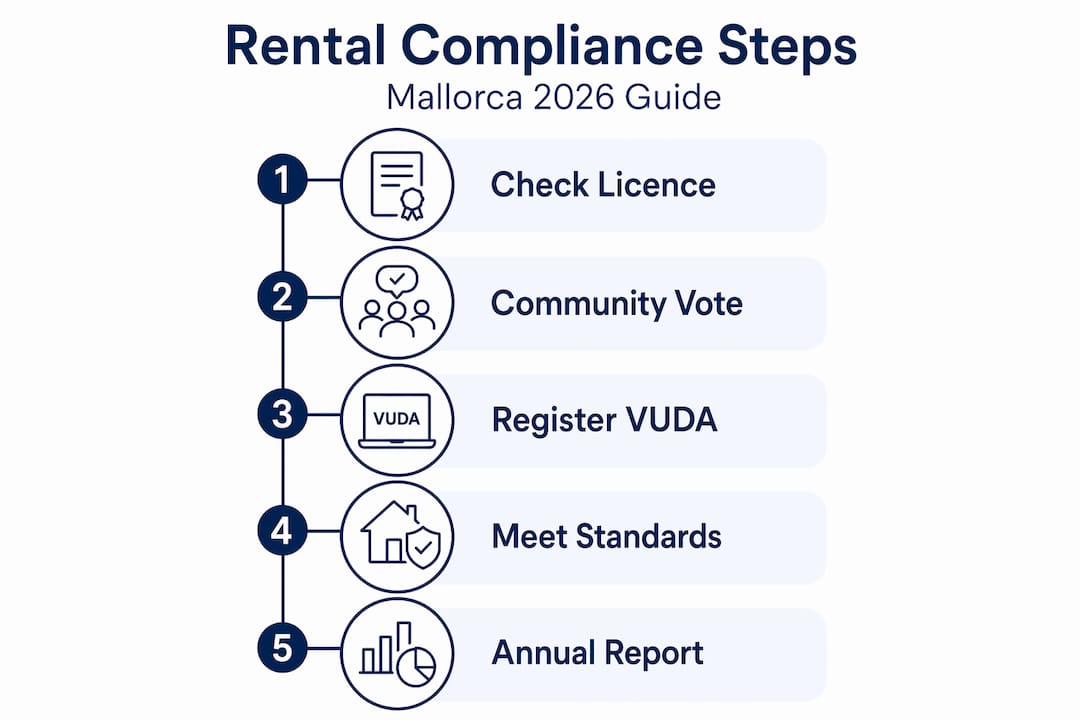
Here is the compliance sequence every landlord must follow:
- Secure the appropriate ETV licence from the Balearic Islands tourism authority.
- Obtain your NRUA or NRA code through the VUDA registration system.
- Display the rental code on all platform listings before accepting bookings.
- Maintain accurate guest records throughout the rental year.
- Submit the annual informative return each February for the prior year’s activity.
Pro Tip: Set a calendar reminder for January each year to compile your stay data before the February reporting deadline. Missing this submission risks suspension of your rental code and potential delisting from every platform simultaneously.
Enforcement in Mallorca: fines, removals, and real risk
Some investors treat Airbnb laws in Mallorca as loosely enforced guidelines. That calculation is wrong, and the 2024 to 2026 enforcement record proves it.
Mallorca’s tourism authority actively monitors and sanctions illegal rentals through recurring inspections, not one-time licensing checks. The November 2025 batch of 165 cessation orders was part of a sustained campaign, not an isolated sweep. Authorities cross-reference platform listings against the licence registry, identify unlicensed or code-free listings, and initiate formal proceedings.
Non-compliance risks include fines reaching hundreds of thousands of euros, delisting from platforms, and suspension or revocation of rental rights.
The sanction framework is multi-tiered. Failure to register or display a rental code triggers penalties at the lower end of the scale. Operating without any licence, or continuing to operate after a cessation order, escalates to the highest sanction bands. Repeat violations can result in permanent revocation of rental rights on a property. At that point, the investment thesis for that asset collapses entirely.
Community and neighbor dynamics add another enforcement vector. Under Mallorca’s legal framework, a community of owners can challenge an existing licence if the community statute changes after initial approval. That means a property that was compliant in year one of a five-year ETV365-Pluri licence could face a community challenge in year three. Investors who treat community relations as a one-time administrative step rather than an ongoing relationship are taking an unnecessary risk. Understanding enforcement risks for investors is as critical as understanding the licence structure itself.
Practical steps for compliant rental operations
Knowing the rules matters less than applying them in the right sequence. Here is how to build a compliant short-term rental operation in Mallorca from the ground up.
Verify the correct licence category before purchase. The property type determines your licence path. A detached villa qualifies for ETV365-Un. An apartment in a building requires community approval for ETV365-Pluri. Confirm the applicable zoning and any existing community resolutions before signing any purchase agreement.
Engage the community of owners early. For apartment purchases, request the minutes of recent community meetings to check whether a vote on short-term rentals has occurred. If it has not, factor the time required to call a meeting, secure a 3/5 majority, and record the resolution into your timeline. This process can take months. Ignoring governance timelines is one of the most common operational pitfalls in Mallorca rentals for investors who underestimate community approval complexity.
Register via VUDA and maintain annual reporting discipline. Even with the Supreme Court ruling creating legal uncertainty around the national registry, platforms still require the code for listings. Register proactively, display the code, and submit your annual return on schedule.
Meet all operational standards on an ongoing basis. This includes providing 24/7 contact access for guests, maintaining a guest registration system that meets Spanish law requirements, and understanding the rules around guest eviction if problems arise during a stay.
Consider the Alquiler Seguro program for long-term stability. The Balearic Alquiler Seguro scheme, which has covered 82 properties since November 2024, offers rent guarantee programs with government-subsidized payments but imposes price caps at €1,500 per month in Mallorca and requires seven-year contracts. For investors who want stable income without the operational complexity of short-term rentals, this program deserves serious evaluation alongside investment optimization strategies.
My take on where most investors go wrong
In my experience working with international buyers in Mallorca, the most dangerous assumption I see is not ignorance of the law. It is partial knowledge. An investor reads about ETV licences, secures the correct type for their property, and considers the job done. They are not aware that Spain simultaneously requires a national rental code, that platforms will delist them without it, and that an annual reporting obligation now sits on their calendar every February.
The investors who avoid problems are not the ones who know the most law. They are the ones who treat compliance as an ongoing operational system rather than a one-time acquisition step. They build relationships within their community of owners. They work with local professionals who track regulatory changes, and there have been significant changes between 2024 and 2026 alone. They understand that market trends and licensing changes evolve together and that today’s compliant operation must be reviewed annually.
What I have learned is that the properties delivering the best long-term rental returns in Mallorca are almost always the ones where the owner treated legal compliance as a competitive advantage rather than a burden. When neighbors file complaints or platforms run code checks, compliant landlords sail through. Non-compliant ones face compounding penalties that eat through years of rental income in a single enforcement cycle. The regulation is real, the enforcement is real, and the investment case for getting it right is compelling.
— Uli
Work with ULI & LISA to secure your Mallorca rental investment
Short stay rental rules in Mallorca require navigating licence types, community governance, national registry codes, and annual reporting, all simultaneously. Uli-lisa specializes in helping high-net-worth international buyers, particularly from the USA, identify and acquire properties that are already positioned for compliant short-term rental operation. As independent buyer agents representing only buyers, Uli-lisa searches the full Mallorca market without agency bias, evaluates ETV licence eligibility before purchase, and provides guidance on community governance and compliance strategy from day one. If you are evaluating Mallorca as a luxury investment or second-home destination, the right starting point is working with advisors who understand both the legal framework and the property market at depth. Connect with Uli-lisa through the safe property investment service page to begin your compliant, informed search today.
FAQ
What is short-term rental law in Mallorca?
Mallorca short term rental laws require property owners to hold a valid regional ETV licence and, until the legal framework is resolved following the Supreme Court ruling, display a national rental identifier code on all platform listings. Both layers carry independent compliance obligations.
How many types of ETV licences exist in Mallorca?
There are three types: ETV60 for primary residences limited to 60 rental days per year, ETV365-Un for single-family homes with indefinite validity and no day cap, and ETV365-Pluri for apartments with five-year renewable licences requiring community approval.
Do Airbnb laws in Mallorca require a special code on listings?
Yes. From July 1, 2025, all platform listings must display an NRUA or NRA code obtained through Spain’s VUDA registry, or the platform is required to remove the listing. Airbnb removed nearly 8,000 non-compliant ads in 2025 under this rule.
What Mallorca rental permits do apartment owners specifically need?
Apartment owners need an ETV365-Pluri licence, which requires a 3/5 qualified majority vote from the community of owners approving short-term rental activity. Without that vote, no licence can be issued regardless of the property’s physical compliance with technical standards.
What are the annual reporting requirements for holiday rentals in Mallorca?
From February 2026 onward, landlords must submit an annual informative return each February covering the prior year’s bookings. The official reporting model requires stay dates, guest counts, and the purpose of stay linked to the rental code.
Recommended
- Mallorca Rental Laws Explained: Secure Legal ROI for Investors - ULI & LISA Mallorca Property Blog
- Mallorca Investment Tips: Maximize ROI and Navigate Rental Laws - ULI & LISA Mallorca Property Blog
- Holiday Rental Licenses Mallorca – Key Rules for Investors - ULI & LISA Mallorca Property Blog
- Mallorca Rental License Guide: Secure Your Investment - ULI & LISA Mallorca Property Blog