TL;DR:
- The Mallorca non-resident property buying process involves obtaining a NIE, conducting thorough legal due diligence, and understanding tax obligations before completing a purchase.
- Buyers must budget 12 to 15% above the purchase price for taxes, fees, and potential appraisal shortfalls, with non-EU buyers facing additional legal and regulatory requirements.
The Mallorca non-resident buying process is a defined legal and financial sequence that begins with obtaining a Spanish tax identification number and ends with registered title in your name at the Registro de la Propiedad. Mallorca stands as one of Europe’s most stable luxury property markets in 2026, attracting high-net-worth buyers from the United States, Germany, Scandinavia, and the United Kingdom who want a secure European asset base. The steps to buying Mallorca real estate are specific, regulated, and unforgiving of shortcuts. Understanding each phase before you commit capital is the difference between a clean acquisition and a costly legal dispute.
What are the essential steps for non-residents buying property in Mallorca?
The property acquisition workflow for non-residents follows a fixed sequence. Skipping or reordering steps creates legal exposure that can void contracts or delay title transfer by months.
-
Obtain your NIE number. The Número de Identificación de Extranjero is Spain’s foreigner tax identification number. No Spanish bank account, mortgage, or notarial deed can be executed without it. Applications are processed at Spanish consulates abroad or at the Oficina de Extranjeros in Palma. Allow four to eight weeks if applying from outside Spain.
-
Open a Spanish bank account. All transaction funds, tax payments, and utility direct debits must flow through a Spanish account. Sabadell, CaixaBank, and Santander each maintain dedicated non-resident banking desks in Palma with English-speaking staff.
-
Secure financing or confirm liquidity. Spanish banks finance non-residents at 60 to 70% loan-to-value, requiring a 30 to 40% down payment plus 10 to 14% in taxes and fees. Cash buyers must document the source of funds under anti-money laundering regulations.
-
Engage a specialized independent lawyer. Legal due diligence covers title verification, urban planning compliance, outstanding debts on the property, and coastal law status. Your lawyer orders the nota simple from the Registro de la Propiedad and checks for encumbrances before any contract is signed.
-
Sign the reservation contract and pay the deposit. A reservation agreement removes the property from the market for a fixed period, typically two to four weeks, while due diligence is completed. The deposit is usually €10,000 to €30,000.
-
Execute the contrato de arras. This private purchase contract commits both parties. The buyer pays 10% of the purchase price. If the seller withdraws, they return double the deposit. If the buyer withdraws, the deposit is forfeited.
-
Complete at the notary. The escritura pública de compraventa is signed before a Spanish notary, who verifies identities, confirms the deed, and witnesses the transfer of funds. The notary does not represent either party. They are a public official confirming legal formalities.
-
Register the title and pay taxes. The property transfer process in Mallorca requires payment of ITP or VAT within 30 days of signing, followed by registration at the Registro de la Propiedad. Only after registration is your ownership legally protected against third-party claims.
Pro Tip: Hire your lawyer before you make any offer. Due diligence on a Mallorca property can surface coastal restrictions, missing habitability certificates, or illegal extensions that fundamentally change the deal. Finding these issues after signing the arras contract is expensive.
How do taxes and fees impact non-resident buyers in Mallorca?
The Balearic Islands apply the highest ITP progressive rates among all Spanish autonomous communities. For resale properties, the transfer tax scales as follows:
| Purchase Price | ITP Rate |
|---|---|
| Up to €400,000 | 8% |
| €400,001 to €600,000 | 9% |
| €600,001 to €1,000,000 | 10% |
| €1,000,001 to €2,000,000 | 12% |
| Over €2,000,000 | 13% |
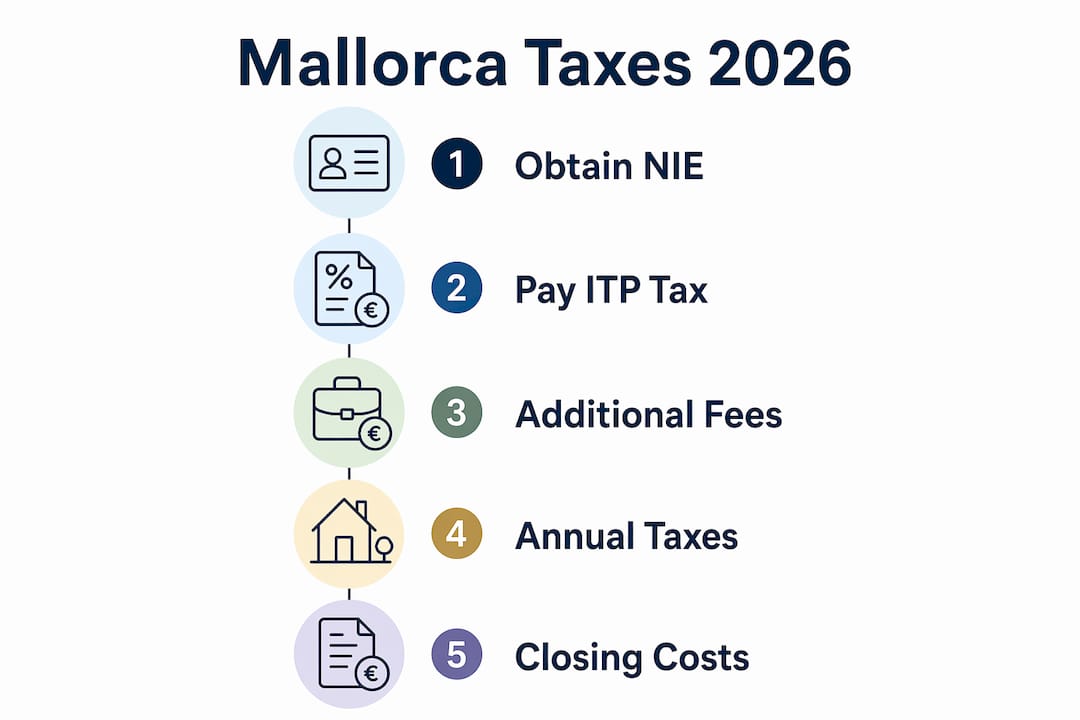
New builds follow a different structure: buyers pay 10% VAT plus 1.5% stamp duty (Actos Jurídicos Documentados) instead of ITP. For a €2 million new villa, that means €230,000 in tax alone before notary and registry fees.
Beyond the purchase tax, non-resident owners face two recurring annual obligations. Non-resident wealth tax applies on net Spanish assets above €700,000, generating annual liabilities of €3,000 to €12,000 for a €2 million property. The Non-Resident Income Tax (IRNR) applies even when a property sits empty. The Spanish tax authority deems a rental income of 1.1% of the cadastral value and taxes it at 19% for EU and EEA residents or 24% for non-EU nationals. Use the purchase cost calculator from Uli-lisa to model your full acquisition cost before making an offer.
Additional closing costs include notary fees (0.1 to 0.5% of the declared value), land registry fees (0.1 to 0.25%), and legal fees typically ranging from 1 to 1.5%. Budget a total of 12 to 15% on top of the purchase price to cover all taxes and transaction costs.
What are the key legal and regulatory considerations for international buyers?
Legal due diligence in the Mallorca property purchase process extends well beyond a title search. Several compliance layers are specific to the Balearic Islands and catch international buyers off guard.

Military authorization for non-EU buyers. Non-EU buyers may require military authorization before purchasing in designated strategic zones. Spanish notaries will not execute the public deed without this permit. Processing times run six to twelve weeks and can push transactions past contract deadlines, so American buyers in particular must factor this into their timeline from day one.
Cédula de habitabilidad. This habitability certificate confirms a property meets minimum living standards. It is mandatory for utility connections and mortgage approval. Many older rural properties and inherited estates lack a current certificate. Obtaining one requires an architect’s inspection and municipal approval, adding weeks to the process and cost to the budget.
Coastal protection law (Ley de Costas). Properties near the shore often fall under restrictions that limit renovations and ownership transfer. Pre-1988 seafront properties can carry concession rights rather than freehold title, meaning the land technically belongs to the Spanish state. Always request a certificado de situación de costas before signing any contract on a waterfront property.
Anti-money laundering compliance. Spain’s AML regulations require buyers to disclose the ultimate beneficial owner of purchasing entities and document the origin of all funds. Transactions above €100,000 in cash are prohibited. Lawyers and notaries are obligated reporters under Spanish law, so incomplete documentation can halt a transaction at the notary’s desk.
Pro Tip: For U.S. buyers specifically, the legal compliance guide from Uli-lisa covers military authorization timelines and FATCA-related banking considerations that most general guides ignore.
What should buyers know about financing and mortgage specifics for non-residents?
Non-resident mortgage lending in Mallorca follows stricter criteria than resident financing, and the gap between expectation and reality surprises many buyers.
| Feature | Non-Resident Terms |
|---|---|
| Loan-to-value | 60 to 70% of appraisal value |
| Loan term | 20 to 25 years |
| Fixed rate (early 2026) | 3.3% to 3.9% |
| Down payment required | 30 to 40% of purchase price |
| Additional cash needed | 10 to 14% for taxes and fees |
The most underestimated risk in Mallorca property financing is the appraisal gap. Properties frequently appraise 5 to 15% below the agreed purchase price. Banks base their mortgage offer on the lower of the contract price or the appraisal value. On a €1.5 million property that appraises at €1.3 million, a buyer expecting a 70% LTV mortgage of €1.05 million receives only €910,000. The €140,000 shortfall must be covered in cash. This is not a rare edge case. It is a structural feature of the Mallorca market that buyers must plan for.
For acquisitions above €2 million, private banking divisions at Banca March, Deutsche Bank España, and UBS Spain offer tailored mortgage structures with more flexible appraisal treatment and faster approval timelines. The financing guide from Uli-lisa details lender-specific criteria and the documentation package required for non-resident mortgage applications.
Pro Tip: Get a mortgage pre-approval before signing the arras contract. Sellers in Mallorca’s competitive market will not extend contract deadlines to accommodate banking delays. Pre-approval takes two to four weeks and protects your 10% deposit.
How do short-term rental regulations affect investment prospects for non-resident buyers?
The 2022 moratorium on new tourist rental licenses for apartments in plurifamiliar buildings remains in force in 2026. This directly limits the short-term rental investment model for buyers targeting Palma, Alcúdia, and other urban coastal zones.
The regulatory picture breaks down as follows:
- Flats and apartments in urban zones: No new ETV (Estancias Turísticas en Viviendas) licenses are being issued. Existing licenses are non-transferable in most cases, meaning a licensed apartment does not pass its license to a new owner.
- Standalone villas and detached houses: ETV licenses remain available outside restricted zones, but the application process takes 6 to 12 months and requires compliance with strict habitability, fire safety, and access standards.
- Licensed properties carry a premium. A villa with a valid, transferable ETV license commands a 15 to 30% price premium over comparable unlicensed properties. That premium reflects real income potential and resale value.
- Long-term rental as an alternative. Properties without tourist licenses generate stable income through annual rental contracts under Spain’s Ley de Arrendamientos Urbanos. Long-term rental yields in Mallorca’s prime zones run 3 to 5% gross annually.
The full picture on rental licensing rules, including which municipalities have active moratoriums, is covered in the rental license overview from Uli-lisa.
Key takeaways
The Mallorca non-resident buying process requires NIE registration, legal due diligence, tax planning, and regulatory compliance before any contract is signed.
| Point | Details |
|---|---|
| NIE is non-negotiable | No Spanish bank account, mortgage, or notarial deed proceeds without a valid NIE number. |
| Budget 12 to 15% above purchase price | ITP rates reach 13% on properties over €2 million, plus notary, registry, and legal fees. |
| Appraisal gaps are common | Banks lend on appraisal value, not contract price. Prepare cash reserves for a 5 to 15% shortfall. |
| Coastal and military rules apply | Non-EU buyers need military authorization in strategic zones; waterfront properties require a coastal compliance certificate. |
| Rental licenses add 15 to 30% premium | Licensed villas command significant resale premiums. Verify license transferability before pricing any investment. |
What I’ve learned guiding buyers through Mallorca’s property process
After working with international buyers across dozens of transactions in Mallorca, the pattern I see most often is this: buyers arrive well-prepared on price and property type, and completely unprepared on process and compliance. The NIE delay alone has cost buyers their preferred property more than once. One American client lost a €1.8 million villa in Pollença because the military authorization took eleven weeks and the seller refused to extend the arras deadline.
The tax burden also surprises people who have bought property in other European markets. A 13% ITP on a €2.5 million purchase is €325,000 in transfer tax before you pay a single euro in notary or legal fees. I have seen buyers budget 8% and find themselves short by six figures at the notary’s desk. That is not a recoverable situation on closing day.
What actually protects buyers is independent legal and financial preparation done in parallel, not in sequence. Engage your lawyer and your mortgage broker at the same time you start your property search. Run your tax exposure before you fall in love with a property. And if you are buying a villa with rental income in mind, verify the ETV license status and transferability before the offer stage. A property without a transferable license is not an investment property. It is a second home with a different cost structure.
The buyers who close cleanly are the ones who treat Mallorca’s regulatory specifics as features of the market to understand, not obstacles to work around.
— Uli
How Uli-lisa supports non-resident buyers through Mallorca’s property market
Uli-lisa operates as an independent buyer agent, representing only the purchaser’s interests with no seller-side commissions and no agency conflicts. The team provides full market access across all Mallorca agencies and private listings, combined with expert guidance through the legal, tax, and regulatory steps that define the real estate workflow in Mallorca for expats and international investors. From NIE coordination and mortgage introductions to legal due diligence oversight and notary preparation, every step is managed on your behalf. For buyers seeking a secure property acquisition in one of Europe’s most stable luxury markets, Uli-lisa delivers the independent representation that protects your capital and your timeline. Start your search with Uli-lisa’s buyer agent services today.
FAQ
What is the first step in the Mallorca non-resident buying process?
The first step is obtaining a Spanish NIE number, the foreigner tax identification number required for all property transactions, bank accounts, and mortgage applications in Spain.
How much should non-residents budget for taxes and fees in Mallorca?
Budget 12 to 15% above the purchase price. The Balearic Islands’ ITP transfer tax reaches 13% for properties over €2 million, with additional notary, registry, and legal fees on top.
Can non-EU buyers purchase any property in Mallorca?
Non-EU buyers can purchase most properties, but acquisitions in designated strategic zones require military authorization from the Spanish Ministry of Defense, which adds six to twelve weeks to the transaction timeline.
Do short-term rental licenses transfer with a property sale?
Not automatically. ETV licenses for standalone villas may be transferable, but buyers must verify this before purchase. No new licenses are being issued for apartments in urban zones under the current moratorium.
What is the appraisal gap and why does it matter for financing?
Spanish banks lend based on the lower of the contract price or the bank appraisal. Properties in Mallorca frequently appraise 5 to 15% below the agreed price, creating a cash shortfall that buyers must cover from personal funds at closing.
Recommended
- Mallorca Real Estate Closing Process: A Step-by-Step Guide - ULI & LISA Mallorca Property Blog
- Steps to Buy Property Mallorca: Your Luxury Guide - ULI & LISA Mallorca Property Blog
- Steps to Buy Property Mallorca: Your Luxury Guide - ULI & LISA Mallorca Property Blog
- Mallorca property legal process: Expert guide for U.S. buyers - ULI & LISA Mallorca Property Blog