Mallorca is drawing international buyers with its beautiful coastlines and luxurious villas, but the real shock is in the bottom line. Total transaction costs can run 10-15 percent above the listed price, catching many first-time buyers off guard. Most people only focus on the sticker price, yet the biggest surprise is buried in taxes, fees, and required paperwork, revealing how much more planning you actually need before pursuing that dream property.
Table of Contents
- Step 1: Assess Your Financial Readiness
- Step 2: Research and Shortlist Properties
- Step 3: Engage a Local Real Estate Agent
- Step 4: Conduct Property Visits and Inspections
- Step 5: Make an Offer and Negotiate Terms
- Step 6: Finalize Legal and Financial Documentation
Quick Summary
| Key Point | Explanation |
|---|---|
| 1. Assess Total Acquisition Costs | Consider property transfer tax, fees, and other expenses to budget accurately beyond just the purchase price. |
| 2. Compile Robust Financial Documentation | Prepare bank statements, income verification, and credit reports to demonstrate purchasing capability to sellers and financial institutions. |
| 3. Engage a Local Real Estate Agent | Select an expert with local knowledge and experience guiding international buyers through the property-buying process. |
| 4. Conduct Systematic Property Inspections | Use checklists for evaluating properties, focusing on condition, location, and future investment potential during visits. |
| 5. Finalize Legal Documentation Thoroughly | Assemble a team of professionals for legal and financial requirements to ensure compliance with Spanish property laws before signing. |
Step 1: Assess Your Financial Readiness
Buying property in Mallorca requires strategic financial preparation and a comprehensive understanding of your investment capabilities. Before diving into the luxurious Mediterranean real estate market, you must conduct a thorough assessment of your financial landscape to ensure a smooth and successful property acquisition.
Understanding Your Budget Parameters
Mallorca’s property market offers diverse options ranging from charming countryside fincas to stunning seafront villas, with prices typically spanning €500,000 to over €10 million. Your initial step involves conducting a realistic financial self-evaluation that goes beyond simple property pricing. You need to consider total acquisition costs, which include not just the purchase price but also additional expenses such as:
- Property transfer tax (6-11% of property value)
- Notary and registration fees (approximately 1-2% of purchase price)
- Legal representation costs
- Initial renovation or refurbishment expenses
- Potential currency exchange fees
According to Spanish Property Insight, international buyers should anticipate total transaction costs ranging between 10-15% above the listed property price. This comprehensive budgeting approach prevents unexpected financial strain and ensures you have adequate reserves beyond the initial purchase.
Financial Documentation and Verification
Preparing robust financial documentation is crucial for demonstrating your purchasing capability to sellers and Spanish financial institutions. American buyers should compile a comprehensive financial portfolio including recent bank statements, investment account summaries, income verification, and credit history reports. International banks and Spanish mortgage providers will scrutinize these documents carefully. If you plan to secure financing, most lenders in Spain typically require:
- Proof of stable income
- Credit score above 700
- Debt-to-income ratio below 35%
- Minimum 30-40% down payment
By meticulously assessing your financial readiness, you transform a complex international property purchase into a calculated, confident investment strategy.
The following table summarizes the main steps for buying property in Mallorca, highlighting each stage’s primary objective and key actions required for a successful transaction.
| Step | Primary Objective | Key Actions |
|---|---|---|
| 1. Assess Financial Readiness | Determine true buying power and plan for all expenses | Calculate acquisition costs, gather financial documentation |
| 2. Research & Shortlist Properties | Identify target properties matching your criteria | Analyze regions, track listings, compare features |
| 3. Engage Local Real Estate Agent | Gain expert guidance for the local market | Vet and select agent, establish communication |
| 4. Property Visits & Inspections | Evaluate suitability and investment value | Visit properties, inspect condition, document insight |
| 5. Offer & Negotiate | Formalize purchase terms and secure agreement | Develop negotiation strategy, submit proposal |
| 6. Finalize Legal & Financial Docs | Complete transaction and acquire ownership | Prepare documents, involve notary, sign deed |
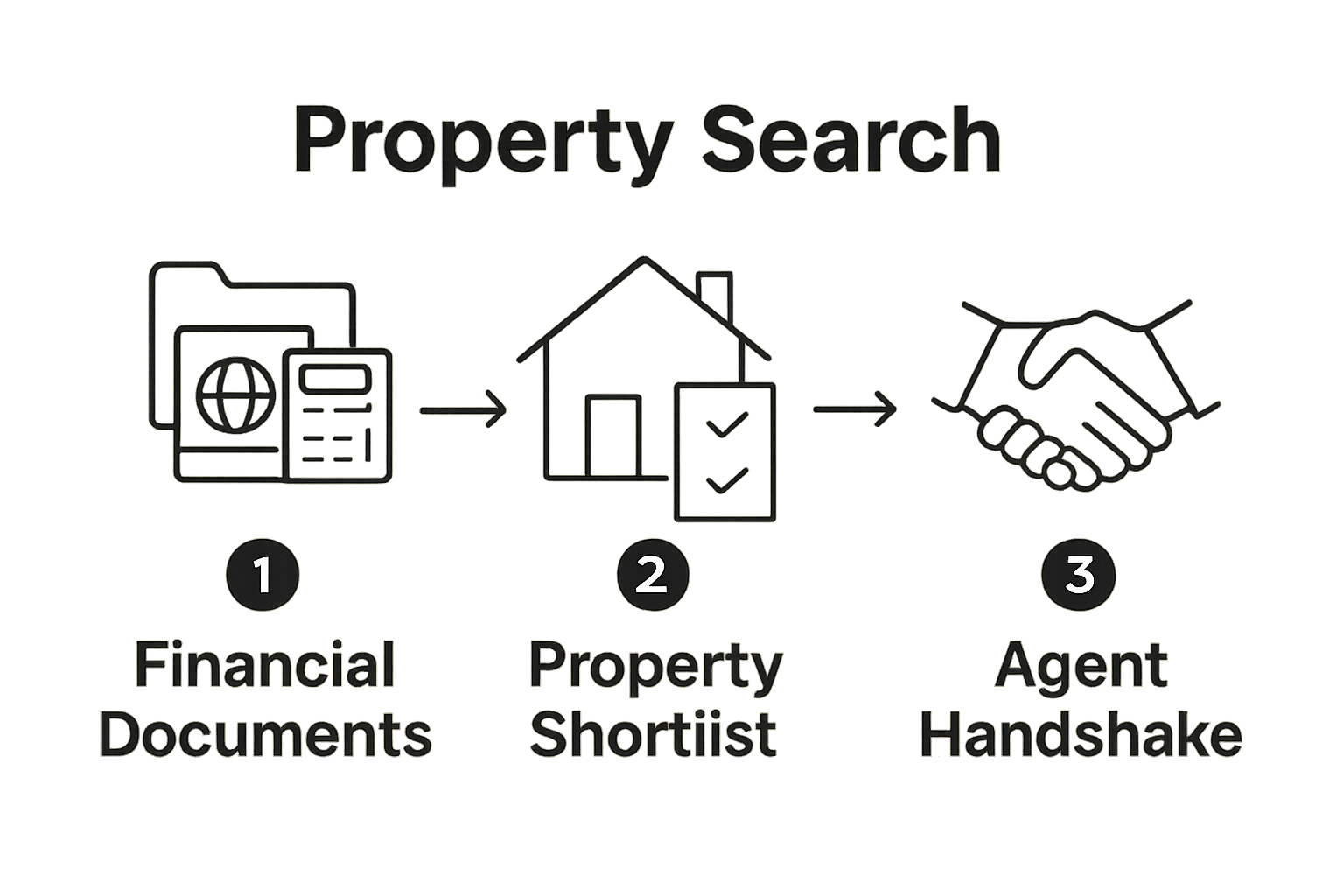 This foundational step sets the stage for discovering your ideal Mallorcan property with financial clarity and strategic precision.
Step 2: Research and Shortlist Properties
After establishing your financial foundation, the next critical phase in your Mallorca property journey involves strategic research and targeted property exploration. This step transforms your abstract investment goals into tangible real estate opportunities by methodically navigating Mallorca’s diverse and nuanced property landscape.
Mallorca presents a complex real estate ecosystem with distinct microcosms ranging from historic Palma neighborhoods to tranquil mountain villages and exclusive coastal regions. Successful property selection demands a multifaceted research approach that goes beyond surface-level browsing. Begin by comprehensively mapping your priorities across lifestyle, investment potential, and personal preferences.
Comprehensive Property Market Investigation
Effective research requires leveraging multiple information channels to build a robust understanding of Mallorca’s property market. Digital platforms like specialized real estate websites, local agency listings, and international property databases provide initial insights. Key research focus areas should include:
- Property price trends in specific regions
- Local infrastructure and development plans
- Rental yield potential
- Neighborhood amenities and accessibility
- Property age and renovation requirements
According to Global Property Guide, international buyers must consider regional variations that significantly impact property value. For instance, properties in Palma’s historic center differ dramatically from modern villas in Southwest Mallorca in terms of investment profile and potential appreciation.
Your shortlisting process should incorporate rigorous filtering mechanisms. Create a detailed spreadsheet tracking potential properties against your predefined criteria. Include columns for location, price, square meters, condition, proximity to amenities, and potential renovation costs. This systematic approach transforms overwhelming market data into actionable intelligence, enabling you to identify properties that precisely match your financial and lifestyle objectives. Successful shortlisting is not about finding perfect properties, but about identifying strategic real estate investments aligned with your specific goals.
Step 3: Engage a Local Real Estate Agent
Transitioning from independent research to professional guidance marks a pivotal moment in your Mallorca property acquisition journey. A local real estate agent serves as your strategic partner, transforming complex market insights into personalized property recommendations that align precisely with your investment objectives.
Selecting the right real estate agent represents more than a transactional decision – it’s about finding a trusted local expert who understands the nuanced Mallorcan property landscape. Your ideal agent should possess deep regional knowledge, multilingual capabilities, and a proven track record of supporting international buyers through successful property transactions.
The agent selection process requires careful vetting and strategic evaluation. Begin by identifying agents specializing in your target property segments and regions within Mallorca. Look for professionals with demonstrated experience working with international buyers, particularly those familiar with American investment patterns and expectations. Critical qualifications to prioritize include:
- Fluency in English and Spanish
- Comprehensive understanding of local property regulations
- Proven network of legal and financial professionals
- Track record of transactions in your desired property category
- Transparent communication and responsive communication style
According to Spanish Property Insight, international buyers benefit significantly from agents who provide end-to-end support navigating Spain’s complex real estate ecosystem. Your selected agent should offer more than property listings – they must act as a holistic advisor guiding you through legal intricacies, negotiation strategies, and cultural nuances specific to Mallorcan property transactions.
Successful agent engagement involves establishing clear communication protocols and mutually understood expectations. Schedule initial consultations with multiple agents, preparing a comprehensive brief outlining your investment goals, budget parameters, and preferred property characteristics. A truly exceptional agent will not just show properties, but will proactively curate opportunities that match your precise investment strategy, transforming your Mallorca property search from a challenging process into a strategic, informed journey.
Step 4: Conduct Property Visits and Inspections
Property visits represent the critical moment where theoretical research transforms into tangible real estate potential. This step moves beyond digital listings and spreadsheet analysis, allowing you to personally evaluate Mallorca properties through sensory and strategic assessment. Your objective extends far beyond aesthetic appreciation – you are conducting a comprehensive evaluation of potential investment performance and lifestyle compatibility.
Effective property visits require a structured approach that balances emotional connection with analytical scrutiny. Unlike casual tourism, these inspections demand methodical examination of each property’s structural integrity, location advantages, and long-term investment potential. Prepare for multiple visits, understanding that initial impressions often require deeper investigation and comparative analysis.
Approach each property visit with a systematic checklist that encompasses both quantitative and qualitative evaluation criteria. Critical inspection elements should include:
- Structural condition and potential renovation requirements
- Neighborhood infrastructure and future development potential
- Natural light exposure and architectural orientation
- Proximity to essential services and amenities
- Acoustic environment and potential noise disturbances
- Potential maintenance challenges specific to Mediterranean properties
According to Spanish Property Insight, international buyers must pay special attention to unique Mallorcan property characteristics. Factors like traditional stone construction, water access rights, and historical preservation regulations can significantly impact property value and future usability.
A comprehensive property visit strategy involves more than physical inspection. Engage local professionals who can provide nuanced insights into each property’s historical context, potential legal restrictions, and investment trajectory. Photograph and document every aspect of potential properties, creating a comprehensive reference archive that allows for objective comparison after emotional first impressions fade. Successful property visits transform abstract real estate listings into tangible investment opportunities, bridging the gap between market research and personal discovery.
Step 5: Make an Offer and Negotiate Terms
Navigating the offer and negotiation phase represents a delicate balance of strategic positioning and cultural understanding in the Mallorca real estate market. This critical stage transforms your property search from exploration to potential ownership, requiring nuanced communication and calculated financial strategy.
Successful negotiation in Mallorca demands more than aggressive pricing tactics – it requires a sophisticated approach that respects local market dynamics and seller expectations. Your previously established relationship with a local real estate agent becomes invaluable during this phase, providing cultural insights and strategic guidance that bridge potential communication gaps between international buyers and local sellers.
Prepare a comprehensive negotiation strategy that goes beyond simple price discussions. Mallorca’s property market values comprehensive proposals that demonstrate buyer commitment and understanding. Key negotiation elements to consider include:
- Flexibility on closing timelines
- Potential inclusion of furnishings or property improvements
- Understanding seasonal market variations
- Demonstrating financial readiness through pre-approved financing
- Willingness to accommodate seller’s specific requirements
According to Global Property Guide, international buyers must approach negotiations with a balanced perspective that combines financial prudence with cultural sensitivity. Initial offers typically range between 5-10% below asking price, but this can vary significantly depending on property condition, location, and market circumstances.
Your negotiation should culminate in a formal propuesta de compraventa (purchase proposal), a legally binding document outlining specific transaction terms.
 This document serves as a critical protection mechanism for both buyer and seller, establishing clear expectations and preventing potential misunderstandings. Professional guidance from your real estate agent and legal representative ensures that this document comprehensively captures the nuanced details of your potential property acquisition.
Step 6: Finalize Legal and Financial Documentation
The legal and financial documentation phase represents the most complex and critical transformation of your property acquisition journey. This intricate process demands meticulous attention to detail, precise documentation, and comprehensive understanding of Spanish real estate regulations that differ significantly from typical American property transactions.
Successful documentation finalization requires assembling a specialized team of professionals who understand both international and local legal frameworks. Your core team should include a Spanish-speaking lawyer specializing in real estate transactions, a certified tax advisor familiar with cross-border property investments, and a notary who will officially validate the entire transaction.
Key documentation preparation involves gathering an extensive portfolio of official documents that demonstrate your financial capability and legal eligibility to purchase property in Spain. Essential documentation requirements encompass:
- Valid passport with appropriate visa status
- Proof of international banking history
- Tax identification documents (NIE number)
- Comprehensive property survey reports
- Verified proof of funds or mortgage pre-approval
- Criminal background check
- Translated and officially authenticated personal identification documents
According to Official UK Government Guidance, international buyers must work with a Spanish notary who plays a crucial role in verifying document authenticity and ensuring legal compliance. The notary serves as an impartial government representative who validates the entire transaction, protecting both buyer and seller’s interests.
The final documentation phase culminates in the escritura de compraventa (property deed signing), a momentous legal event where ownership officially transfers. This process requires physical presence, comprehensive document verification, and payment of associated transfer taxes. Your meticulously prepared documentation portfolio becomes the foundation of your legal property ownership in Mallorca, transforming months of strategic planning into tangible real estate investment.
Use this checklist to verify all financial documents and legal requirements necessary for purchasing property in Mallorca as an international buyer.
| Requirement | Description | Importance |
|---|---|---|
| Valid Passport | Official photo identification for all parties | Essential |
| Proof of Funds | Bank statements, investment summaries | Required |
| Income Verification | Pay stubs, tax returns, or proof of stable income | Required |
| NIE Number | Spanish tax identification for foreigners | Mandatory |
| Credit Report | Documentation for lender evaluation | Important |
| Mortgage Pre-Approval | Bank confirmation if financing is needed | Recommended |
| Criminal Background Check | Depending on legal requirements | Sometimes needed |
Unlock a Seamless Mallorca Buying Experience With ULI & LISA
Navigating each step toward luxury property ownership in Mallorca can feel overwhelming. In the article, you saw the unique challenges international buyers face. From assessing financial readiness, sorting through endless listings, and shortlisting properties to negotiating unfamiliar legal and cultural details, every phase holds its own risks. The market is fast-moving and demands reliable insights. Without trustworthy guidance and unbiased data, it is easy to overlook hidden costs or miss out on the best opportunities.
Let ULI & LISA transform that uncertainty into clarity. As independent local experts with deep experience supporting international buyers, we offer personalized service at every stage. Our AI-powered search tools give you full control over Mallorca’s real estate landscape so you never miss a property that matches your investment goals. Connect with us through our main site and discover how our transparent, tailored approach will help you secure your dream home or investment in Mallorca—without the stress. Start your confident journey today and let us handle the details. Explore your buying advantage now.
Frequently Asked Questions
What are the initial costs involved in buying property?
Buying property involves total acquisition costs, which include property transfer tax (6-11%), notary and registration fees (1-2%), legal representation costs, renovation expenses, and potential currency exchange fees.
How much of a down payment is typically required for property financing?
Most lenders in Spain require a minimum down payment of 30-40% of the property’s purchase price for financing options.
What financial documents do I need to prepare for buying property?
You should prepare recent bank statements, investment account summaries, income verification, and credit history reports to demonstrate your purchasing capability to sellers and lenders.
How can I effectively research properties in Mallorca?
Effective research can be conducted using online real estate platforms, local agency listings, and databases while focusing on property price trends, rental yield potential, neighborhood amenities, and local infrastructure.