
Every serious American investor knows that securing a luxury property abroad means more than picking the perfect Mallorca villa. The path from initial offer to legal ownership involves a multi-step process built around strict Spanish regulations, unfamiliar paperwork, and substantial financial commitments. This guide highlights the critical stages, key documents, and unique requirements that define the Mallorca property closing process, giving buyers confidence to protect their assets while navigating every legal and tax consideration across borders.
Key Takeaways
| Point | Details |
|---|---|
| Understanding the Closing Process | The property closing in Mallorca involves steps such as a reservation contract, due diligence, and final deed signing, all adhering to Spanish regulations. |
| Legal Requirements for U.S. Buyers | American buyers need to obtain a Foreign Identification Number (NIE) and engage legal representation familiar with international real estate transactions. |
| Comprehensive Document Verification | It is crucial to compile and verify key documents like title documents and proof of funds to ensure a legally compliant transaction. |
| Importance of Professional Guidance | Engaging a local bilingual attorney early in the process can help navigate the complexities and mitigate risks associated with buying property in Mallorca. |
Mallorca property closing process defined
The property closing process in Mallorca represents a structured legal transaction that transforms real estate ownership from seller to buyer through a series of carefully orchestrated steps. Understanding the property transfer process requires navigating complex Spanish legal requirements and administrative protocols.
Typically, the Mallorca property closing involves several critical stages that American buyers must comprehend:
- Reservation contract: Initial agreement securing the property
- Deposit payment: Demonstrating buyer’s financial commitment
- Due diligence: Comprehensive legal and property documentation review
- Final deed signing: Official transfer of property ownership at notary
- Tax payment: Settling required local and national transaction taxes
- Property registration: Formal recording of new ownership
Each stage demands meticulous attention to detail and strict adherence to Spanish real estate regulations. American investors must understand that the process differs significantly from United States property transactions, with more formalized legal steps and documentation requirements.
Here’s a comparison of property closing steps in Mallorca versus the United States:
| Step | Mallorca Process | United States Process |
|---|---|---|
| Reservation Contract | Common and required for buyers | Rare, often not required |
| Notary Involvement | Mandatory for deed transfer | Optional, title company leads |
| Tax Identification | Foreigners must obtain NIE | Social Security Number used |
| Due Diligence Scope | Extensive focus on legal docs | Title search/lien check |
| Deposit Structure | Paid directly after reservation | Often at closing only |
| Formal Registration | Compulsory via land registry | Standard county recording |
The notary plays a central role in the Mallorca property closing, serving as an impartial official who validates the transaction’s legal integrity. They ensure all documents are correctly prepared, taxes are calculated accurately, and both buyer and seller understand their contractual obligations.
Pro tip: Always engage a local Spanish legal professional who specializes in international real estate transactions to guide you through Mallorca’s complex property closing process and protect your investment interests.
Essential legal steps for US buyers
US buyers pursuing property in Mallorca must navigate a complex legal landscape that requires careful preparation and expert guidance. Obtaining specific legal documentation for foreign ownership represents the critical first stage of the real estate acquisition process.
Key legal requirements for American investors include:
- Foreign Identification Number (NIE): Mandatory tax identification for non-Spanish residents
- Spanish bank account: Required for processing property transactions
- Legal representation: Specialized real estate attorney familiar with international transactions
- Title verification: Comprehensive due diligence on property ownership status
- Defense ministry clearance: Mandatory approval for purchases in restricted zones
The NIE number serves as a fundamental legal prerequisite, functioning as the official tax identification mechanism that enables foreign nationals to engage in financial and property transactions within Spain. Without this document, American buyers cannot legally complete a property purchase or open a Spanish bank account.

Property transactions demand meticulous legal scrutiny, particularly for international investors unfamiliar with Spanish real estate regulations. Hiring a bilingual legal expert who understands both American and Spanish property laws can help mitigate potential risks and ensure seamless transaction completion.
Pro tip: Consult with a specialized Spanish real estate attorney at least three months before your intended purchase to streamline the complex legal documentation process and avoid potential transaction delays.
Required documents and due diligence
American buyers must meticulously compile and verify a comprehensive set of documents when purchasing property in Mallorca. Property buying documentation requires careful preparation to ensure a smooth and legally compliant transaction.
Critical documents for foreign property acquisition include:
- Passport: Valid international travel document
- NIE Number: Spanish tax identification number
- Proof of funds: Bank statements demonstrating financial capacity
- Property title documents: Complete ownership history and current status
- Certificate of urban status: Confirming property’s legal classification
- Energy performance certificate: Required for all property transactions
Due diligence represents a multifaceted process that extends far beyond document collection. American investors must conduct thorough investigations to uncover potential legal complications, including:
- Verifying property title for existing liens or encumbrances
- Checking zoning and planning regulation compliance
- Reviewing potential community fees or shared property obligations
- Confirming no outstanding tax or utility debts
- Validating building permits and construction legality
The title insurance provides an additional layer of protection, mitigating risks associated with potential ownership disputes or undisclosed property claims. Professional legal assistance becomes crucial in navigating these complex verification processes, ensuring that American investors understand every nuanced aspect of their Mallorca real estate investment.
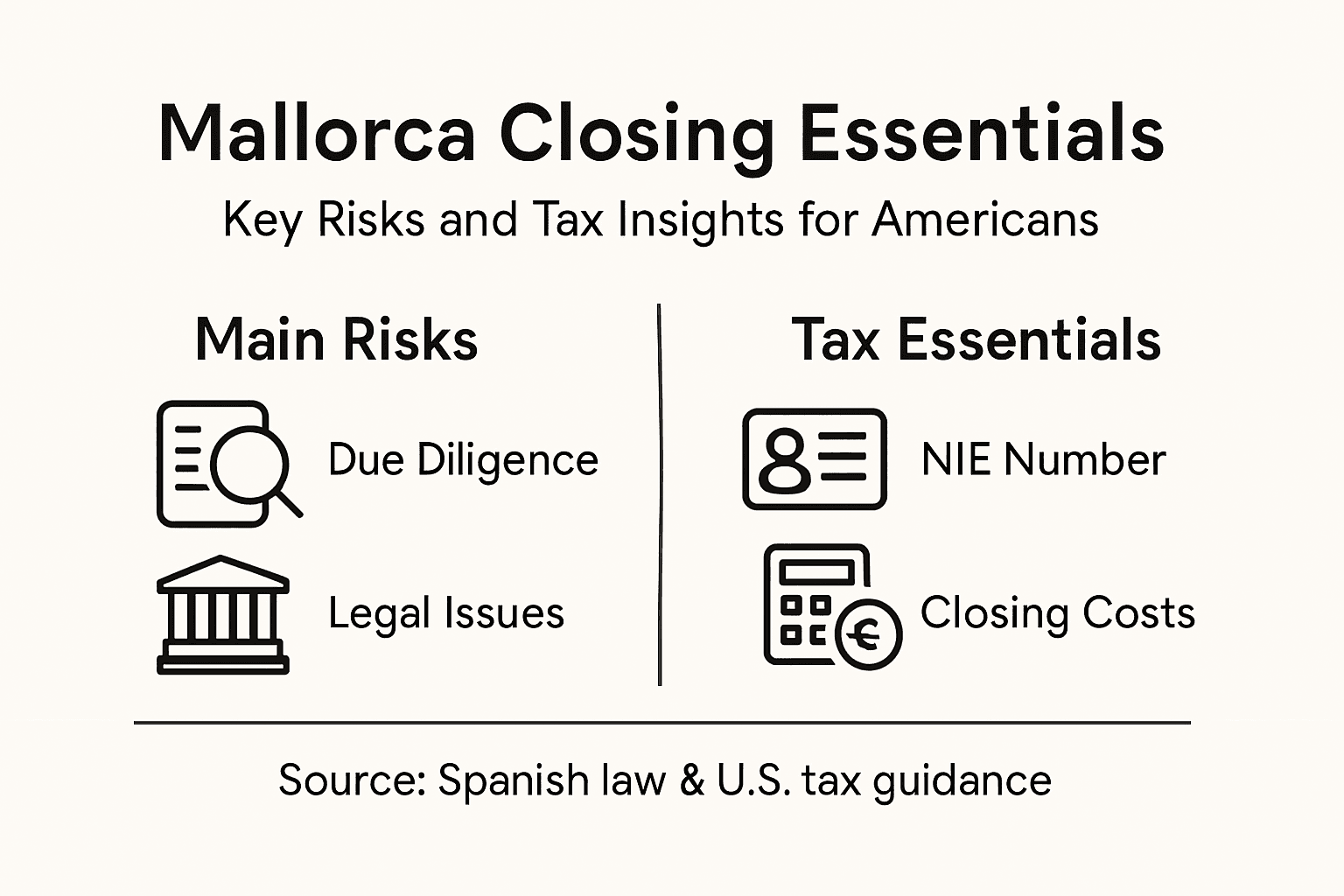
Pro tip: Engage a local Spanish real estate attorney to conduct a comprehensive title search and document verification at least two months before finalizing your property purchase.
Typical closing costs and tax implications
American buyers investing in Mallorca real estate must anticipate significant financial considerations beyond the property’s purchase price. Closing costs in Mallorca represent a substantial investment that typically range between 10% to 13% of the total property value.
Key closing cost components include:
- Transfer tax: 8%-11% for resale properties
- VAT: Applicable on new construction builds
- Notary fees: Legal documentation processing
- Land registry fees: Official property registration
- Legal representation fees: Professional guidance through transaction
Tax implications for foreign property owners involve multiple ongoing financial obligations:
- Annual property tax (IBI): Local municipal assessment
- Non-resident income tax: Required filing even without rental income
- Capital gains tax: Applicable upon property sale
- Rental income tax: Specific requirements for property generating revenue
- Wealth tax: Additional annual tax for high-value property owners
Non-resident American investors must particularly focus on precise tax reporting, as Spanish authorities maintain stringent documentation requirements. Failure to comply can result in significant penalties and potential legal complications. Professional tax advisement becomes crucial in navigating these complex regulatory landscapes.
Below is a reference table summarizing major ongoing tax obligations for American owners in Mallorca:
| Tax Type | Applies When | Approximate Amount/Rate |
|---|---|---|
| Annual Property Tax (IBI) | Each year, all properties | 0.4%-1.1% of cadastral value |
| Non-Resident Income Tax | Even without rental income | 19%-24% on imputed income |
| Rental Income Tax | Property is rented out | 19% on net rental profit |
| Wealth Tax | Value exceeds threshold | Progressive, from 0.2% |
| Capital Gains Tax | When property is sold | 19%-23% on gain |
Pro tip: Budget an additional 12-15% above the property’s purchase price to cover all closing costs and initial tax obligations.
Key risks and common pitfalls to avoid
American investors must be acutely aware of the complex risks inherent in Mallorca property transactions. Property buying risks require comprehensive understanding to protect your substantial investment and avoid potential legal complications.
Critical risks for US buyers include:
- Title verification challenges: Incomplete or disputed property ownership records
- Community association complications: Hidden debts or regulatory restrictions
- Inheritance law complexities: Spanish legal framework differs significantly from US standards
- Tourist rental regulation issues: Strict local permissions affecting investment potential
- Cross-border tax planning: Intricate reporting requirements and potential double taxation
Foreign buyers frequently encounter several specific pitfalls that can derail their real estate investment:
- Inadequate legal representation: Relying on non-specialized advisors
- Incomplete due diligence: Overlooking critical documentation and property history
- Misunderstanding local regulations: Failing to comprehend Spanish property laws
- Underestimating financial obligations: Hidden costs and tax implications
- Emotional decision-making: Purchasing without comprehensive market analysis
Navigating these risks demands meticulous preparation and expert guidance. American investors must recognize that Mallorca’s real estate market operates under a distinct legal and regulatory framework that significantly differs from United States property transactions. Professional local expertise becomes not just recommended, but essential.
Pro tip: Allocate a minimum of three months for comprehensive due diligence and engage bilingual legal specialists who understand both American and Spanish property regulations.
Navigate Mallorca Property Closings with Confidence and Expert Support
Buying property in Mallorca as an American investor comes with unique challenges such as understanding the detailed closing process, managing tax implications, and avoiding common pitfalls like incomplete due diligence or legal complexities. With terms like NIE, notary involvement, and transfer taxes playing crucial roles, it is easy to feel overwhelmed by the strict Spanish regulations and ongoing financial obligations.
At ULI & LISA, we specialize in guiding American buyers through these complexities by providing personalized, trustworthy advice combined with advanced AI-powered property searches. Our team helps you avoid risks by ensuring thorough title verification, legal review, and clear tax guidance.
Discover how you can protect your investment and enjoy a seamless buying experience. Ready to take the stress out of your Mallorca property purchase? Visit our site now to learn more and get started here. Embrace expert support today and make your dream home or investment in Mallorca a reality.
Frequently Asked Questions
What are the essential steps in the Mallorca property closing process for American buyers?
The essential steps include signing a reservation contract, making a deposit payment, conducting due diligence, signing the final deed at the notary, paying taxes, and registering the property.
What legal documents do Americans need to buy property in Mallorca?
Americans need a valid passport, a Foreign Identification Number (NIE), proof of funds, property title documents, a certificate of urban status, and an energy performance certificate.
What are common pitfalls American buyers should avoid when purchasing property in Mallorca?
Common pitfalls include inadequate legal representation, incomplete due diligence, misunderstanding local regulations, underestimating financial obligations, and making emotional purchasing decisions without market analysis.
How much should American buyers expect to pay in closing costs and taxes when buying a property in Mallorca?
American buyers should expect closing costs to range between 10% to 13% of the property’s value, plus ongoing taxes like annual property tax, non-resident income tax, and capital gains tax that can significantly impact their investment.
Recommended
- Buying Property in Mallorca: Key Steps for Americans - ULI & LISA Mallorca Property Blog
- Mallorca Real Estate Closing Process: A Step-by-Step Guide - ULI & LISA Mallorca Property Blog
- Mallorca Real Estate Closing Process: A Step-by-Step Guide - ULI & LISA Mallorca Property Blog
- Buying Vacation Homes in Mallorca: Smart Steps for American Investors - ULI & LISA Mallorca Property Blog
- Estate Agents San Pedro - Luxury Villas and Apartments for Sale | Marbellapads