
American and international buyers often assume securing a mortgage for luxury properties in Mallorca mirrors the US home loan process. The reality involves navigating distinct Spanish and EU regulations, stricter eligibility criteria, and cross-border financing complexities that can surprise unprepared buyers. This guide clarifies loan mechanisms, legal compliance essentials, and actionable strategies for confident mortgage decision-making in Mallorca’s high-end real estate market.
Key takeaways
| Point | Details |
|---|---|
| International buyers face stricter eligibility | Non-residents typically receive 60-70% loan-to-value limits compared to higher ratios for Spanish residents. |
| Legal compliance is mandatory | Obtaining an NIE number, translating documents, and completing notarization are required before mortgage approval. |
| Cross-border financing adds complexity | Expect additional fees, longer approval timelines of 4-8 weeks, and currency exchange risks. |
| Mortgage products vary by lender | Spanish banks offer competitive rates but strict requirements, while international lenders may integrate US credit history. |
| Fee transparency prevents surprises | Arrangement, valuation, notary, and registry fees combined can reach 2-3% of the mortgage amount for non-residents. |
Introduction to Mallorca mortgage landscape
The Mallorca mortgage market operates under Spanish banking regulations that differ significantly from US lending practices. American and affluent international buyers pursuing luxury properties must understand these distinctions to avoid delays and unexpected obstacles during the financing process.
Spanish banks prioritize documentation that proves income stability, legal residency status, and creditworthiness through EU-recognized channels. Non-resident buyers face stricter scrutiny because lenders view cross-border loans as higher risk compared to domestic mortgages. This caution translates to lower loan-to-value ratios and more rigorous underwriting standards.
Luxury property financing in Mallorca involves additional layers of complexity beyond standard residential mortgages. High-value properties often require specialized valuation methods, larger down payments, and relationships with lenders experienced in international transactions. Understanding these market dynamics helps buyers set realistic expectations and prepare appropriate financial documentation.
Mallorca’s lending culture emphasizes relationship banking and thorough due diligence. Banks want to understand not just your financial capacity but also your intentions for the property. Working with agents experienced in American buyer needs can bridge cultural and procedural gaps that might otherwise slow your application.
Key considerations for international luxury buyers include:
- Spanish banks typically offer better interest rates but demand complete regulatory compliance
- International lenders may provide more flexible documentation requirements but charge premium rates
- Luxury property valuations require certified appraisers familiar with high-end Mallorca real estate
- Lender relationships matter more in Spain than in transactional US mortgage markets
Understanding Mallorca’s mortgage financing landscape
Loan-to-value ratios for international buyers in Mallorca typically cap at 60-70% of the property’s appraised value. Spanish residents can access ratios up to 80% or occasionally higher, creating a significant disparity that requires larger down payments from non-resident buyers. This conservative approach reflects lender risk management when dealing with cross-border transactions.
Lenders in Mallorca fall into two primary categories: Spanish banks and international financial institutions. Spanish banks like Banco Sabadell, CaixaBank, and Banco Santander dominate the market with competitive rates but strict documentation requirements. International lenders including HSBC and Deutsche Bank offer alternative pathways that may integrate US credit history more seamlessly.
Pro Tip: Request pre-qualification from multiple lenders before committing to a property. Rate differences of 0.5-1% can translate to tens of thousands in savings over a 20-year mortgage term.
Underwriting criteria focus on three core elements: verifiable income, creditworthiness, and legal status. Lenders require proof of stable income through tax returns, employment contracts, or business financial statements spanning at least two years. US credit reports must be supplemented with Spanish or EU-recognized credit assessments to meet local standards.
| Buyer Type | Typical LTV | Down Payment Required | Documentation Complexity |
|---|---|---|---|
| Spanish Resident | 70-80% | 20-30% | Moderate |
| EU Non-Resident | 65-75% | 25-35% | High |
| US/International | 60-70% | 30-40% | Very High |
Income verification for self-employed buyers or those with complex financial portfolios demands additional scrutiny. Banks want to see consistent earnings patterns and minimal debt-to-income ratios, typically below 35%. Investment income, rental yields, or portfolio dividends can supplement employment income but require extensive documentation.
Legal status verification includes confirming your NIE number validity and ensuring no outstanding tax obligations in Spain. Some lenders also review your home country’s tax compliance to assess overall financial responsibility. Securing the right mortgage structure requires matching your documentation capabilities with lender requirements.
Key underwriting factors include:
- Debt-to-income ratios below 35% improve approval odds significantly
- Consistent income history spanning 24-36 months demonstrates stability
- Existing Spanish bank relationships can expedite underwriting processes
- Property location and condition affect loan terms and approval likelihood
Legal and documentation requirements for US buyers
The NIE number serves as your tax identification in Spain and is mandatory for all property transactions and mortgage applications. Without this number, you cannot legally purchase real estate or open a Spanish bank account. Obtaining an NIE typically takes 4-6 weeks through Spanish consulates in the US or expedited services in Mallorca.
Document translation and apostille certification represent critical compliance steps that many buyers underestimate. All US documents including tax returns, bank statements, and employment verification must be translated by certified Spanish translators. The Hague Apostille authenticates these documents for Spanish legal recognition.
Pro Tip: Start the apostille process immediately after deciding to pursue a Mallorca property. State-level processing times vary, and delays here cascade through your entire mortgage timeline.
Notarization requirements in Spain differ fundamentally from US practices. Spanish notaries serve as impartial legal officers who verify transaction legality, not just witness signatures. Your mortgage deed must be executed before a Spanish notary who reviews all terms, confirms your understanding, and registers the agreement with the Property Registry.
Property Registry registration finalizes your mortgage’s legal standing. This government office maintains official records of property ownership and encumbrances. Registration fees vary based on property value but typically range from 0.5-1% of the mortgage amount. Following the complete buying checklist ensures you complete each legal requirement in the correct sequence.
Essential documents for American buyers include:
- Valid passport and NIE number for identity verification
- Last two years of US tax returns with apostille certification
- Bank statements covering 6-12 months showing deposit capacity
- Employment verification letter or business ownership documentation
- US credit report supplemented with international credit assessment
- Proof of address in the US and intended Spanish address
Mortgage products and interest rates for international buyers
Interest rates for international luxury buyers in Mallorca typically range from 2.5% to 3.5% in 2026, depending on lender type, loan term, and borrower qualifications. Spanish banks generally offer the lower end of this spectrum for well-qualified buyers who meet strict documentation standards. International lenders charge premium rates but provide more flexible underwriting.
Fixed-rate mortgages lock your interest rate for the entire loan term, providing payment predictability that appeals to international buyers managing currency exchange risks. Terms typically span 15-25 years for non-residents, shorter than the 30-year standard in the US. Variable-rate products tie to the Euribor benchmark plus a margin, offering lower initial rates but exposure to future increases.
Spanish banks reward relationship banking with preferential rates. Opening accounts, transferring deposits, or purchasing insurance products can reduce your mortgage rate by 0.25-0.5%. These incentives make Spanish banks attractive despite their rigorous compliance requirements. However, the total cost of bundled products sometimes exceeds the interest savings.
International banks leverage your existing credit history and banking relationships to streamline approvals. HSBC and Citibank offer mortgage products specifically designed for cross-border buyers that integrate US credit assessments. These products carry higher rates but reduce documentation burdens and approval timelines.
| Lender Type | Interest Rate Range | Typical Term | Key Advantage | Main Drawback |
|---|---|---|---|---|
| Spanish Banks | 2.5-3.0% | 15-25 years | Lowest rates | Strict documentation |
| International Banks | 3.0-3.5% | 15-20 years | US credit integration | Higher rates |
| Private Lenders | 3.5-4.5% | 10-15 years | Flexible terms | Highest costs |
Mortgage product features vary significantly between lenders. Some allow penalty-free early repayment after five years, while others charge 1-2% fees for prepayment. Offset mortgage products let you link savings accounts to reduce interest charges, though these are less common in Spain than the UK.
Financing strategies for Mallorca properties should align with your long-term plans. Investment properties generating rental income may benefit from interest-only periods, while primary residences typically use standard amortization schedules. Understanding product nuances prevents mismatched financing choices.
Cross-border mortgage financing: options and challenges
Cross-border mortgage financing introduces complexity layers that domestic Spanish buyers never encounter. Higher fees and stricter underwriting reflect lender caution about currency risk and regulatory coordination across jurisdictions. Fee premiums of 1-2% above standard rates are common for international luxury property loans.
Currency exchange risk represents a significant consideration for US buyers earning dollars while servicing euro-denominated mortgages. Exchange rate fluctuations can increase your effective payment amounts by 10-15% during volatile periods. Forward contracts lock in exchange rates for future payments, while multi-currency accounts let you hold euros and time conversions strategically.
Approval timelines extend to 4-8 weeks for cross-border mortgages compared to 2-4 weeks for Spanish resident applications. This extension accommodates international document verification, currency compliance checks, and cross-border legal reviews. Planning your purchase timeline around these realities prevents frustration and missed opportunities.
“International buyers should factor currency hedging costs into their total financing expenses. A 2% forward contract premium over five years often costs less than a single adverse exchange rate swing.” Financial Advisor Specializing in Cross-Border Real Estate
Documentation challenges multiply when coordinating between US and Spanish legal systems. Apostille certifications, translation verifications, and cross-referenced credit assessments create numerous potential delay points. Working with experienced advisors familiar with vacation home purchases helps navigate these administrative hurdles efficiently.
Key cross-border financing considerations:
- Currency conversion fees add 0.5-1.5% to each mortgage payment without hedging strategies
- International wire transfer costs typically run €25-50 per transaction
- Time zone differences can slow communication and document exchange by days
- Regulatory reporting requirements in both countries demand careful compliance
- Professional currency management services reduce exchange rate risk exposure
Cost structure and fees associated with Mallorca mortgages
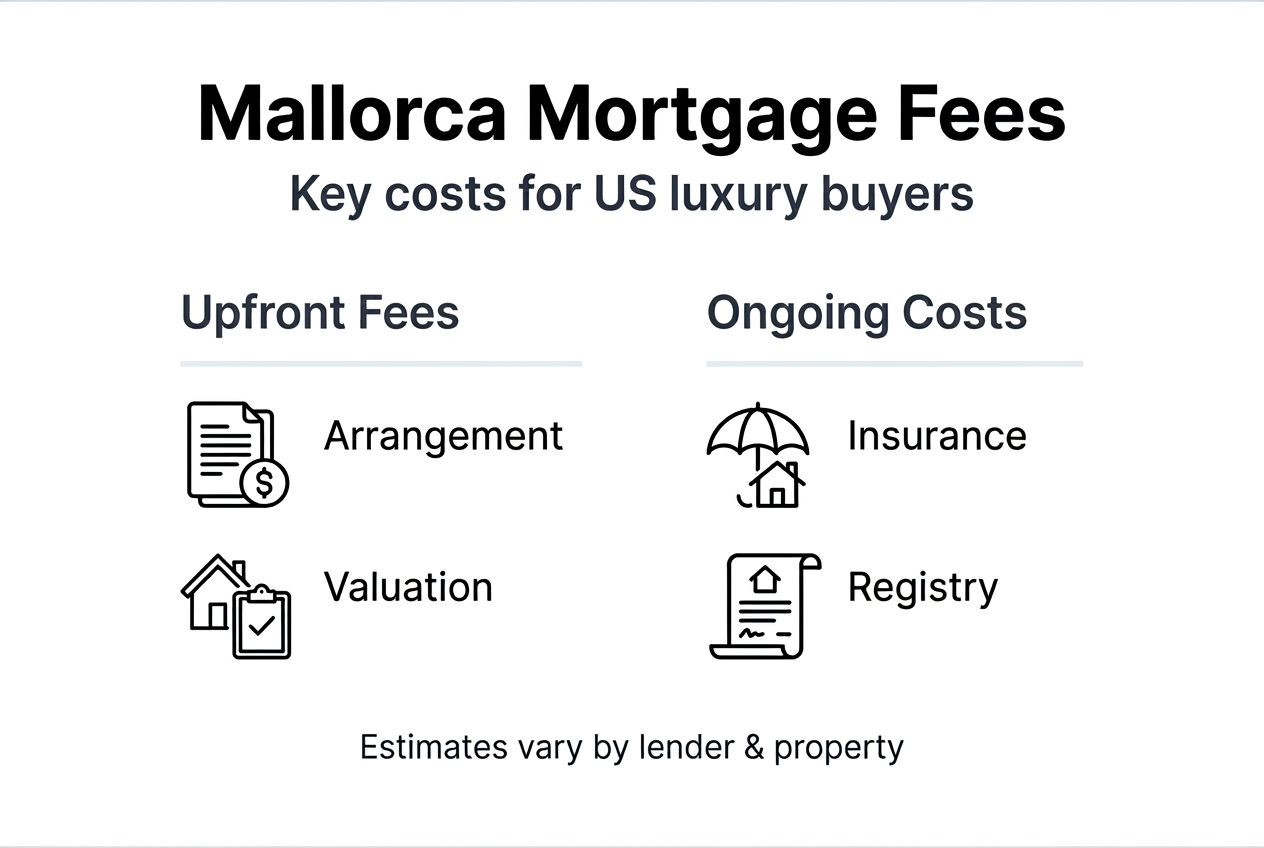
Arrangement fees charged by Spanish banks typically equal 1% of the mortgage amount, though some lenders waive this fee to attract high-value clients. International lenders may charge higher arrangement fees of 1.5-2% but offer faster processing or more flexible terms. These fees are usually due at closing and cannot be rolled into the mortgage principal.

Valuation fees range from €400 to €700 depending on property value and location. Luxury properties in prime areas like Port Andratx or Deià command premium valuation fees because fewer comparable sales complicate appraisal processes. Spanish law requires independent valuations by certified tasadores to protect lender interests.
Notary and registry fees combine to reach 1-1.5% of the mortgage amount for non-residents, higher than the 0.5-1% Spanish residents pay. Notary fees cover document review, legal verification, and deed execution. Property Registry fees ensure your mortgage is officially recorded and legally enforceable. Both scale with property value under government-regulated fee schedules.
Pro Tip: Request itemized fee estimates from multiple lenders before choosing. Hidden costs like insurance requirements, account maintenance fees, or mandatory product bundles can add thousands to your total expense.
Insurance requirements add ongoing costs beyond initial fees. Spanish lenders mandate property insurance covering fire, flood, and structural damage. Life insurance covering the mortgage balance is often required for borrowers over 50. Annual insurance premiums typically run 0.2-0.4% of property value, higher for coastal or rural locations.
Upfront cost transparency prevents closing day surprises that derail transactions. Request detailed breakdowns showing arrangement fees, valuation costs, notary charges, registry fees, insurance premiums, and any mandatory product purchases. Understanding the complete closing process including all associated costs lets you budget accurately.
Typical fee breakdown for a €1 million mortgage:
- Arrangement fee: €10,000 (1%)
- Valuation fee: €600
- Notary fees: €2,000-3,000
- Property Registry: €2,000-3,000
- Insurance (first year): €2,000-4,000
- Legal fees: €3,000-5,000
- Total upfront costs: €19,600-25,600
Common misconceptions about Mallorca mortgages
Many American buyers mistakenly assume their strong US credit history alone will secure favorable Mallorca mortgage terms. While US credit provides supporting evidence of financial responsibility, Spanish lenders require EU-recognized credit assessments and Spanish documentation. Your 800 FICO score helps but doesn’t replace Spanish compliance requirements.
The belief that mortgage terms match between residents and non-residents causes frequent disappointment. Non-resident buyers face systematically lower loan-to-value ratios, shorter maximum terms, higher interest rates, and more extensive documentation requirements. These differences reflect regulatory frameworks that classify cross-border loans as higher risk.
Some buyers underestimate mortgage application complexity and timeline requirements. The process involves coordinating multiple government agencies, legal professionals, and financial institutions across different countries and languages. Assuming a 2-3 week timeline like typical US mortgages leads to rushed decisions or missed purchase opportunities.
Pro Tip: Add 2-4 weeks buffer to any mortgage timeline estimate. Cross-border documentation verification, translation certification, and international background checks introduce unpredictable delays even with perfect preparation.
Another misconception involves assuming all Spanish banks offer identical products and rates. Significant variation exists between institutions in interest rates, fee structures, documentation flexibility, and willingness to work with international buyers. Shopping multiple lenders can save tens of thousands over your mortgage term.
Frequent misconceptions include:
- Believing vacation properties qualify for the same financing as primary residences
- Assuming you can close within 30 days like US transactions
- Thinking Spanish mortgages allow 30-year terms for non-residents
- Expecting to avoid opening Spanish bank accounts
- Believing English-language documentation suffices without certified translation
Step-by-step guidance for mortgage approval and application
Securing a mortgage for luxury Mallorca property requires systematic progression through legal, financial, and administrative requirements. Following this roadmap minimizes delays and ensures you meet all Spanish regulatory standards.
-
Obtain your NIE number immediately upon deciding to pursue Mallorca property. Apply through the nearest Spanish consulate in the US or use expedited services in Mallorca. This typically takes 4-6 weeks and is prerequisite for all subsequent steps. Without an NIE, you cannot open bank accounts or sign mortgage documents.
-
Compile and apostille all required financial documentation. Gather two years of tax returns, 6-12 months of bank statements, employment verification or business financial statements, and US credit reports. Submit these to your state’s apostille office for certification, a process taking 2-4 weeks depending on your state.
-
Research and compare lender options across Spanish banks and international institutions. Request pre-qualification from at least three lenders to understand rate ranges, fee structures, and documentation requirements. Spanish banks offer better rates but stricter compliance, while international lenders provide flexibility at premium costs. Review comprehensive financing strategies to identify optimal lender matches.
-
Submit your formal mortgage application with complete documentation packages. Include apostilled financial documents, translated and certified copies of all US paperwork, proof of NIE, and property details. Incomplete applications trigger request cycles that extend timelines by weeks. Double-check every requirement before submission.
-
Coordinate property valuation and legal reviews. The lender arranges independent valuation by certified Spanish appraisers, typically completing within 2-3 weeks. Simultaneously, your legal representative reviews the property title, confirms no encumbrances exist, and verifies seller documentation. These parallel processes determine final mortgage approval.
-
Complete notarization and Property Registry mortgage registration. Once approved, schedule your signing appointment with the Spanish notary who will execute your mortgage deed. The notary verifies all terms, confirms your comprehension, and submits registration documents to the Property Registry. Registration finalizes your legal mortgage standing within 2-3 weeks.
-
Plan for the complete 4-8 week timeline from application to funding. International verification, translation certification, and cross-border legal coordination introduce unavoidable delays. Build timeline buffers into your purchase negotiations to avoid pressure and hasty decisions. Following detailed mortgage securing procedures and comprehensive buying checklists ensures smooth progression through each phase.
Expert guidance to secure your Mallorca mortgage with confidence
Navigating Mallorca’s mortgage landscape requires understanding Spanish banking culture, regulatory frameworks, and cross-border financing complexities that differ fundamentally from US home loans. Professional guidance eliminates costly mistakes and streamlines the approval process for American and international luxury buyers.
ULI & LISA specialize in supporting international buyers through every mortgage and property purchase phase. Our comprehensive services include lender coordination, legal compliance assistance, documentation preparation, and timeline management tailored to American buyers’ specific needs. We leverage established relationships with Spanish banks and international lenders to secure competitive terms.
Our AI-powered property search tools combined with personalized mortgage guidance help you identify financing options aligned with your luxury property goals. From initial mortgage strategy development through final closing, we ensure you understand each requirement and meet every deadline. Complete buying checklists keep your transaction on track while our local expertise navigates cultural and procedural nuances that challenge international buyers.
FAQ
Can American credit history help secure a mortgage in Mallorca?
US credit history provides supporting evidence of financial responsibility but cannot replace Spanish documentation requirements. Spanish lenders require EU-recognized credit assessments and income verification through apostilled tax returns and bank statements. International banks like HSBC may offer mortgage products integrating US credit more directly, though these typically carry premium interest rates. Your strong American credit helps but expect to fulfill complete Spanish compliance standards regardless.
What documents must American buyers prepare for Mallorca mortgages?
American buyers need NIE numbers, two years of apostilled tax returns, 6-12 months of bank statements, employment verification or business financials, and US credit reports with Spanish translations. All documents require certified translation by Spanish-recognized translators and apostille certification for legal validity. Property purchase contracts must be notarized by Spanish notaries, and final mortgage registration requires Property Registry submission. Incomplete or improperly certified documentation triggers delays of weeks or months in the approval process.
How long does the mortgage approval process usually take for international buyers?
Mortgage approval for international buyers typically spans 4-8 weeks from complete application submission to final funding. This timeline accommodates international document verification, apostille certification review, translation validation, and cross-border legal coordination that domestic applications skip. Spanish bank processing alone takes 2-3 weeks, with additional time for notary scheduling and Property Registry recording. Building 2-4 week timeline buffers into purchase negotiations prevents pressure and allows proper due diligence.
Are there extra fees for non-resident buyers applying for Mallorca mortgages?
Non-resident buyers face systematically higher fees across arrangement costs, valuation charges, notary expenses, and Property Registry recording. Arrangement fees typically reach 1-1.5% compared to 0.5-1% for residents, while notary and registry fees combined can hit 1.5-2% versus 1% for Spanish citizens. Insurance requirements also cost more for non-residents due to perceived higher risk. Total upfront fees often reach 2.5-3.5% of mortgage amount, substantially more than domestic borrowers pay. Understanding complete fee structures upfront prevents closing day surprises.
Recommended
- Buying Property in Mallorca: Key Steps for Americans - ULI & LISA Mallorca Property Blog
- Buying Vacation Homes in Mallorca: Smart Steps for American Investors - ULI & LISA Mallorca Property Blog
- Mallorca Property Market – Key Insights for U.S. Buyers - ULI & LISA Mallorca Property Blog
- How to Finance Property in Mallorca: A Step-by-Step Guide - ULI & LISA Mallorca Property Blog
- How to Buy Property in Dubai: A Complete Guide for Investors