
TL;DR:
- Mallorca’s luxury real estate market attracts increasing American and corporate investors due to stability and high yields.
- Understanding Spanish regulations, tax structures, and community statutes is crucial for profitable investment.
- A systematic, well-informed workflow and local expert guidance are essential to avoid costly mistakes.
Mallorca is no longer just a vacation fantasy for American wealth. It has quietly become one of Europe’s most resilient luxury real estate markets, drawing high-net-worth buyers who want both lifestyle and strong financial returns. But buying a luxury investment property here is genuinely complex. Spanish regulations, tourism licensing, currency exposure, and community statutes can derail even experienced investors who skip the preparation phase. This guide walks you through exactly what you need to know before signing anything, how the workflow unfolds from search to closing, and the practical strategies that separate profitable acquisitions from costly mistakes.
Key Takeaways
| Point | Details |
|---|---|
| Prepare for regulations | Understand Mallorca’s zoning, licensing, and tax rules before making any offer. |
| Follow the workflow | Use a step-by-step process tailored for US buyers to secure luxury investment property successfully. |
| Optimize for profit | Maximize rental income and returns through proper ownership structure and market timing. |
| Get expert guidance | An experienced local advisor will help you avoid costly legal and tax mistakes. |
What to know before you invest in Mallorca
The first thing American buyers usually underestimate is how different the Mallorca property market is from anything they have experienced stateside. The legal framework, tax structure, and zoning rules are not just different in detail. They are different in kind.
The US buyer presence is growing fast. American investors currently account for roughly 5 to 8% of market share in Mallorca, with the strongest concentration in Palma, the Southwest coast, and the scenic Northeast. That share has risen steadily since 2022, driven by the strength of the dollar against the euro, remote work flexibility, and a growing appetite for hard assets in stable jurisdictions.
Currency dynamics matter more than most buyers expect. The USD/EUR exchange rate directly affects your purchasing power and your offer timing. A 5% swing in the exchange rate on a 3 million euro property is a 150,000 dollar difference. Smart buyers lock in favorable rates through currency specialists before making offers, not after.
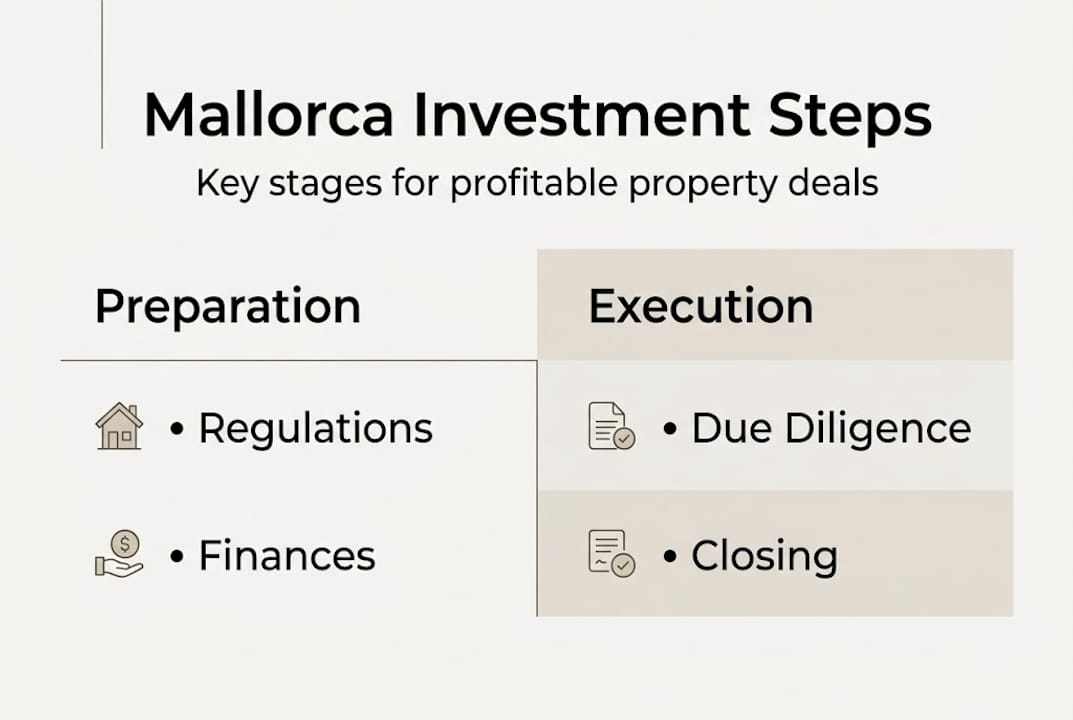
One of the most important pre-investment decisions is new build versus resale. These carry entirely different tax structures:
| Property type | Purchase tax | Notes |
|---|---|---|
| New build | 10% VAT + 1.5% AJD | Developer sale, first transfer |
| Resale | ITP (8 to 11%) | Scales with purchase price |
| Commercial property | 21% VAT + AJD | Different rate applies |
Beyond taxes, corporate buys, rustic land restrictions, and tourism zoning represent the most frequent pre-investment blind spots. Rustic land and historic buildings carry licensing challenges that can take months or years to resolve. Some rural fincas have illegally constructed additions, meaning the legal footprint of the property does not match what you see on the ground.
Before you even start viewing properties, get clear on these fundamentals:
- Tourism zoning status of any area you are targeting
- Whether the community of owners (comunidad de propietarios) permits short-term rentals
- NIE number (Spanish tax ID, required for all purchases)
- Whether corporate or joint ownership makes tax sense for your situation
- Your target yield versus personal use balance
Pro Tip: Review the Mallorca buying checklist for Americans before your first property viewing. It covers the documents, registrations, and legal checks that save you from expensive surprises later.
Corporate ownership structures, including Spanish SLs (limited liability companies) or holding companies in other EU jurisdictions, are increasingly popular for US investors managing multiple assets or high-value single acquisitions. They can reduce wealth tax exposure and simplify inheritance planning, but they also add setup and compliance costs. Run the numbers with a bilingual tax advisor who understands both Spanish and US tax obligations, including FBAR and FATCA reporting requirements for overseas assets.
Step-by-step investment property workflow
Building from legal and market preparation, the workflow requires systematic, step-by-step execution. Skipping any phase creates compounding problems that show up at the worst possible moment, usually right before closing.
Here is the precise sequence we recommend for US buyers targeting luxury investment properties in Mallorca:
- Define your investment thesis before searching. Are you targeting short-term rental yield, long-term appreciation, or a blend of both? Your answer eliminates whole categories of property and geography from the start.
- Assemble your team early. You need an independent buyer’s agent, a Spanish property lawyer who is independent from the seller, a currency specialist, and a bilingual tax advisor. Do not rely on the seller’s recommended professionals.
- Obtain your NIE number. This Spanish fiscal identifier is non-negotiable for any property transaction. Apply through the Spanish consulate in the US or in person in Mallorca. It typically takes two to four weeks.
- Begin your Mallorca property search with a clear brief. Use an agent with AI-powered tools who can scan the entire market, not just listings tied to their own agency.
- Conduct initial due diligence before making an offer. This includes checking the Land Registry (Registro de la Propiedad), verifying building licenses, and confirming the legal description matches the physical property.
- Make a reserva (reservation offer) backed by a deposit, typically 1 to 3% of the price. This takes the property off the market while full due diligence proceeds.
- Sign the contrato de arras (private purchase contract) with a 10% deposit. This legally binds both parties. If the buyer withdraws, the deposit is forfeited. If the seller withdraws, they return double.
- Final financing in Mallorca should be confirmed at this stage. Spanish mortgages are available to non-residents, but expect tighter LTV ratios (typically 60 to 70%) and more documentation than a US mortgage requires.
- Sign at the notario (public notary). The escritura (title deed) is signed here, funds are transferred, and keys are exchanged.
- Post-purchase registration and tax filings. The deed must be registered, transfer taxes paid within 30 days, and rental licenses applied for if applicable.
The full steps to buying Mallorca real estate typically take three to five months for a luxury transaction, though complex properties with licensing issues can take longer.
| Phase | Typical duration | Key risk |
|---|---|---|
| Search and preparation | 4 to 8 weeks | Incomplete due diligence |
| Offer to arras | 1 to 2 weeks | Missing licensing defects |
| Arras to closing | 6 to 10 weeks | Financing delays |
| Post-closing | 2 to 4 weeks | Late tax filings |
The rise of US and corporate buyers has increased competition at the top end of the market. Well-prepared buyers with financing in place and a clear brief move faster and negotiate from strength.
Pro Tip: Never skip the independent legal check on building licenses and urbanistic compliance. We have seen properties with stunning ocean views that had extensions built without proper permits, meaning the buyer inherited an illegal structure and all the associated liability.
Navigating Spanish regulations: Licenses, taxes, and community statutes
Once your workflow is defined, regulatory and tax hurdles become the central challenge. This is where many US buyers get blindsided, not from bad intentions, but from assuming Spanish property law works like American real estate law. It does not.
License types you need to understand:
- Licencia turística (tourist rental license): Required to legally rent your property short term. Mallorca has a fixed quota system, meaning licenses are not freely issued. Many areas have a moratorium on new licenses.
- Licencia de obras (construction license): Any renovation work requires this. Unpermitted works create legal liabilities that transfer to the buyer.
- Certificado de habitabilidad (habitation certificate): Confirms the property meets minimum living standards. Required for resale and rental.
- Licencias para edificios históricos (historic building licenses): Properties in heritage zones require additional permits from local authorities. Renovation timelines stretch significantly.
Key insight: Some comunidades de propietarios (homeowner communities) have voted to prohibit short-term tourist rentals entirely, regardless of what the regional government permits. This is a private statute and it is fully legal. Always obtain and review the community statutes before closing.
The Mallorca closing process guide covers what documents your lawyer needs to verify before you sign at the notario.
Tax layers for US investors buying in Mallorca:
The key tax differences, tourism zoning rules, and licensing nuances go well beyond the purchase transaction. Once you own the property, expect:
- Impuesto sobre Bienes Inmuebles (IBI): Annual local property tax, similar to US property taxes
- Impuesto sobre el Patrimonio (wealth tax): Spain taxes non-resident wealth above 700,000 euros. US investors with high-value portfolios often use corporate structures to manage this exposure.
- Rental income tax: Non-residents pay 19% (EU rate) or 24% on gross rental income if not EU-based. Tax treaty provisions between the US and Spain apply, so confirm your exact position with a cross-border tax advisor.
- Capital gains tax: Payable on any profit from the sale. Rates range from 19 to 28% depending on the gain amount.
Practical strategies for verifying zoning and compliance before closing include requesting the nota simple from the Land Registry, obtaining an urbanistic certificate from the local town hall (ayuntamiento), and hiring an independent architect to assess any structural or licensing concerns. Refer to our Mallorca investment property guide for a detailed breakdown of each document and who is responsible for obtaining it.
Profit maximization: Rental income, yield, and investment resilience
With the legal foundation set, focus shifts to tactical profit maximization. This is the part of the conversation most buyers want to start with, but it only makes sense after the preparation work is done.
What drives strong rental yields in Mallorca:
- Location within a zona turística (tourism zone) with an active rental license quota
- Property features that command premium pricing: pool, sea views, high-end finishes, proximity to marinas or golf courses
- Flexible pricing strategy that captures both peak summer rates and shoulder season demand
- Professional property management that handles guest experience, maintenance, and compliance
Prime areas for US investors currently showing strong yield potential include the Southwest (Puerto Andratx, Camp de Mar), the Palma Old Town for boutique urban rentals, and the Northeast (Pollença, Alcúdia) for family villa rentals. Each area has distinct dynamics.
Corporate and joint ownership schemes are rising precisely because they allow investors to optimize both income tax on rentals and wealth tax exposure simultaneously. A well-structured SL (Spanish limited company) can also hold multiple properties, simplifying management and succession planning.
Resilience factors that protect your investment:
- Mallorca has an inelastic supply of premium coastal properties due to environmental protection laws
- International demand is genuinely diversified across European, American, and Middle Eastern buyers
- The island’s infrastructure, healthcare, and international schools make it attractive for long-stay and semi-permanent residents, not just vacationers
Pro Tip: Gross rental yields on luxury Mallorca properties typically range from 3 to 6%, but after tax and management costs, net yields are closer to 2 to 4%. Structure your acquisition cost, financing, and rental model to optimize net yield, not just headline numbers. Read our detailed breakdown of Mallorca investment property tips for 2026 for current yield benchmarks by area.
Currency risk deserves its own line item in your investment model. If your income base is in USD and your property expenses are in EUR, exchange rate movements affect your net return every year. Hedging strategies, local euro accounts, and staggered currency conversions can reduce this exposure meaningfully.
Track Mallorca real estate market trends regularly, because the regulatory environment shifts. New rental license quotas, updated community regulations, and changes to non-resident tax rates can all affect your investment thesis.
What most advisors miss about investing in Mallorca
After working with international buyers across every price tier in this market, the pattern we see most often is not recklessness. It is overconfidence in generic advice.
Standard guidance tells you to hire a lawyer, check the licenses, and calculate the taxes. That is correct, but it is incomplete. What changes outcomes is understanding the micro dynamics of each municipality, each community of owners, and each property’s individual legal history. A villa in Calvià with a tourist license and compliant community statutes is a fundamentally different investment from a nearly identical villa 500 meters away where the community voted to ban rentals last year.
We have seen buyers with impeccable financial credentials walk away from what looked like problem properties, only to watch more informed buyers pick them up, resolve the licensing issues with local counsel, and turn them into top-performing rentals within 18 months. The difference was not money. It was access to the right local knowledge at the right time.
Standard advisors often underestimate community statute research because it is unglamorous work. But it is exactly the kind of detail that determines whether your smart investment moves in Mallorca deliver the returns you modeled. Seek advisors who have genuinely navigated these details themselves, not just read about them.
Work with dedicated buyer agents for Mallorca investments
For hands-on support at every workflow stage, expert guidance is a game changer. At ULI & LISA, we work exclusively as independent buyer agents, meaning our loyalty is to you, not to a seller or developer. We use advanced AI-powered tools to search across the entire Mallorca market, giving you an unbiased, complete picture of what is available. We specialize in helping American investors navigate the legal, regulatory, and tax complexities that make this market uniquely demanding. Whether you are targeting your first European acquisition or expanding an existing portfolio, our Mallorca property advisors team can build a personalized strategy, coordinate your legal and financial team, and guide you through every step from search to closing and beyond. Contact us to start your property strategy today.
Frequently asked questions
What taxes apply to investment property purchases in Mallorca?
New builds incur 10% VAT plus 1.5% AJD stamp duty, while resales are subject to ITP transfer tax, which scales from 8 to 11% based on purchase price. American investors should also account for annual wealth tax and rental income tax obligations under the US-Spain tax treaty.
How do Mallorca’s rental regulations impact foreign buyers?
Some communities ban rentals through private statutes that override regional tourism permits, so always verify both the official tourism zoning map and the specific community rules before making an offer on any property you intend to rent.
Is it better to buy in your own name or via a company?
Joint or corporate ownership optimizes wealth tax exposure and can improve after-tax rental income, but the right structure depends on your total asset picture, US tax filing obligations, and whether you plan to hold one property or build a portfolio.
What is the typical market share of American property buyers in Mallorca?
US buyers account for 5 to 8% of the Mallorca property market, with a strong concentration in Palma and the coastal luxury zones, and that share has grown as the dollar has remained strong against the euro.
Recommended
- Mallorca Investment Tips: Maximize ROI and Navigate Rental Laws - ULI & LISA Mallorca Property Blog
- Property Viewing Workflow Mallorca: Smarter, Secure Choices - ULI & LISA Mallorca Property Blog
- Mallorca Investment Property: Smart Moves for 2026 Buyers - ULI & LISA Mallorca Property Blog
- Property Investment Strategies Mallorca: Complete Guide - ULI & LISA Mallorca Property Blog