
TL;DR:
- Buying in Palma requires early legal and financial preparation to avoid costly mistakes.
- The market offers villas, fincas, and apartments, each with unique legal and investment considerations.
- US buyers must adhere to Spanish legal steps, tax reporting, and work with trusted local agents.
Buying luxury property in Palma, Mallorca is one of the most rewarding moves a high-net-worth American can make, but it is not a simple weekend decision. Spanish regulations, cross-border tax obligations, and a market increasingly dominated by international competition mean that preparation is everything. The gap between a smooth transaction and a costly mistake often comes down to how early you engage the right advisors, structure your finances, and understand what the Spanish legal system actually demands of foreign buyers. This guide walks you through every critical stage, from initial criteria to final registration.
Key Takeaways
| Point | Details |
|---|---|
| No purchase restrictions | Americans can buy Palma property freely but must complete legal steps like NIE and Spanish banking. |
| Choose property wisely | Villas, fincas, and apartments each have distinct advantages and different paperwork. |
| Prepare for tax reporting | US and Spanish tax rules require dual reporting and treaty-based credits for rental income. |
| Legal due diligence is critical | Independent legal advice and compliance checks are non-negotiable for cross-border safety. |
| Expert help adds value | Buyer agents can streamline your search, negotiation, and successful transaction in Mallorca. |
Key criteria for selecting property in Palma
Before you tour a single villa, you need to have your legal and financial foundation in place. Americans can buy property in Mallorca with no government restrictions, but the process requires an NIE (Número de Identificación de Extranjero), a Spanish bank account, an independent lawyer, a 10% deposit contract, and notary signing followed by land registry. Skipping any of these steps does not just delay your deal, it can invalidate it.
Your location priorities matter enormously. Palma offers distinct zones: the historic old town (Casc Antic), the waterfront promenade, and residential neighborhoods like Son Vida and Bonanova. Each carries different price levels, rental licensing rules, and urban planning restrictions. Beyond the city, the surrounding municipality includes rustic land where fincas sit, and these properties operate under a separate legal classification that affects what you can build, renovate, or rent.
Clarify your investment goals before you start searching:
- Rental yield: Short-term tourist licenses in Mallorca are tightly controlled. Not every property qualifies, so confirm licensing status before committing.
- Long-term appreciation: Palma’s prime zones have shown consistent value growth. Understand which micro-locations outperform.
- Lifestyle use: If this is a personal retreat with occasional rental, your due diligence priorities shift toward comfort, privacy, and land quality.
- Tax structuring: Whether you buy personally or through a holding structure affects your Spanish and US obligations significantly.
Legal due diligence is non-negotiable. Your independent lawyer must verify the title is clean, confirm there are no outstanding debts or charges on the property, check the urban or rustic land classification, and assess the property’s eligibility for rental licensing. Review the full Mallorca buying steps before your first site visit, and download our property buying checklist to track every document you will need.
Pro Tip: Engage your Spanish lawyer and apply for your NIE at least 4-8 weeks before you plan to make an offer. Delays in either can cost you the property, especially in a fast-moving market like Palma.
With the bigger picture in mind, next explore the individual property types that fit these criteria.
Top property types for American buyers: Villas, fincas, and modern apartments
Palma’s luxury market offers three dominant property types, and each one serves a different buyer profile. Understanding what you are actually getting, legally and practically, separates informed buyers from those who get surprised after signing.
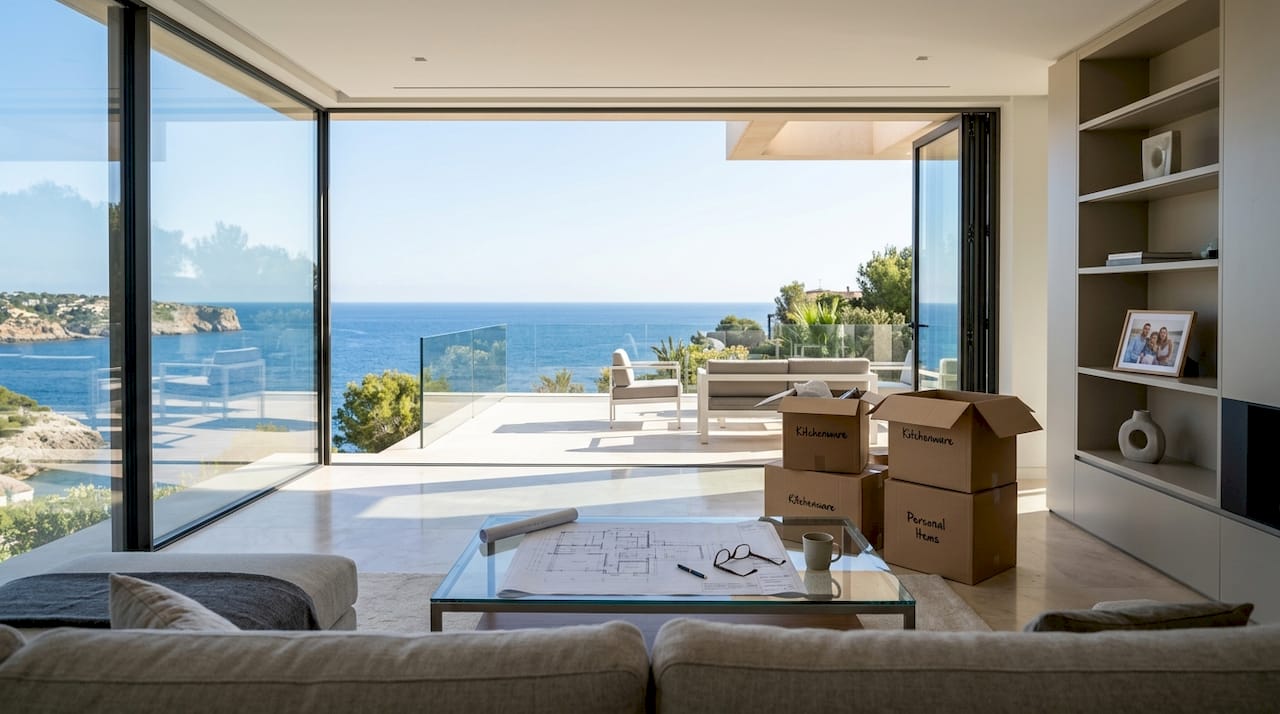
Luxury villas are the flagship of Palma’s premium market. Many sit in gated communities or elevated positions with panoramic sea views. They typically offer private pools, generous living space, and high-end finishes. Villas in neighborhoods like Son Vida often come with security infrastructure and strong resale demand from international buyers. For Americans who want turnkey luxury with a rental income option, a well-licensed villa is hard to beat.
Fincas are traditional country estates, and they hold a special appeal for buyers who want land, privacy, and a sense of Mallorcan heritage. A finca might come with olive groves, citrus orchards, and several hectares of rural land. But the legal complexity is real. Your independent lawyer should verify the rustic or urban classification and confirm what rental licensing is possible. Some fincas cannot be legally rented to tourists at all, while others qualify for agrotourism licenses. Never assume.
Modern apartments in Palma’s center or along the waterfront are the most liquid investment category. They require minimal maintenance, often come with concierge services, and are popular with a reliable tenant base of professionals and long-term renters. For Americans who want rental yield without the complexity of managing a large estate, a high-specification apartment is frequently the smartest starting point.
Here is what experienced local agents consistently observe about US buyers:
“American clients often arrive with a strong vision for fincas or waterfront villas, but the ones who succeed long-term are those who also ask the right legal questions upfront. The property type matters less than the due diligence quality.”
Key differences to keep in mind:
- Villas: High entry cost, strong lifestyle value, rental licensing varies by zone
- Fincas: Unique privacy and land, complex rustic classification, agrotourism potential
- Apartments: Lower entry point, easier management, stronger rental liquidity
Explore the broader Mallorca real estate advantages to understand why international capital continues to flow into this market regardless of global economic cycles.
Once you know what to look for and why it matters, it is time to compare options head-to-head.
Side-by-side comparison: Villas vs. fincas vs. apartments in Palma
| Feature | Luxury villa | Finca | Modern apartment |
|---|---|---|---|
| Entry price range | €1.5M to €10M+ | €800K to €5M+ | €400K to €3M |
| Maintenance level | High | Very high | Low |
| Legal complexity | Medium | High | Low |
| Tourist rental potential | Medium to high | Low to medium | Medium |
| Appreciation outlook | Strong | Moderate to strong | Strong |
| Ideal buyer profile | Lifestyle and investment | Privacy and heritage | Pure investment or pied-à-terre |
| Typical paperwork load | Moderate | Heavy | Light |
Mortgage access is available for Americans, but the terms differ from what you are used to at home. Non-resident mortgage LTV typically runs 60-70% of the purchase price, and the full process from application to approval takes roughly 6-12 weeks. Spanish banks will want proof of income, US tax returns, and evidence of existing assets. Budget for this timeline when you are negotiating your deposit contract.
Review your financing options carefully, because some buyers underestimate how different Spanish mortgage structures are from US products. Also, take time to read about the most common buyer mistakes so you can sidestep the traps that catch first-time foreign buyers.
Pro Tip: Do not wait until after signing to think about tax structuring. Allow at least two to three months post-purchase to work with a cross-border tax advisor on how best to hold the asset, report income, and minimize your combined Spanish and US tax burden.
Understanding the practical differences makes choosing clearer, but execution is key. Next, see the legal and tax compliance every US buyer must know.
Legal, tax, and compliance checklist for US buyers in Palma
This is where many buyers lose momentum, or worse, make expensive errors. Here is a clear, ordered process to follow:
- Apply for your NIE at the Spanish consulate in the US or in person in Spain. Allow 1-4 weeks.
- Hire an independent Spanish lawyer before making any offer. They protect you, not the seller.
- Open a Spanish bank account to hold your deposit and pay ongoing costs (local taxes, utilities, community fees).
- Sign the deposit contract (contrato de arras), typically 10% of the purchase price, which locks in the deal.
- Complete mortgage process if financing: 6-12 weeks, 60-70% LTV for non-residents.
- Sign at the notary and receive the escritura (title deed).
- Register at the land registry to make your ownership legally binding against third parties.
On the US side, your obligations do not stop at the border. FBAR reporting is required for any Spanish bank account holding over $10,000 at any point in the year, due April 15 with an automatic extension to October 15. Form 8938 applies when foreign assets exceed $50,000 for single filers or $100,000 for joint filers. The US-Spain tax treaty protects you from being taxed twice on rental income, with Spain taxing non-EU residents at 24% and the IRS allowing a credit for taxes already paid abroad.
| Obligation | Threshold | Deadline | Form |
|---|---|---|---|
| FBAR | Spanish account over $10,000 | April 15 (auto-extension Oct 15) | FinCEN 114 |
| FATCA / Form 8938 | Foreign assets over $50,000 (single) | Tax filing deadline | IRS Form 8938 |
| Spanish rental income tax | All rental income | Quarterly in Spain | Modelo 210 |
| Spanish wealth tax | Assets over €700,000 | Annual | Modelo 714 |
Study the full tax reporting guide to understand exactly how each obligation interacts. Learn how the Mallorca land registry protects your investment, and read the detailed closing process guide before your notary appointment.
With compliance handled, it is time to weigh your options and make a strategic decision.
What most US buyers overlook: Beyond the obvious in Palma’s luxury market
Here is what years of working with American clients in Palma’s market has made very clear: the buyers who get the best deals are rarely the ones who searched the hardest online. They are the ones who had access to off-market inventory and acted with legal confidence when an opportunity appeared.
Palma’s finest properties rarely reach public listings. Sellers in this segment prioritize discretion. Without a trusted local network, you are only seeing a fraction of what is actually available.
Most Americans over-invest in site visits and under-invest in legal review. Seeing a property is important, but it cannot tell you whether a finca’s renovation was permitted, whether there is a debt registered against the title, or whether the rental license will survive a regulatory change. Your lawyer can. Read the detailed Mallorca property laws guide before you start touring.
The buyers who do best long-term get their NIE, bank account, and tax structure sorted before they fall in love with a property. Structuring early gives you the speed and confidence to move decisively when the right opportunity arrives.
Work with trusted independent buyer agents in Mallorca
Navigating Palma’s luxury market from the US is genuinely complex, and the stakes are high. ULI & LISA are independent buyer agents who specialize in exactly this: helping American professionals find, evaluate, and acquire luxury villas, fincas, and investment apartments in Mallorca. We work for you, not the seller, which means unbiased advice, rigorous due diligence support, and full transparency on every deal. Explore our safe property Mallorca process and review our luxury real estate services to see how we handle cross-border transactions from first inquiry to final registration. Schedule a call today and get a curated shortlist built around your goals.
Frequently asked questions
Can Americans buy property in Palma, Spain without restrictions?
Yes, Americans can freely buy property in Palma with no government restrictions, but you must obtain an NIE, open a Spanish bank account, and complete full legal due diligence before closing.
What US tax reporting is required after buying property in Mallorca?
US owners must file FBAR for Spanish accounts over $10,000 and Form 8938 for foreign assets over $50,000, plus report all rental income to both Spanish tax authorities and the IRS annually.
How long does it take to close a property transaction in Palma?
Most US buyers complete the full process in 6-12 weeks from offer to land registration, assuming NIE, financing, and legal documentation are prepared in advance.
What mortgage options are available for Americans buying in Palma?
Spanish banks typically offer non-resident buyers a loan-to-value of 60-70%, with the application process taking roughly 6-12 weeks and requiring US income documentation and tax returns.
Does the US-Spain tax treaty help avoid double taxation?
Yes, the US-Spain tax treaty allows American owners to apply taxes paid in Spain as a credit against their US liability, so rental income is effectively taxed once, not twice.
Recommended
- Buying Property in Mallorca: Key Steps for Americans - ULI & LISA Mallorca Property Blog
- Navigate Mallorca property laws: guide for U.S. buyers - ULI & LISA Mallorca Property Blog
- How to Finance Property in Mallorca: A Step-by-Step Guide - ULI & LISA Mallorca Property Blog
- Mallorca Property Buying Checklist for Americans Simplified - ULI & LISA Mallorca Property Blog