TL;DR:
- Evaluating Mallorca luxury homes requires understanding legal, urban planning, and licensing complexities for safe investment.
- Thorough legal verification, specialized inspections, and cross-border transaction planning protect buyers from costly risks.
Knowing how to evaluate luxury homes in Mallorca isn’t just about falling in love with a sea-view terrace or an infinity pool. For high-net-worth American buyers, the stakes are far higher: legal exposure, licensing restrictions, cross-border tax obligations, and a property market where a single missed document can cost hundreds of thousands of euros. This guide walks you through every stage of evaluation, from understanding Mallorca’s regulatory environment and verifying legal title to conducting specialized inspections and structuring a cross-border transaction that protects your investment from day one.
Key Takeaways
| Point | Details |
|---|---|
| Dual-track diligence | Evaluating Mallorca luxury homes requires parallel legal/technical and rental licensing due diligence for full investment security. |
| ETV license critical | Existing ETV licenses significantly enhance rental income potential due to a moratorium on new licenses until 2026. |
| Comprehensive inspection | Luxury inspections must cover structural and custom features to reveal costly hidden issues. |
| Cross-border process | US buyers should use a Spanish power of attorney to manage transactions efficiently from abroad. |
| Budget for extras | Plan for 10-13% additional costs beyond purchase price to cover taxes, notaries, and legal fees. |
Understanding the Mallorca luxury property market and buyer challenges
To evaluate Mallorca luxury homes effectively, you need to understand the market context and legal environment before you ever schedule a viewing.
Mallorca sits in a category of its own among European luxury destinations. Demand from Northern European, American, and Middle Eastern buyers has kept prices resilient even during broader market slowdowns. But as a stable European market, Mallorca also carries complex urban planning regulations and strict rules that catch many foreign buyers off guard. Buying here without understanding those rules is genuinely risky.
What makes this market unique for luxury buyers:
- Rental licensing moratoriums. Mallorca has paused new tourist rental licenses (ETV licenses) until at least 2026, making properties that already hold one dramatically more valuable for income-seeking investors.
- Urban planning restrictions. Many luxury homes sit in protected rural zones (rústico land) where extensions, new structures, or even swimming pools require special permits that are not always in place.
- Foreign ownership complexity. Americans face extra steps: obtaining a NIE (Número de Identificación de Extranjero, Spain’s tax identification number for foreigners), opening a Spanish bank account, and navigating FATCA reporting requirements.
- Pricing opacity. Unlike the U.S. market, Mallorca does not have a centralized MLS. Properties appear across dozens of listing platforms with inconsistent pricing, making independent market access critical.
For investors focused on ROI, the Mallorca real estate investment guide is essential reading before making any offer. Understanding these dynamics separates buyers who secure strong returns from those who inherit costly problems.
Preparing your due diligence: key legal and administrative checks
With the market context understood, the next step is meticulous due diligence focused on legal and administrative certainty.
Investors must verify legal title and urbanistic legality including building licenses, tax and community fee status, and holiday-rental licenses such as ETV. Each of these carries real financial consequences if overlooked.
Here is the core sequence to follow:
- Order the Nota Simple. This is an official extract from the Spanish Land Registry. It confirms who legally owns the property, any mortgages or charges against it, and any legal restrictions on use. This is your starting point for every evaluation.
- Request all building licenses. Every structure on the property, including guest houses, pools, and garages, must have an approved building permit. Unlicensed structures can be subject to demolition orders.
- Confirm urbanistic classification. Determine whether the property sits on urban, urbanizable, or rústico land. Each category has strict limits on what can be built, renovated, or expanded.
- Check outstanding tax and community debts. Unpaid IBI (property tax), garbage fees, or community fees transfer with the property to the new owner in Spain. Request certificates proving all payments are current.
- Verify ETV license status. If rental income is part of your plan, confirming ETV license status early saves enormous time and protects your investment thesis.
- Establish power of attorney. US buyers require a Spanish power of attorney (poder general) apostilled in the U.S. to complete transactions efficiently without being physically present in Spain.
| Document | What it verifies | Risk if missing |
|---|---|---|
| Nota Simple | Legal ownership and charges | Buying from wrong party or inheriting debt |
| Building licenses | Legality of all structures | Demolition orders, renovation blocks |
| Urbanistic certificate | Legal land use classification | Building restrictions, illegal structures |
| IBI and fee receipts | Tax and community compliance | Inheriting unpaid obligations |
| ETV license | Rental permission | No legal short-term rental income |
Pro Tip: Hire an independent Spanish lawyer, not one recommended by the seller’s agent. Your lawyer works exclusively for you and has no incentive to overlook red flags. Cross-reference their findings with a Mallorca property laws guide written specifically for American buyers.
Conducting a comprehensive luxury home inspection for investment protection
Having secured legal and administrative clarity, the inspection phase ensures the physical and functional integrity of the luxury home.
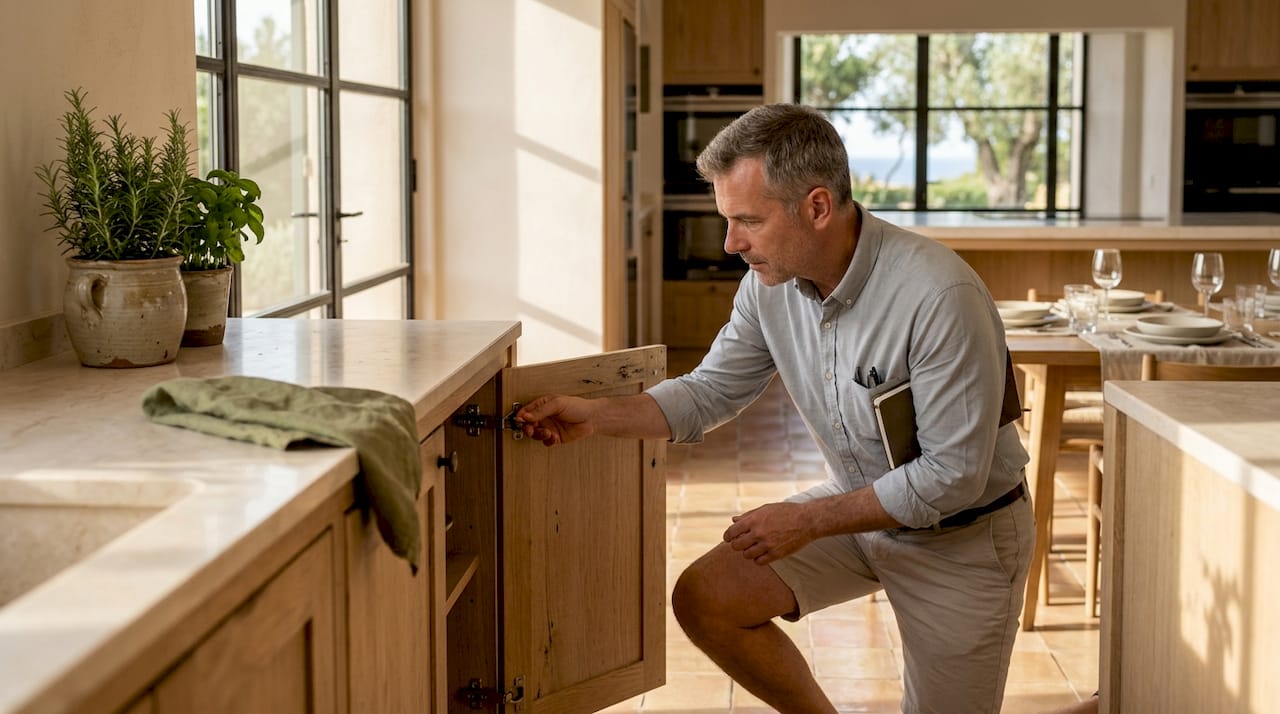
Luxury home inspections must assess custom construction, specialized amenities, and structural stability to identify costly risks unique to upscale properties. A standard home inspector is simply not equipped for this. You need specialists.
Key areas that require expert review in Mallorca luxury homes:
- Structural systems. Foundations and load-bearing walls in older Mallorcan stone (marès sandstone) properties require a structural engineer, not a generalist. Cracks in marès can signal subsidence or simply normal aging. Knowing the difference matters.
- Roofing and waterproofing. Flat terrace roofs are extremely common in Mallorca luxury homes and are notorious for water infiltration problems. Have a specialist check drainage, waterproof membranes, and any recent repairs.
- Smart home and electrical systems. High-end properties frequently include home automation, cinema rooms, EV charging points, and complex lighting systems. These require a licensed electrician with experience in smart home technology, not a standard inspection.
- Pool, spa, and outdoor systems. Pools in Mallorca often run year-round and have complex heating and filtration systems. Inspect motors, pumps, heating equipment, and structural integrity of the pool shell separately.
- Climate systems. Underfloor heating, ducted air conditioning, and solar installations are common in luxury homes. Each has a distinct maintenance cost profile that affects your annual operating budget.
“The cost of a thorough luxury home inspection is almost always recovered in the first negotiation alone. Identified issues become price reduction leverage or repair requirements before closing.”
Use a due diligence checklist to document every finding systematically. This ensures nothing falls through the gaps between your legal team and your inspection team. For a deeper look at what defines value in Mallorca properties, explore the key luxury features that most impact resale and rental appeal.
Pro Tip: Ask for maintenance records and service contracts. A luxury home without documented maintenance history is a liability, regardless of how good it looks on viewing day.
Navigating investment decisions with rental licensing and ROI considerations
Beyond physical condition, understanding rental licensing status is the single most important factor for evaluating a luxury home’s income potential in Mallorca.
The ETV license moratorium in Mallorca directly impacts the ability to rent short-term legally, making existing license status a critical investment factor. This isn’t a minor administrative detail. It determines whether a property generates €50,000 a season or sits idle.
| License type | Rental duration allowed | Key condition | Market premium |
|---|---|---|---|
| ETV | Year-round short-term | Standalone property, private access required | High |
| ETV-PL | Short-term in apartments | Community vote required (60% approval) | Medium |
| ETV-60 | Up to 60 days per year | Registered primary residence | Lower |
| No license | Long-term rentals only (12+ months) | Any property type | Significant discount |
What to verify before making an offer on an income-focused property:
- Confirm the license is active and registered in the NRUA (the Balearic Islands’ tourist rental registry).
- Verify the license is tied to the property, not the seller. ETV licenses do transfer with ownership for standalone properties, but confirm this explicitly with your lawyer.
- Check whether the license has any pending sanctions or complaints, which can affect its status after transfer.
- Review historical rental income documentation. Ask for actual booking records and platform data, not just projected figures from the listing agent.
The real estate investment guide for Mallorca covers rental yield benchmarks by zone and property type, giving you a realistic baseline for comparing properties. Properties in the southwest (Andratx, Puerto Portals, Camp de Mar) and northeast (Pollença, Puerto Pollença) tend to command the strongest weekly rates.
Executing cross-border transactions: timing, costs, and practical advice for American buyers
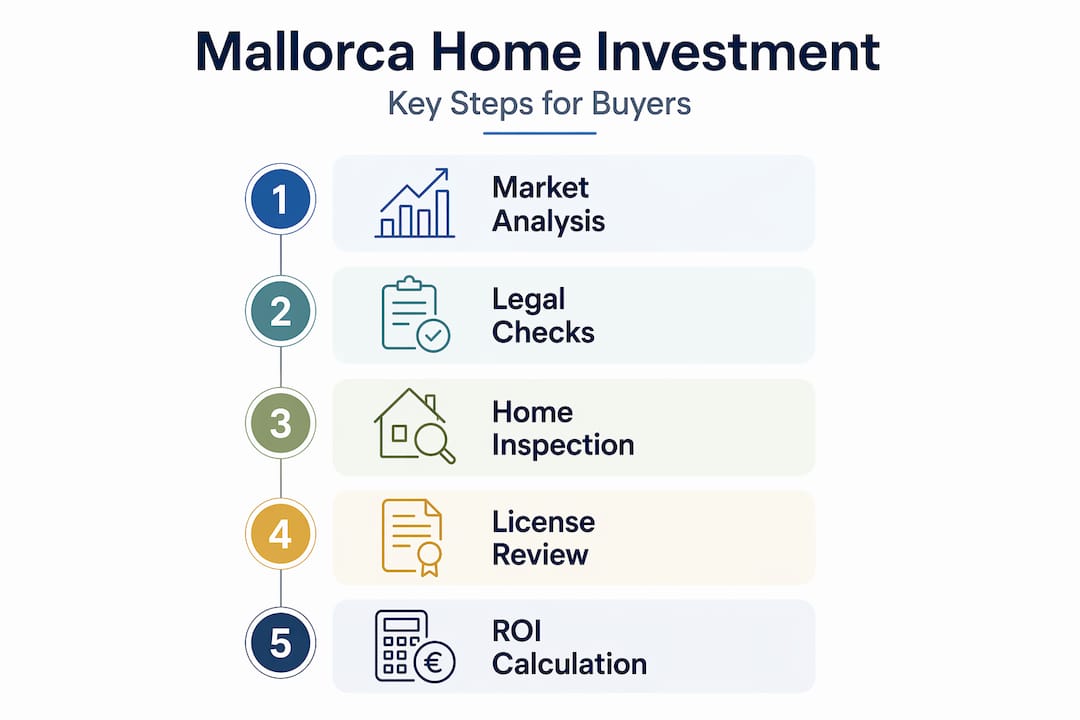
Mastering transaction logistics completes the evaluation framework needed to purchase luxury homes in Mallorca securely and confidently.
The Spanish property purchase process for U.S. buyers typically takes 6 to 12 weeks and involves roughly 10 to 13% additional costs above the purchase price. That timeline moves quickly once both parties agree on terms. Being unprepared slows you down and, in competitive situations, costs you the deal.
Follow this sequence:
- Obtain your NIE number. You cannot sign any Spanish legal document, open a bank account, or pay taxes without one. Apply through the Spanish consulate in your city before you travel, or have your lawyer apply in Spain via power of attorney.
- Open a Spanish bank account. All Spanish property transactions require payments to originate from a Spanish bank account. This is non-negotiable.
- Assemble your independent team. You need an independent lawyer, a licensed tax advisor familiar with U.S.-Spain treaty obligations, and ideally an independent buyer’s agent with full market access.
- Sign the reservation contract and pay the deposit. This takes the property off the market. Deposits are typically €10,000 to €20,000 and are non-refundable if you withdraw without cause.
- Sign the arras contract. This is a binding preliminary purchase agreement where you typically deposit 10% of the purchase price. If the seller withdraws, they owe you double. If you withdraw, you lose the deposit.
- Sign the escritura (deed) before a notary. Final payment is made, and ownership transfers. Your lawyer registers the deed with the Land Registry immediately after.
| Cost item | Approximate percentage |
|---|---|
| Transfer tax (ITP) on resale properties | 8 to 11% (sliding scale) |
| Notary fees | 0.2 to 0.5% |
| Land registry fees | 0.1 to 0.25% |
| Legal fees | 1 to 1.5% |
| Total additional costs | 10 to 13% |
American buyers should secure a Spanish power of attorney apostilled in the U.S. to manage signing and payments remotely. This single document keeps your transaction moving even when you cannot be in Mallorca.
Pro Tip: Use the Mallorca buying checklist for Americans to track every step from NIE application to deed registration. A detailed closing process guide specific to Mallorca will help you anticipate each payment milestone and avoid delays.
Why rigorous dual-track due diligence unlocks true investment value in Mallorca luxury homes
Here is what most buyers get wrong: they treat the inspection and the legal check as a single linear process. Inspect first, then review documents. Or they focus so heavily on physical condition that legal and licensing issues surface too late.
The buyers who come away with the strongest investments run two parallel tracks simultaneously: legal and administrative verification on one side, physical and technical inspection on the other. Both tracks inform valuation. A beautiful villa with a structural crack is a negotiation point. A beautiful villa without an ETV license is a completely different investment, one that may yield 40 to 60% less annual income depending on your strategy.
The uncomfortable truth is that investment viability in Mallorca luxury requires verifying both legal and technical habitability and rental permission capacity. Most buyers discover ETV issues at the offer stage or later. The smartest ones ask about license status before they even book a viewing.
There is also the issue of agent access. Many buyers work with a single listing agent who represents the seller and shows only the properties that agent controls. In a market as fragmented as Mallorca’s, that limits your view to maybe 20% of what is actually available. An independent buyer agent with full market access sees everything and owes loyalty only to you.
Accepting what we call “inspection scope creep” also pays off. That means saying yes to the extra structural engineer, yes to the pool specialist, yes to the smart home technician. The combined cost of those specialists is almost always less than the price concession you can negotiate once their findings are on paper.
Get expert buyer representation for safe luxury property investment in Mallorca
ULI & LISA work exclusively as independent buyer agents. That means we represent you and only you, with access to the entire Mallorca luxury property market, not just listings from a single agency. Every evaluation we support covers legal title verification, urbanistic compliance, ETV license status, physical inspection coordination, and cross-border transaction logistics tailored for American buyers.
If you are navigating your first luxury purchase in Mallorca or adding to an existing European portfolio, having advisors who understand both the American buyer’s perspective and Mallorca’s specific regulatory environment makes a measurable difference. Explore our approach to safe property investment in Mallorca and connect with our independent buyer agents to start your property search with full market access and genuine expert support.
Frequently asked questions
What documents should I verify before buying a luxury home in Mallorca?
You should verify the Nota Simple for title and ownership, building licenses and urbanistic legality, tax and community fee status, and ETV holiday-rental license if you plan short-term rentals. Investors must verify all of these before making a binding commitment to any property.
Why is an ETV license important for luxury home investors in Mallorca?
An ETV license is what legally allows short-term tourist rentals, and with the moratorium on new licenses in place until 2026, properties that already hold a valid one command significantly higher investment valuations and income potential.
How can U.S. buyers manage the property purchase process in Spain if they cannot be physically present?
U.S. buyers grant a Spanish power of attorney (poder general) apostilled in the U.S. that authorizes their lawyer to handle contracts, payments, and notary signings. A poder general apostilled in the U.S. covers the entire due diligence to completion window.
What additional costs should U.S. buyers budget for beyond the purchase price in Mallorca?
Plan for 10 to 13% on top of the purchase price to cover transfer taxes, notary fees, land registry fees, and legal representation. These are non-negotiable costs and must be factored into your total investment calculation from the start.
What makes luxury home inspections in Mallorca different from standard property inspections?
Luxury inspections must assess custom construction, smart home systems, pools, spas, and imported materials, requiring specialists rather than generalists. Standard inspectors simply lack the training to evaluate the systems and materials found in high-end Mallorcan properties.
Recommended
- Mallorca apartment rental: a luxury investor’s guide - ULI & LISA Mallorca Property Blog
- How to Navigate Mallorca Real Estate Market: Luxury Buyer’s Guide - ULI & LISA Mallorca Property Blog
- How to Navigate Mallorca Real Estate Market: Luxury Buyer’s Guide - ULI & LISA Mallorca Property Blog
- Mallorca Luxury Property Guide: Everything You Need to Know - ULI & LISA Mallorca Property Blog