
TL;DR:
- Closing a property in Mallorca involves transferring ownership through a notary-certified deed registered in the Land Registry.
- International buyers must obtain a Spanish NIE, perform thorough due diligence, and settle taxes within strict deadlines to complete the process.
Closing a property deal in Mallorca is defined as the legal transfer of ownership from seller to buyer, completed through a public deed signed before a Spanish notary and registered in the Land Registry. For American and international buyers, this process involves obtaining a Spanish foreigner identification number (NIE), conducting thorough due diligence, negotiating binding contracts, and settling all taxes within strict legal deadlines. Mallorca’s property market remains one of Europe’s most stable, attracting high-net-worth buyers seeking both lifestyle value and long-term security. Understanding the full closing process before you commit protects your investment and prevents costly delays.
How to close a property deal in Mallorca: the process explained
The Spanish property purchase process, known formally as compraventa inmobiliaria, follows a structured sequence that differs significantly from U.S. real estate transactions. There is no escrow company, no title insurance standard, and no single closing attorney coordinating both sides. Instead, the Spanish notary acts as a neutral public official who reads and certifies the deed but does not represent either party’s interests. That distinction matters enormously for international buyers.
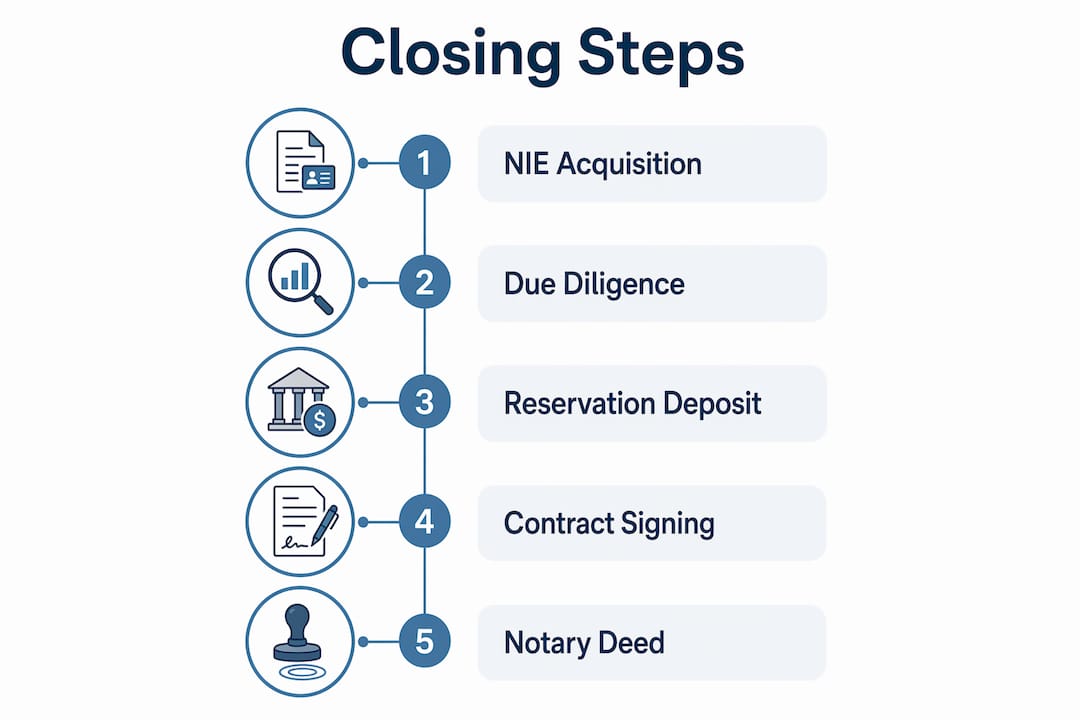
The full closing sequence moves through five defined phases: NIE acquisition, due diligence, reservation and deposit contract, notary signing, and post-signing tax and registration. Each phase has legal deadlines and financial consequences for non-compliance. Skipping or rushing any phase is the single most common reason deals collapse or buyers face unexpected costs.
Mallorca’s luxury segment, where properties regularly exceed €1 million, adds further complexity. Sellers in this bracket often have sophisticated legal teams, and buyers without independent representation frequently accept terms that favor the seller. Working with an independent buyer agent from the start changes that dynamic entirely.
What is an NIE and why is it critical for closing?
The NIE (Número de Identificación de Extranjero) is the foreigner identification number issued by the Spanish government to all non-citizens conducting legal or financial transactions in Spain. Without a valid NIE, signing the final deed and paying property taxes cannot be completed. The notary will not proceed, and the Spanish Tax Agency will not process any tax payments under your name.
This is not a formality. The notary and Spanish Tax Agency will not process the deed signing or tax payments without a valid NIE, making its timely acquisition the first practical step in any Mallorca purchase.
Three ways to obtain your NIE
- In Spain at a police station: Apply at a Comisaría de Policía with a foreigner affairs unit. Appointments in Palma de Mallorca fill up weeks in advance, so book as soon as you identify a property.
- Through a Spanish consulate abroad: American buyers can apply at the Spanish Consulate in New York, Los Angeles, Miami, or Chicago. Processing times vary but typically run two to four weeks.
- Via power of attorney: You authorize a Spanish lawyer to apply on your behalf in Spain. This is the fastest route when you cannot travel and the closing timeline is tight.
NIE application methods include all three options, and appointment availability is consistently the biggest bottleneck. Start the NIE process the moment you make a serious offer, not after contracts are signed.
Pro Tip: If you are using a Spanish lawyer for due diligence, ask them to handle the NIE application by power of attorney simultaneously. This runs both processes in parallel and typically saves two to four weeks.
How to conduct due diligence before closing
Due diligence in Mallorca means verifying that the property you are buying is legally clean, physically sound, and free of hidden liabilities. Proper due diligence includes verifying property ownership, checking for encumbrances, and confirming urban planning compliance through a Nota Simple and cadastral reference.
The Nota Simple is a one-page extract from the Spanish Land Registry (Registro de la Propiedad) that shows the registered owner, the property’s legal description, and any mortgages, liens, or easements attached to it. It costs under €10 and takes 24 to 48 hours to obtain. Any buyer who skips this step before paying a deposit is taking an unnecessary risk.
| Document | What it confirms | Where to obtain it |
|---|---|---|
| Nota Simple | Ownership, liens, mortgages | Land Registry (online or in person) |
| Cadastral certificate | Physical boundaries, tax value | Spanish Cadastre (Catastro) |
| Community fee certificate | Outstanding HOA debts | Property administrator |
| Urban planning certificate | Legal building status, permits | Local town hall (Ayuntamiento) |
| Energy performance certificate | Energy rating (required by law) | Seller obligation |
A qualified Spanish property lawyer should review all five documents before you sign any binding contract. A licensed surveyor (arquitecto técnico) adds a physical inspection layer that protects against structural defects not visible in legal documents.
Pro Tip: In Mallorca’s southwest, properties in protected rural zones (ANEI areas) carry strict building restrictions. Always request the urban planning certificate from the local Ayuntamiento, not just the seller’s agent, to confirm what modifications are legally permitted.
What are the steps to negotiate and sign the purchase contract?
The contractual sequence in Spanish property law moves through three distinct stages, and confusing them is one of the most expensive mistakes international buyers make.
-
Reservation contract (contrato de reserva): A short document accompanied by a small deposit, typically €3,000 to €10,000, that takes the property off the market for a defined period, usually 10 to 14 days. It is not legally binding in the same way as an arras contract and is primarily a gesture of intent.
-
Deposit contract (contrato de arras): This is the binding agreement. Arras contracts vary legally; penitential, confirmatory, and penal arras each carry different legal consequences, so contract wording must be scrutinized carefully. Under arras penitenciales (the most common type), if the buyer withdraws, the deposit is forfeited. If the seller withdraws, they must return double the deposit. Deposits typically represent 10% of the purchase price.
-
Public deed (escritura pública): The final notarized document that legally transfers ownership. This is signed at the notary’s office, usually 30 to 60 days after the arras contract.
Negotiating the timeline between arras and notary signing is where buyers have real leverage. A longer period gives you time to finalize mortgage financing, complete due diligence, and secure your NIE without pressure. Sellers motivated to close quickly will often accept a shorter timeline in exchange for a higher deposit.
Pro Tip: Always have your Spanish lawyer review the arras contract before signing. Sellers’ agents sometimes insert clauses that convert standard penitential arras into confirmatory arras, which removes the double-return protection if the seller withdraws.
Getting a mortgage approval in principle before signing the arras contract demonstrates financial seriousness and prevents deal collapse if financing takes longer than expected.
What happens at the notary signing and how do you finalize ownership?
The notary signing is the legal climax of the purchase. The public deed signing involves paying the balance, the notary reading the deed aloud, and the official transfer of ownership. Both buyer and seller (or their authorized representatives) must be present.
Here is what the final closing day involves:
- Transfer the remaining purchase price to the seller’s account, typically via bank-certified check (cheque bancario) issued the morning of signing.
- Attend the notary appointment with your NIE, passport, and proof of payment. Your lawyer should accompany you.
- Listen to the deed reading. The notary reads the full escritura pública aloud. You have the right to ask questions before signing.
- Sign the deed. Both parties sign. The notary certifies and seals the document. You receive a certified copy (copia simple) immediately.
- Pay taxes within 30 business days. Taxes must be paid within 30 business days of signing the deed to avoid fines. For resale properties, this is the Impuesto de Transmisiones Patrimoniales (ITP), currently 8% to 11% in the Balearic Islands depending on the purchase price.
- Register the property at the Land Registry under your name. Your lawyer handles this, and it typically takes two to eight weeks.
Closing costs for properties in Mallorca typically total 10% to 13% of the purchase price, covering ITP or VAT, notary fees, Land Registry fees, and legal representation. Budget for this in addition to the purchase price itself.
If you cannot attend the notary signing in person, a power of attorney granted to your Spanish lawyer allows them to sign on your behalf. This is common for American buyers closing remotely, though attending in person is always preferable for a transaction of this size.
Common mistakes to avoid when closing in Mallorca
The most preventable deal failures in Mallorca share a common thread: buyers underestimate the legal specificity of Spanish property law and overestimate the protection offered by sellers’ agents.
- Starting the NIE too late. Delays in NIE applications are among the most common reasons for deal postponements. Apply the moment you make a serious offer.
- Signing arras without legal review. Contract wording determines your financial exposure. A €50,000 deposit on a €500,000 property is real money at risk if the contract contains unfavorable clauses.
- Relying on the seller’s agent for legal advice. Sellers’ agents in Spain represent the seller. Their legal advice, however well-intentioned, carries a conflict of interest.
- Missing tax payment deadlines. Failure to pay ITP or VAT on time triggers penalties and can complicate Land Registry registration.
- Skipping the survey. Structural defects in older Mallorcan properties, particularly traditional fincas and village houses, are common and expensive to fix.
Pro Tip: Review the top mistakes foreign buyers make before signing anything. The patterns repeat across buyers from every country, and knowing them in advance costs nothing.
Key takeaways
Closing a property deal in Mallorca requires obtaining your NIE before any deed can be signed, completing legal due diligence through a Nota Simple and qualified lawyer, and paying all taxes within 30 business days of the notary signing.
| Point | Details |
|---|---|
| NIE is non-negotiable | Apply immediately after making a serious offer to avoid closing delays. |
| Due diligence protects your deposit | Verify ownership, liens, and planning compliance before signing any binding contract. |
| Arras contract type determines your risk | Penitential arras is standard; other types can remove key buyer protections. |
| Closing costs run 10% to 13% | Budget ITP or VAT, notary, Land Registry, and legal fees on top of the purchase price. |
| Tax deadlines are strict | Pay ITP or VAT within 30 business days of signing to avoid penalties. |
What I have learned from closing deals in Mallorca
After years of working with international buyers in Mallorca, the pattern I see most often is this: buyers who do their homework on the property spend almost no time preparing for the legal process. They research neighborhoods, compare villas, and negotiate price with confidence, then hand off the paperwork to whoever is available rather than whoever is qualified.
The Spanish property system is actually well-designed for buyer protection when you use it correctly. The Land Registry is reliable. The notary system is rigorous. The arras contract gives you real leverage if the seller backs out. But none of those protections work if you sign the wrong type of arras, miss a tax deadline, or let your NIE application sit for three weeks because you assumed it was someone else’s job.
The buyers who close smoothly are the ones who treat the legal process with the same seriousness they give to price negotiation. They hire an independent lawyer, not the one the selling agent recommends. They apply for their NIE before they need it. They read the arras contract before they sign it. These are not complicated steps. They are just steps that require intention.
Mallorca’s market in 2026 remains one of the most resilient in Europe, with demand from American and Northern European buyers continuing to outpace supply in the southwest and northeast. That means sellers have options. Buyers who arrive prepared close deals. Buyers who arrive unprepared lose them.
— Uli
How Uli-lisa supports your Mallorca property closing
Uli-lisa operates as independent buyer agents in Mallorca, representing only buyers with no conflict of interest and full access to every property on the market across all agencies. For American and international buyers, that means you get unbiased guidance through every phase of the closing process, from NIE coordination and due diligence to arras negotiation and notary signing.
The Uli-lisa team uses AI-powered search tools to identify properties that match your criteria across the entire Mallorca market, not just one agency’s listings. Legal coordination, tax planning, and post-signing registration support are part of the service. If you are serious about buying property in Mallorca as a secure European asset, start with representation that works exclusively for you.
To learn how Uli-lisa protects international buyers in Mallorca’s current market, visit uli-lisa.com/en/safe-property-mallorca.
FAQ
What is an NIE and do I need one to buy property in Mallorca?
The NIE is Spain’s foreigner identification number, and it is legally required for all non-citizens purchasing property. Without it, neither the notary signing nor tax payments can be processed.
How much are closing costs for properties in Mallorca?
Closing costs in Mallorca typically total 10% to 13% of the purchase price, covering ITP or VAT (8% to 11% depending on price), notary fees, Land Registry fees, and legal representation.
What is the difference between an arras contract and the final deed?
The arras contract is a binding deposit agreement that commits both parties before the notary signing. The final deed (escritura pública) is the notarized document that legally transfers ownership and is recorded in the Land Registry.
Can I close a Mallorca property deal remotely from the United States?
Yes. You can grant power of attorney to a qualified Spanish lawyer who signs the deed on your behalf at the notary. This is a standard and legally recognized practice for international buyers.
How long does it take to close a property deal in Mallorca?
The full process from accepted offer to notary signing typically takes 60 to 90 days, depending on NIE processing time, due diligence complexity, and mortgage financing requirements.
Recommended
- Mallorca Real Estate Closing Process: A Step-by-Step Guide - ULI & LISA Mallorca Property Blog
- How to Negotiate Mallorca Real Estate Successfully - ULI & LISA Mallorca Property Blog
- How to Negotiate Mallorca Real Estate Successfully - ULI & LISA Mallorca Property Blog
- What Are Closing Costs in Mallorca? 2026 Guide - ULI & LISA Mallorca Property Blog