
How do I negotiate the price of a property in Spain?
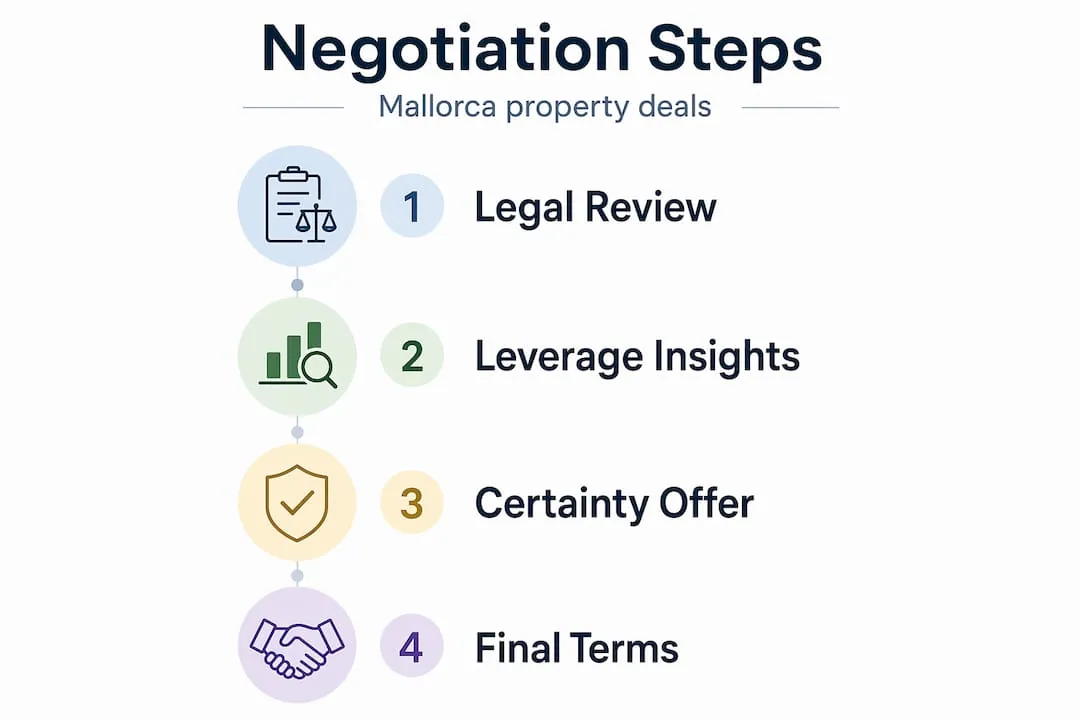
Negotiate with facts, not lowballs. Before making an offer, get the Nota Simple and check debts, permits and comparable prices; use documented issues such as illegal extensions or unpaid fees to justify a lower price. Show proof of funds or a mortgage pre-approval, and negotiate terms too: deposit, completion date, furniture and conditions in the arras contract. Sellers in Mallorca often value certainty as much as price.
TL;DR:
- Successfully negotiating Mallorca luxury properties requires understanding local practices, verifying legal documents, and emphasizing certainty over price. Building a strategic offer with factual leverage, legal clarity, and professional preparation improves outcomes and reduces risks. US buyers must adapt to Mallorca’s formal legal process and prioritize documentation to avoid costly mistakes and secure better deals.
Missing one critical negotiation lever in a Mallorca luxury transaction can cost you six figures. Not a rounding error. Hundreds of thousands of euros left on the table, or worse, absorbed into a purchase price that never reflected true risk. The Mallorca property market plays by different rules than the U.S., and high-net-worth buyers who walk in assuming familiar tactics work here routinely overpay, face legal complications, or lose deals to better-prepared competitors. This guide gives you the exact tools, documents, and strategic approach to negotiate with real authority from the moment you first engage a seller.
Key Takeaways
| Point | Details |
|---|---|
| Leverage the Nota Simple | This key Spanish document reveals hidden risks and is essential for smart negotiation. |
| Negotiate terms, not just price | Mallorca sellers value certainty and flexibility as much as the amount offered. |
| Prepare your legal checks | Verify debts, ownership, and encumbrances before starting any negotiation. |
| Avoid common U.S. mistakes | Don’t skip due diligence or assume processes mirror the U.S. system. |
| Expert agents make a difference | Local buyer agents optimize deals and protect your investment throughout the process. |
Understand Mallorca’s property negotiation landscape
The first thing to accept is that Mallorca is not New York, Miami, or Los Angeles. Price negotiation still happens, but extreme discounting is rare, especially in prime areas like Puerto Portals, Son Vida, or the Tramuntana foothills. Sellers in these markets are often emotionally attached to their asking prices, and an aggressive lowball offer can shut the door entirely.
What distinguishes successful buyers here is their focus on terms alongside price. Non-price concessions like furniture inclusions, extended completion timelines, or repair allowances regularly deliver more total value than grinding over a headline number. Understanding this mindset shift is foundational to negotiating Mallorca prices effectively.
Before any offer conversation begins, certain legal steps are mandatory in Spain. The most important starting point is the Nota Simple, which is a Land Registry extract (in Spanish: Nota Simple Informativa del Registro de la Propiedad) that provides official details on ownership, surface area, any mortgages, liens, or encumbrances attached to the property. As this foundational document shows, the Nota Simple is a key starting point for leveraging negotiation levers and understanding risks and price adjustments.
Here is what separates the Mallorca negotiation environment from what most Americans expect:
- Seller psychology: Mallorca sellers often prioritize certainty of close over maximum price, particularly in longer-listed properties.
- Legal weight: Spain’s property law places specific obligations on both buyer and seller; missing legal checks exposes you to inherited liabilities.
- Process sequence: Offers without prior legal review are considered amateur and can weaken your position immediately.
- Timeline patience: Negotiations routinely extend over weeks, not days. Rushing signals desperation.
- Professional advisors: Both parties typically use separate lawyers (called abogados), plus an official notary (notario) is required at signing.
| Factor | U.S. practice | Mallorca practice |
|---|---|---|
| Opening offer | Driven by comparables and days on market | Depends on the property and seller; aggressive lowballs often end talks in prime areas |
| Non-price terms | Sometimes overlooked | Highly valued by sellers |
| Due diligence timing | Often post-offer | Must precede offer for leverage |
| Legal representation | Optional in some states | Strongly advised; standard practice |
| Closing timeline | 30-60 days typical | 60-120 days common |
In Mallorca’s luxury segments, the buyer who arrives with documents reviewed, legal questions answered and a clean financing position is in the strongest position.
Before engaging in any price discussion, verifying property documents is a non-negotiable first step.

Start strong: Gathering information and legal levers
Once you understand the landscape, the next move is building your negotiation ammunition. This means acquiring and analyzing the legal documents that expose seller vulnerabilities and pricing justification gaps. Buyers who skip this step negotiate blind.
Here is a step-by-step approach to gathering your pre-negotiation intelligence:
- Request the Nota Simple. You can obtain this through Spain’s Land Registry (Registro de la Propiedad) online portal or through your lawyer. The document costs just a few euros and takes one to three business days. It identifies the current legal owner, exact surface area registered, any outstanding mortgage, easements, and any restrictions on use.
- Check for outstanding debts. Beyond the Nota Simple, request a Certificado de Deudas to confirm if there are unpaid community fees (gastos de comunidad), local property taxes (IBI), and, separately, utility arrears. Unpaid community fees and IBI can be claimed against the property after the sale, so they must be settled at or before completion.
- Review ownership duration. A seller who has owned the property for only two or three years may have specific capital gains tax pressure, which creates motivation to close faster and at a reasonable price.
- Check for planning or license issues. In the Balearic Islands, illegal extensions or unauthorized construction are common. Your lawyer should verify that all structures on the property match the registered description and hold valid building licenses.
- Analyze comparables. Pull recent sales data for similar properties in the same zone. This gives you a factual baseline that no seller can dismiss.
As requesting the Nota Simple confirms, this document exposes debts, legal descriptions, and encumbrances that directly shape your negotiation stance. You should always verify Mallorca property documents before making any offer, and understand the legal process so nothing surprises you mid-transaction.
| Legal finding | Negotiation leverage it creates |
|---|---|
| Outstanding mortgage close to property value | Seller motivated to move quickly; price reduction likely |
| Unregistered extension or illegal structure | Request significant reduction or require seller to legalize |
| Long ownership period (10+ years) | Seller has equity cushion; price may be more flexible |
| Unpaid IBI or community fees | Demand price reduction to cover liabilities or net settlement |
| Easement on access road | Use as justification for a discount; highlights buyer risk |
| Recent ownership (2-3 years) | Possible capital gain pressure; seller may prioritize speed |
Pro Tip: Never open a price negotiation before your legal review is complete. Walking into a discussion without document findings strips you of your strongest factual levers. Documented liabilities are the most objective argument for a price adjustment.
Build your negotiation strategy
With your legal homework done, you are ready to structure an offer that actually wins. The most common mistake at this stage is treating the offer as purely a number. In Mallorca, how you present an offer often matters as much as what number you put in it.
Here is how to build a negotiation strategy that covers the full picture:
- Lead with certainty signals. Before naming a price, communicate your readiness. Cash buyers should confirm liquidity explicitly. Buyers using financing should arrive with documented mortgage pre-approval from a credible institution. Sellers here fear fallen deals. Buyers who remove that fear gain immediate goodwill.
- Structure the offer with price plus terms package. Combine your price with specifics on deposit amount, preferred signing timeline, what fixtures or furniture you expect to remain, and any conditions you require (such as legalization of structures). A complete offer signals professionalism.
- Time your offer strategically. Properties that have been listed for more than six months without a price reduction indicate a seller who has tested the market and found resistance. This is your moment for a stronger price position.
- Use your legal findings as evidence, not weapons. If the Nota Simple revealed an outstanding community debt, present it neutrally as a factual discovery and request adjustment. Aggressive tactics create defensive sellers. Facts create productive conversations.
- Prepare your walk-away number before negotiations start. Emotions run high in luxury transactions. Knowing your absolute ceiling in advance prevents you from making impulsive concessions in the room.
Demonstrating terms certainty, such as cash readiness or mortgage pre-approval, reduces seller risk and adds hidden value beyond price alone. In a competitive market, sellers frequently choose a lower but cleaner offer over a higher offer with uncertain conditions. This insight changes the game for prepared buyers.
Your negotiation leverage checklist:
- Price: Based on comparables and legal findings
- Deposit amount: A higher deposit signals commitment
- Completion timeline: Offering flexibility often wins points
- Furniture and fixtures: Inclusion reduces seller’s removal costs
- Pending repairs: Document and quantify before the offer
- Legal conditions: Clear, specific, and time-limited
- Financing proof: Pre-approval letter or proof of funds
Refer to the step-by-step buying process to make sure your offer fits within Spain’s legal framework for property transactions.
Pro Tip: In premium Mallorca markets, certainty often beats a higher competing bid. If you can close quickly with no financing condition, a motivated seller may accept a lower price in exchange for that certainty.
Common pitfalls for U.S. buyers—and how to avoid them
Even well-informed buyers make predictable mistakes when crossing into a foreign real estate market. Here are the most costly traps Americans fall into during Mallorca property negotiations, and exactly how to sidestep them.
Mistakes to avoid:
- Jumping to price negotiation without documents. This is the single biggest error. Opening a price discussion without the Nota Simple or debt certificate means you are negotiating without facts. Sellers know this and will hold firm.
- Applying U.S. process expectations. In the U.S., a signed purchase agreement moves quickly to closing. In Spain, the Contrato de Arras (a preliminary sale contract with a binding deposit) is a distinct first step, and the timeline to escritura (final deed) is longer and more document-heavy.
- Skipping independent legal review. Some buyers rely entirely on the seller’s agent or a single shared notary. In Spain, you need your own abogado (lawyer) who works exclusively for your interests.
- Misreading seller motivation. Assuming price is the seller’s only concern causes buyers to miss opportunities. A seller relocating to another country may prioritize timeline over money. A seller managing an estate may value a smooth, uncomplicated process.
- Ignoring post-purchase costs in your offer math. Property transfer tax in the Balearic Islands (Impuesto de Transmisiones Patrimoniales) is progressive from 8 to 13 percent, each rate applying to its own price band. Add notary fees, legal fees, and registration costs, and your total purchase costs are typically roughly 10 to 15 percent on top of the agreed price.
Legal due diligence and timing are critical for negotiation leverage and post-closing peace of mind. Review the typical Mallorca negotiation mistakes and read up on the property viewing process so you arrive at each step fully prepared.
Experience in U.S. real estate can become a blind spot in Mallorca if you assume the process works the same way.
Why negotiation isn’t just about price: A buyer agent’s perspective
Let us be direct about something the market rarely says out loud. Most high-net-worth buyers focus relentlessly on the headline purchase price. They track the percentage discount they achieved. They benchmark against what a friend paid last year. This is the wrong scorecard entirely.
The buyers who walk away with truly exceptional outcomes in Mallorca are not the ones who fought hardest over price. They are the ones who arrived prepared, reduced the perceived risk for the seller, and structured deals where certainty and legal clarity did the heavy lifting.
A seller with several offers on the table will often choose the middle price from a buyer who presented cleanly verified documents, demonstrated deposit readiness, and communicated through a competent local representative. The highest offer, buried in conditions and delays, gets passed over. The lowest offer, no matter how well argued, creates anxiety.
The real edge in Mallorca property negotiation is preparation that signals professionalism. Sellers talk to their agents. Their agents form impressions fast. A buyer who arrives knowing the Nota Simple details, has reviewed the building license, and knows the comparable sales data is treated as a serious principal. That status opens doors and softens prices in ways that aggressive haggling simply cannot.
There is also the matter of what happens after you close. Properties with unresolved legal issues, unregistered structures, or undeclared debts create ongoing headaches that no price discount fully compensates. The negotiation that genuinely protects your investment is the one where you use documentation to either resolve issues before closing or obtain appropriate compensation for inherited risk.
Review the expert buying strategies that consistently deliver results in this market, and recalibrate your approach toward holistic deal-making rather than pure price focus.
How expert guidance can transform your Mallorca property negotiation
If you want a team that brings these negotiation and compliance principles to your purchase, ULI & LISA works as an independent buyer’s agent: we represent only buyers, never sellers. We search the whole market (35,000+ listings from 800+ agencies and portals), compare prices, review the Nota Simple findings with your independent lawyer and help you structure and negotiate your offer. There is no fee for buyers, because in Spain the seller pays the agent commission. If safe property investment in Mallorca is your goal, talk to our Mallorca buyer agents about your search.
Recommended
- Navigate Mallorca property laws: guide for U.S. buyers - ULI & LISA Mallorca Property Blog
- Mallorca property legal process: Expert guide for U.S. buyers - ULI & LISA Mallorca Property Blog
- Buying Property in Mallorca: Key Steps for Americans - ULI & LISA Mallorca Property Blog
- How to Work With Real Estate Agents Mallorca for US Buyers - ULI & LISA Mallorca Property Blog
Frequently asked questions
How much below asking price should I offer in Mallorca?
There is no fixed rule. The realistic room depends on how long the property has been listed, whether the price was already reduced, comparable sales nearby and what due diligence reveals. In sought-after areas, aggressive lowball offers often end the conversation, while documented defects or legal issues are accepted reasons for a lower price.
When is the price fixed when buying property in Spain?
The price becomes binding when you sign the arras contract, usually with a deposit of about 10%. Everything you want to negotiate, including price, furniture, repairs, completion date and conditions, should be settled before then, ideally after your lawyer has reviewed the Nota Simple and permits.
Does a buyer’s agent help with negotiating in Mallorca?
A buyer’s agent represents only you, compares the asking price with the market, gathers information about the seller’s situation and negotiates on your behalf. With ULI & LISA there is no fee for buyers, because in Spain the seller pays the agent commission and the buyer’s agent receives a share of it.
Should I include the purchase taxes in my offer calculation?
Yes. On top of the agreed price you pay transfer tax on resale homes, progressive from 8% to 13% in the Balearic Islands, plus notary, registry and legal fees. Total purchase costs are roughly 10% to 15% of the price, so set your walk-away number including these costs.