
Securing luxury property in Mallorca comes with its own financial and legal complexities for American buyers. The unique property tax system in Spain operates differently from what most Americans expect, with annual taxes based on official cadastral value rather than market price. Understanding this framework is vital for protecting your investment and ensuring full compliance across jurisdictions. This guide helps you master the essentials of Spanish property taxes and legal obligations, so your cross-border real estate purchase proceeds with confidence.
Key Takeaways
| Point | Details |
|---|---|
| Understanding Property Taxes | Property taxes in Mallorca are based on cadastral value, differing from U.S. market value assessments. Investors should note annual rates typically range from 0.4% to 1.1%. |
| Luxury Property Tax Obligations | Luxury buyers should be aware of multiple tax categories, including Property Transfer Tax and Wealth Tax, with rates that can significantly impact overall investment costs. |
| Legal Compliance Considerations | U.S. buyers must navigate legal requirements both in Spain and the U.S., including property ownership registration and cross-border reporting obligations. |
| Common Tax Mistakes | American investors often make errors related to residency status and reporting. Consulting with a tax specialist can help avoid these pitfalls and optimize tax strategies. |
Property Taxes Mallorca: Core Definitions
Property tax represents a fundamental financial obligation for real estate owners in Mallorca, with unique characteristics that differ from standard US taxation models. At its core, property tax is a mandatory recurring levy assessed on immovable property, encompassing both land and permanent structures. Property taxation fundamentals demonstrate that these taxes fund critical local government services and infrastructure development.
In the Mallorca context, property taxes involve several key components that US buyers must understand:
- Impuesto sobre Bienes Inmuebles (IBI): The primary annual property tax in Spain
- Tax rates determined by local municipal government valuations
- Calculated based on property’s cadastral value, not market value
- Annual rates typically range between 0.4% to 1.1% depending on location
Understanding the property valuation process is crucial for American investors. Unlike US systems, Spanish property taxes are assessed using a cadastral value, which often differs significantly from market price. This value is established by local authorities and serves as the basis for tax calculations.
Here’s a quick comparison of Spanish and US property tax systems for American buyers considering Mallorca:
| Aspect | Spain (Mallorca) | United States |
|---|---|---|
| Valuation Basis | Cadastral value (official) | Market value (appraised) |
| Annual Tax Rate | 0.4% to 1.1% | Varies widely: 0.6% to 2.5% |
| Tax Authority | Local municipal government | County/local governments |
| Common Additional Taxes | Wealth, transfer, capital gains | Income, transfer, capital gains |
The taxation framework in Mallorca involves multiple layers of potential tax obligations. Investors must consider not just annual property taxes, but also potential capital gains taxes when selling, non-resident income taxes, and municipal assessment fees. These complex regulations underscore the importance of professional guidance when navigating real estate investments.
Pro tip: Always consult with a local tax professional who specializes in international property transactions to fully understand your specific tax obligations in Mallorca.
Types of Taxes for Luxury Property Buyers
Luxury property buyers in Mallorca face a complex landscape of tax obligations that extend far beyond standard real estate transactions. Luxury property tax structures reveal multiple layers of financial considerations that American investors must carefully navigate. These tax responsibilities encompass several distinct categories, each with unique implications for high-end real estate investments.
The primary tax categories for luxury property buyers in Mallorca include:
- Property Transfer Tax (ITP): Applies to resale properties
- Value Added Tax (VAT): Charged on new construction properties
- Non-Resident Income Tax: Required for properties not used as primary residence
- Wealth Tax: Annual tax on high-value property assets
- Capital Gains Tax: Levied upon property sale
Understanding tax rates is crucial for luxury property investors. The percentages can vary significantly based on property value, with higher-end properties potentially facing more complex tax calculations. Transfer taxes for luxury properties can range from 8% to 11%, depending on the property’s assessed value and specific regional regulations.

Below is a summary of the main taxes luxury property buyers in Mallorca may face:
| Tax Type | Applies To | Typical Rate/Cost |
|---|---|---|
| Property Transfer Tax (ITP) | Resale properties | 8% to 11% based on value |
| VAT | New construction | 10% on purchase price |
| Wealth Tax | High-value assets | Progressive, varies regionally |
| Non-Resident Income Tax | Rental income or non-use | Fixed percentage, annually |
| Capital Gains Tax | Property sale | 19% to 23%, depends on residency |
Foreign investors, particularly Americans, must be especially vigilant about their tax obligations. Luxury property tax laws often include specific provisions for international buyers, with potential additional reporting requirements and potential tax treaties that can impact overall tax liability. This complexity underscores the importance of professional tax consultation to ensure full compliance and optimize potential tax efficiencies.
Pro tip: Engage a Spanish tax specialist with international experience to conduct a comprehensive tax analysis before finalizing your luxury property investment in Mallorca.
Calculating Your Purchase and Annual Taxes
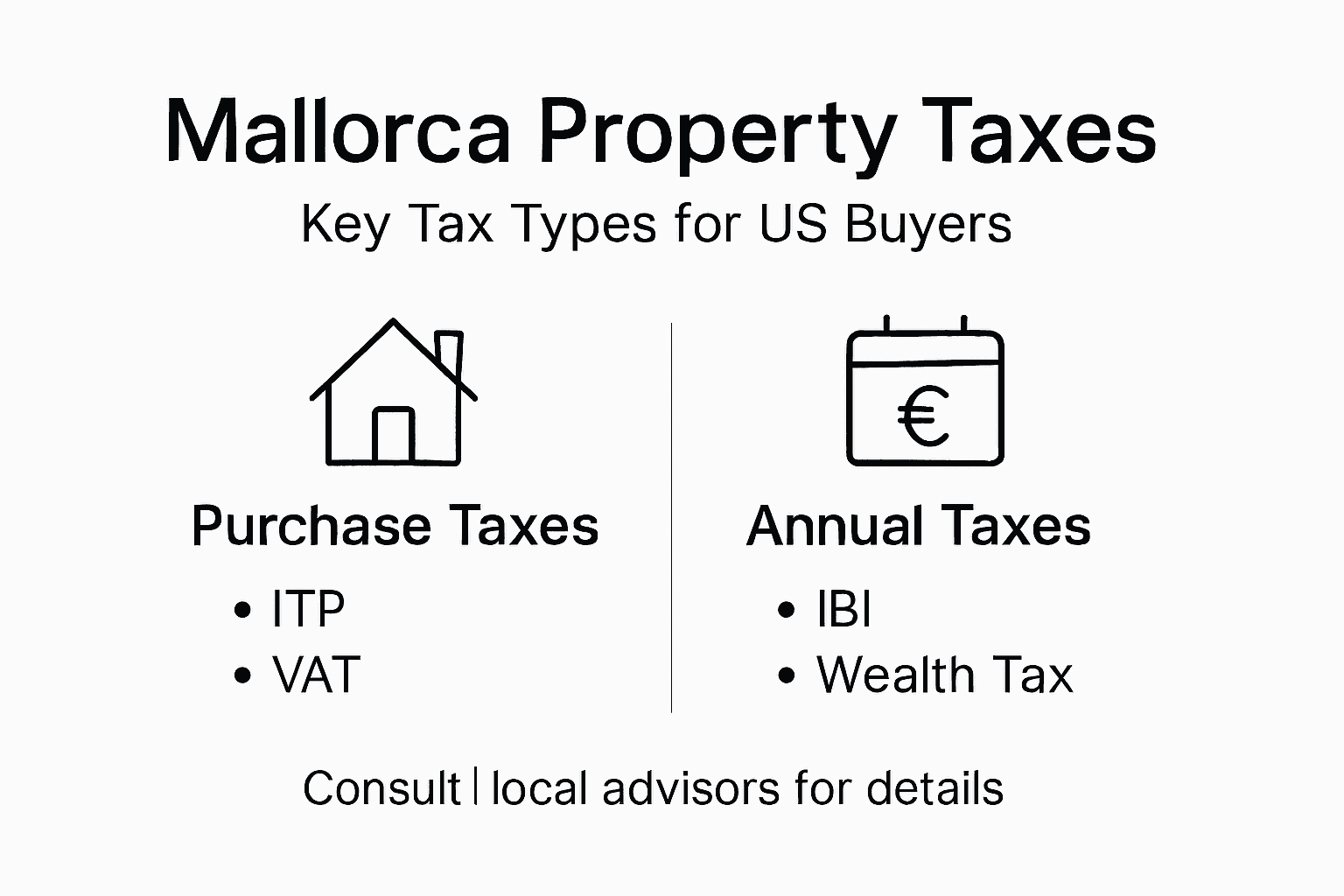
Calculating property taxes in Mallorca requires a comprehensive understanding of multiple tax components that impact both initial purchase and ongoing ownership. Property tax calculation methods involve intricate assessments that can significantly influence the total cost of luxury real estate investments. American buyers must navigate a complex landscape of regional and national tax regulations specific to Spanish property transactions.
The key elements in tax calculations for luxury property buyers include:
- Purchase Taxes:
- Transfer Tax (ITP) for resale properties
- VAT for new construction properties
- Notary and registration fees
- Annual Taxes:
- Impuesto sobre Bienes Inmuebles (IBI)
- Non-Resident Income Tax
- Potential Wealth Tax
- Supplementary Fees:
- Capital Gains Tax upon sale
- Municipal value increment tax
Understanding cadastral value is crucial in tax calculations. This official property valuation, established by local authorities, differs from market value and serves as the primary basis for tax assessments. For luxury properties, this can mean significant variations in tax liabilities. The cadastral value typically represents 50-70% of the actual market price, with tax rates ranging from 0.4% to 1.1% depending on the specific location and property characteristics.
Property tax assessment techniques reveal that foreign investors face additional complexity. US buyers must consider not just Spanish tax obligations but also potential reporting requirements to American tax authorities. This includes potential FBAR and FATCA reporting, making professional tax consultation essential for navigating the intricate cross-border tax landscape.
Pro tip: Obtain an official property valuation and consult with a tax specialist who understands both Spanish and US international tax regulations to ensure comprehensive tax planning.
Legal Compliance for US Owners in Mallorca
Property ownership regulations for US buyers in Mallorca represent a complex landscape of legal requirements spanning both Spanish and American jurisdictions. American property owners must navigate intricate compliance frameworks that extend well beyond traditional real estate ownership. Understanding these multifaceted legal obligations is crucial to avoiding potential penalties and ensuring smooth property investment.
Key legal compliance requirements for US owners include:
- Spanish Legal Obligations:
- Property ownership registration
- Local tax reporting
- Adherence to Spanish property transfer laws
- US Federal Reporting:
- FATCA reporting
- Foreign bank account declarations
- Annual foreign asset disclosures
- Cross-Border Documentation:
- Beneficial ownership declarations
- International tax treaty compliance
- Property investment documentation
The beneficial ownership framework demands particular attention from US investors. Spanish authorities require comprehensive disclosure of property ownership structures, including detailed information about individual owners, corporate entities, and potential trust arrangements. These requirements aim to enhance financial transparency and prevent potential tax evasion strategies.
Real property ownership laws reveal significant differences between US and Spanish legal systems. US buyers must recognize that Spanish property law operates under distinct legal principles, including unique registration processes, inheritance regulations, and ownership rights. Professional legal consultation becomes essential to effectively navigate these complex jurisdictional nuances.
Pro tip: Engage a bilingual legal specialist with expertise in both US and Spanish international property law to ensure comprehensive compliance and mitigate potential legal risks.
Common Tax Mistakes and Cost-Saving Tips
Tax planning strategies for American property owners in Mallorca require meticulous attention to detail and proactive financial management. Foreign investors frequently encounter complex taxation challenges that can significantly impact their overall investment returns. Understanding these potential pitfalls is crucial for maintaining financial efficiency and legal compliance.
Common tax mistakes US buyers often make include:
- Residency-Related Errors:
- Misinterpreting tax residency status
- Failing to report global income
- Overlooking dual taxation implications
- Reporting Oversights:
- Missing critical filing deadlines
- Incomplete foreign asset declarations
- Neglecting FATCA and FBAR requirements
- Strategic Planning Failures:
- Ignoring available tax deductions
- Not utilizing bilateral tax treaties
- Lack of comprehensive tax consultation
The tax optimization process demands sophisticated understanding of both Spanish and American tax regulations. Taxation complexities in Spain reveal multiple layers of potential financial exposure that require strategic navigation. Regional tax variations, progressive tax rates, and specific exemptions create a nuanced landscape where professional guidance becomes invaluable.
Mallorca’s property tax environment presents unique opportunities for savvy investors who approach their investments with comprehensive financial planning. By leveraging bilateral tax agreements, understanding regional tax incentives, and maintaining meticulous documentation, US buyers can significantly reduce their overall tax burden while ensuring full legal compliance.
Pro tip: Develop a comprehensive tax strategy with a cross-border tax specialist who understands both US and Spanish tax regulations to maximize potential savings and minimize compliance risks.
Simplify Your Mallorca Property Tax Journey with Expert Support
Navigating the complex world of property taxes in Mallorca can be overwhelming for American buyers. From understanding IBI calculations based on cadastral values to managing luxury property transfer taxes and cross-border legal compliance, the challenges are real. You face the risk of costly mistakes like overlooking residency rules or missing critical reporting deadlines that could impact your investment return and legal standing.
At ULI & LISA, we specialize in assisting international buyers, especially from the United States, to overcome these exact hurdles. Our advanced AI-powered tools deliver comprehensive, unbiased property searches across Mallorca’s luxury market while our personalized guidance ensures you fully comprehend tax obligations, purchase costs, and annual fees upfront. Don’t let complex tax terminologies or legal requirements hold you back from seizing the perfect investment. Visit our main site today and let us help you make smart, informed decisions to protect your investment and enjoy a smooth buying experience.
Ready for a stress-free property purchase that anticipates all tax challenges from day one Take the first step now by exploring properties tailored for you at ULI & LISA and gain the confidence that comes from expert support every step of the way.
Frequently Asked Questions
What is the primary property tax that US buyers need to pay in Mallorca?
The primary property tax for US buyers in Mallorca is the Impuesto sobre Bienes Inmuebles (IBI), which is an annual property tax assessed by local municipal governments, typically ranging from 0.4% to 1.1% based on the property’s cadastral value.
How is the property tax valuation determined in Mallorca?
In Mallorca, the property tax valuation is determined using the cadastral value, which is set by local authorities and often differs from the market value of the property. This cadastral value serves as the basis for tax calculations.
What additional taxes should luxury property buyers in Mallorca consider?
Luxury property buyers in Mallorca should consider several additional taxes including the Property Transfer Tax (ITP), Value Added Tax (VAT) for new constructions, Non-Resident Income Tax, annual Wealth Tax, and Capital Gains Tax upon sale of the property.
What are common tax mistakes that American investors make when buying property in Mallorca?
Common tax mistakes include misinterpreting tax residency status, failing to report global income, missing filing deadlines, and not utilizing available tax deductions or bilateral tax treaties. Comprehensive tax consultation is essential to avoid these pitfalls.
Recommended
- Property Types in Mallorca – What U.S. Buyers Should Know - ULI & LISA Mallorca Property Blog
- Buying Property in Mallorca: Key Steps for Americans - ULI & LISA Mallorca Property Blog
- Hidden Costs When Buying a Villa in Mallorca - ULI & LISA Mallorca Property Blog
- Hidden Costs When Buying a Villa in Mallorca - ULI & LISA Mallorca Property Blog
- Reduced Price Property Marbella | Marbellapads