Most American buyers discover too late that success in the Mallorca luxury property market depends on precise understanding of local terminology. With over 30 percent of international home purchases in Mallorca facing expensive delays because of misunderstandings, the difference between a profitable investment and a legal misstep often comes down to clear definitions. This guide demystifies key terms and crucial distinctions, giving American investors a smarter path to owning vacation homes that combine elegance with financial confidence.
Key Takeaways
| Point | Details |
|---|---|
| Understanding Terminology | Familiarize yourself with key real estate terms in Mallorca to navigate the market effectively. Knowing terms like Finca and Apartamento is essential for making informed investment decisions. |
| Navigating Ownership Structures | Different ownership models exist in Mallorca that differ from the U.S. Understanding these, such as Comunidad de bienes and Usufructo, is crucial for managing rights effectively. |
| Contractual Awareness | Spanish real estate contracts require careful attention to detail, including understanding the Contrato de arras and Escritura publica to ensure compliance with local laws. |
| Tax Compliance | Familiarize yourself with the variety of taxes and fees applicable to property ownership in Mallorca, including property transfer tax and annual property tax to avoid unexpected costs. |
Essential Mallorca Real Estate Terminology Defined
Understanding real estate terminology is crucial for American investors navigating the Mallorca property market. Real estate fundamentally represents property consisting of land, buildings, and associated natural resources, with legal distinctions that separate immovable property from personal possessions. In the Mallorca context, this means understanding specific Spanish property regulations and investment classifications.

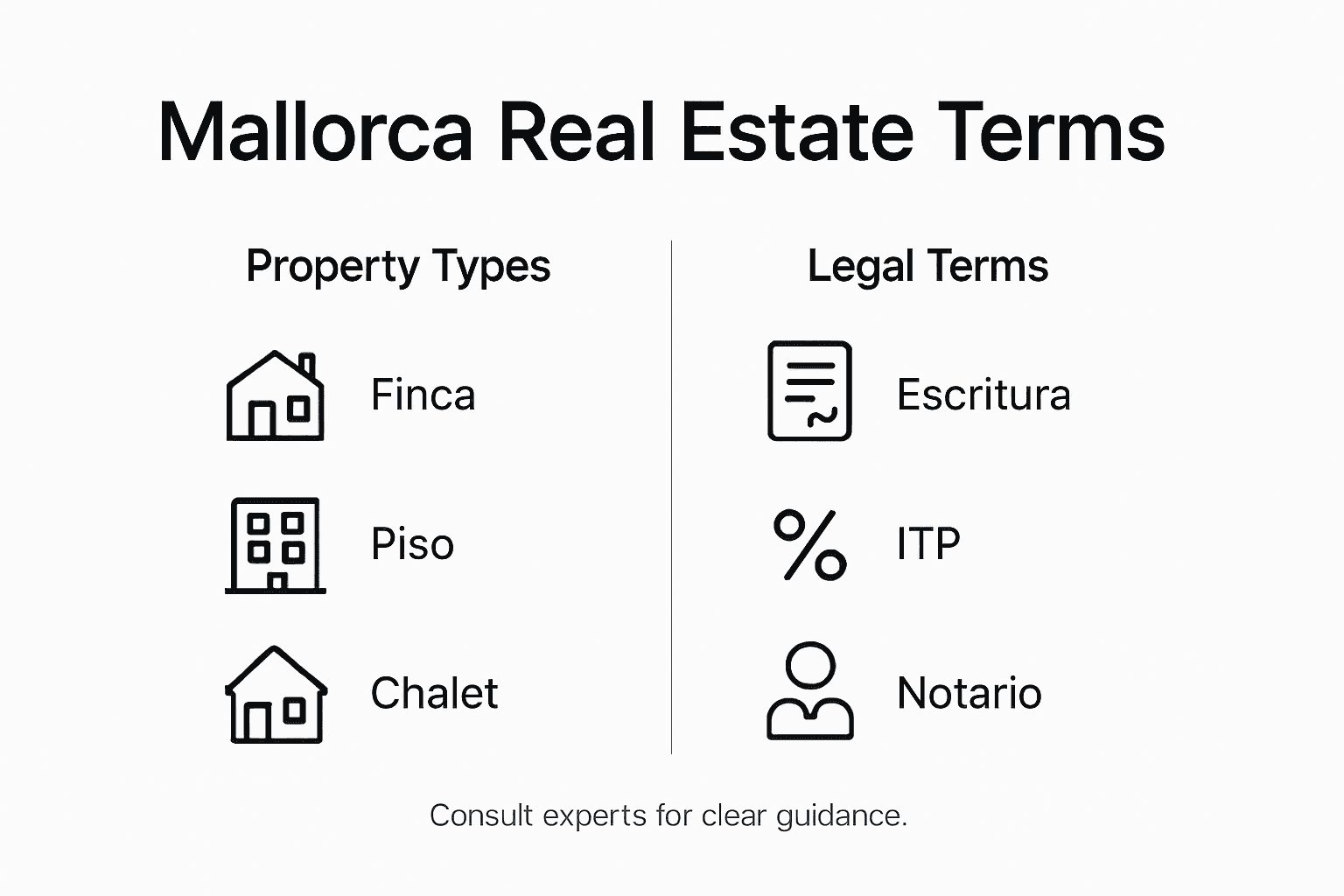
Mallorca real estate terminology encompasses several key categories that investors must comprehend. Finca refers to a rural property or land parcel, often including agricultural space or a traditional Spanish farmhouse. Apartamento describes an apartment, while chalet indicates a standalone house, typically with more land and privacy. Urbanización represents a planned residential development, often featuring shared amenities like swimming pools or landscaped gardens, popular among international buyers seeking turnkey investment properties.
Legal and financial terms are equally important for international investors. Escritura represents the official property deed, a critical document in Spanish property transactions. Catastro is the national property registry that records land ownership and property values. Investors should also understand ITP (Impuesto de Transmisiones Patrimoniales), the property transfer tax that varies depending on purchase price and property type. Understanding these investment terms helps American buyers navigate the complex Mallorca real estate landscape more confidently.
Pro tip: Before finalizing any Mallorca property purchase, work with a local agent who can translate complex terminology and explain nuanced legal requirements specific to international buyers.
Key Property Categories and Legal Definitions
Understanding the property law categories is crucial for American investors in the Mallorca real estate market. Property can be classified into several distinct legal types, each with unique ownership rights and implications. Real property includes land and permanent structures, while personal property encompasses movable assets. In Mallorca, these distinctions significantly impact taxation, transfer processes, and investment strategies.
Mallorca presents specific property ownership models that differ from typical American real estate structures. Propiedad horizontal represents shared ownership in multi-unit buildings, similar to condominium arrangements. Pleno dominio indicates full ownership rights, allowing investors complete control over their property. Nuda propiedad represents ownership without full usage rights, often involving complex inheritance or trust arrangements that require careful legal navigation.
Legal definitions become particularly important when considering investment potential. Property ownership rights can vary dramatically between residential, commercial, and rural properties. Suelo urbano defines urban land with existing infrastructure, typically more valuable and easier to develop. Suelo rústico refers to rural land with agricultural or undeveloped status, which has different regulatory constraints and potential for transformation.
Pro tip: Consult with a local Spanish real estate attorney who specializes in international property law to fully understand the nuanced legal classifications specific to Mallorca’s unique property landscape.
Here’s a quick comparison of Mallorca’s property types and their investment factors:
| Property Type | Typical Use | Development Potential | Main Regulatory Concern |
|---|---|---|---|
| Finca | Rural or agricultural | Limited, strict zoning | Agricultural restrictions |
| Apartamento | Residential | High, easy to modify | Urban community association rules |
| Chalet | Private residence | Flexible, more privacy | Land use regulations |
| Urbanización | Residential complex | Varies, shared amenities | Community management oversight |
| Suelo urbano | Development land | High, pre-approved plans | Building codes and permits |
| Suelo rústico | Agriculture or rural | Very limited | Environmental protections |
Understanding Ownership Structures and Rights
Property rights) form the fundamental legal framework that governs real estate investments in Mallorca, presenting complex ownership models that American investors must carefully navigate. These rights encompass the legal authority to use, generate income from, and transfer property, creating a sophisticated system of ownership that extends beyond simple possession. In the Mallorca context, these rights can be fragmented, shared, or exclusively held, requiring investors to understand nuanced legal distinctions.
The Spanish property system offers unique ownership structures that differ significantly from American real estate practices. Comunidad de bienes represents a joint ownership model where multiple parties share property rights and responsibilities. Usufructo allows for separated ownership rights, where one party owns the physical property while another holds the right to use and benefit from it. This complex system enables intricate inheritance arrangements and provides flexibility for international investors seeking diverse investment strategies.
Private property rights in Mallorca are robustly protected by Spanish law, ensuring exclusive authority for property holders. Investors must understand key distinctions like derecho de superficie, which permits building on land owned by another party, and servidumbre, which establishes legal easements and right-of-way provisions. These nuanced legal concepts can significantly impact property value, development potential, and long-term investment returns for American buyers seeking Mallorcan real estate.
Pro tip: Engage a specialized Spanish real estate attorney who understands international property law to conduct a comprehensive rights assessment before finalizing any Mallorca property investment.
Common Contract Terms and Purchase Process
Navigating real estate contracts in Mallorca requires a thorough understanding of Spanish legal requirements and specific documentation unique to the Spanish property market. These legally binding agreements must comprehensively outline property details, purchase price, payment terms, and transfer conditions. American investors must recognize that Spanish real estate contracts differ significantly from typical US transactions, demanding meticulous attention to local legal nuances.
The Mallorca property purchase process involves several critical contractual stages. Contrato de arras represents the initial reservation contract, where buyers typically pay a deposit (10-15% of property value) to secure the transaction. Escritura publica is the official deed of sale, signed before a Spanish notary and legally transferring property ownership. Key contract terms include condiciones suspensivas, which allow buyers to include specific conditions like successful mortgage approval or property inspection results as prerequisites for finalizing the purchase.
Real estate transactions in Spain involve complex legal protections for both buyers and sellers. International investors must navigate additional requirements such as obtaining a NIE (Número de Identificación de Extranjero), a mandatory tax identification number for foreign property buyers. The purchase process typically requires multiple document verifications, including property registry checks, energy certification, and tax clearance certificates. Buyers should budget for additional costs including notary fees, property transfer tax (ITP), and legal representation, which typically range from 10-15% of the property’s purchase price.
Pro tip: Hire a bilingual Spanish real estate lawyer specializing in international property transactions to review all contract documents and ensure full compliance with local regulations before signing.
Tax Obligations, Fees, and Legal Compliance
Navigating the complex landscape of property tax regulations in Mallorca requires American investors to understand multiple taxation layers that significantly impact real estate investments. Taxes in Spain are structured differently from US systems, with various national, regional, and municipal levies applied to property ownership and transactions. These obligations extend beyond simple annual property taxes, encompassing transfer taxes, capital gains taxes, and specific fees that can substantially affect overall investment returns.
Foreign property owners face unique tax requirements in Mallorca. Impuesto sobre Bienes Inmuebles (IBI) represents the annual municipal property tax, calculated based on the property’s cadastral value. Non-resident owners must also file Modelo 210, a tax declaration for non-resident property owners, even if the property generates no rental income. Capital gains tax ranges from 19% to 26% for non-resident sellers, with rates increasing for higher-value properties. International investors should budget for additional costs including Plusvalía Municipal, a local tax on property value increases at the time of sale.
Property registration processes in Mallorca involve specific legal compliance requirements that American buyers must carefully navigate. The Registro de la Propiedad (Property Registry) requires detailed documentation, including proof of tax identification number (NIE), valid passport, and comprehensive property valuation reports. Foreign investors must also obtain a Spanish bank account, secure a tax identification number, and complete multiple bureaucratic steps to ensure full legal compliance. Additional fees typically include notary costs, registration fees, and legal representation expenses, which can range from 1% to 2.5% of the property’s purchase price.
Pro tip: Engage a specialized tax consultant with international property expertise to conduct a comprehensive tax analysis and create a strategic compliance plan before finalizing your Mallorca real estate investment.
Below is an overview of mandatory taxes and fees for Mallorca real estate investors:
| Cost Type | Who Pays? | Typical Amount |
|---|---|---|
| Property transfer tax | Buyer | 8%-10% of purchase price |
| Notary and legal fees | Buyer | 1%-2.5% of purchase price |
| Annual property tax (IBI) | Property owner yearly | 0.4%-1.1% of cadastral value |
| Plusvalía Municipal | Seller (on sale) | Varies by value increase |
| Modelo 210 filing | Non-resident owners | Based on fiscal value |
Navigate Mallorca Real Estate Terminology with Expert Guidance
Understanding Mallorca real estate terminology like finca, escritura, and ITP can feel overwhelming for American investors. The complex legal definitions and ownership structures pose real challenges when you want to make confident investment decisions. Whether you are deciphering property types such as chalet versus urbanización or navigating contract terms like contrato de arras, having expert help can transform confusion into clarity.
At ULI & LISA, we specialize in supporting international buyers with exactly these challenges. Using advanced AI-powered tools, we provide comprehensive and unbiased property searches across Mallorca’s market while offering personalized guidance that translates complex terminology into clear advice. Don’t let unfamiliar legal jargon slow your investment journey. Visit https://uli-lisa.com today to connect with trusted Mallorca real estate agents who understand your needs. Empower your decision-making with ULI & LISA’s expert support. Start your smooth and confident buying experience now by exploring our services at https://uli-lisa.com.
Frequently Asked Questions
What does ‘finca’ mean in Mallorca real estate terminology?
A ‘finca’ refers to a rural property or land parcel in Mallorca, often including agricultural space or a traditional Spanish farmhouse.
What are the primary legal documents involved in a property transaction in Mallorca?
The primary legal documents include the ‘escritura,’ which is the official property deed, and the ‘contrato de arras,’ an initial reservation contract where buyers pay a deposit to secure the transaction.
How is the property transfer tax (ITP) calculated in Mallorca?
The property transfer tax (ITP) varies based on the purchase price and type of property, generally ranging from 8% to 10% of the purchase price.
What is ‘comunidad de bienes’ in the context of property ownership?
‘Comunidad de bienes’ represents a joint ownership model in which multiple parties share property rights and responsibilities, commonly used in multi-unit buildings.
Recommended
- Understanding Mallorca Real Estate FAQs for Buyers - ULI & LISA Mallorca Property Blog
- Why Buy Real Estate in Mallorca Explained - ULI & LISA Mallorca Property Blog
- Understanding Mallorca Property Investment Tips for Buyers - ULI & LISA Mallorca Property Blog
- Mallorca Real Estate: Complete Guide to Key Advantages - ULI & LISA Mallorca Property Blog
- Real Estate vs Property Management: What Owners Need to Know - Guestly Homes