
TL;DR:
- Mallorca’s 2025 rental laws require property owners to secure community approval through a supermajority before offering short-term rentals. Regional bans prevent new licenses in multifamily buildings, and Palma’s urban plan fixes the existing rental plazas; compliance now hinges on legal due diligence. Investors should prioritize properties with existing licenses and thorough legal checks to navigate the complex regulatory landscape effectively.
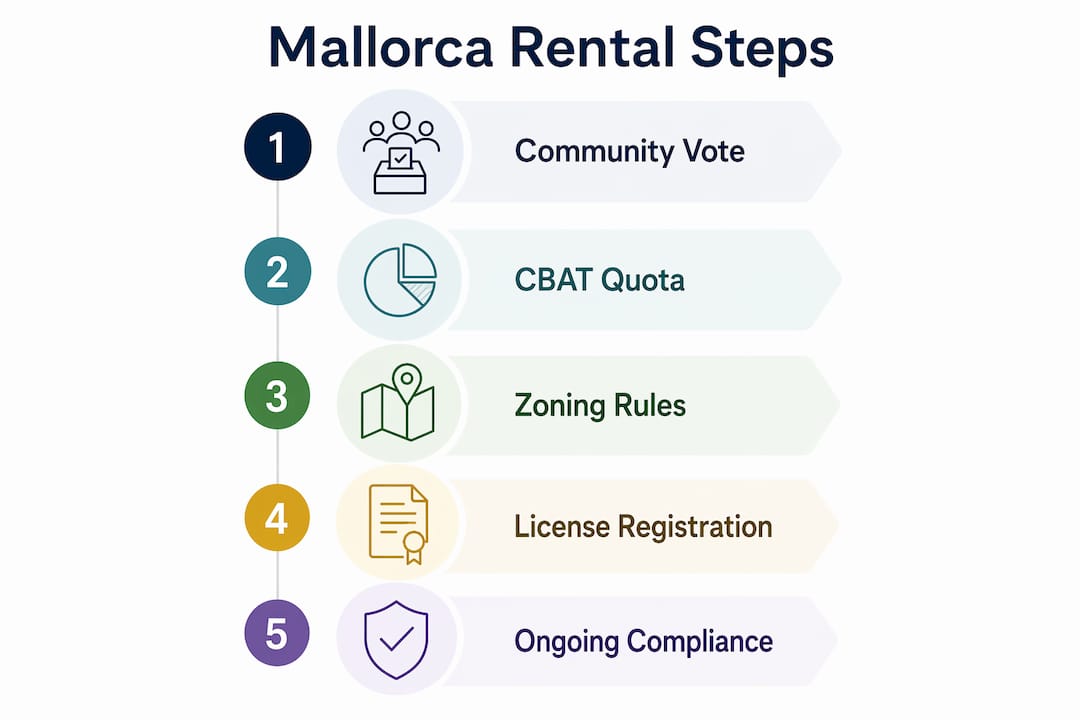
Mallorca rental laws 2025 define a new compliance framework that requires property owners in multifamily buildings to secure a qualified community majority before operating any short-term rental. The reforms, effective April 3, 2025, layer three distinct authorization systems: community consent under the reformed Ley de Propiedad Horizontal, regional licensing under Decreto Ley 4/2025, and municipal zoning restrictions that now cover all of Palma. For investors, this means a property’s rental viability depends on far more than its physical condition or location. Legal due diligence on community statutes, plaza availability, and municipal zoning has become as decisive as assessing rental yield.
What are the key legal requirements for short-term rentals in Mallorca?
Short-term rental law in Mallorca now operates under a dual authorization system. Owners must satisfy both community-level consent and regional licensing requirements before listing any property. Neither approval alone is sufficient.
The central legislative change is the reform to article 17.12 of the Ley de Propiedad Horizontal. Since April 3, 2025, community authorization is mandatory for any owner in a multifamily building who wants to start or continue tourist rentals. The required threshold is a qualified majority of 3/5 of owners representing 3/5 of participation quotas. This is not a simple majority vote. It is a double quorum that gives neighbors substantial collective power over rental activity in their building.
On the regional side, Decreto Ley 4/2025 introduced three ETV (Estancia Turística en Vivienda) modalities that define what types of rentals are legally possible:
- ETV365-Un: A single-family dwelling rented year-round, not subject to the multifamily ban.
- ETV365-Pluri: A unit in a multifamily building rented year-round. New licenses in this category are now prohibited under the decree.
- ETV60: A principal residence rented for up to 60 days per year. Available through the Consorcio Bolsa de Alojamientos Turísticos (CBAT) quota system.
The CBAT quota system allocates tourist rental plazas through a public lottery with set pricing. This mechanism was created specifically to manage the scarcity of available plazas after the regional ban on new multifamily licenses. Investors seeking ETV60 licenses must apply through this process, and availability is limited.
Pro Tip: Before purchasing any apartment in Mallorca for rental purposes, request a copy of the community statutes and the minutes of the last three general meetings. These documents reveal whether the community has already voted to restrict or prohibit tourist rentals, which would make a new license legally impossible regardless of regional approvals.
How does community approval affect landlords and investors in Mallorca?
Community consent is now the first and most unpredictable hurdle in the Mallorca short-term rental regulations framework. Community agreements now determine whether a rental can proceed, shifting significant power to neighbors and making proactive engagement with the community a core investment strategy.
The procedural requirements for obtaining or blocking community authorization follow a defined sequence:
- The owner or community president must formally place the tourist rental authorization on the agenda of a general meeting.
- The vote requires the double quorum: 3/5 of owners and 3/5 of participation quotas must approve.
- The resulting agreement must be notarized and registered in the Property Registry to be enforceable against third parties, including future buyers.
- If the community votes to restrict rentals, that restriction binds all current and future owners of units in the building.
Beyond the vote itself, the 2025 reforms grant communities additional financial tools. Under the same qualified majority threshold, a community can impose a recargo (surcharge) of up to 20% on common expenses for any unit used for tourist rentals. This surcharge reflects the additional wear on shared spaces and services generated by short-term guests. For a property with annual community fees of €3,000, that translates to an additional €600 per year, a cost that must factor into rental yield calculations.
Communities can also establish coexistence rules: specific hours for guest check-in and check-out, restrictions on luggage in elevators, and noise protocols. These rules are legally binding on the rental operator and can be enforced through the courts.
Pro Tip: If you are buying into a building where no community vote has yet taken place, consider engaging a local property lawyer to attend the first relevant meeting on your behalf. Early, respectful engagement with neighbors before a vote is called dramatically increases the probability of a favorable outcome. Waiting until after a negative vote is registered is too late.
What municipal and regional zoning rules impact short-term rental licensing?
Mallorca’s short-term rental regulations operate at three geographic levels: the Balearic Islands region, the municipality of Palma, and individual community statutes. Each layer can restrict but not expand what the layer above permits.

At the regional level, Decreto Ley 4/2025 prohibits new tourist rental plazas in multifamily dwellings across the Balearic Islands from April 2025 onward. Existing properties with prior valid licenses may continue operating, but no new standard ETV365-Pluri licenses will be processed for apartments in residential blocks. This moratorium has immediate consequences for investors entering the market in 2025 or 2026.
Palma’s position is even more restrictive. The city’s 2023 PGOU (Plan General de Ordenación Urbana) designates the entire municipality as a no-new-tourist-plaza zone, locking the existing stock at 4,473 plazas with no mechanism for replacement if a license is lost or surrendered. This urban planning decision is permanent and not subject to the same legislative revision process as regional decrees.
| Jurisdiction | Rule | Impact on New Licenses |
|---|---|---|
| Balearic Islands (regional) | Decreto Ley 4/2025 moratorium | No new ETV365-Pluri for multifamily buildings |
| Palma (municipal) | 2023 PGOU full-municipality restriction | No new tourist plazas; existing 4,473 are fixed |
| Community level | Ley de Propiedad Horizontal art. 17.12 | 3/5 majority required; can prohibit rentals entirely |
| National (judicial) | Supreme Court annulled national registry mandate | Regional and local rules remain fully enforceable |
One important nuance for investors involves the national registry. The 2024 Real Decreto 1312/2024 created a national tourist rental registry, but Spain’s Supreme Court annulled the requirement to display a national registration number in online listings. This ruling does not reduce compliance obligations. Regional and municipal licensing requirements remain fully enforceable, and the absence of a national number does not exempt any owner from obtaining local and regional approvals.
For investors evaluating resale properties, the practical implication is direct: a property with an existing, valid ETV license carries a premium that is legally justified. That license cannot be replicated under current rules, making it a scarce asset. Properties in Palma with active tourist rental plazas are effectively irreplaceable from a licensing standpoint.
How to legally register and maintain compliance for short-term rentals
Registration under the 2025 rental agreements framework in Mallorca requires submitting a DRIAT (Declaración Responsable de Inicio de Actividad Turística) to the Balearic Islands tourism authority. This declaration triggers the formal licensing process and must be accompanied by documentation confirming community authorization, where applicable.
The technical standards required for a legal tourist rental include:
- A valid habitability certificate confirming the property meets minimum living standards.
- An energy performance certificate with a rating that meets regional thresholds.
- Individual utility meters for electricity, water, and gas, separating the unit from shared building supplies.
- Proof of community authorization, registered in the Property Registry, for all multifamily properties.
Operational obligations are equally specific. Licensed operators must maintain a 24-hour contact line for guests and neighbors, keep a visitor registry that is available to police on request, and comply with all community coexistence rules. Operators also hold the right to expel guests who violate house rules, and this right must be documented in the rental contract.
Legal due diligence is as important as assessing financial returns in the current regulatory context. Advertising a property on platforms such as Airbnb or Booking.com without a valid license number can result in fines up to €40,000 and closure orders. The Balearic Islands tourism inspectorate actively monitors major platforms and cross-references listings against the regional license registry.
For multifamily properties, registrars may suspend license registration if community authorization documentation is missing or improperly formatted. This administrative bottleneck is a new risk that did not exist before April 2025. Owners who assumed their existing license was automatically renewed may find it suspended pending documentation they did not know they needed.
Pro Tip: Commission a full legal audit of any rental property before completing a purchase. The audit should cover the community statutes, the current license status, the CBAT plaza registration, and any pending community votes. This single step prevents the most common and costly compliance failures investors encounter when entering the Mallorca market.
Key takeaways
Mallorca’s 2025 rental law reforms make community authorization, regional plaza availability, and municipal zoning the three non-negotiable pillars of any compliant short-term rental investment.
| Point | Details |
|---|---|
| Community consent is mandatory | A 3/5 double quorum of owners and quotas must approve tourist rentals in multifamily buildings. |
| New multifamily licenses are blocked | Decreto Ley 4/2025 prohibits new ETV365-Pluri licenses; only existing valid licenses retain legal standing. |
| Palma’s plaza cap is permanent | The 2023 PGOU fixes Palma’s tourist rental stock at 4,473 plazas with no replacement mechanism. |
| Penalties for non-compliance are severe | Unlicensed advertising can trigger fines up to €40,000 and closure orders from regional inspectors. |
| Existing licenses carry scarcity premium | Properties with valid ETV licenses are legally irreplaceable assets under current rules. |
Why the compliance complexity is actually good news for serious investors
I have been working in Mallorca’s property market long enough to remember when tourist rental licensing was largely a paperwork formality. What we have now is categorically different, and I think most commentary underestimates how much this shift benefits disciplined investors.
The instinct is to read the new Mallorca property rental laws as obstacles. I read them as a filter. Every layer of complexity, from the community vote to the CBAT lottery to Palma’s plaza cap, reduces the pool of properties that can legally generate short-term rental income. Scarcity of compliant assets is the single most reliable driver of long-term value in any regulated market.
What I tell every investor I work with is this: stop looking for properties where you might get a license and start looking for properties that already have one. The holiday rental licensing framework in Mallorca now makes an existing ETV license a structural asset, not just an administrative convenience. In Palma especially, where the plaza cap is written into urban planning law, that license is genuinely irreplaceable.
The investors who struggle are the ones who buy first and investigate compliance second. The ones who succeed treat legal due diligence as the first stage of the acquisition process, not the last. I have seen transactions collapse at the final stage because a community had already voted to prohibit tourist rentals and the buyer’s lawyer missed it. That is an avoidable loss, and it happens more often than the market acknowledges.
The broader European property context matters here too. As European property market analysis shows, regulated markets with constrained supply consistently outperform open markets over a ten-year horizon. Mallorca’s regulatory tightening is painful in the short term and protective in the long term. That is a trade-off I am comfortable recommending to serious buyers.
— Uli
How Uli-lisa helps investors navigate Mallorca’s rental laws
Uli-lisa operates as an independent buyer agent with full market access across every agency in Mallorca. For investors focused on short-term rental compliance, that independence matters. Uli-lisa’s team conducts pre-purchase legal audits covering community statutes, ETV license status, CBAT plaza registration, and municipal zoning classifications before any offer is made. The firm’s AI-powered property search identifies compliant investment opportunities across the full market, not just listed inventory from a single agency. If you are entering the Mallorca market in 2025 or 2026, the difference between a compliant and a non-compliant acquisition comes down to the quality of due diligence at the start. Explore Uli-lisa’s independent buyer services or review the full compliance advisory framework to understand how the firm protects your investment from day one. For buyers prioritizing security in an uncertain global environment, safe property investment in Mallorca starts with the right representation.
FAQ
What changed in Mallorca’s rental laws in April 2025?
Since April 3, 2025, owners in multifamily buildings must obtain a 3/5 qualified majority community vote before starting or continuing tourist rentals, under the reformed Ley de Propiedad Horizontal article 17.12. Decreto Ley 4/2025 simultaneously banned new ETV365-Pluri licenses for apartments in residential blocks across the Balearic Islands.
Can I still get a short-term rental license for an apartment in Palma?
New tourist rental plazas in Palma are prohibited under the city’s 2023 PGOU, which caps the total at 4,473 existing plazas with no replacement option. The only viable path for an apartment in Palma is acquiring a property that already holds a valid ETV license.
What is the ETV60 license and who qualifies?
The ETV60 license allows a principal residence to be rented for up to 60 days per year and is available through the CBAT public lottery system. It applies to owners who live in the property as their primary home and want limited short-term rental income without a full commercial license.
What are the penalties for renting without a license in Mallorca?
Advertising or operating a tourist rental without a valid license number can result in fines up to €40,000 and closure orders from the Balearic Islands tourism inspectorate. Regional authorities actively monitor major booking platforms and cross-reference listings against the official license registry.
Does the Supreme Court ruling on the national registry affect Mallorca compliance?
No. The Supreme Court annulled the mandatory national registration number requirement for online listings, but regional and municipal licensing in Mallorca remain fully enforceable. Owners still need a valid regional ETV license and, where applicable, community authorization to operate legally.
Recommended
- Mallorca Rental Laws Explained: Secure Legal ROI for Investors - ULI & LISA Mallorca Property Blog
- Mallorca Investment Tips: Maximize ROI and Navigate Rental Laws - ULI & LISA Mallorca Property Blog
- Holiday Rental Licenses Mallorca – Key Rules for Investors - ULI & LISA Mallorca Property Blog
- Mallorca Rental License Guide: Secure Your Investment - ULI & LISA Mallorca Property Blog