TL;DR:
- Buying luxury property in Mallorca involves complex legal, tax, and licensing considerations that demand proper planning and local expert support. Mallorca remains a resilient and highly sought-after market for American investors, offering privacy, currency diversification, and strong rental demand. Strategic acquisitions focused on licensed properties and tax-efficient structures deliver long-term value, not just price discounts.
Purchasing a luxury villa in Mallorca feels like a dream until the paperwork arrives. Many high-net-worth Americans assume that buying international real estate mirrors the U.S. process: find the property, wire the funds, move in. In reality, Spanish legal compliance, non-resident tax obligations, and the island’s notoriously restricted rental licensing create a landscape that rewards preparation and punishes assumptions. This guide cuts through the confusion and gives you a clear, evidence-backed framework covering taxes, legal steps, and rental income strategies so you can make your Mallorca investment with confidence.
Key Takeaways
| Point | Details |
|---|---|
| Mallorca’s tax advantages | The Balearic Islands’ €3M wealth tax exemption shields most luxury buyers from ongoing asset taxes. |
| Licensing impacts returns | Rental licenses are scarce, so properties with permits command premium prices and rental income. |
| Structured compliance matters | Navigating legal and tax steps properly ensures seamless deals and protects your investment. |
| Strategic investment beats price | Long-term value comes from smart structuring and planning, not just hunting for bargains. |
Why Mallorca attracts luxury U.S. investors
With these complexities in mind, let’s understand why Mallorca stands out as a destination for luxury U.S. investors.
Mallorca is not simply a Mediterranean vacation spot. It is one of Europe’s most resilient luxury real estate markets, drawing serious capital from the United States, Germany, Scandinavia, and the UK year after year. The reasons go beyond the sunshine and turquoise water. Investors are drawn to the island’s Mallorca lifestyle benefits that combine privacy, year-round accessibility through Palma’s international airport, and a mature infrastructure that most comparable island destinations simply cannot match.
From a pure investment standpoint, the benefits of international property in Mallorca are compelling. Property values in prime zones like Puerto Portals, Andratx, and the Southwest coast have demonstrated long-term resilience, even during broader European economic cycles. Limited land supply, strict building regulations, and growing foreign demand create an environment where quality assets hold and grow their value.
Here are the key factors that drive American luxury buyers toward Mallorca specifically:
- Privacy and security: Gated estates and private coastal properties offer genuine seclusion rarely found at comparable price points in the U.S.
- Eurozone diversification: Owning a euro-denominated asset provides meaningful currency diversification for dollar-heavy portfolios.
- Rental market demand: International tourist arrivals consistently outpace available licensed rental inventory, creating strong yield potential.
- Tax efficiency for single-property buyers: The Balearics wealth tax exemption shields most single luxury properties up to €3M, which protects a large segment of buyers from this annual cost.
- Lifestyle arbitrage: European quality of living, access to world-class sailing, food, and culture at a cost of living that competes favorably with comparable U.S. luxury destinations.
“The scarcity of licensed short-term rental properties in Mallorca is not a problem for investors who plan ahead. It is a structural advantage that keeps rental yields elevated and property values robust for those who hold the right assets.”
Understanding this demand picture is essential before you model any returns. Mallorca is not a speculative market. It rewards patient, informed buyers who understand the regulatory environment as clearly as they understand the architecture.
Understanding Spanish property taxes for Americans
Understanding the purchase appeal is just the start; let’s break down the Spanish tax realities for American buyers.
Spain’s tax system for non-resident property owners has several distinct layers, and each one carries real financial consequences. As a U.S. citizen buying in Mallorca, you are treated as a non-resident for Spanish tax purposes unless you actually live in Spain for more than 183 days per year. That non-resident status shapes nearly every tax obligation you face.
The three primary taxes you need to understand are:
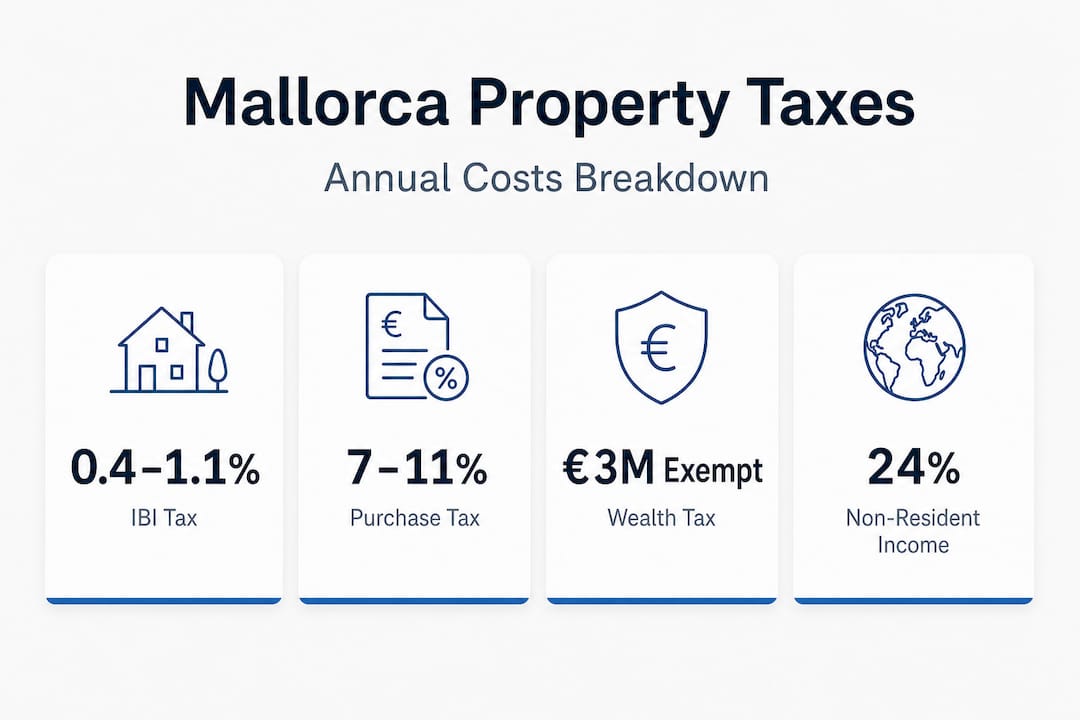
| Tax | When it applies | Rate / Basis |
|---|---|---|
| IBI (Local property tax) | Annual | 0.4% to 1.1% of cadastral value |
| Wealth tax (Impuesto sobre el Patrimonio) | Annual, on Spanish assets | 0.2% to 3.5%; Balearics exemption up to €3M |
| ITP (Property transfer tax) | On purchase | Progressive, up to 13% in the Balearics |
| IRNR (Non-resident income tax) | Annual, on imputed or actual rental income | 19% for EU residents; 24% for non-EU (U.S. buyers) |
Let’s make this concrete with a practical example. You purchase a villa in Son Vida for €4 million. Your ITP on purchase would be calculated progressively: 8% on the first €400,000, rising to 13% on amounts above €1,000,000 in the Balearics. On a €4M purchase, that translates to a significant acquisition cost you must budget for before closing.
Annually, you pay IBI based on the cadastral value, which is usually well below the market value. Your wealth tax exposure begins only if your total Spanish-held assets exceed €3M in the Balearics, meaning a single property at or below that threshold largely avoids this liability. Above €3M, the progressive rates from 0.2% to 3.5% apply to the excess. See the U.S.–Spain tax guide for specific FBAR and FATCA reporting obligations that apply to American owners, which are separate from Spanish taxes entirely.
Pro Tip: American buyers often overlook that Spain and the U.S. have a tax treaty that prevents most forms of double taxation. However, the treaty does not eliminate all reporting obligations. You must still report the property on your U.S. tax return and potentially on FBAR if related financial accounts exceed $10,000. Budget for a cross-border tax specialist, not just a local Spanish gestor.
One more statistic worth remembering: IRNR (non-resident income tax) at 24% applies to imputed rental income even if you never rent the property. Spain assumes you earn a percentage of the cadastral value annually as notional income, and you owe tax on that figure. If you do rent, actual rental income is taxed at 24% for U.S. residents after allowable deductions.
Legal compliance: Navigating cross-border transactions
Understanding taxes is only part of the challenge. Legal compliance is equally critical for a trouble-free transaction.
The buying process in Mallorca follows a structured sequence that differs meaningfully from U.S. real estate transactions. There is no escrow system in the traditional American sense, and title insurance is not standard. The notary plays a central, neutral role confirming the deed, but the notary does not conduct due diligence on your behalf. That responsibility falls entirely on your legal team.
Here is the step-by-step sequence every American buyer needs to follow:
- Obtain your NIE (Número de Identificación de Extranjero): This Spanish tax identification number is required for every financial transaction in Spain, including opening a bank account and signing property deeds. Apply at a Spanish consulate in the U.S. or in person in Mallorca.
- Open a Spanish bank account: Funds must flow through a Spanish account to comply with anti-money-laundering regulations. This step often takes longer than buyers expect, so start early.
- Sign the reservation contract: A small deposit (typically €6,000 to €10,000) secures the property and takes it off the market while due diligence is underway.
- Sign the Arras (private purchase contract): Usually 10% of the purchase price is paid here. If you withdraw, you forfeit the deposit. If the seller withdraws, they pay you double.
- Due diligence phase: Your Spanish lawyer checks for debts, liens, planning violations, rental license status, community fees, and building permits. This is where most costly surprises are caught or missed.
- Notary deed signing (Escritura Pública): Both parties sign before a notary, the purchase price is transferred, and ownership legally changes hands.
- Registration: Your lawyer registers the deed with the Land Registry (Registro de la Propiedad), finalizing your legal ownership.
“Skipping or rushing the due diligence phase is the single most expensive mistake we see American buyers make. A property with an undisclosed building infraction or a clouded rental license can cost multiples of the legal fee you were trying to avoid.”
The U.S. buyer guide provides deeper context on the documentation required at each stage. Common legal pitfalls include purchasing a property with illegal extensions built without a license, acquiring a property where the seller has outstanding community debt, or buying a rural property with no legitimate access road documented in the registry. All of these are avoidable with rigorous due diligence.
Pro Tip: Engage a bilingual Spanish property lawyer, not a general practice attorney, before you even make an offer. A specialist in Balearic property law will flag issues that a generalist misses and will coordinate directly with your U.S. tax advisor on the cross-border structuring. Reviewing investment strategies for Mallorca before your first property viewing will also sharpen your criteria considerably.
The Balearics ITP progressive structure also influences buying decisions directly. Two properties at €2M each carry a lower combined ITP burden than one property at €4M in some scenarios, which is why sophisticated buyers sometimes structure acquisitions deliberately across price bands.
Maximizing returns: Rental income, licenses, and value strategies
Legal compliance lays the foundation, but maximizing your returns is the ultimate goal. Let’s see how the top investors do it.
The short-term rental market in Mallorca operates under rules that most other European destinations have not yet implemented. The Balearic Government issued a rental moratorium that effectively halted the issuance of new tourist rental licenses in many zones. What this means in practice: if you want to run a legal short-term holiday rental, you need to buy a property that already holds a valid license, or one where a transferable license can be secured.
This scarcity has done something counterintuitive. It has made licensed properties significantly more valuable than comparable unlicensed ones. Buyers who understood this dynamic early are now holding assets that command a measurable premium. Here is how the strategic landscape looks:
| Strategy | License required? | Yield potential | Risk level |
|---|---|---|---|
| Short-term vacation rental | Yes (existing license needed) | High (8 to 12% gross in peak areas) | Medium (regulatory) |
| Long-term residential rental | No | Moderate (3 to 5% net) | Low |
| Renovation and resale | Depends on renovation scope | High (capital gain) | Medium (planning) |
| Buy-and-hold luxury asset | No | Appreciation-focused | Low |
For buyers interested in the rental income path, here is a practical checklist to optimize your position:
- Verify the license before any offer: Confirm the tourist license is valid, transferable, and currently active. Your lawyer must obtain this from the relevant authority.
- Check the property’s tourist capacity (plazas): Licenses specify maximum occupancy. Higher capacity means higher gross revenue potential.
- Assess the property management ecosystem: Quality management companies in Mallorca charge 20 to 30% of rental revenue but handle everything from guest relations to compliance.
- Model both short and long-term scenarios: Given regulatory uncertainty, any property that works as a long-term rental provides downside protection if licensing rules change.
- Understand community rules: Some urbanizations restrict or prohibit holiday rentals regardless of government licensing.
The 2026 property investment strategies blog gives current context on where the market is heading. Combining that with the essential investment checklist will give you a structured framework before you commit capital. For more targeted advice on building returns, the Mallorca investment property tips resource is worth your time before any serious negotiation.
The real secret: Why buying in Mallorca is more about strategy than price
Here is where we push back on the conventional approach to luxury property investment.
Most buyers, even experienced ones, anchor their decision-making on price. They compare villa prices per square meter, benchmark against similar markets in the South of France or Tuscany, and negotiate toward the lowest number they can reach. That thinking misses the bigger picture entirely.
In our experience working with American investors in Mallorca, the buyers who generate the strongest long-term outcomes are almost never the ones who found the cheapest price. They are the ones who bought the right asset structure. A villa priced at €200,000 above comparable properties may carry a valid short-term rental license, clean title history, and a tax-optimized ownership structure that saves more than the price premium within the first three years of ownership.
The regulatory environment in Mallorca is not static. Rental rules will likely continue to tighten, which means the gap between licensed and unlicensed properties will probably widen further. Buyers who future-proof their acquisitions today by securing licensed inventory and proper tax structuring are not paying more. They are paying smarter.
We also see too many buyers making emotion-driven decisions based on a single viewing during peak summer. Mallorca in August is intoxicating. But the property that felt like a dream in the sun may have a northwest-facing terrace that is unusable from October to March, or a rural location that makes generating rental demand nearly impossible outside of July and August. Deep local knowledge, not a beautiful listing, is what protects your investment.
The understanding Mallorca investment guide lays out this framework in detail. The single most important thing you can do before signing anything is find a local partner who will tell you the uncomfortable truths, not just the ones that close the deal.
Ready to invest? Work with Mallorca specialists
Strategic investing in Mallorca requires expert local support that goes far beyond a standard real estate transaction. At ULI & LISA, we work exclusively as independent buyer agents, which means our loyalty is to you, not to the seller or the listing. We use advanced AI-powered search tools to cover the full Mallorca market without the blind spots of agency-exclusive listings. From structuring your purchase correctly to verifying rental licenses and coordinating with cross-border tax advisors, our Mallorca real estate services are built around American investors who want to get this right the first time. Learn how we keep your purchase compliant and protected at every stage through our safe property investment approach.
Frequently asked questions
What are the main taxes Americans face when buying property in Mallorca?
Americans must pay the local property tax (IBI), possible wealth tax above €3M of Spanish assets, Spain’s progressive property transfer tax (ITP) on purchase, and non-resident income tax (IRNR) on imputed or actual rental income annually.
Is it possible to rent out my Mallorca property for short stays?
Short-term holiday rentals require a specific license, and Mallorca’s current moratorium on new licenses makes existing licensed properties significantly more valuable and in demand.
How does the wealth tax exemption in the Balearics benefit American investors?
The Balearics €3M exemption means most single luxury property purchases fall below the threshold where annual wealth tax applies, reducing your ongoing holding costs meaningfully.
What are the key legal steps for an American to complete a property purchase in Mallorca?
You need a Spanish NIE tax number, a Spanish bank account, a private purchase contract with a 10% deposit, a thorough due diligence review by a specialist lawyer, notary deed signing, and formal registration with the Land Registry to complete ownership.
Does buying property in Mallorca make me a Spanish tax resident?
No, purchasing property alone does not trigger Spanish tax residency. You are taxed as a non-resident unless you spend more than 183 days per year in Spain, which activates worldwide income tax obligations under Spanish law.
Recommended
- Buying Vacation Homes in Mallorca: Smart Steps for American Investors - ULI & LISA Mallorca Property Blog
- Mallorca Property Market – Key Insights for U.S. Buyers - ULI & LISA Mallorca Property Blog
- Why Invest in Palma Property: A Guide for US Luxury Buyers - ULI & LISA Mallorca Property Blog
- Buying Property in Mallorca: Key Steps for Americans - ULI & LISA Mallorca Property Blog