
TL;DR:
- Buying luxury property in Mallorca requires a dedicated team of independent advisers to navigate complex legal, tax, and cross-border compliance issues effectively. High-net-worth Americans face unique risks such as IRS reporting obligations and local legal pitfalls that generalist agents or notaries cannot address properly. Engaging specialists ensures proper due diligence, optimal tax structuring, and smooth transaction coordination to protect your investment.
Buying luxury property in Mallorca looks deceptively simple from the outside. You find a stunning hillside villa, you wire the funds, and you move in, right? Wrong. For high-net-worth Americans, purchasing real estate in Spain involves a web of legal obligations, Spanish tax law, IRS worldwide reporting requirements, and cross-border compliance traps that can cost hundreds of thousands of dollars if mishandled. The right team of advisers is not a luxury add-on. It is the single most important decision you will make before signing anything.
Key Takeaways
| Point | Details |
|---|---|
| Advisers safeguard investment | Specialized advisers protect your interests from legal and tax risks in Mallorca property purchases. |
| Due diligence is essential | Step-by-step legal checks help avoid costly errors before you sign. |
| Tax and compliance needs are complex | American buyers face multiple Spanish and U.S. tax obligations requiring expert coordination. |
| Cross-border logistics demand expertise | Advisers streamline every procedural step, even for remote buyers. |
| Edge cases amplify risk | Discreet deals and company structures require advanced legal and tax guidance. |
Why advisers are crucial for American luxury buyers in Mallorca
Most buyers assume that a competent listing agent and a notary are enough to close a deal. In Mallorca’s luxury market, that assumption is dangerous. Property advisers for HNWI Americans buying luxury properties encompass lawyers, tax advisors, and buyer’s agents who handle legal due diligence, tax optimization, and transaction coordination. Each role is distinct and non-negotiable.
Here is what a full advisory team covers for an American buyer:
- Independent lawyer: Verifies title, checks for encumbrances, confirms planning compliance, and protects you from undisclosed liabilities
- Tax adviser: Structures your ownership to minimize Spanish and U.S. tax exposure while ensuring full cross-border compliance
- Buyer’s agent: Searches the full market including off-market inventory, negotiates exclusively on your behalf, and coordinates the transaction timeline
- Currency/banking specialist: Manages your euro transfers, opens your Spanish bank account, and reduces foreign exchange risk
Americans face a unique set of risks that European buyers simply do not. The U.S. taxes its citizens on worldwide income, which means your Spanish rental income, imputed income, and capital gains are reportable to the IRS regardless of what Spain collects. Add FATCA and FBAR obligations, and you have a compliance landscape that most local Spanish lawyers are not equipped to navigate. Reviewing the essential buyer’s checklist before you start is one concrete step toward organizing the process. Understanding global property adviser roles also clarifies why international deals require specialized teams, not generalists.
“The biggest mistake American buyers make is assuming that local advisers who work perfectly for European clients will automatically understand U.S. tax obligations. They often do not.” — Experienced international property counsel
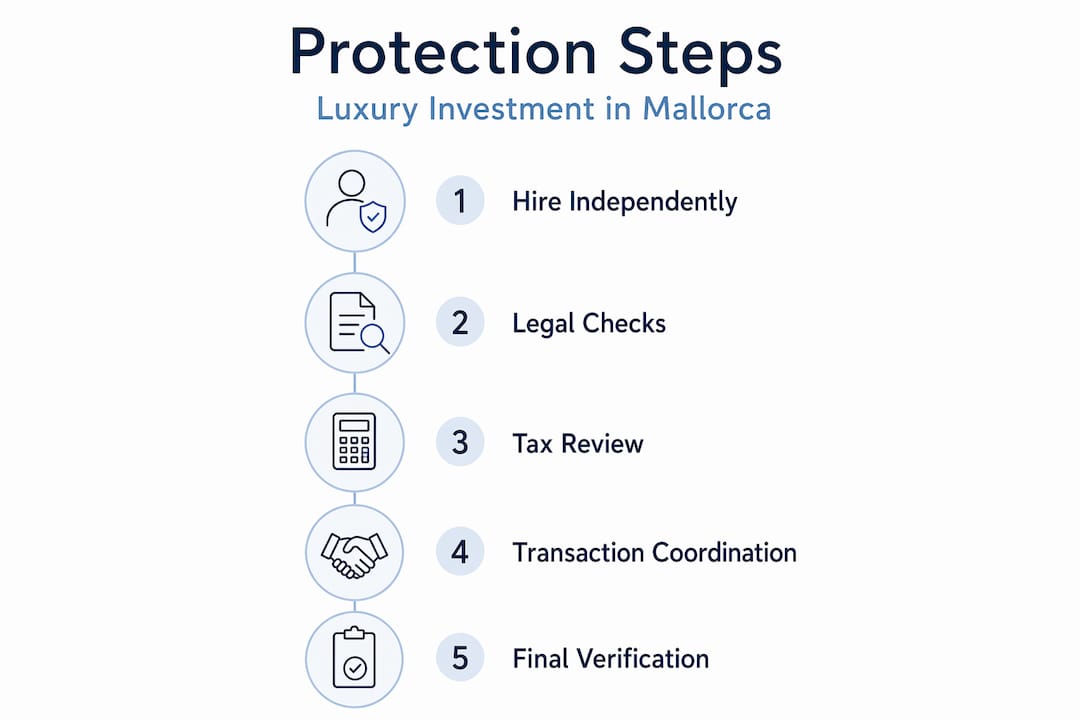
Pro Tip: Always hire advisers independently, not through recommendations from the seller’s agent. A referral from the selling side creates a conflict of interest that can compromise your negotiation position and due diligence quality.
Legal due diligence: Protecting your investment
Understanding who to hire is just the start. Next, let’s look at exactly what legal protection looks like in a real Mallorca transaction.
Legal due diligence mechanics include verifying title through a Nota Simple from the Land Registry, checking for liens and mortgages, confirming urban planning compliance, validating building licenses, checking community debts, and verifying that utility payments are current. Each step can reveal issues that derail a deal or, worse, saddle you with someone else’s liabilities.
Here is the typical sequence your lawyer follows:
- Nota Simple retrieval: Pulls the official title document from Spain’s Land Registry to confirm ownership, surface any mortgages, and identify registered encumbrances
- Urban planning check: Confirms the property sits within legal building parameters and has no pending demolition orders or illegal construction
- Building license validation: Verifies that the villa or apartment was constructed with proper permits and has a valid certificate of occupancy (Cédula de Habitabilidad)
- Community of owners debt check: Confirms no outstanding homeowner association fees, which transfer to the new owner under Spanish law
- Utility and tax debt search: Verifies that IBI (local property tax), water, and electricity accounts are current
- Coastal Law compliance: For beachfront properties, checks that the property does not fall within protected coastal zones under Spain’s Ley de Costas
The table below illustrates common issues found during due diligence and what your legal team can do about them:
| Issue discovered | Frequency | Legal remedy |
|---|---|---|
| Undisclosed mortgage | Common | Require payoff at closing or price reduction |
| Illegal extension or structure | Very common | Negotiate legalization or price adjustment |
| Pending community debt | Common | Escrow holdback from seller proceeds |
| Urban planning violation | Occasional | Injunction risk assessment; may abort deal |
| Coastal Law encroachment | Rare but costly | Full legal review; sometimes deal-breaker |
| Incorrect cadastral boundaries | Occasional | Registry correction before signing |
For a clear timeline of how this process unfolds, the Mallorca due diligence timeline walks you through each phase. If you want deeper insight into protecting U.S. buyers specifically, there is dedicated guidance on that as well. You can also reference this due diligence checklist as a cross-reference for investment property standards.
Pro Tip: Spanish notaries authenticate signatures and confirm legal formalities, but they do not independently verify the title or check for hidden liabilities. Your independent lawyer must perform that work. Relying on a notary for protection is one of the most common and expensive mistakes foreign buyers make.
Tax strategy and cross-border compliance essentials
Once legal risks are covered, maximizing your financial outcome means knowing exactly where Spanish and American tax rules overlap and collide.

Spain imposes multiple layers of taxation on non-resident property owners. Non-residents pay IRNR at 24% on imputed income calculated at 1.1 to 2% of the cadastral value annually, plus IBI at 0.4 to 1.1%, wealth tax above the €700,000 personal exemption (with the Balearic Islands offering an additional €3 million exemption for primary residences), and capital gains tax ranging from 19 to 28%. On top of Spanish obligations, U.S. worldwide taxation requires cross-border treaty relief and FATCA and FBAR reporting.
The ownership structure you choose on day one determines how much tax you pay for decades. The table below compares direct personal ownership against a corporate or SPV structure:
| Factor | Direct personal ownership | Corporate/SPV ownership |
|---|---|---|
| Spanish income tax (rental) | 24% IRNR flat rate | 25% corporate tax (IS) |
| Wealth tax exposure | Applies above exemption | Often higher scrutiny |
| Capital gains on sale | 19 to 28% | Potential share sale route |
| Inheritance simplicity | Complex cross-border | Potentially cleaner transfer |
| AML and compliance burden | Low | High; increased scrutiny |
| U.S. FATCA/FBAR obligations | Personal reporting | Entity plus personal reporting |
Key tax documents and filings every American buyer must understand:
- Model 210: Annual non-resident income tax return for imputed or actual rental income
- Model 720: Declaration of assets held abroad (mandatory for Spanish tax residents with overseas holdings above €50,000)
- FBAR (FinCEN 114): Required if your Spanish bank account balance exceeds $10,000 at any point during the year
- Form 8938 (FATCA): Reports specified foreign financial assets to the IRS when thresholds are met
- IBI receipt: Local property tax paid to the municipality annually; confirm the seller is current
- Plusvalía: Municipal capital gains tax calculated on land value appreciation; typically a seller obligation but worth confirming in your contract
For additional context on navigating Mallorca’s market from a financial planning perspective, our guide covers market dynamics alongside tax strategy. The FATCA and FBAR rules for foreign property buyers provide further detail on the U.S. side of the equation.
Coordinating the cross-border transaction: From NIE to notary
After tackling compliance, let us look at how advisers manage the practical logistics that can derail deals when mishandled.
Cross-border transaction methodology starts with obtaining your NIE (Número de Identificación de Extranjero), opening a Spanish bank account, using a power of attorney for remote signing, coordinating the notary deed, updating the Land Registry, and handling post-purchase tax filings including Models 210 and 720. Each of these steps involves bureaucratic hurdles that experienced advisers navigate routinely but that first-time buyers find paralyzing.
Here is the standard sequence from first contact to keys in hand:
- NIE application: Your lawyer applies for your Spanish tax identification number at a consulate or Spanish police station. Without it, no purchase can proceed.
- Spanish bank account opening: Required for the official payment transfer and for paying ongoing taxes. Many banks require in-person visits; your adviser can facilitate this remotely in some cases.
- Power of attorney (POA) execution: If you cannot travel to Spain for every stage, a notarized and apostilled POA allows your lawyer to sign documents on your behalf. This is standard practice for U.S. buyers.
- Private purchase contract (Contrato de Arras): A reservation deposit, typically 10% of the price, is paid here. Walk away after this point and you forfeit the deposit.
- Final due diligence window: Your legal team completes all checks between the Arras and the notary signing.
- Notary deed signing (Escritura Pública): The formal transfer of ownership. Funds transfer via bank wire on the same day.
- Land Registry update: Your lawyer registers your ownership within 10 to 15 business days.
- Post-purchase filings: Model 210 for the first tax year, IBI setup, and any required U.S. reporting initiated.
Critical documents your adviser team manages:
- NIE certificates for all purchasing parties
- Apostilled power of attorney documents
- Spanish bank account confirmation letters
- Property insurance binding before notary signing
- Transfer tax (ITP) payment confirmation (typically 8 to 11% in the Balearics for resale properties)
- Stamp duty for new construction properties
For a detailed walkthrough of each steps to buy property in Mallorca, that resource covers the full sequence with timelines.
Pro Tip: Choose advisers who have personally managed transactions for U.S. clients before, not just European ones. The POA requirements, IRS reporting integration, and FBAR compliance add layers that advisers unfamiliar with American clients simply miss.
Edge cases: Off-market properties, company ownership, and legal red flags
Now let us uncover risks and nuances that only surface in top-tier, high-value luxury transactions.
Corporate and SPV ownership through foreign companies is possible in Spain but carries real risks: higher effective tax rates, anti-avoidance scrutiny from Spanish tax authorities, full AML (anti-money laundering) checks on beneficial owners, and complex U.S. reporting for the underlying entity. Off-market luxury properties require discreet professional networks to access. Coastal and rural properties need special verification under Spain’s Coastal Law and rural land planning regulations.
The most complex scenarios advisers regularly handle include:
- Coastal Law (Ley de Costas) properties: Beachfront estates may sit within protected maritime zones. Ownership rights can be time-limited rather than permanent. Only an expert lawyer identifies this before you sign.
- Rural “rústico” land: Building rights on agricultural land are severely restricted in the Balearics. Many buyers discover post-purchase that extensions or new construction are impossible.
- Off-market estate acquisitions: The finest properties in Mallorca never reach public portals. Accessing them requires trusted relationships built over years. Advisers with genuine networks provide access that no search engine can replicate.
- Inherited or multi-owner titles: Properties passing through Spanish inheritance can carry complex co-ownership situations that require legal resolution before a clean transfer is possible.
- Money laundering compliance: High-value transactions above €1 million trigger enhanced due diligence on source of funds. Your legal team prepares the documentation package for Spanish notaries and financial institutions.
“What most agents won’t tell you: The most exclusive properties in Mallorca are sold before they are ever listed. And the most dangerous transactions involve coastal or rural assets that look straightforward but carry hidden legal time bombs. Only advisers who specialize in these categories can protect you.”
For a structured approach to these scenarios, the Mallorca international buyer checklist covers seven critical steps that address many of these edge cases. Understanding company ownership tax risks in more detail will help you decide whether a corporate structure genuinely serves your goals.
The uncomfortable truth about overseas advisers most Americans miss
Here is what we have seen repeatedly across years of working with American high-net-worth buyers in Mallorca: sophistication in domestic real estate does not transfer to international transactions. Buyers who have successfully closed dozens of deals in New York, Miami, or Los Angeles routinely underestimate how different the Spanish system is, and how specific the cross-border compliance piece is.
The most common misconception is that any licensed Spanish lawyer or local real estate agent can handle an American buyer’s needs. Buyer’s agents emphasize exclusive access and unbiased negotiation, lawyers stress independent due diligence because notaries do not verify title, and tax professionals warn specifically against unoptimized structures that lead to double taxation. These three roles require specialists, not generalists who do a bit of everything.
What most Americans get wrong, and how to correct it:
- Wrong: “The developer’s lawyer can represent both sides.” Right: Always hire your own independent legal counsel, period.
- Wrong: “I’ll sort out the U.S. tax reporting after closing.” Right: Your structure must be decided before you sign anything. Unwinding a bad structure post-purchase is expensive and sometimes impossible.
- Wrong: “The notary will catch any problems with the title.” Right: Notaries in Spain do not conduct independent title searches. Your lawyer must do this work.
- Wrong: “I only need local expertise.” Right: You need advisers who understand both Spanish property law and U.S. international tax compliance simultaneously.
- Wrong: “The price is what matters most.” Right: The structure, the tax position, and the legal cleanliness of the asset determine your actual return over time.
We have seen buyers save seven figures through proper pre-purchase tax structuring. We have also seen buyers inherit six-figure legal problems because they skipped independent due diligence. The fee for a full advisory team is always a fraction of what mistakes cost. For additional perspective on navigating the Mallorca market with experience behind you, our guide offers further context.
Secure your Mallorca investment with independent expert advisers
Working with independent buyer agents like ULI & LISA means your interests come first throughout every step of the process. We do not represent sellers. We do not earn commissions from developers. Our entire focus is on finding the right property for you, structuring the purchase correctly, and coordinating your legal, tax, and transaction team so that nothing falls through the cracks. From accessing off-market estates in the Tramuntana to coordinating your NIE and connecting you with bilingual U.S.-aware tax advisers, we manage the complexity so you can focus on the investment itself. Discover what safe property investment in Mallorca truly looks like when independent experts work solely for you.
Frequently asked questions
Do I need both a lawyer and a buyer’s agent when purchasing property in Mallorca?
Yes. Lawyers and buyer’s agents serve distinct roles: lawyers provide independent legal protection and due diligence, while buyer’s agents secure the best property and negotiate exclusively on your behalf.
How are property taxes calculated for American non-residents in Mallorca?
Non-residents face IRNR at 24% on imputed income, IBI annually, Balearic wealth tax above exemption thresholds, and capital gains tax of 19 to 28% on sale, all layered on top of U.S. worldwide income tax obligations.
What documents do advisers handle for American buyers?
Advisers coordinate NIE registration, bank accounts, apostilled powers of attorney, notary deeds, Land Registry updates, and Spanish tax filings including Model 210 and FBAR reporting support.
Are there advantages to buying property through a company or SPV?
Company ownership carries significant risks including higher effective taxes, enhanced anti-avoidance scrutiny, and complex AML compliance, making it suitable only in specific, adviser-confirmed scenarios.
What’s a common mistake American buyers make without advisers?
Many buyers create double taxation exposure by choosing the wrong ownership structure, or close on properties carrying undisclosed legal issues that the seller’s notary never flagged.
Recommended
- Mastering market analysis for luxury property in Mallorca - ULI & LISA Mallorca Property Blog
- Mallorca apartment rental: a luxury investor’s guide - ULI & LISA Mallorca Property Blog
- Key features of Mallorca homes: luxury, value, and security - ULI & LISA Mallorca Property Blog
- Mallorca Luxury Homes: Investment and Lifestyle Perks - ULI & LISA Mallorca Property Blog