
Purchasing a luxury home in Mallorca seems straightforward until you encounter the intricate web of Spanish financing regulations, legal compliance requirements, and tax implications that catch many high-net-worth American buyers off guard. The reality is that financing luxury Mallorca homes demands specialized knowledge of non-resident mortgage criteria, mandatory legal documentation, and strategic tax planning to protect your investment. This comprehensive guide clarifies the financing options available, breaks down Spanish legal procedures, and reveals tax considerations that directly impact your purchasing power and long-term returns in Mallorca’s competitive luxury market.
Key Takeaways
| Point | Details |
|---|---|
| Financing options | Non residents can obtain traditional mortgages for up to about 60 to 70 percent of the property value, while cash purchases remain common and offer speed and negotiating leverage. |
| Legal procedures | The purchase follows a multi stage process beginning with obtaining a NIE and opening a Spanish bank account, followed by completing required documentation and fees. |
| Tax considerations | Tax implications vary by residency status and financing structure and can affect purchasing power and long term returns. |
| Expert guidance | Working with experienced buyer agents helps simplify financing, navigate legal steps, and secure favorable terms. |
Overview of financing options for Mallorca homes
High-net-worth American buyers pursuing luxury properties in Mallorca face three primary financing pathways, each with distinct implications for closing speed, negotiation leverage, and long-term financial strategy. Understanding these options before property hunting begins positions you to act decisively when the perfect villa appears.
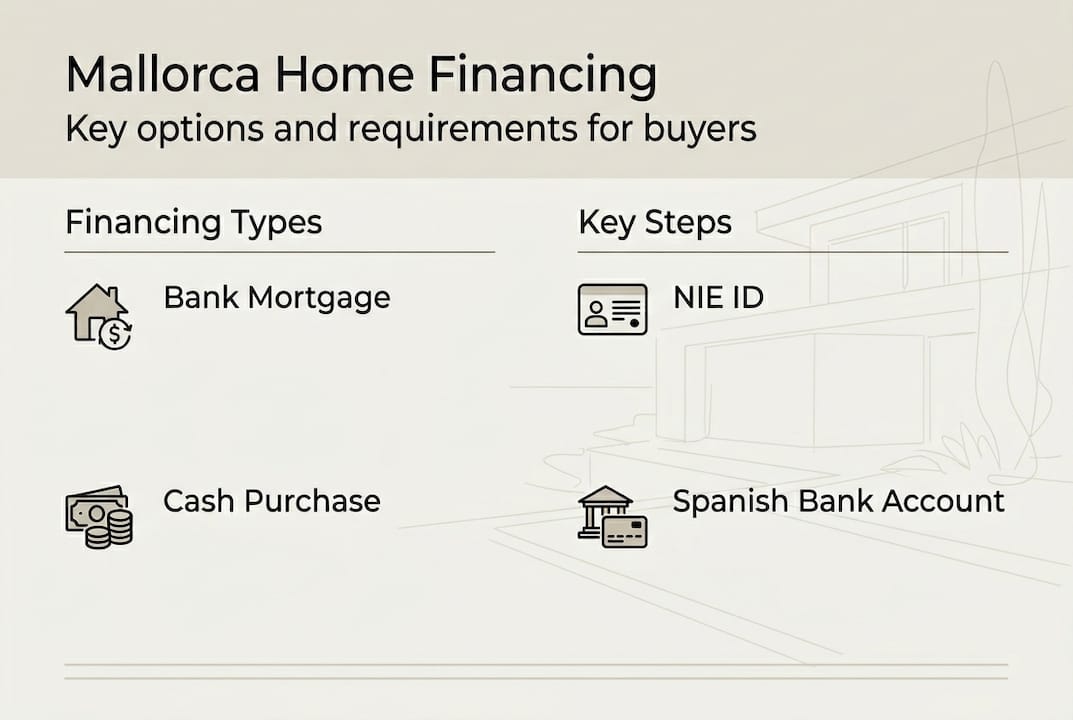
Traditional mortgage solutions Mallorca banks offer typically provide financing up to 60-70% of the property value for non-residents, compared to 80% for Spanish residents. These mortgages require extensive documentation including proof of income from the past two years, tax returns, bank statements, and a clean credit history. Interest rates for non-residents generally range 0.5-1% higher than resident rates, reflecting the perceived additional risk. Spanish banks also mandate life insurance and property insurance as loan conditions, adding to the overall financing cost.
Cash purchases dominate Mallorca’s luxury market, with wealthy buyers preferring the speed and negotiating power that immediate liquidity provides. Sellers often accept lower offers from cash buyers because transactions close in 4-6 weeks rather than the 3-4 months typical for financed purchases. Cash also eliminates mortgage approval uncertainty, making your offer more attractive in competitive bidding situations. However, moving large sums internationally triggers currency exchange considerations and potential tax reporting requirements in both the US and Spain.
Alternative financing solutions include private loans from international banks familiar with cross-border transactions, home equity lines of credit against US properties, and portfolio loans for buyers with substantial investment assets. These options often provide more flexibility than Spanish mortgages but may carry higher interest rates or require personal guarantees beyond the property itself.
Before pursuing any financing route, you must obtain a NIE (Número de Identificación de Extranjero), the foreigner identification number required for all financial transactions in Spain. This process takes 2-4 weeks and requires either traveling to Spain or appointing a legal representative with power of attorney. Opening a Spanish bank account follows NIE acquisition and facilitates mortgage applications, utility payments, and ongoing property expenses.
Pro Tip: Secure pre-approval from Spanish banks before viewing properties to demonstrate serious buyer intent and accelerate negotiations when you find your ideal home. Pre-approval also reveals your exact budget including all associated costs, preventing emotional attachment to properties beyond your financial reach.
Spanish legal requirements and property purchase process
Navigating Spanish property law requires understanding a multi-stage process designed to protect both buyers and sellers while ensuring government tax collection and proper ownership registration. Each stage involves specific documentation, fees, and legal obligations that Americans often find unfamiliar compared to US real estate transactions.
The purchase process begins with obtaining your NIE, followed by opening a Spanish bank account to facilitate all financial transactions. Once you identify a property, the reservation contract (contrato de reserva) secures the property off-market for 1-4 weeks while due diligence occurs. This contract typically requires a deposit of 3,000-10,000 euros, which applies toward the purchase price if the transaction proceeds or may be forfeited if you withdraw without valid cause.
The private purchase contract (contrato de compraventa privado) follows successful due diligence and commits both parties to the sale terms. This stage requires a deposit of 10% of the purchase price and establishes the closing date, typically 4-8 weeks later. During this period, your lawyer verifies the property has clear title, no outstanding debts or liens, proper building permits for all structures, and compliance with local zoning regulations.
The public deed (escritura pública) represents the final transaction stage, executed before a Spanish notary who verifies all parties’ identities, confirms the property’s legal status, and witnesses the final payment transfer. The notary reads the entire deed aloud in Spanish, though translators assist non-Spanish speakers. Notary fees range from 0.5-1% of the purchase price depending on property value and complexity.
Registering the property at the Land Registry (Registro de la Propiedad) protects your ownership rights against future claims and makes the purchase publicly official. Your lawyer handles this registration, which costs approximately 0.5% of the property value and takes 2-4 weeks to complete. Until registration finalizes, your ownership remains vulnerable to competing claims despite holding the notarized deed.
Legal fees for the complete Mallorca property buying guide process typically total 2-3% of the purchase price, covering lawyer services, notary fees, and registry costs. Transfer tax (Impuesto de Transmisiones Patrimoniales) adds another 8-11% depending on the Balearic Islands’ current rate structure and property characteristics. New construction purchases substitute VAT at 10% for transfer tax, plus a 1.5% stamp duty.
Pro Tip: Engage an independent buyer agent familiar with Spanish property law from your first property viewing to identify potential legal issues before emotional attachment develops. Agents experienced with buying checklist for Americans prevent costly mistakes that surface only after deposits are paid.
Tax implications and financial planning for non-resident buyers
Tax obligations for American buyers financing Mallorca properties extend far beyond the initial transfer tax, creating ongoing annual costs and potential liabilities that significantly impact investment returns. Strategic tax planning during the financing decision reveals opportunities to minimize these obligations while maintaining full compliance with Spanish and US regulations.
Annual property tax (Impuesto sobre Bienes Inmuebles or IBI) applies to all property owners regardless of residency status, calculated as a percentage of the cadastral value, the official government assessment typically 50-70% of market value. IBI rates in Mallorca range from 0.4-1.1% of cadastral value depending on the municipality, with luxury coastal areas generally charging higher rates. A property with a 500,000 euro market value might have a 300,000 euro cadastral value, generating annual IBI of 1,200-3,300 euros.
Non-resident property owners face annual income tax obligations even without rental activity. Spain imputes theoretical rental income at 1.1% of cadastral value for properties not generating actual rental income, taxing this imputed amount at 19% for EU residents and 24% for non-EU residents including Americans. This creates an annual tax of approximately 200-800 euros for typical luxury properties, paid through the annual non-resident income tax return (Modelo 210).
Rental income from financed investment properties faces taxation in both Spain and the US, though tax treaties prevent double taxation through foreign tax credits. Spain taxes non-resident rental income at 19% after allowing deductions for property expenses, maintenance, insurance, and mortgage interest. Proper documentation of all deductible expenses significantly reduces tax liability, making meticulous record-keeping essential for investment properties.
| Tax Type | Rate Range | Calculation Basis | Payment Frequency |
|---|---|---|---|
| Property Transfer Tax | 8-11% | Purchase price | One-time at purchase |
| Annual IBI | 0.4-1.1% | Cadastral value | Annual |
| Non-resident Income Tax | 19-24% | Imputed or actual rental income | Annual |
| Capital Gains Tax | 19% | Profit on sale | At sale |
| Wealth Tax | 0.5-3.45% | Net worth over threshold | Annual if applicable |
Capital gains tax applies when selling Mallorca properties, calculated at 19% of the profit (sale price minus purchase price and improvement costs). The financing method affects this calculation because mortgage interest paid during ownership doesn’t reduce capital gains, while cash purchases avoid interest costs entirely. Sellers must also account for a 3% retention that buyers withhold from the sale price and remit directly to Spanish tax authorities, later credited against the final capital gains tax liability.
Wealth tax (Impuesto sobre el Patrimonio) targets high-net-worth individuals with Spanish assets exceeding approximately 700,000 euros, though exemption thresholds and rates vary by region. The Balearic Islands apply wealth tax on a sliding scale from 0.5-3.45% on net worth above the threshold. Safe property investment Mallorca strategies often structure ownership through Spanish corporations or trusts to optimize wealth tax exposure, though these structures require expert legal and tax guidance to ensure compliance.
American buyers must also report foreign financial accounts exceeding $10,000 to the US Treasury through FBAR filings, and foreign real estate holdings may trigger additional IRS reporting requirements. The complexity of dual-country tax obligations makes professional tax planning essential during the financing decision, as the structure you choose now affects tax efficiency for years to come.
Comparing financing solutions and applying expert strategies
Selecting the optimal financing approach for your Mallorca luxury home requires weighing multiple factors including transaction speed, total cost, tax implications, and personal financial strategy. Each financing method offers distinct advantages that align with different buyer profiles and investment objectives.
Spanish bank mortgages provide the lowest interest rates among financing options, currently ranging 3.5-5% for non-residents depending on loan-to-value ratio, property type, and borrower creditworthiness. These mortgages preserve your liquidity for other investments while mortgage interest creates tax-deductible expenses against rental income if you generate rental revenue. However, Spanish mortgages demand extensive documentation including translated and apostilled financial records, require 30-40% down payments for non-residents, and extend the purchase timeline by 6-10 weeks for approval and processing.
International financing through US or global banks familiar with cross-border transactions offers faster approval than Spanish mortgages, often within 2-3 weeks, because these institutions already hold your financial records and credit history. Rates typically run 1-2% higher than Spanish mortgages but avoid currency exchange on monthly payments if denominated in dollars. The tradeoff involves higher interest costs over the loan term and potential complications if property values decline, creating negative equity in euro terms even as dollar values remain stable.
Cash purchases eliminate interest costs entirely, saving 100,000-300,000 euros over a typical 15-20 year mortgage term on luxury properties. Sellers favor cash buyers, often accepting 5-10% below asking price for transaction certainty and speed. Closing occurs in 4-6 weeks rather than 3-4 months, crucial in competitive markets where desirable properties receive multiple offers. The primary drawback involves opportunity cost, as capital tied up in real estate can’t generate returns in other investments, and large international transfers trigger currency exchange costs of 1-3% plus potential tax reporting requirements.
| Financing Method | Typical Timeline | Interest Rate Range | Down Payment Required | Best For |
|---|---|---|---|---|
| Spanish Bank Mortgage | 10-16 weeks | 3.5-5% | 30-40% | Buyers prioritizing lowest rates and tax deductions |
| International Financing | 6-8 weeks | 5-7% | 20-30% | Buyers wanting dollar-denominated loans and faster approval |
| Cash Purchase | 4-6 weeks | 0% | 100% | Buyers seeking maximum negotiation leverage and speed |
| Hybrid Approach | 8-12 weeks | Varies | 50-70% | Buyers balancing liquidity preservation with competitive offers |
Currency exchange risk affects all financing decisions for American buyers, as euro-dollar fluctuations impact both purchase costs and ongoing expenses. Buyers financing in dollars face exchange rate risk on every mortgage payment, while cash buyers lock in exchange rates at purchase but face ongoing risk for property taxes, maintenance, and utilities. Forward contracts and currency hedging strategies mitigate these risks but add complexity and cost to the transaction.
Tax consequences vary significantly by financing method. Mortgage interest deducts against rental income, reducing Spanish tax liability for investment properties. Cash purchases avoid interest costs but lose this deduction, potentially increasing net tax obligations despite lower gross costs. The optimal choice depends on whether you plan to generate rental income, your US tax bracket, and your overall investment portfolio strategy.
Pro Tip: Customize your financing strategy with expert agents who understand both Spanish regulations and American financial planning to meet your personalized investment goals. The steps to buying Mallorca real estate involve dozens of decisions that interact with financing choices, making comprehensive guidance essential for optimal outcomes.
Partner with expert buyer agents for secure Mallorca investments
Navigating Mallorca’s luxury property market while managing complex financing, legal compliance, and tax optimization requires specialized expertise that general real estate agents rarely possess. ULI & LISA specialize exclusively in representing international buyers, particularly Americans, through every stage of the Mallorca purchase process. Their services extend beyond property identification to comprehensive financing consultation, ensuring you select the mortgage or cash strategy that aligns with your investment objectives and tax situation. Legal compliance checks verify every document meets Spanish requirements before you commit funds, while tax strategy support coordinates with your US advisors to optimize efficiency across both jurisdictions. Engaging independent buyer agents who understand American financial planning and Spanish regulations reduces risks, streamlines the complex purchase process, and protects your investment from costly mistakes that surface only after closing. Discover how safe property investment Mallorca expertise transforms the purchasing experience, or explore comprehensive buyer services at ULI & LISA.
FAQ
Can non-residents qualify for a mortgage in Mallorca?
Yes, non-residents can obtain mortgages in Mallorca but face stricter criteria than Spanish residents. Banks typically require 30-40% down payments compared to 20% for residents, plus comprehensive income documentation including two years of tax returns, bank statements, and employment verification. Credit checks from your home country and proof of existing assets strengthen applications, while most lenders cap loan-to-value ratios at 60-70% for non-residents versus 80% for residents.
What taxes must buyers consider when financing a Mallorca property?
Buyers face property transfer tax averaging 8-11% of the purchase price, paid at closing along with notary and registry fees totaling another 1-1.5%. Annual IBI property tax ranges 0.4-1.1% of cadastral value, while non-residents pay income tax on imputed rental income even without actual renters. Investment properties generating rental income face 19% tax on net rental profits after deducting mortgage interest, maintenance, and operating expenses.
Are there benefits to paying cash versus financing in Mallorca?
Cash offers provide significant advantages including 20-40% faster closing times, stronger negotiating position often yielding 5-10% price reductions, and elimination of interest costs saving 100,000-300,000 euros over typical loan terms. However, financing preserves liquidity for other investments, creates tax-deductible interest expenses against rental income, and allows diversification rather than concentrating wealth in a single asset. The optimal choice depends on your broader financial strategy, investment timeline, and whether you plan to generate rental revenue.
How can buyer agents assist with financing and purchase compliance?
Experienced buyer agents identify the best financing routes by analyzing your financial profile, investment goals, and tax situation to recommend Spanish mortgages, international financing, or cash purchases. They ensure full legal compliance by coordinating with lawyers, notaries, and tax advisors throughout the purchase process, verifying all documentation meets Spanish requirements before you commit funds. Agents protect buyer interests by conducting thorough due diligence, negotiating favorable terms, and preventing common pitfalls that cost Americans thousands in avoidable fees and taxes.
Recommended
- How to Finance Mallorca Property: Your Guide to Luxury Living - ULI & LISA Mallorca Property Blog
- How to Navigate Mallorca Real Estate Market: Luxury Buyer’s Guide - ULI & LISA Mallorca Property Blog
- Top Tips for Buying Mallorca Homes with Confidence - ULI & LISA Mallorca Property Blog
- How to Finance Property in Mallorca: A Step-by-Step Guide - ULI & LISA Mallorca Property Blog
- 7 Schritte zur perfekten Immobilien Checkliste 2026