
TL;DR:
- Mallorca offers a high quality of life, excellent healthcare, and vibrant expat communities for American retirees.
- However, navigating Spanish residency, cross-border taxes, and property laws requires careful planning and professional guidance.
Mallorca is not simply a postcard destination. It is one of Europe’s most resilient choices for American retirees seeking a genuine quality-of-life upgrade, strong property values, and a community that actually supports long-term living. But here is the surprising reality: the biggest obstacle to retiring here is rarely falling in love with the island. It is navigating the tangle of Spanish residency law, cross-border US tax obligations, FATCA reporting, and property ownership structures. Get the planning right, and Mallorca rewards you generously. Underestimate it, and even the most beautiful villa can become a compliance headache.
Key Takeaways
| Point | Details |
|---|---|
| Mallorca’s unique lifestyle | Mallorca offers a mix of Mediterranean climate, luxury amenities, and a robust expat community appealing to US retirees. |
| Visa and legal hurdles | Americans must navigate Spain’s Non-Lucrative Visa or other residency options, requiring rigorous paperwork and financial evidence. |
| Cross-border tax complexity | Dual tax reporting and compliance obligations are central to successful planning for US retirees. |
| Smart investment choices | Luxury property in Mallorca combines lifestyle value with strong investment potential—when chosen strategically. |
| Expert guidance pays off | Partnering with local professionals reduces legal risks and maximizes lifestyle and financial benefits. |
What makes Mallorca stand out for American retirees?
Mallorca has earned its reputation well beyond tourist brochures. For Americans used to high standards in healthcare, infrastructure, and social life, the island consistently delivers. The public and private healthcare systems here are world-class by European standards, and many international clinics have English-speaking staff who understand the needs of foreign residents. Mallorca is an established expatriate and retirement destination, with international infrastructure and access to healthcare that many retirees cite as key benefits.
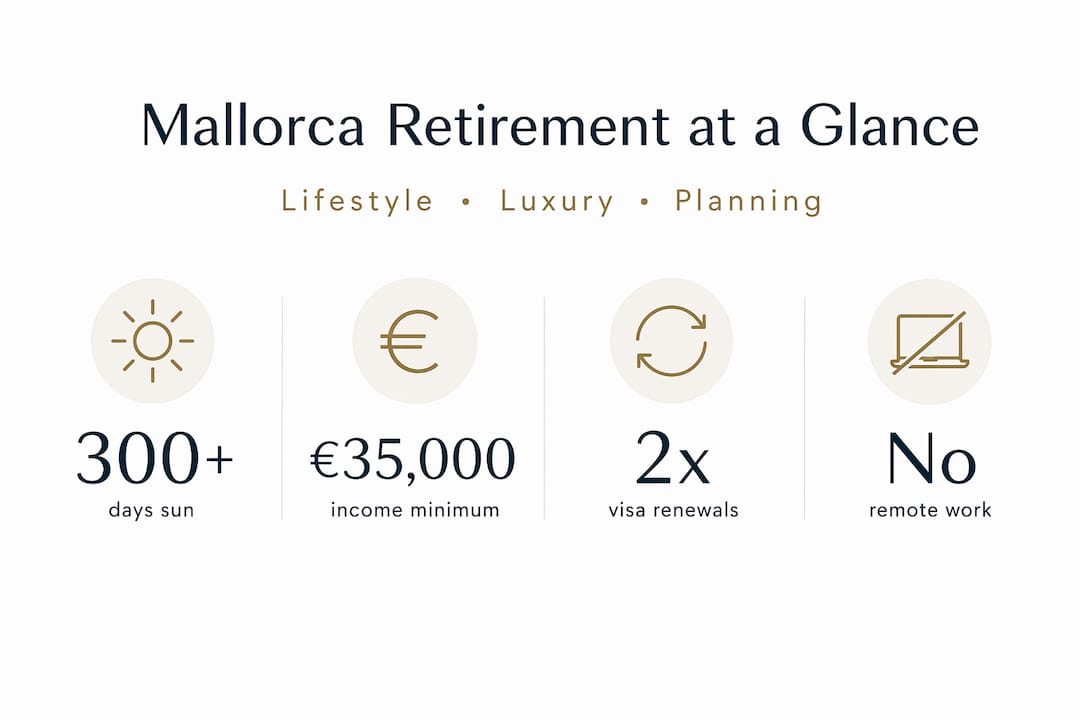
The climate alone is remarkable. Mallorca enjoys over 300 days of sunshine annually, mild winters, and a Mediterranean coast that stays swimmable well into October. But what distinguishes it from other sun-drenched retirement spots is its balance: you get the natural beauty alongside genuinely urban conveniences. Palma de Mallorca, the island’s capital, has Michelin-starred restaurants, world-class art museums, luxury marina developments, and a vibrant cultural calendar that rivals many European capitals.
One underappreciated advantage is the strength of American expat communities across the island. These networks provide everything from physician referrals to tax advisor recommendations to informal social connections that make the first year of living abroad far less disorienting. Established expat groups hold regular events, and there are English-speaking legal and financial professionals who specialize specifically in serving American residents.
Key lifestyle advantages for American retirees:
- Palma International Airport connects directly to major European hubs, with easy transatlantic routing through Madrid or Barcelona
- International schools serve expat families, making multi-generational living feasible
- High-speed fiber internet is widely available, supporting remote work or active investment management
- Safety ratings consistently rank Mallorca among Spain’s safest regions
- Luxury vacation rental benefits are accessible when you want to test areas before committing to purchase
“The Mediterranean lifestyle is not just slower—it is smarter. Meals are longer, relationships deepen over time, and the daily rhythm encourages the kind of active, engaged retirement that health research consistently associates with longevity.”
With the big picture set, it’s critical to understand the residency path and legal realities for Americans.
Visa realities: Residency routes and legal essentials
Most Americans who retire in Mallorca long-term use the Non-Lucrative Residence Visa (also called the Non-Working Visa). This is Spain’s primary pathway for financially independent retirees who do not plan to work in the country. The core requirement is demonstrating sufficient passive income to support yourself without employment. Retirement in Mallorca requires a legal right to reside, typically via Spain’s non-working (non-lucrative) residence visa if you have passive income.
The financial threshold for 2026 is approximately 2,400 euros per month for a single applicant, with additional amounts required per dependent family member. This income must come from passive sources: pensions, Social Security, dividends, rental income, or investment returns. Salary or active business income does not qualify.
Steps in the Non-Lucrative Visa application process:
- Gather documentation: bank statements (typically covering 12 months), proof of income sources, criminal background check, and a certified medical certificate
- Obtain private health insurance coverage with no co-pays, valid in Spain
- Have all documents apostilled (officially certified for international use) and translated into Spanish by a sworn translator
- Submit the full application at the Spanish Consulate in your US jurisdiction
- Wait for approval (typically 30 to 90 days), then travel to Mallorca within the visa validity window
- Register with local Spanish authorities (empadronamiento) within 30 days of arrival
- Apply for your foreigner identification number (NIE) and residence card (TIE)
Residency planning for non-EU applicants often hinges on administrative rigor and documentation completeness; failures commonly stem from paperwork and proof-of-means issues.
The most common rejection trigger is incomplete documentation. A missing apostille, a bank statement that does not clearly show the required monthly income average, or a health insurance policy with coverage gaps can stall or kill an application. Many Americans underestimate how precise Spanish bureaucracy can be.
Pro Tip: Work with a Spanish immigration lawyer who handles American clients specifically. The investment is modest compared to the cost of a rejected application, an emergency flight back to the US, or months of delay.
The non-lucrative visa also has a critical restriction: no gainful activity. This includes many forms of remote work. If you plan to maintain consulting contracts, freelance income, or active management of a US business, you need to explore alternative visa categories or restructure your professional arrangements before applying. Check our Mallorca residency guide for a full breakdown of residency options for property buyers.
One more practical note: the visa is initially granted for one year, then renewable for two-year periods. Maintaining residency requires spending at least 183 days per year in Spain, which also has significant tax implications covered in the next section.
You can also explore information about the property registration guide to understand how legal residency interacts with property ownership in Spain.
Cross-border finances: Taxes, reporting, and compliance
This is the section most Americans wish they had read before making any decisions. Cross-border tax and reporting complexity is a major reason to plan carefully, including double taxation risk, worldwide taxation if resident, and special US compliance like FATCA and FBAR.
Here is the core issue: the US taxes its citizens on worldwide income, regardless of where they live. Spain taxes its residents on worldwide income after 183 days in-country. So if you are a legal resident of Mallorca and a US citizen, you are potentially reporting to two governments simultaneously on the same income.
Key tax and compliance obligations for US retirees in Mallorca:
- File a US federal tax return every year, including all Spanish and global income
- File an FBAR (FinCEN Form 114) if foreign financial accounts exceed $10,000 at any point during the year
- Comply with FATCA (Foreign Account Tax Compliance Act) by filing Form 8938 if foreign assets exceed applicable thresholds
- Pay Spanish income tax (IRPF) on worldwide income as a Spanish resident
- Report any property owned in Spain on IRS Form 8938 if applicable
| Tax obligation | Authority | Threshold | Penalty for non-compliance |
|---|---|---|---|
| Federal income tax return | IRS | All income | Up to 25% of unpaid tax plus interest |
| FBAR filing | FinCEN | $10,000 in foreign accounts | Up to $10,000 per violation (non-willful) |
| FATCA (Form 8938) | IRS | $200,000 (single, abroad) | $10,000 per failure to file |
| Spanish IRPF | Spanish tax authority | Residency status | Varies by bracket |
The US-Spain tax treaty does exist and provides some protection against paying full tax in both countries simultaneously. But it does not eliminate the obligation to file in both countries. Credits and exemptions must be actively claimed; they are not automatic.
Pro Tip: Hire a cross-border tax accountant who holds credentials in both US and Spanish tax law. A generalist who handles only US returns will miss critical Spanish filing requirements, and a Spanish gestor (tax advisor) without US expertise will not understand FBAR or FATCA at all.
Smart ownership structuring also matters. How you hold your Mallorca property (personally, through a US LLC, or through a Spanish entity) affects both your Spanish tax liability and your US reporting obligations. Get this wrong at purchase and unwinding it later is expensive.
Explore our detailed US-Spain property tax tips and our Mallorca tax guide for US buyers for specifics on property-related tax planning. The Spanish property taxes guide also offers a useful overview of acquisition costs, annual taxes, and rental income obligations.
Investing for lifestyle and legacy: Luxury property and community integration
Once your residency and tax framework is in place, the actual joy of property investment in Mallorca comes into focus. This is where lifestyle and financial strategy genuinely align.

The Mallorca luxury market has shown remarkable resilience. Prime areas like Puerto Andratx, Son Vida, Santa Ponsa, and the coastal zones around Alcúdia consistently attract international buyers. Price appreciation has outpaced many other European luxury markets, and the island’s limited land supply (much of it protected natural reserve) creates a structural argument for long-term value retention.
What to evaluate when choosing a luxury property:
- Location relative to amenities: Golf courses, marinas, private beaches, and international schools all affect both lifestyle and rental yield
- Rental licensing status: Tourist rental licenses (ETV licenses) in Mallorca are tightly controlled; confirm legal rental status before purchase if income generation is part of your plan
- Energy efficiency rating: Spanish law increasingly requires higher ratings; a lower-rated property can mean significant renovation costs
- Community fees and maintenance: Luxury properties in gated communities carry ongoing costs that affect total return
- Title clarity and legal encumbrances: Never skip a full due diligence search on the property registry
Community integration is largely driven by location choice. Southwest Mallorca (Andratx, Calvià) has the densest concentration of English-speaking expat services. The northeast (Pollença, Alcúdia) offers a quieter, more authentically Spanish atmosphere with a growing international community. Palma itself suits those who want city access alongside Mediterranean living.
For multi-generational planning, buying vacation homes in Mallorca can serve dual purposes: a primary residence for you and a retreat for adult children who visit. This type of legacy planning requires attention to Spanish inheritance law, which differs significantly from US estate law and can create unexpected tax liabilities for heirs.
Mallorca luxury vacation homes investment advantages in 2026 are substantial for buyers who approach the market strategically. Our retirement property guide walks through the full decision framework for Americans at this stage.
The non-lucrative visa’s income and lifestyle requirements reinforce the value of owning a well-chosen property: it stabilizes your lifestyle costs, builds wealth outside the US dollar, and signals long-term commitment to Spanish authorities.
Pro Tip: Before committing to a specific property, spend at least one full winter season renting in your target area. Mallorca’s character shifts dramatically between July and January, and the community you want to be part of year-round may be very different from the summer crowd.
The uncomfortable truth: Planning beats paradise
We have worked with many American professionals who arrived in Mallorca utterly enchanted and completely underprepared. The fantasy is consistent: sell the house in Greenwich or Scottsdale, buy a villa with a sea view, and let the Mediterranean do the rest. The reality is more demanding, and more rewarding when you get it right.
The deepest regrets we hear are never about the lifestyle. Nobody regrets the food, the climate, or the community. Regrets cluster around three areas: visa choices that locked people out of income streams they needed, compliance failures that triggered IRS penalties years after the move, and property purchases made without understanding Spanish inheritance law or rental licensing restrictions.
The smartest retirees we work with treat Mallorca as a serious strategic decision, not a romantic impulse. They assemble a team before they move: an immigration lawyer, a cross-border tax accountant, a notary-level legal advisor in Spain, and an independent property agent who works exclusively for the buyer. They understand why using a buyer agent in Mallorca is not a luxury but a form of financial protection.
The Mediterranean lifestyle is genuinely extraordinary. But it is not self-organizing. The Americans who thrive here long-term are the ones who invested time and professional resources into the legal and financial framework before they ever signed a purchase agreement. Paradise is the reward for planning, not a substitute for it.
Next steps: Secure your Mallorca retirement the smart way
Retiring in Mallorca with confidence means having the right team on the ground. At ULI & LISA, we are independent buyer agents who work exclusively for you, not for sellers or developers. We use AI-powered market tools to give you an unbiased view of Mallorca’s entire luxury property market, and we specialize in guiding American clients through the legal, residency, and financial complexities that come with cross-border moves. Explore our full Mallorca luxury real estate services or learn more about how our safe property investment services protect your interests at every step. Let us help you build a retirement in Mallorca that is legally sound, financially smart, and genuinely fulfilling.
Frequently asked questions
Can Americans retire in Mallorca without a Spanish visa?
No. Americans planning to stay long-term need a legal residency permit, most commonly the Non-Lucrative Visa, which requires proof of passive income and private health insurance with no co-pays.
What is the biggest mistake Americans make when retiring in Mallorca?
Most struggle with visa documentation and severely underestimate their ongoing US reporting duties, including FBAR and FATCA, which creates costly compliance failures years after the move.
Does buying property in Mallorca guarantee residency?
No. Property purchase is completely separate from residency rights. You must independently qualify for and receive a residency visa by meeting income and documentation requirements.
Are US retirees taxed on worldwide income in Mallorca?
Yes. US citizens must file US federal returns on all global income and, once legally resident in Spain for over 183 days, may also be subject to Spanish worldwide income tax under IRPF rules.
Is remote work allowed on a Non-Lucrative Visa in Mallorca?
No. The Non-Lucrative Visa prohibits gainful activity, including remote work for a foreign employer, which can push some applicants toward different visa categories entirely.
Recommended
- Mallorca Luxury Homes: Investment and Lifestyle Perks - ULI & LISA Mallorca Property Blog
- Mallorca luxury vacation homes: investment advantages in 2026 - ULI & LISA Mallorca Property Blog
- Understanding the Mallorca Retirement Property Guide - ULI & LISA Mallorca Property Blog
- Advantages of living in Mallorca for luxury buyers 2026 - ULI & LISA Mallorca Property Blog