TL;DR:
- Mallorca’s heritage protections, especially BIC status, impose strict renovation and sale restrictions.
- Foreign buyers face no legal bans but must navigate complex heritage confirmation and due diligence.
- Patience and thorough pre-purchase research are essential for successful heritage property investment.
Most high-net-worth buyers assume that once they have the capital, acquiring a magnificent historic estate in Mallorca is simply a matter of negotiation. That assumption has stopped deals cold. Mallorca’s heritage property framework is a layered legal system that can block construction, halt sales, and expose owners to serious fines, regardless of how much money they bring to the table. This guide unpacks the cataloguing system, explains cross-border freedoms and limitations, and shows you how to approach these exceptional assets with the legal clarity and strategic patience that the market demands.
Key Takeaways
| Point | Details |
|---|---|
| Protections can block deals | Legal safeguards for heritage properties may prevent or complicate sales and renovations, even for well-resourced buyers. |
| No foreign quotas apply | Americans and other non-EU buyers face no legal bans for purchasing heritage property in Mallorca as of 2026. |
| Grants aid restorations | Public funding exists for BIC property rehabilitations, but availability is limited and competition is high. |
| Due diligence is critical | Comprehensive legal and architectural checks early in the process are essential to prevent expensive delays or disputes. |
| Heritage estates drive value | Limited supply and exclusive status mean properly restored properties often see exceptional price appreciation. |
Understanding heritage property protection in Mallorca
Mallorca’s heritage protection system operates on two primary levels, and understanding the difference between them is non-negotiable before you make any offer on a historic property.
The highest tier is the BIC designation, short for Bien de Interés Cultural (Asset of Cultural Interest). This is Spain’s most stringent heritage classification, and it functions almost like a national easement on the property. A BIC listing means the government retains a legal stake in how the asset is used, modified, and even sold. Owners cannot simply decide to gut a baroque façade or add a swimming pool where a historic courtyard once stood. Every proposed change requires formal review, and the bar for approval is high.
Below BIC, Mallorca’s municipalities operate their own heritage catalogues. Towns like Pollença, Sóller, and Alcúdia maintain detailed registers that assign properties one of two protection levels:
- Comprehensive protection: Full architectural integrity must be preserved. Interior layouts, structural elements, and exterior facades are all controlled.
- Partial protection: Certain components are protected while others allow for modern intervention, but a conservation study is still required before any permit is issued.
| Protection level | Who controls it | Renovation freedom | Conservation study required |
|---|---|---|---|
| BIC | Spanish national/regional government | Very limited | Always |
| Comprehensive catalogue | Municipal authority | Limited | Always |
| Partial catalogue | Municipal authority | Moderate | Usually required |
| Unlisted historic property | Standard planning process | Flexible | Rarely required |
The legal weight of these protections is not theoretical. A widely cited court ruling in Mallorca confirmed that BIC status held firm even when property owners and developers challenged the classification on procedural grounds. Heritage catalogues in places like Pollença impose strict levels of protection requiring conservation studies, with meaningful penalties for non-compliance. Courts have repeatedly sided with the heritage authority over private ownership interests. Fines for unauthorized work can exceed €300,000, and authorities have the power to mandate restoration at the owner’s expense, a cost that can dwarf the original fine.
Understanding Mallorca property laws for buyers is foundational, and heritage classification is one of the most consequential variables in that legal landscape.
Foreign buyers: Regulatory hurdles and cross-border freedoms
American investors frequently arrive in Mallorca with a concern that seems reasonable on the surface: will Spain restrict their ability to buy a protected historic property? The answer, as of 2026, is more reassuring than the political noise might suggest.
No foreign buyer quotas or bans have been enacted as of 2026, and the Balearic Islands government has actively opposed proposals to limit foreign acquisition. This stance is not simply political preference. Spain’s EU membership means that most nationality-based property restrictions would conflict directly with EU free movement of capital rules. Even non-EU buyers like Americans benefit from this framework because the legal baseline for property transactions is set at the European level.
That said, there is an important distinction between what is legally permitted and what is politically discussed. Debates about housing affordability have led some Spanish politicians to propose tighter controls on foreign buyers, particularly in high-demand islands like Mallorca. None of these proposals have become law, but the debate continues. This is why staying informed is not optional.
“The Balearic government has been clear: restricting foreign buyers is not their policy direction. But policy conversations move faster than legislation, and smart investors track both.”
Here are the concrete steps an American buyer should take to ensure a clean acquisition:
- Obtain a NIE number (Número de Identificación de Extranjero): This Spanish tax ID is mandatory for any real estate transaction and should be secured before negotiations begin.
- Open a Spanish bank account: While technically possible to transact through foreign accounts, a local account simplifies everything from tax payments to utility transfers.
- Engage a Spanish notary and an independent property lawyer: The notary formalizes the transfer, but only an independent lawyer will protect your specific interests in due diligence.
- File for currency reporting compliance in the US: Americans must report foreign real estate and financial accounts to the IRS and FinCEN under FBAR and FATCA rules. Your US tax advisor needs to be involved from the start.
- Verify the property’s heritage status before contracting: Ask for a full extract from the municipal heritage catalogue and a BIC check with the regional government before signing any binding agreement.
Pro Tip: Monitor the Spanish government’s housing policy announcements every few months. Even if no restrictions pass, new compliance requirements or taxes targeting foreign buyers could emerge with short lead times. Being caught unprepared costs time and money.
Avoiding foreign buyer pitfalls is far easier when you understand the regulatory landscape from day one. It also helps to know the Mallorca property types guide so you can identify which categories carry the heaviest regulatory burden.
Ownership responsibilities and renovation rules for heritage properties
Buying a catalogued or BIC property is not the end of the regulatory journey. It is the beginning of a structured ownership relationship with the local and regional heritage authority. This is where many buyers underestimate the commitment they are making.
Every BIC property owner in Mallorca is legally required to maintain the asset in a condition that preserves its cultural integrity. Deferred maintenance is not a neutral decision. If a protected property deteriorates due to neglect, authorities can issue a formal restoration order and, in extreme cases, trigger a compulsory purchase process. Ownership without active stewardship carries real risk.
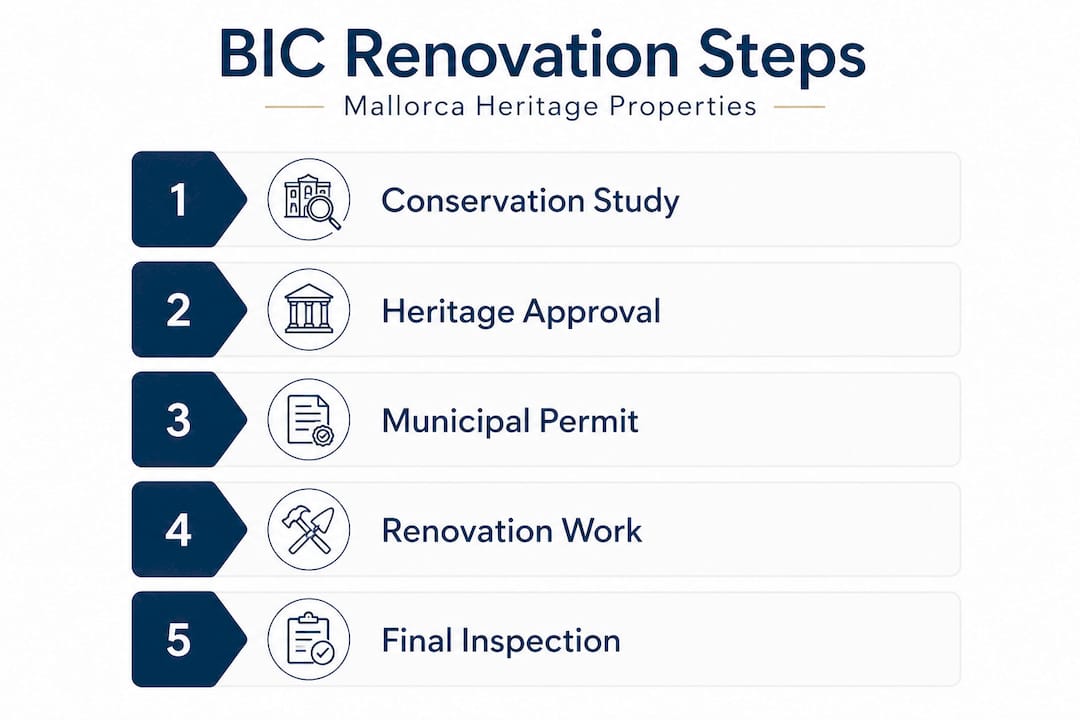
For renovation specifically, the process is layered:
- Preliminary conservation study: An architect with heritage credentials must document the current state of the property and identify which elements are protected.
- Draft renovation plan: The plan must comply with the specific protection level assigned to the property.
- Submission to the municipal heritage commission: Partial protection cases are often reviewed at this level. BIC cases go further.
- Regional government review (for BIC): The Consell de Mallorca or the Balearic regional government reviews the plan and may request modifications.
- Building permit issuance: Only after all heritage approvals are in place will a standard building permit be issued.
- Construction phase monitoring: Heritage authorities may require on-site inspections during construction to ensure compliance.
| Step | Timeframe estimate | Key authority |
|---|---|---|
| Conservation study | 4-8 weeks | Licensed architect |
| Municipality review | 2-4 months | Local heritage commission |
| Regional BIC review | 3-6 months | Consell de Mallorca |
| Permit issuance | 1-2 months after approval | Municipal planning office |
| Construction phase | 6-18 months | Contractor plus oversight |
The Consell de Mallorca offers grants up to €50,000 for qualified BIC property rehabilitation under its 2025 program, and restoration timelines of 12 to 24 months are typical for major projects. These grants are competitive, and the application windows are narrow. Investors who engage local experts early are consistently better positioned to access this funding.
The risks of ignoring these rules are severe. Unauthorized work on a protected property can result in stop-work orders the same day construction begins. Fines accumulate daily until compliance is restored. In documented cases in Mallorca, buyers who purchased without proper due diligence inherited the previous owner’s violations and faced legal proceedings they did not anticipate.
Pro Tip: Hire your heritage architect and your property lawyer before you sign a purchase agreement, not after. A competent heritage architect can review the catalogue entry and give you a preliminary renovation feasibility assessment within days. That information is worth far more than moving quickly.
The Mallorca luxury property overview gives useful context on what high-end buyers typically prioritize, and thorough property inspections on heritage assets should always include a heritage compliance audit alongside a standard structural inspection.
Investment outlook: Market value, supply, and appreciation potential
Here is the strategic reality that makes Mallorca’s heritage properties so compelling despite their regulatory complexity: the very protections that limit what you can do also limit what everyone else can do. Supply is structurally capped.
No new BIC properties will be created by development. The number of historic estates, listed mansions, and catalogued village houses is fixed. When international demand for exclusive Mallorcan real estate rises, as it has consistently done over the past decade, the pressure concentrates directly on a pool of assets that cannot expand. That is a fundamentally different supply dynamic than standard luxury development.
Key investment considerations for heritage properties in Mallorca:
- Post-renovation appreciation is well documented: Luxury heritage properties that have undergone compliant, high-quality restorations consistently command premiums of 30 to 60 percent over pre-restoration valuations in comparable locations.
- Partial protection status can be strategically advantageous: Properties listed under partial protection face fewer approval stages, which means faster renovation timelines and earlier market realization.
- International buyer demand remains robust: With no legal barriers to foreign ownership and sustained demand from German, British, American, and Scandinavian buyers, price pressure on limited heritage stock has continued upward.
- Location specificity matters enormously: Heritage properties in Pollença, Deià, and the Tramuntana UNESCO World Heritage Zone carry the strongest premiums. Palma’s historic center (casco antiguo) follows closely.
- Long-term holds outperform short-term speculation: The regulatory timeline and restoration investment mean that buyers with a 7 to 10 year horizon consistently see stronger returns than those seeking quick asset flips.
The Mallorca luxury real estate market rewards investors who understand these dynamics and position themselves accordingly. The advantages of Mallorca luxury homes as a wealth preservation vehicle are especially clear in the heritage segment, where exclusivity and legal protections work together to insulate values from broader market volatility.
Why due diligence—and patience—define success in Mallorca’s heritage market
Most articles about Mallorca heritage property focus on the price. We have seen enough deals unravel to tell you that price is rarely the problem.
The real make-or-break variables are timing, documentation quality, and stakeholder management. A buyer can have unlimited resources and still find themselves locked in a multi-year legal battle if they underestimate any one of those three factors.
Here is what we have observed from cases where buyers ran into serious difficulty. In several documented BIC cases, courts upheld heritage status even when challenges were mounted on legitimate procedural grounds. Courts have confirmed that BIC protections hold firm even when procedural challenges arise, including arguments that pandemic-era delays invalidated the classification process. If the courts will not lift a BIC designation for a well-resourced legal team, a buyer who purchases assuming they can modify the property freely is in a very difficult position.
The buyers we have seen navigate this market successfully share one consistent trait: they started their due diligence before their first formal offer, not after. They spent weeks reviewing the heritage catalogue entry, meeting with the local planning office informally, and commissioning a preliminary architect’s assessment. By the time they made an offer, they already understood the renovation scope, the approval pathway, and a realistic timeline. That preparation reduced surprises to near zero.
Patience is not passive in this context. It is a strategic posture. Knowing that BIC appeals can take 18 months to resolve and that major restoration permits follow a 12 to 24 month path means that the buyers who are mentally and financially prepared for that timeline consistently out-negotiate buyers who expect faster results. Sellers recognize serious buyers. Local authorities respond better to prepared applicants.
The most common misstep we see listed in top buyer mistakes in Mallorca is skipping the local legal and architectural consultation phase before contracting. In a standard property transaction, that might be recoverable. In a BIC purchase, it can mean discovering post-signing that your planned renovation is impossible under current law.
Pro Tip: Begin due diligence before your first offer. Commission a heritage status report and a preliminary renovation feasibility study. This typically costs a few thousand euros and can save hundreds of thousands in misspent legal fees or stranded renovation costs.
Expert help for luxury heritage buying in Mallorca
Knowing the rules is the first step. Applying them correctly across a cross-border transaction, in a foreign legal system, with a heritage overlay, requires a team of specialists working together. That is exactly what we offer at ULI & LISA.
As Mallorca buyer agents focused exclusively on the international luxury segment, we guide American and other foreign investors through every stage of heritage property acquisition. Our AI-powered search tools identify catalogued properties that match your investment criteria, and our network of vetted heritage architects, independent lawyers, and notaries ensures that due diligence is thorough, timely, and legally sound. Our luxury property services are designed for buyers who need more than a property listing. They need a strategic partner. And our approach to safe property investment means you never move forward without a clear view of your rights, your obligations, and your options.
Frequently asked questions
Are there any restrictions for Americans buying heritage properties in Mallorca?
No, as of 2026, no quotas or bans apply to Americans or any other foreign buyers acquiring protected heritage properties in Mallorca. The Balearic government has actively opposed such restrictions.
What permits are required to renovate a BIC property in Mallorca?
Renovating a BIC property requires a preliminary conservation study from a qualified architect, followed by heritage commission review, and all renovation plans must receive formal approval before any construction begins. Heritage catalogues impose comprehensive protection requirements that make unauthorized work a serious legal risk.
Are there financial incentives for restoring historic properties in Mallorca?
Yes, the Consell de Mallorca offers grants up to €50,000 for qualifying BIC rehabilitation projects, but competition is strong and application deadlines require close monitoring to avoid missing the window.
How long do major heritage restorations in Mallorca typically take?
Based on current programs and documented projects, restorations run 12 to 24 months for comprehensive projects, factoring in both the permit approval process and the construction phase itself.
Does heritage status affect property value in Mallorca?
Heritage status restricts alterations but creates genuine supply scarcity, and the limited supply drives strong appreciation post-renovation, making these assets a compelling long-term wealth preservation vehicle for high-net-worth investors.
Recommended
- 7 Key Investment Property Types in Mallorca Explained - ULI & LISA Mallorca Property Blog
- Mallorca Luxury Homes: Investment and Lifestyle Perks - ULI & LISA Mallorca Property Blog
- Mallorca Luxury Property Guide: Everything You Need to Know - ULI & LISA Mallorca Property Blog
- Mallorca Luxury Property Guide: Everything You Need to Know - ULI & LISA Mallorca Property Blog