TL;DR:
- Mallorca property taxes include annual IBI, transfer-based plusvalía, and non-resident income tax, varying by municipality.
- IBI is calculated on cadastral value and local tax rates, which can differ greatly between towns.
- Selling property involves paying plusvalía based on land value increase and withholding 3% for capital gains tax.
Buying luxury real estate in Mallorca is one of the most rewarding decisions an American investor can make, but underestimating the local tax system is also one of the most expensive mistakes you can walk into. Spanish property taxes are not a single line item on an annual bill like most U.S. buyers expect. They include recurring municipal taxes, transaction taxes triggered by sales or transfers, and specific withholding rules that apply only to non-residents. If you plan your budget based on what you know from owning property in California or Florida, you’re working with the wrong map entirely.
Key Takeaways
| Point | Details |
|---|---|
| Multiple taxes apply | Both annual and transaction-based taxes impact Mallorca property owners. |
| IBI varies by location | The municipal IBI rate and cadastral value can greatly change your yearly bill. |
| Sales trigger extra taxes | Selling a property adds plusvalía municipal and capital gains taxes for non-residents. |
| Expert guidance is vital | Knowledgeable local advisors help you avoid costly missteps and stay compliant. |
Understanding Mallorca’s property tax structure
To understand what you’ll need to pay, let’s break down each key tax that applies when you own or sell property in Mallorca.
Spain’s property tax system works on two levels: national and municipal. That means the taxes you pay depend not only on Spanish federal law but also on which town or district your property sits in. This catches a lot of American buyers off guard. Back home, property tax is largely predictable within a given county. In Mallorca, two properties a few kilometers apart can carry meaningfully different annual tax obligations.
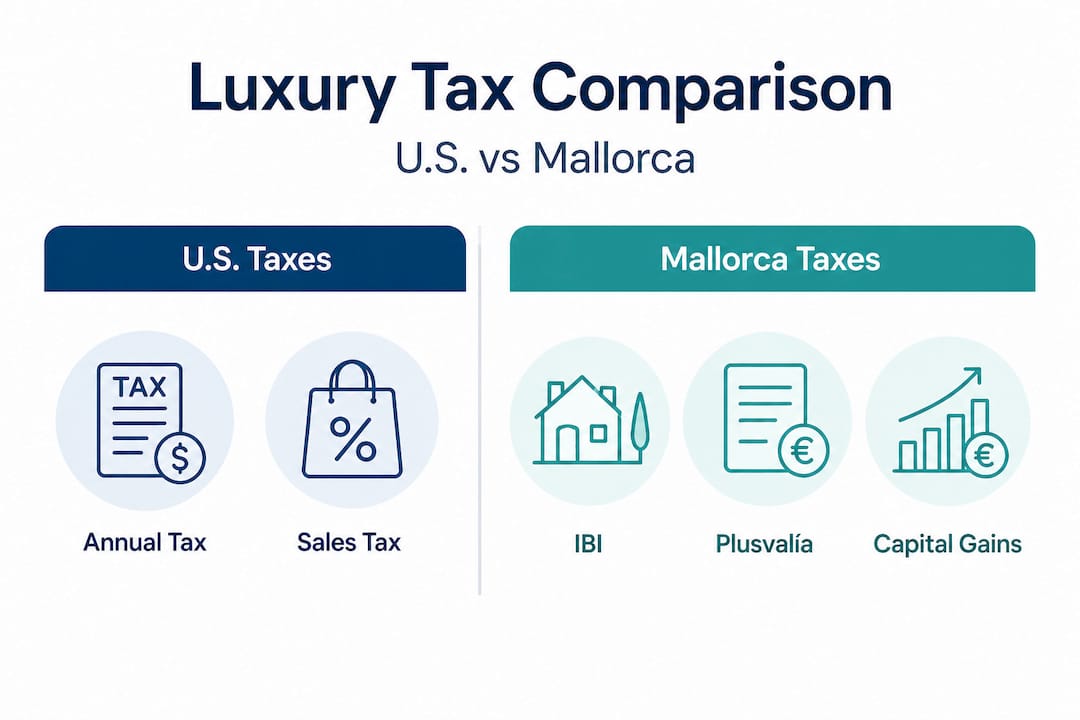
The Mallorca property tax breakdown for most buyers comes down to three core taxes:
- IBI (Impuesto sobre Bienes Inmuebles): The annual municipal property tax every property owner pays, regardless of residency status.
- Plusvalía municipal: A local tax triggered when you sell or transfer property, based on the theoretical increase in urban land value.
- Non-resident income tax (IRNR): If you own property but don’t live in Spain full time, you owe an annual imputed income tax even if the property sits empty.
- Capital gains tax: Applies when you sell at a profit, with specific withholding rules for non-residents that we’ll detail below.
Understanding the major tax categories is the first step to building a realistic budget. Here’s a simplified comparison of what U.S. buyers typically expect versus what they actually encounter in Mallorca:
| Tax type | U.S. expectation | Mallorca reality |
|---|---|---|
| Annual property tax | County-set flat rate on assessed value | Municipal IBI based on cadastral value |
| Tax on home sale | Federal and state capital gains | Plusvalía municipal plus national capital gains |
| Non-resident tax | None (U.S. taxes residents worldwide) | Annual IRNR on imputed rental value |
| Withholding on sale | Seller reports own gains | Buyer withholds 3% from sale price |
The bottom line: IBI is the annual municipal property tax in Mallorca, calculated primarily from the property’s cadastral value multiplied by the municipality’s tax rate. That formula sounds simple enough, but the variability underneath it is where the complexity lives.
How IBI (municipal property tax) is calculated
Now that you know which taxes apply, let’s examine IBI, the main recurring property tax and a frequent source of confusion for buyers.
IBI is paid annually and goes to the local municipality where your property is located. Think of it as the Spanish equivalent of U.S. property tax, but with a few important mechanical differences that affect how much you actually owe.
The starting point is the cadastral value (valor catastral). This is a government-assigned value for your property that reflects land and construction, and it is almost always lower than the market price. Cadastral values are updated periodically by Spain’s national cadastre office, but many properties in Mallorca carry values that haven’t been formally revised in years. For buyers, this can be a double-edged situation. A low cadastral value means lower IBI now, but a pending reassessment could raise your bill significantly after purchase.
Once you have the cadastral value, the municipality applies its own tipo de gravamen (tax rate). IBI is determined using the property’s cadastral value and the local municipal tax rate, which typically falls between about 0.4% and 1.1% for urban residential properties. That range sounds small, but on a luxury property with a high cadastral value, the difference between a 0.4% and a 1.1% rate can add up to thousands of euros per year.
Here’s how that plays out in practice:
| Cadastral value | Tax rate | Annual IBI |
|---|---|---|
| €500,000 | 0.4% | €2,000 |
| €500,000 | 0.8% | €4,000 |
| €500,000 | 1.1% | €5,500 |
| €1,000,000 | 0.6% | €6,000 |
Some municipalities also offer bonificaciones (reductions or exemptions) for certain circumstances, such as properties used as a primary residence or those with specific energy ratings. These are not automatic. You often have to apply for them, and they vary by town hall.
Pro Tip: Before signing any purchase contract, ask the seller for the most recent IBI receipt. This document tells you the exact cadastral value the municipality is using and the rate being applied. It’s a fast way to confirm your actual annual cost rather than relying on estimates.
“IBI amounts can vary significantly depending on which municipality your property falls in. A villa in Deià might carry very different municipal tax implications than a comparable villa in Calvià, even at similar market values, because each town hall sets its own tipo de gravamen.”
Understanding this variability is not just academic. For luxury buyers investing €2 million or more, a 0.3% difference in tax rate on even a €600,000 cadastral value means €1,800 per year in extra taxes. Over a 10-year holding period, that’s €18,000 you didn’t budget for.
Taxes on property sales: plusvalía municipal and capital gains
Annual taxes are only part of the picture. Knowing what happens on sale or transfer is equally crucial.
When you eventually sell your Mallorca property, two major tax obligations kick in: plusvalía municipal and capital gains tax. Each works very differently, and together they represent one of the biggest areas where American buyers make expensive assumptions.
Plusvalía municipal is a local tax levied by the town hall at the time of sale or transfer. Importantly, plusvalía is based on the increase in urban land value since the property was last transferred, not the actual profit you made on the deal. Spain calculates this using the cadastral land value and a coefficient based on how many years you held the property. This means you can owe plusvalía even in years when the market was flat.
Here’s how the process typically unfolds when you sell:
- The notary closes the sale and the tax liability is confirmed.
- The seller is responsible for paying plusvalía to the local municipality, typically within 30 days.
- The amount is calculated using the official coefficient table applied to the cadastral land value.
- If the seller can demonstrate that no real gain occurred (or there was a loss), Spanish law after a 2021 Constitutional Court ruling now allows an alternative calculation method based on actual gain.
- The seller files the declaration and settles the tax directly with the town hall.
Capital gains tax for non-residents is handled at the national level and follows a different process entirely. When a non-resident sells Spanish property, the buyer must withhold 3% of the purchase price as an advance payment for the seller’s capital gains tax, later reconciled with the Spanish tax authority. This is not optional. The buyer deposits that 3% directly with Spain’s tax authority (Agencia Tributaria) within 30 days of closing.
As the seller, you then file a capital gains return, report your actual gain, and either receive a refund if your true tax liability is lower than 3% of the sale price, or pay the difference if it’s higher. For non-resident U.S. sellers, the current capital gains tax rate is 19% on the net gain for EU/EEA nationals but also 19% for most non-EU residents under Spain’s current framework. You should confirm the applicable rate with a local tax advisor at the time of sale, as these figures can change.
Pro Tip: If you’re a U.S. citizen selling a Mallorca property, you’ll also need to report the sale to the IRS regardless of where the property is located. The U.S. taxes its citizens on worldwide income. Work with a cross-border tax specialist who understands first-time sale taxes in Spain alongside U.S. foreign tax credit rules to avoid double taxation.
One commonly overlooked statistic: a significant portion of American buyers who sell Spanish property miss the 30-day deadline for withholding remittance because they didn’t know the buyer carried this legal obligation. Missing that deadline can expose the buyer to penalties, which is why having a local lawyer at closing is not a luxury, it’s a necessity.
Critical planning tips for American buyers
With the risks and rules in mind, here’s how you can plan ahead and avoid costly pitfalls.
Good preparation before you buy can save you far more than any negotiation on the asking price. Here are the most important steps U.S. buyers should take when planning around Mallorca’s property tax system:
- Request full tax documentation before purchase. Ask for the last three years of IBI receipts, the current valor catastral certificate, and any pending reassessment notices. This is standard due diligence and any credible seller will provide it.
- Confirm the municipal tax rate independently. Don’t rely on the seller’s agent for this. Check directly with the local town hall or have your Spanish lawyer confirm the current tipo de gravamen for that municipality.
- Budget for IRNR if you won’t be a Spanish tax resident. Many American buyers don’t realize they owe an annual imputed income tax just for owning property in Spain, even if it sits empty all year. This is calculated as a percentage of the cadastral value and must be filed annually.
- Account for cadastral reassessment risk. Always request the latest valor catastral and confirm the local tipo de gravamen and any bonificaciones before finalizing your budget, since estimates can vary materially by municipality and reassessment status.
- Work with a buyer agent who knows the local landscape. There’s a meaningful difference between a listing agent (who represents the seller) and an independent buyer agent who works exclusively for you.
The value of using a buyer agent is often underestimated by American buyers who are used to a system where agents technically represent both sides. In Spain, having someone firmly in your corner who can cross-check tax figures, flag inconsistencies, and connect you with trusted tax attorneys is not just helpful, it’s often the difference between a smooth purchase and a costly surprise.
Pro Tip: Explore financing strategies that consider Spanish mortgage structures, since how you finance your purchase can affect your overall tax exposure, including deductions available to non-residents who hold mortgages on Spanish property.
For luxury properties specifically, budget conservatively. Homes in the €3 million to €10 million range attract more scrutiny from Spanish tax authorities in terms of declared values at closing, and discrepancies between market value and declared sale price can trigger audits or transfer tax reassessments.
The uncomfortable truth about Mallorca property taxes for U.S. buyers
Here’s something we’ve seen play out with American clients time and again, even the well-prepared ones: there is no universally “correct” answer to the question “what will my taxes be?” in Mallorca. And that’s genuinely uncomfortable for buyers who are used to the relative predictability of U.S. property tax systems.
Municipal differences are real and significant. A beachfront property in Pollença and an equally priced hillside villa in Andratx can carry radically different IBI bills because two different town halls are setting the rules. Cadastral values in some parts of Mallorca have not been formally updated in over a decade, which means a reassessment triggered by a sale can create a sudden jump in the tax base that neither buyer nor seller anticipated.
Beyond the numbers, the legal landscape shifts. Spain’s Constitutional Court struck down the old plusvalía calculation method in 2021, fundamentally changing how local governments compute the tax. New formulas were introduced but practical application still varies by municipality. Buyers who purchased before that ruling may not have experienced the new system yet. Sellers who assumed they knew their plusvalía exposure were sometimes caught flat-footed.
We genuinely believe that reading the property buyer agent guide is one of the most valuable things an American buyer can do before starting their property search, not because it’s our content, but because understanding how local representation actually works in Spain changes how you approach every conversation with a seller’s agent.
The buyers who come to Mallorca with a trusted local team, an independent agent, a Spanish tax attorney, and a cross-border CPA who handles U.S. and Spanish obligations together, consistently navigate the system better. Not because the system becomes simpler, but because they stop trying to figure it out alone.
How expert support can simplify your Mallorca property journey
If you want a smooth experience navigating Mallorca’s property taxes, the right local support makes all the difference. ULI & LISA are independent buyer agents who work exclusively for international buyers, with deep experience helping Americans navigate the legal, financial, and tax complexities of purchasing luxury property in Mallorca. From reviewing IBI documentation and confirming cadastral values to connecting you with vetted local tax attorneys, our role is to be the expert in your corner from first search to closing day. We use AI-powered tools to run comprehensive, unbiased property searches across the full Mallorca market, so you see every relevant opportunity and never pay more than you should. If you’re ready to start planning your purchase with confidence, our team of Mallorca property advisors is ready to help you move forward.
Frequently asked questions
What is IBI and how is it calculated for luxury homes in Mallorca?
IBI is a municipal property tax based on the cadastral value of your property, multiplied by the local tax rate set by your municipality. As the IBI calculation shows, rates typically range from 0.4% to 1.1%, meaning luxury homes with higher cadastral values carry proportionally larger annual bills.
Who pays the plusvalía municipal when selling a property in Mallorca?
The seller typically pays the plusvalía municipal tax, which is based on the increase in urban land value since their acquisition. Under Spanish law, plusvalía is the seller’s obligation at time of transfer, though it can be negotiated in some private sale contracts.
How does the 3% capital gains withholding work for non-residents selling Spanish property?
On closing, the buyer must withhold 3% of the sale price as a pre-payment of the seller’s capital gains tax, with the seller reconciling any balance due or refund afterward. This 3% withholding requirement applies to all non-resident sellers and must be deposited with Spain’s tax authority within 30 days of the sale.
How can buyers estimate IBI before purchase?
Ask the seller or agent for the most recent valor catastral document and check the local municipality’s published tax rate for urban properties. Confirming IBI with documentation before signing is essential, as estimates without the actual cadastral value can be significantly off.
Recommended
- Mallorca Real Estate Taxes – What U.S. Buyers Need to Know - ULI & LISA Mallorca Property Blog
- Mallorca Real Estate Taxes – What U.S. Buyers Need to Know - ULI & LISA Mallorca Property Blog
- Mallorca Real Estate Taxes – What U.S. Buyers Need to Know - ULI & LISA Mallorca Property Blog
- Mallorca Real Estate Taxes – What U.S. Buyers Need to Know - ULI & LISA Mallorca Property Blog
- Steuervorteile Mallorca-Immobilien 2026: Top 5 Tipps