
TL;DR:
- The Spanish legal process for Mallorca property involves multiple steps including NIE, contracts, and registration.
- Due diligence by an independent lawyer is crucial to uncover legal issues and irregularities before purchasing.
- U.S. buyers must navigate cross-border compliance and tax reporting, with independent guidance essential for success.
Buying a luxury property in Mallorca feels straightforward until you realize the Spanish legal system operates by entirely different rules than anything you’ve encountered in the United States. There’s no escrow officer walking you through closing, no title company absorbing the risk, and no standardized disclosure package landing in your inbox. What you get instead is a layered sequence of contracts, government filings, and compliance obligations that can unravel quickly without the right team. This guide maps every critical step so you can move from interest to ownership with confidence, not guesswork.
Key Takeaways
| Point | Details |
|---|---|
| Spanish legal sequence | Buying in Mallorca requires several legal steps, from NIE to property registration, unique from U.S. processes. |
| Independent due diligence | An experienced independent lawyer is essential to avoid costly legal issues and hidden liabilities common in Mallorca properties. |
| Critical deposit contracts | Understand the terms and risks of reservation and arras contracts before making any payment or binding commitment. |
| U.S.-Spain compliance | High-net-worth Americans must fulfill both Spanish (AML/UBO) and U.S. (FBAR/FATCA) reporting for full legal compliance. |
| Local expert advantage | Independent buyer agents with cross-border expertise can make your Mallorca purchase smooth and legally secure. |
Understanding the legal journey: Step-by-step overview
The legal process for buying property in Mallorca spans from NIE acquisition to land registry registration, and each stage carries its own risks and deadlines. For American buyers, the first surprise is usually how early the paperwork starts.
Your NIE number comes first. The NIE (Número de Identificación de Extranjero) is Spain’s tax identification number for foreigners. You cannot sign a contract, open a bank account, or pay taxes without it. You can apply at a Spanish consulate in the U.S. or in person in Mallorca, and the process typically takes one to three weeks. Many buyers underestimate this step and lose time on competitive listings while waiting.
Opening a Spanish bank account is not optional. Spanish property transactions require payments from a Spanish account. The notary, tax office, and land registry all expect local transfers. Opening an account as a non-resident is possible but requires documentation including your passport, NIE, and proof of address. Plan for this to take one to two weeks as well.
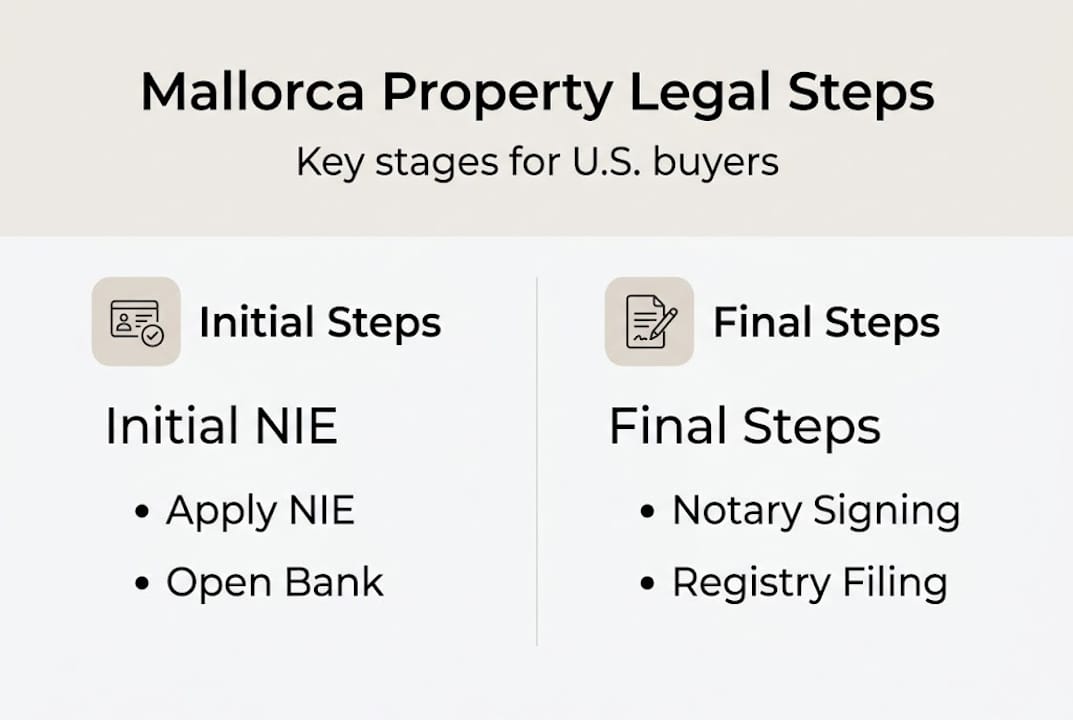
Once those foundations are in place, the legal sequence moves through five distinct stages:
- Reservation contract: A small deposit (typically €3,000 to €10,000) holds the property while due diligence begins. Usually refundable if the deal falls through for legitimate reasons.
- Due diligence period: Your independent lawyer investigates the property’s legal status, debts, licenses, and planning compliance. This is your window to walk away safely.
- Arras contract (private purchase contract): A binding agreement where the buyer pays 10% of the purchase price. If the buyer withdraws without cause, the deposit is forfeited. If the seller withdraws, they must return double.
- Public deed at the notary (Escritura Pública): Both parties sign before a Spanish notary. Full payment is made, and ownership transfers officially.
- Tax payment and land registry: Transfer taxes (typically 8 to 11% in the Balearics) are paid within 30 days of signing, followed by registration at the Registro de la Propiedad.
The Mallorca real estate closing process typically runs six to twelve weeks from reservation to registration when documents are clean and all parties are prepared.
| Stage | Responsible party | Typical timeline |
|---|---|---|
| NIE application | Buyer | 1-3 weeks |
| Spanish bank account | Buyer | 1-2 weeks |
| Reservation contract | Buyer + seller | Day 1 |
| Due diligence | Buyer’s lawyer | 2-4 weeks |
| Arras contract | Buyer + seller | Week 3-5 |
| Notary signing | All parties | Week 6-10 |
| Tax payment | Buyer | Within 30 days of signing |
| Land registry | Buyer’s lawyer | Week 8-12 |
Understanding buying property in Spain as an American means accepting that this timeline is optimistic. Complications in due diligence, slow seller responses, or missing documents can push the process past three months.
Due diligence: Your strongest legal shield
Understanding the sequence is vital, but the real protection lies in the depth of due diligence. This is where many American buyers make their most expensive mistakes, often because they trust the seller’s agent to flag problems or assume the notary will catch everything. Neither is true.
Legal due diligence by an independent lawyer is essential to uncover ownership, debts, planning compliance, and license issues before you commit serious money. A thorough check covers several critical documents and databases:
- Nota Simple: The official property registry extract showing ownership, mortgages, liens, and encumbrances. This is your first line of defense.
- Cadastral records: Spain’s land registry and cadastral records don’t always match. Discrepancies can signal illegal construction or boundary disputes.
- Urban planning compliance: Your lawyer checks whether the property complies with local zoning laws and whether any extensions or structures have proper building licenses.
- Outstanding debts: In Spain, property debts (including unpaid community fees, utility bills, and mortgages) transfer to the new owner. You inherit the seller’s financial problems if you skip this step.
- Tourist rental license: If you plan to rent the property short-term, you need a valid tourist license. Mallorca has strict limits, and many properties are advertised as “rental ready” without proper authorization.
“Common pitfalls include illegal builds — up to 40% of listings have issues with unauthorized construction or unlicensed modifications that can result in demolition orders or heavy fines.”
That statistic should stop any buyer cold. Nearly half of all properties on the market carry some form of legal irregularity. These aren’t always obvious. A beautifully renovated villa might have an extension built without permits, making it legally impossible to insure or resell at full value.
Red flags Americans must not overlook when understanding property due diligence in Mallorca:
- Sellers who rush the arras signing before due diligence is complete
- Properties with recent renovations but no corresponding building permits on file
- Listings advertised with tourist rental income but no verifiable license number
- Discrepancies between the advertised square footage and the cadastral record
- Sellers who resist providing the Nota Simple or community meeting minutes
Pro Tip: Always hire a lawyer who has no connection to the seller, the seller’s agent, or the developer. In Mallorca, it’s common for selling agents to recommend “their” lawyer. That arrangement creates a conflict of interest that can cost you dearly. Your lawyer’s job is to protect you, and that means being willing to tell you to walk away. Check verifying Mallorca property documents for a practical checklist of what to request before signing anything.

Contracts and notary: Key documents and obligations
With due diligence in hand, buyers must navigate the most important paperwork and pivotal moments. The contract phase is where American buyers often feel most disoriented, because the documents carry binding consequences that differ significantly from U.S. purchase agreements.
The reservation contract is relatively low-stakes. You pay a small holding deposit, typically between €3,000 and €10,000, and the seller takes the property off the market for an agreed period (usually two to four weeks). This deposit is generally refundable if due diligence reveals serious problems, but the specific terms must be written into the contract. Never assume refundability. Have your lawyer draft or review the reservation agreement before you sign.
The arras contract is where the transaction becomes serious. Reservation and arras contracts require careful understanding of deposits, binding obligations, and suspensive clauses before you commit. The standard deposit at arras is 10% of the agreed purchase price. For a €3 million villa, that’s €300,000 at risk. If you walk away without a contractually valid reason, you lose it entirely.
The most important protective mechanism is the suspensive clause (condición suspensiva). This clause makes the arras contract conditional on satisfactory due diligence results, mortgage approval, or other specified conditions. Without it, you have limited grounds to recover your deposit if problems emerge after signing. An American guide to Spanish contracts confirms that many buyers sign arras agreements without suspensive clauses and later discover they have no legal recourse.
| Document | Deposit amount | Binding? | Can you withdraw? |
|---|---|---|---|
| Reservation contract | €3,000-€10,000 | Partially | Yes, often refundable |
| Arras contract | 10% of price | Yes | Yes, but deposit forfeited |
| Public deed (Escritura) | Full balance | Fully | No, transfer complete |
The notary signing (Escritura Pública) is the moment of legal transfer. The notary reads the full deed aloud in Spanish. If you don’t speak Spanish fluently, a sworn interpreter must be present. Many American buyers are surprised to learn that the notary represents neither buyer nor seller. The notary’s role is to authenticate the transaction, not to protect your interests. That’s your lawyer’s job.
If you cannot be physically present in Spain for the signing, you can grant Power of Attorney (Poder Notarial) to your lawyer. This is standard practice for U.S. buyers. The POA must be notarized in the U.S. and apostilled before it’s valid in Spain. Allow two to three weeks for this process.
Pro Tip: Always negotiate suspensive clauses into the arras contract before signing. This single step protects your deposit if due diligence uncovers problems, financing falls through, or the seller cannot deliver clean title. Review Mallorca property due diligence for specific clause language your lawyer should include.
Compliance, reporting and registration: Cross-border essentials for Americans
After formalizing contracts and notary signing, compliance and reporting become crucial for cross-border buyers. This is the area where American buyers face obligations that simply don’t exist for European purchasers, and the penalties for missing them are severe.
U.S. high-net-worth buyers must coordinate Spanish AML/UBO disclosures and U.S. reporting such as FBAR and FATCA alongside their Spanish purchase. Spain’s anti-money laundering (AML) regulations require buyers to disclose the source of funds for any significant property transaction. For luxury purchases, expect requests for bank statements, proof of income, and documentation of your financial history going back several years.
If you purchase through a corporate structure such as a Spanish SL (Sociedad Limitada), you must also disclose the Ultimate Beneficial Owner (UBO) to Spanish authorities. Foreign buyers sometimes use SL companies for tax efficiency or estate planning, but the setup requires additional legal work and a military authorization for non-EU buyers purchasing in certain zones of Spain.
On the U.S. side, your reporting obligations include:
- FBAR (FinCEN Form 114): Required if your Spanish bank account balance exceeds $10,000 at any point during the calendar year. Filed annually with the U.S. Treasury, not the IRS.
- FATCA Form 8938: Required for foreign financial assets above $200,000 (single filers) or $400,000 (married filing jointly) at year-end. Filed with your federal tax return.
- Schedule E: If you earn rental income from the property, it must be reported on your U.S. tax return regardless of whether you pay tax in Spain.
The Mallorca land registry process is the final step in Spain. After the notary signing and tax payment, your lawyer submits the deed to the Registro de la Propiedad. Registration typically takes four to eight weeks and officially records you as the legal owner. Until registration is complete, the property is technically vulnerable to claims from third parties.
| Form/disclosure | Who files | When | Penalty for failure |
|---|---|---|---|
| FBAR (FinCEN 114) | U.S. buyer | Annually by April 15 | Up to $10,000 per violation |
| FATCA Form 8938 | U.S. buyer | With tax return | Up to $10,000 per violation |
| Spanish AML disclosure | Buyer’s lawyer | At purchase | Transaction blocked |
| UBO declaration | Buyer (if using SL) | At company setup | Fines and legal exposure |
| Land registry filing | Buyer’s lawyer | Within 30 days of signing | Loss of priority rights |
For Mallorca residency and tax compliance questions that arise after purchase, and for understanding Mallorca real estate tax reporting obligations in detail, your cross-border tax advisor and Spanish lawyer need to work in coordination. The requirements for U.S. buyers are genuinely more complex than for any other nationality purchasing in Spain, and that complexity demands specialists on both sides of the Atlantic.
Our perspective: What U.S. luxury buyers often get wrong (and how to do better)
After working with American buyers across dozens of Mallorca transactions, the pattern is consistent. The buyers who run into serious trouble are rarely naive. They’re often experienced real estate investors who assume their U.S. instincts translate. They don’t.
The most dangerous assumption is that the selling agent is a neutral party. In Spain, the agent typically represents the seller. When that same agent recommends a lawyer, a notary, or a mortgage broker, every referral has a built-in bias. We’ve seen buyers lose substantial deposits because they trusted a selling agent’s “preferred” lawyer who had no incentive to recommend walking away from a flawed deal.
The second major mistake is treating compliance as an afterthought. FBAR and FATCA aren’t bureaucratic nuisances. Missing either can trigger penalties that dwarf the cost of proper advice upfront. Sophisticated buyers treat cross-border compliance as strategic risk management, not red tape.
What truly successful U.S. buyers do differently is simple: they engage independent buyer agents in Mallorca before they fall in love with a property. When your representation is independent, your interests are protected from the first viewing to the final registration. That’s not a luxury. That’s the minimum standard for a transaction of this magnitude.
Streamline your Mallorca purchase with expert local guidance
Navigating Mallorca’s legal process from the United States requires a team that understands both worlds. At ULI & LISA, we work exclusively as independent buyer agents in Mallorca, which means our only obligation is to you. We use AI-powered search tools to give you unbiased access to the full Mallorca market, and we coordinate every legal, compliance, and due diligence step with vetted specialists who have no connection to the seller. Whether you’re purchasing a finca in the Tramuntana or a penthouse in Palma, our Mallorca property advisors are ready to guide you from first inquiry to registered ownership. Schedule a confidential consultation today and take the first step toward a smooth, legally sound acquisition.
Frequently asked questions
How long does the Mallorca property legal process take for U.S. buyers?
The typical legal timeline runs six to twelve weeks from reservation to land registry registration when all documents are in order and parties are responsive.
Can I buy Mallorca property remotely without being present in Spain?
Yes. Many American buyers use Power of Attorney to authorize their lawyer to sign at the notary and complete all steps without the buyer traveling to Spain.
What U.S. tax forms do I need if I buy property in Mallorca?
You’ll need FBAR for Spanish bank accounts over $10,000 and FATCA Form 8938 for foreign financial assets above the applicable threshold, filed with your annual U.S. tax return.
What are the biggest risks for American buyers in Mallorca?
Hidden debts, illegal builds, and unlicensed tourist rentals are the most common traps. Due diligence by an independent lawyer is the only reliable way to catch these issues before your deposit is at risk.
Recommended
- Navigate Mallorca property laws: guide for U.S. buyers - ULI & LISA Mallorca Property Blog
- Buying Property in Mallorca: Key Steps for Americans - ULI & LISA Mallorca Property Blog
- Mallorca Property Search Guide: Expert Insights - ULI & LISA Mallorca Property Blog
- Mallorca Real Estate Closing Process: A Step-by-Step Guide - ULI & LISA Mallorca Property Blog