
TL;DR:
- International buyers in Mallorca face a complex process involving obtaining an NIE, hiring independent legal counsel, and completing sequential legal and financial steps to secure ownership. Due diligence on permits, coastal regulations, and tax obligations is critical before signing the private contract, with total costs often exceeding the purchase price by 11% to 14%. Working with an independent buyer agent and starting legal preparations early significantly improves transaction security and efficiency.
The Mallorca buying process steps are a defined sequence of legal, financial, and administrative actions that international buyers must complete to secure valid property ownership on the island. Unlike purchasing real estate in the United States, the Spanish system introduces mandatory documents such as the NIE (Número de Identidad de Extranjero), a multi-stage contract structure, and Mallorca-specific regulations including the Ley de Costas and the cedula de habitabilidad. Buyers who skip or misorder these steps risk losing deposits, inheriting illegal constructions, or facing forced demolition orders. This guide walks you through every stage of the Mallorca real estate process with the legal and tax specificity that luxury and investment buyers require.
What are the prerequisites for buying property in Mallorca?
Before you view a single property, three foundational requirements must be in place: your NIE number, independent legal representation, and documented financial capacity.
Getting your NIE number
The NIE is Spain’s tax identification number for foreigners, and no property transaction can close without it. You can apply at a Spanish consulate in the United States before traveling, or at a Policía Nacional office in Mallorca upon arrival. Processing takes two to four weeks through a consulate and can be faster in person with an appointment. Applying early prevents the NIE from becoming a bottleneck when you are ready to sign a reservation agreement.
Hiring an independent property lawyer
An independent lawyer, one who has no commercial relationship with the selling agent or developer, is the single most consequential decision in the documentation workflow for buying Mallorca property. Your lawyer will conduct due diligence, review all contracts, verify permits, and represent your interests at the notary. Firms specializing in Mallorca real estate law, such as those listed on property-lawyers.com, typically charge between 1% and 1.5% of the purchase price. That fee is not optional for a safe transaction.
Financial preparation and documentation
Spanish banks and sellers require proof of funds before accepting an offer on luxury property. If you plan to finance, note that non-resident mortgages in Mallorca typically cover 60% to 70% of the appraised value, meaning a €2 million villa requires at least €600,000 to €800,000 in liquid capital at signing. For a detailed breakdown of financing structures, the Mallorca mortgage guide covers non-resident mortgage prerequisites in full.
Pro Tip: Open a Spanish bank account before you arrive. Sellers and notaries require payment in euros from a Spanish account, and international wire transfers can delay closing by days.
| Document | Purpose |
|---|---|
| NIE number | Required for all contracts and tax filings |
| Passport (certified copy) | Identity verification at notary |
| Proof of funds or mortgage pre-approval | Confirms financial capacity to seller |
| Spanish bank account details | Required for deposit and final payment |
| Power of attorney (optional) | Allows lawyer to act on your behalf if you cannot attend |
What are the step-by-step stages of the Mallorca property purchase?
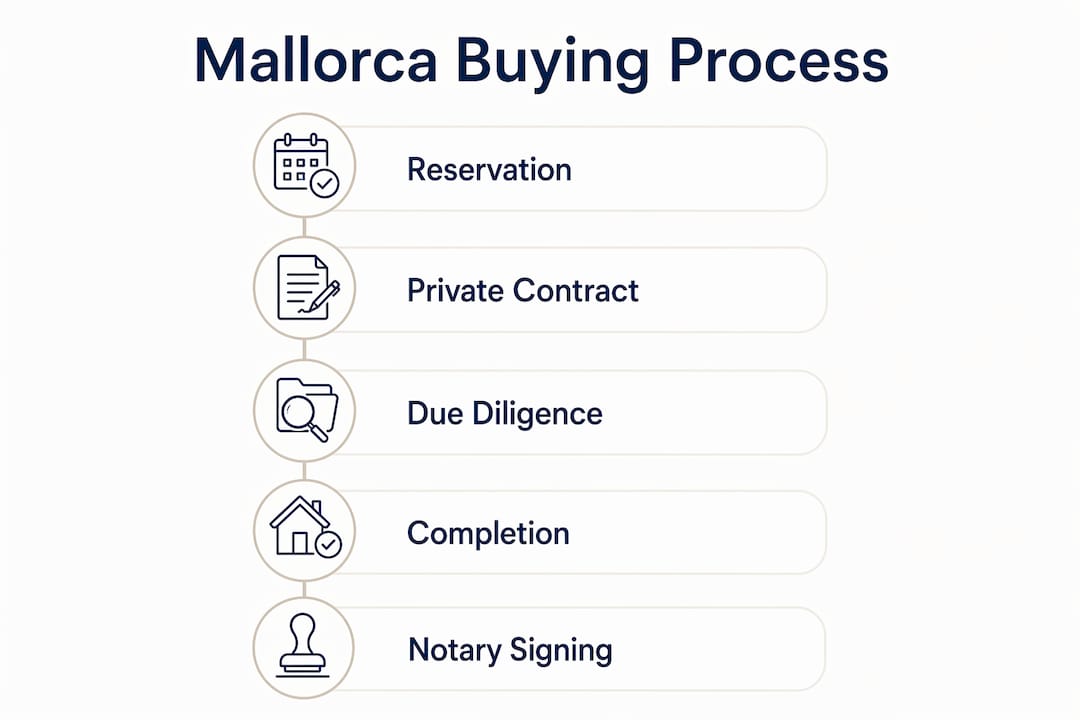
The legal process in Mallorca follows a fixed sequence: reservation agreement, private purchase contract, and notary completion, with property registration as the final step. The typical timeline runs 6 to 10 weeks for straightforward transactions, though complex cases involving missing permits or tenant issues can extend to several months.
-
Property search and offer. Work with a buyer’s agent to identify properties across all agencies. Once you identify a target, your agent negotiates price and terms on your behalf before any paperwork is signed.
-
Reservation agreement and deposit. Signing the reservation agreement (contrato de arras or reserva) takes the property off the market. The standard deposit is 10% of the agreed purchase price. If you withdraw without legal cause, you forfeit the deposit. If the seller withdraws, they owe you double the deposit.
-
Due diligence period. Your lawyer spends two to four weeks verifying ownership status, outstanding debts, planning permissions, and cadastral compliance. Legal due diligence includes checking for illegal constructions, which can result in forced demolitions if undiscovered. This stage also covers coastal law certificates and cedula de habitabilidad status.
-
Private purchase contract (contrato de compraventa). Once due diligence clears, both parties sign a binding private contract. A further deposit, typically bringing the total to 20% to 30%, is paid at this stage.
-
Notary completion (escritura pública). The final balance, transfer taxes, notary fees, and registry fees are paid on the day of signing before a Spanish notary. Title transfers officially at this moment.
-
Land Registry registration. Your lawyer submits the signed escritura to the Registro de la Propiedad. Registration confirms your ownership publicly and protects against future claims. This step takes two to eight weeks after notary signing.
Pro Tip: Request a nota simple from the Land Registry before signing any agreement. This one-page document confirms the legal owner, any mortgages, and encumbrances on the property in real time.
| Stage | Typical timeline |
|---|---|
| Reservation to private contract | 2 to 4 weeks (due diligence) |
| Private contract to notary | 2 to 6 weeks (financing, final checks) |
| Notary to Land Registry | 2 to 8 weeks (administrative) |
| Full process end to end | 4 to 12 weeks |
What legal and tax rules specifically affect international buyers in Mallorca?
Mallorca sits within the Balearic Islands, an autonomous community with tax rates and regulations that differ from mainland Spain. Three areas demand particular attention from American buyers.
Ley de Costas and coastal property certificates
Properties within 100 meters of Mallorca’s coastline fall under Ley de Costas regulations, which restrict renovations, extensions, and in some cases future sales. Pre-1988 villas are frequently affected by the servitude de protección zone. Lawyers stress the necessity of obtaining a certificado de situación de costas before committing to any coastal purchase. Without this certificate, you may buy a property you cannot legally renovate or resell at full value.
Spanish wealth tax for non-residents
Non-resident buyers face Spanish wealth tax on properties valued above €700,000 per owner, with typical annual liabilities between €3,000 and €12,000 depending on ownership structure and declared value. This means a couple purchasing a €3 million villa as co-owners each holds €1.5 million in taxable assets, both exceeding the individual allowance. Structuring ownership correctly before signing any contract can reduce this liability materially. Consult a Spanish tax advisor, not a general accountant, before you commit.
Tourist rental licenses and the ETV moratorium
Since 2022, a moratorium on new tourist rental licenses (ETV) applies to apartments and plurifamiliar buildings in Palma and coastal urban areas. Only standalone villas outside restricted zones can currently obtain ETV licenses, and processing takes six to twelve months. If rental income is part of your investment thesis, verify license eligibility before signing the reservation agreement, not after.
Pro Tip: Ask the seller to provide the existing ETV license number and confirm its transferability with the Consell de Mallorca before signing. Licenses are property-specific but not always automatically transferable.
Key legal and tax pitfalls to verify before purchase:
- Cedula de habitabilidad status (valid, expired, or nonexistent)
- Coastal zone classification and any active servitude restrictions
- Outstanding IBI (property tax) or community fee debts
- Illegal extensions or constructions not reflected in the cadastre
- Tourist rental license validity and transferability
- Urban planning classification (rustic land has strict build limits)
What are the most common pitfalls in the Mallorca buying process?
The most expensive mistakes in Mallorca property transactions share one cause: insufficient due diligence before the private contract is signed.
Many older Mallorca homes lack a valid cedula de habitabilidad, the habitability certificate required for legal water and electricity connections and for mortgage eligibility. Legalizing a property without a valid cedula can take months or years and cost tens of thousands of euros in architect fees and municipal permits. Buyers who discover this after signing the private contract are contractually committed with limited recourse.
Coastal zone properties present a second category of risk. A villa listed as “beachfront” may sit within the servitude de protección zone, meaning any renovation beyond cosmetic work requires special authorization that is rarely granted. The market price rarely reflects this constraint until a buyer’s lawyer requests the coastal certificate.
“Verifying the coastal property certificate is not optional for any property near Mallorca’s shoreline. It is the document that determines what you can legally do with the asset you are buying.” — Mallorca property law practitioners
Financing delays affect even cash-rich buyers who decide late to use a mortgage. Spanish bank appraisals take three to five weeks, and non-resident mortgage approval adds another two to four weeks. Starting the financing process before the reservation agreement, rather than after, prevents timeline overruns.
Pro Tip: Work with an independent buyer agent who has full market access across all Mallorca agencies. Agents tied to specific developers or agencies have financial incentives that do not align with your interests as a buyer.
How much does buying property in Mallorca actually cost?
Total acquisition costs for a resale property in Mallorca typically run 11% to 14% above the agreed purchase price. Budgeting only for the headline price is the most common financial miscalculation among first-time buyers on the island.

Transfer tax in the Balearic Islands is progressive and can reach 13% for resale properties above certain value thresholds. New builds carry a different structure: 10% VAT plus 1.5% stamp duty (AJD), totaling 11.5%. Notary fees run 0.5% to 1% of the purchase price, land registry fees add 0.3% to 0.5%, and legal fees typically fall between 1% and 1.5%.
| Cost item | Resale property | New build |
|---|---|---|
| Transfer tax (ITP) | Up to 13% (progressive) | Not applicable |
| VAT | Not applicable | 10% |
| Stamp duty (AJD) | Included in ITP | 1.5% |
| Notary fees | 0.5% to 1% | 0.5% to 1% |
| Land registry fees | 0.3% to 0.5% | 0.3% to 0.5% |
| Legal fees | 1% to 1.5% | 1% to 1.5% |
Ongoing costs include annual wealth tax for non-residents above the €700,000 threshold, IBI (local property tax), community fees for shared developments, and property insurance. For investment properties, income tax on rental revenue applies at 19% for EU residents and 24% for non-EU residents including Americans.
Pro Tip: Engage a Spanish tax advisor before signing any contract to assess whether holding the property personally, through a Spanish SL company, or via a foreign holding structure minimizes your total tax exposure over a five-year ownership horizon.
Key takeaways
The Mallorca buying process steps require sequential legal, financial, and administrative actions that international buyers must complete in order to secure valid, protected property ownership on the island.
| Point | Details |
|---|---|
| NIE and legal representation first | Obtain your NIE and hire an independent lawyer before viewing or offering on any property. |
| Fixed contract sequence | Reservation agreement, private contract, and notary completion must occur in order with deposits at each stage. |
| Due diligence is non-negotiable | Verify cedula, coastal certificates, permits, and cadastral compliance before signing the private contract. |
| Budget 11% to 14% above purchase price | Transfer taxes, notary, registry, and legal fees add significantly to the headline cost. |
| Rental license eligibility | Confirm ETV license status before committing if rental income is part of your investment plan. |
What I have learned from watching buyers navigate Mallorca’s market
After working with international buyers across Mallorca’s luxury market, the pattern I see most clearly is this: buyers who treat legal due diligence as a formality pay for it later, and buyers who treat it as the core of the transaction close with confidence.
The regulatory environment here is genuinely complex. Ley de Costas, the ETV moratorium, and the cedula de habitabilidad are not bureaucratic footnotes. They are the variables that determine whether a property is worth its asking price. I have seen buyers fall in love with a beachfront villa, rush through due diligence, and discover post-signing that the coastal servitude zone prevents any structural renovation. The property was beautiful. It was also effectively frozen in its 1970s condition.
The other observation I would offer is about market access. Mallorca’s property inventory is fragmented across dozens of agencies, each with exclusive listings. A buyer working with a single agency sees a fraction of what is available. Independent buyer agents with full market access, like the model Uli-lisa operates on, give you the complete picture before you commit. That breadth matters especially in the €1.5 million to €5 million range, where the difference between the right property and the wrong one is not always obvious from a listing photo.
My honest recommendation: start the legal and tax preparation three to six months before you plan to buy. The buyers who do this close faster, negotiate better, and avoid the costly surprises that derail transactions at the private contract stage.
— Uli
How Uli-lisa supports your Mallorca property purchase
Uli-lisa operates exclusively as an independent buyer agent, representing your interests alone with no ties to any seller or developer. Using AI-powered property search tools, Uli-lisa provides access to the full Mallorca market across all agencies, including off-market listings that never appear on public portals. The team coordinates legal and tax professionals, manages the documentation workflow for buying Mallorca property, and guides American buyers through every stage from NIE application to Land Registry registration. For buyers seeking a secure property purchase in Mallorca, Uli-lisa’s independent buyer representation removes the conflicts of interest that complicate most luxury transactions on the island.
FAQ
What is the first step in the Mallorca buying process?
The first step is obtaining your NIE number, Spain’s tax identification number for foreigners, without which no property contract or tax filing can be completed. Apply through a Spanish consulate in the United States or at a Policía Nacional office in Mallorca.
How long does buying property in Mallorca take?
The process typically takes 4 to 12 weeks from reservation to notary completion, with most straightforward transactions closing in 6 to 10 weeks. Missing permits, coastal zone issues, or financing delays can extend the timeline to several months.
Do Americans pay wealth tax on Mallorca property?
Yes. Non-resident buyers including Americans pay Spanish wealth tax on property values above €700,000 per owner, with typical annual liabilities between €3,000 and €12,000 depending on the property value and ownership structure.
Can I rent out my Mallorca property as a vacation rental?
Only standalone villas outside restricted coastal urban zones can currently obtain new ETV tourist rental licenses. A moratorium since 2022 blocks new licenses for apartments and plurifamiliar buildings in Palma and most coastal areas.
What is a cedula de habitabilidad and why does it matter?
The cedula de habitabilidad is Spain’s habitability certificate, required for legal utility connections and mortgage eligibility. Many older Mallorca homes lack a valid cedula, and legalizing a property without one can take months and significant additional expense.
Recommended
- Mallorca Real Estate Closing Process: A Step-by-Step Guide - ULI & LISA Mallorca Property Blog
- 7 Steps for a Successful Mallorca International Buyer Checklist - ULI & LISA Mallorca Property Blog
- Property Viewing Process Mallorca: A Luxury Buyer’s Guide - ULI & LISA Mallorca Property Blog
- Steps to Buy Property Mallorca: Your Luxury Guide - ULI & LISA Mallorca Property Blog