TL;DR:
- Mallorca offers a safe environment with low violent crime and strong tourism infrastructure.
- The island provides diverse outdoor activities suitable for children year-round.
- International schools and expat communities facilitate easy integration for American families.
Plenty of American families dismiss European relocation as too complicated, too unfamiliar, or simply too far from the support systems they rely on back home. Mallorca quietly dismantles every one of those objections. This Spanish island in the Mediterranean offers a rare combination of safety, world-class outdoor amenities, legitimate schooling options for English-speaking children, and an expat community that genuinely helps newcomers settle in fast. Whether you’re considering a vacation home or a longer stay, this guide breaks down exactly what Mallorca offers families, from crime statistics and beach safety ratings to school enrollment timelines and community hubs that make integration feel natural.
Key Takeaways
| Point | Details |
|---|---|
| Mallorca is safe | Mallorca consistently ranks as one of the safest European destinations for families. |
| Abundant family activities | Families enjoy year-round outdoor and leisure opportunities from beaches to adventure parks. |
| Easy school integration | International schools and expat communities streamline the transition for American families. |
| Strong expat support | Long-term integration is eased by multilingual services and vibrant expat networks. |
| Expert help available | Buyer agents and local services help affluent families find their ideal Mallorca home. |
Safety and peace of mind: How Mallorca stacks up for families
For most American families, safety is the first question. Before they think about square footage or swimming pools, they want to know their children will be secure. The good news is that Mallorca’s numbers are reassuring. According to Mallorca safety statistics, the island ranks well above the European average for family safety. Palma, the capital, sits at a crime index of roughly 35/100, with a safety score of approximately 82/100, placing it among the safer urban centers in Southern Europe.
| Destination | Crime index | Safety score |
|---|---|---|
| Palma, Mallorca | ~35/100 | ~82/100 |
| Barcelona, Spain | ~55/100 | ~45/100 |
| Rome, Italy | ~52/100 | ~48/100 |
| Lisbon, Portugal | ~40/100 | ~60/100 |
Those numbers tell a clear story. Mallorca is meaningfully safer than many of the European cities Americans typically compare it to. Violent crime is rare. The island’s economy depends heavily on tourism and real estate, which creates strong incentives for local authorities to maintain public order and safety standards.
That said, no destination is entirely without nuance. Petty theft is common in tourist-heavy areas, particularly during peak summer months from June through August. Pickpocketing can occur near busy markets, beaches, and crowded attractions. This is standard across Mediterranean tourist destinations and is manageable with basic precautions: use a cross-body bag, avoid leaving valuables on the beach, and keep a digital copy of your passport.
The area most worth avoiding for families is Magaluf, a resort town on the southwest coast known for its nightlife. It’s not inherently dangerous, but its party-heavy atmosphere is simply not aligned with a family-centered lifestyle. Most affluent families buying in Mallorca naturally gravitate toward quieter areas like Santa Ponsa, Son Vida, or the north of the island near Pollensa.
“Mallorca’s combination of low violent crime and strong tourism infrastructure makes it one of the most reliably safe environments for families in the entire Mediterranean region.”
Pro Tip: If you’re visiting during high season to view properties, read through our Mallorca home buying tips to plan viewings in quieter areas where you’ll get a more accurate feel for day-to-day family life.
Family-friendly outdoor activities and amenities
With safety covered, families considering Mallorca should look closely at what daily life and entertainment options exist for children. This is where the island genuinely surprises people. Mallorca is not just beaches. Its outdoor offerings are remarkably diverse, and they hold up across every season.
The island’s coastline features over 200 beaches, many of which hold Blue Flag certification, meaning they meet strict European standards for water quality, safety facilities, and environmental management. For families with young children, beaches like Cala Mondragó, Cala Formentor, and Es Trenc are calm, clean, and well-organized. Lifeguards are on duty at most popular spots during summer.
Abundant outdoor family activities include safe beaches, hiking in the Serra de Tramuntana (a UNESCO World Heritage site), cycling paths, waterparks, aquariums, boat trips, and adventure parks like Jungle Parc. The Tramuntana range in particular offers trails at every difficulty level, from gentle woodland walks perfect for toddlers to more challenging routes for older kids.
Here’s a quick comparison of activity options by age group:
| Activity | Best age group | Year-round? |
|---|---|---|
| Blue Flag beaches | All ages | May to October |
| Tramuntana hiking | 5 and up | Year-round |
| Cycling paths | 6 and up | Year-round |
| Waterparks | 3 and up | June to September |
| Jungle Parc adventure | 4 and up | March to November |
| Boat trips | All ages | April to October |
Beyond the outdoor calendar, Mallorca offers kids activities that span culture, food, and nature. The Palma Aquarium hosts regular educational programs. Local markets in towns like Sineu and Alcúdia give children a hands-on sense of Mediterranean culture.
For family home buying tips that connect property location to activity access, it’s worth cross-referencing which areas sit closest to the activities your family values most before committing to a neighborhood.
Pro Tip: The shoulder seasons, specifically April through June and September through October, give families the best mix of good weather, open attractions, and far fewer crowds. If you’re evaluating the island for a family home, visiting during these months gives you the most realistic picture of everyday life.
Schooling and integration: Ease of transition for American families
Once you’ve decided what type of lifestyle and activities you want, schooling and integration become the next critical concerns. American families are often relieved to discover that Mallorca has a genuinely strong educational infrastructure for English-speaking children.
Here are the main school types available:
- International schools teach entirely or primarily in English, often follow the IB or British curriculum, and serve large expat populations. These are the most common choice for American families.
- Private Spanish schools offer bilingual programs and are a strong option for families committed to full language immersion.
- State (public) schools are free and fully in Spanish. Some families choose this for cultural integration, particularly if they plan a long-term stay.
The school registration process varies by school type, but international schools typically allow pre-arrival registration, meaning you can secure a place before your family has a permanent local address. This removes one of the biggest logistical headaches of international relocation.
| School type | Language | Pre-arrival enrollment | Cost |
|---|---|---|---|
| International | English or bilingual | Yes | High |
| Private Spanish | Spanish/bilingual | Possible | Medium |
| State | Spanish | No | Free |
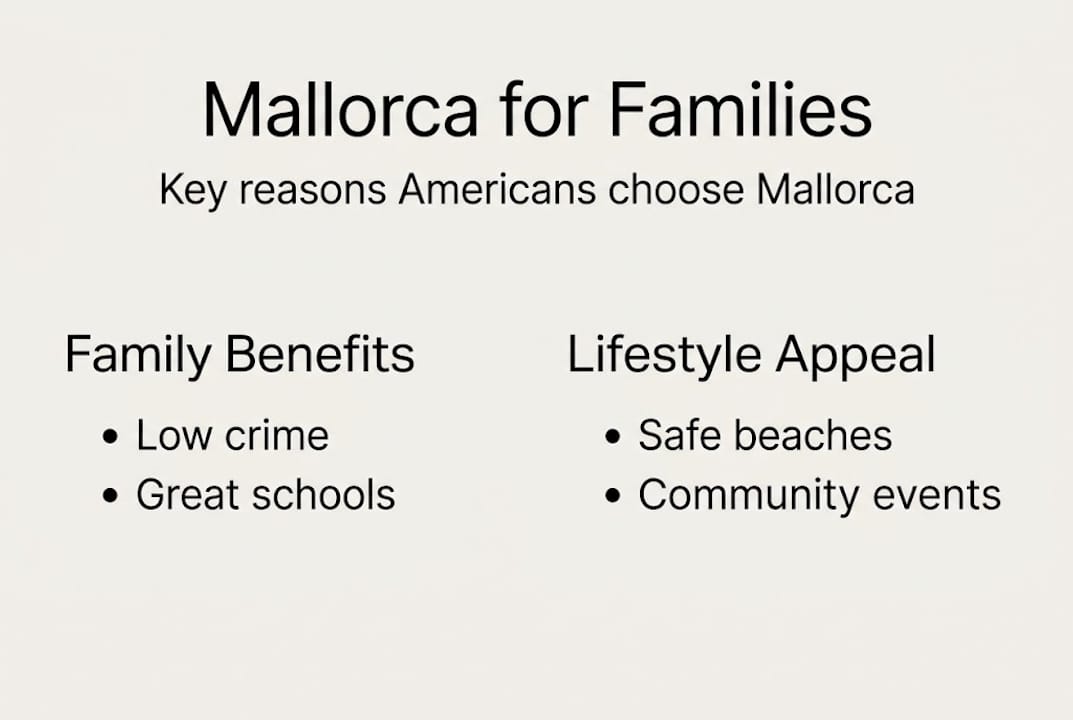
Strong expat communities in Calvià, Palma, and the north around Pollensa provide integration support through international schools, multilingual services, and community events. These networks are not informal or accidental. They’re well-organized and specifically designed to help new arrivals get settled quickly.
For families thinking about where to buy, our holiday home buying Mallorca guide and family home examples Mallorca posts show how property location and school access connect in practice.
Pro Tip: Start your international school enrollment inquiry by April or May for a September start. The best schools fill quickly, and late inquiries often result in waiting lists that push enrollment back a full academic year.
Expat community and long-term support
After tackling schooling, let’s explore long-term support and community resources that set Mallorca apart for American families. The expat network here is one of the island’s most underrated assets, and it operates on a scale most first-time visitors don’t expect.
Mallorca has been attracting international residents for decades. The result is a mature, well-resourced expat infrastructure with real depth. Here’s what that looks like in practice:
- Calvià municipality on the southwest coast is home to one of the largest expat concentrations on the island, with multiple international schools, English-language services, and a strong community events calendar.
- Son Vida, often called Mallorca’s Beverly Hills, is a gated residential area near Palma with a high proportion of affluent international families and excellent security.
- Pollensa and the north attract families who prefer a more rural, authentic Mallorcan lifestyle while still accessing strong expat networks and quality English-language education.
- Palma city offers the broadest range of multilingual services, international supermarkets, American-friendly amenities, and professional networks.
The expat communities in Calvià, Palma, and Pollensa provide integration support through international schools, multilingual services, and organized community events throughout the year. These aren’t just Facebook groups. They include structured welcome programs, relocation advisors, language tutors, and parent networks tied to specific schools.
“Most international schools in Mallorca offer dedicated transition programs for new families, including buddy systems for children and orientation events for parents arriving mid-year.”
For a broader picture of where Mallorca’s property market is headed and which areas are gaining popularity with families, our Mallorca property forecast covers recent trends in detail. And when you’re ready to start looking at specific homes, our property viewing tips will help you evaluate each neighborhood through a family-first lens.
Why most guides underestimate Mallorca’s appeal for American families
Most relocation guides treat Mallorca as a summer holiday destination with a sidebar about schools. That framing misses the point entirely. What we’ve seen, working with American families on luxury property searches across the island, is that Mallorca’s true value is its infrastructure density. You get the lifestyle of a small Mediterranean island combined with the support systems of a cosmopolitan city.
The outdated reputation, often centered on party tourism in Magaluf, has almost nothing to do with the Mallorca that affluent families actually experience. Families who relocate to Son Vida or northern Mallorca are living in quiet, secure, beautifully landscaped communities with world-class schools, easy access to nature, and a social network that makes the transition genuinely manageable.
Where other European destinations make you choose between lifestyle and practicality, Mallorca rarely forces that trade-off. The family home search tips we share with buyers consistently reflect one theme: families who do their research before arrival settle in faster and with far less friction.
Pro Tip: Plug into expat-led community events and school parent networks within your first month. The families who integrate fastest are the ones who show up, not the ones who wait to feel settled first.
Find your ideal family home in Mallorca with expert support
Finding the right property in Mallorca means more than browsing listings. It means understanding which neighborhoods align with your children’s school options, which communities have the strongest expat networks, and which homes will hold their value as the island’s market matures. That’s exactly what we do at ULI & LISA. As independent buyer agents based in Mallorca, we use AI-powered search tools to give you an unbiased view of the full market, not just what one agency wants to sell. Whether you’re just beginning to explore or ready to make a move, our Mallorca property agents are here to guide every step of your family’s search with honesty and local expertise.
Frequently asked questions
What are the safest areas in Mallorca for families?
Calvià, Son Vida, and Pollensa are among the safest family-friendly communities in Mallorca, with strong expat support networks and very low violent crime rates. These areas are consistently preferred by international families relocating long-term.
How quickly can Americans enroll their children in Mallorca schools?
International schools allow pre-arrival registration without requiring a local address, which means enrollment can begin before your family arrives. Starting inquiries by April or May gives you the best chance of securing a spot for September.
What types of family activities are available in Mallorca year-round?
Mallorca offers safe beaches, hiking, cycling, waterparks, aquariums, boat trips, and adventure parks that serve families across every season, not just summer. The Serra de Tramuntana trails and cycling routes are particularly popular with families throughout the cooler months.
How strong is Mallorca’s expat community for American families?
Mallorca has a well-developed expat community with multilingual services and transition support concentrated in Calvià, Palma, and Pollensa. International schools act as social anchors, making it far easier for newly arrived families to build connections quickly.
Recommended
- 7 Essential Family Home Buying Tips for Mallorca - ULI & LISA Mallorca Property Blog
- American Expat Communities in Mallorca: Where US Citizens Live in 2025 - ULI & LISA Mallorca Property Blog
- Buying Vacation Homes in Mallorca: Smart Steps for American Investors - ULI & LISA Mallorca Property Blog
- Family Home Search Tips Mallorca for Luxury US Buyers - ULI & LISA Mallorca Property Blog