
Relocating to Mallorca as a high-net-worth American involves navigating complex legal residence requirements, dual tax obligations, and luxury property acquisition strategies. Unlike typical vacation stays, establishing legal residency triggers Spanish tax rules while maintaining US filing duties under Citizenship-Based Taxation. This guide walks you through securing residence permits, choosing optimal visa pathways, understanding wealth and income tax implications, and executing tax-efficient property purchases with expert support tailored to your financial profile.
Key takeaways
| Point | Details |
|---|---|
| Residency permits | Non-EU citizens must secure formal permits with proof of solvency, health insurance, and clean criminal records |
| Visa pathways | Non-Lucrative Visa suits retirees; Digital Nomad Visa offers 24% flat tax for remote workers |
| Tax residency | Spending 183+ days in Spain triggers worldwide income tax and regional wealth tax |
| Dual obligations | US citizens file with IRS regardless, creating dual compliance requirements |
| Property planning | Wealth tax depends on valuation method and ownership structure, requiring strategic planning |
Understanding residency permits in Mallorca
Americans planning stays beyond 90 days must apply for residence permits through Spain’s formal immigration process. Non-EU citizens face stricter scrutiny than European nationals, requiring comprehensive documentation and patience with bureaucratic timelines. The Extranjería Office in Palma handles high application volumes, making precise submissions critical to avoid rejections or delays that disrupt relocation plans.

Core requirements include proof of financial means, health insurance, criminal records, and accommodation verified through recent, legalized documents. Financial solvency thresholds vary by permit type but typically demand demonstrating income or savings well above Spain’s Public Income Indicator (IPREM). Private health coverage must match Spanish social security benefits without gaps. Criminal background checks require Apostille certification from your home state, and accommodation proof ranges from property deeds to long-term rental contracts.
Additional criteria depend on your permit category. Employment permits need Spanish job offers with labor market tests. Study permits require enrollment confirmation from accredited institutions. Family reunification permits demand proof of relationship and sponsor’s legal status. Each pathway has distinct processing times and renewal conditions that shape long-term planning.
Document preparation demands meticulous attention. All foreign documents need Apostille legalization under the Hague Convention, then sworn translation into Spanish by certified translators. Outdated or incomplete paperwork triggers automatic rejections, restarting the entire process. Financial statements should exceed minimum thresholds by 20-30% to demonstrate comfortable margins, as consular officers scrutinize borderline cases closely.
Pro Tip: Compile your document portfolio six months before your intended move date, allowing time for apostilles, translations, and corrections without rushing your timeline.
Consider consulting specialists familiar with Mallorca residency processes who understand local office procedures and common pitfalls. Independent advisors can review your application before submission, catching errors that would otherwise cause months of delays. Their experience with Palma’s Extranjería Office helps navigate appointment scheduling and follow-up inquiries efficiently.
Visa options tailored for high-net-worth individuals
Two visa categories dominate planning for wealthy Americans: the Non-Lucrative Visa (NLV) and the Digital Nomad Visa. Each serves distinct lifestyle and income profiles, with different financial thresholds and tax treatments that significantly impact your net wealth over time.
The Non-Lucrative Visa requires financial self-sufficiency without authorization to work in Spain. It targets retirees, passive income earners, and those living off investments or savings. Applicants must demonstrate approximately 400% of IPREM annually, roughly €28,800 for the primary applicant in 2026, plus €7,200 for each dependent. These figures adjust yearly with IPREM updates, so verify current thresholds during application.
NLV holders enjoy renewable one-year permits extendable to two years after the initial period. After five years of legal residence, you become eligible for permanent residency, eliminating renewal hassles. The visa prohibits employment but allows property ownership, volunteer work, and investment activities that don’t constitute labor. This restriction suits those whose income flows from US pensions, dividends, rental properties, or trust distributions.
The Digital Nomad Visa offers 24% flat tax under Beckham Law provisions for professionals working remotely for non-Spanish employers. This visa revolutionizes tax planning for consultants, executives, and entrepreneurs earning substantial income while residing in Mallorca. The flat rate applies to income up to €600,000, far below Spain’s top marginal rate of 47%, creating massive savings for high earners.
Eligibility requires proving remote work arrangements with companies outside Spain, demonstrating professional qualifications, and meeting income thresholds around €2,500 monthly. The visa grants three-year initial residence with renewal options, and holders can work for Spanish clients up to 20% of their total income. This flexibility accommodates occasional local projects without jeopardizing visa status.
Pro Tip: If your income exceeds €600,000 annually, calculate whether the Digital Nomad Visa’s flat rate on the first €600,000 plus standard rates on excess income still beats NLV taxation on worldwide income.
Compare both visas against your income sources, work plans, and family situation. NLV suits those fully retired or living on passive income, while Digital Nomad Visa benefits active professionals whose remote work generates high earnings. Both require detailed residency planning that considers not just approval odds but long-term tax efficiency and lifestyle fit.
Navigating tax implications when relocating to Mallorca
Spanish tax residency is determined by 183-day presence, economic interests, or family ties within a calendar year. Once classified as a tax resident, Spain taxes your worldwide income at progressive rates from 19% to 47%, depending on income brackets and autonomous community rates. Non-residents pay tax only on Spanish-source income, typically at flat 24% for most categories.
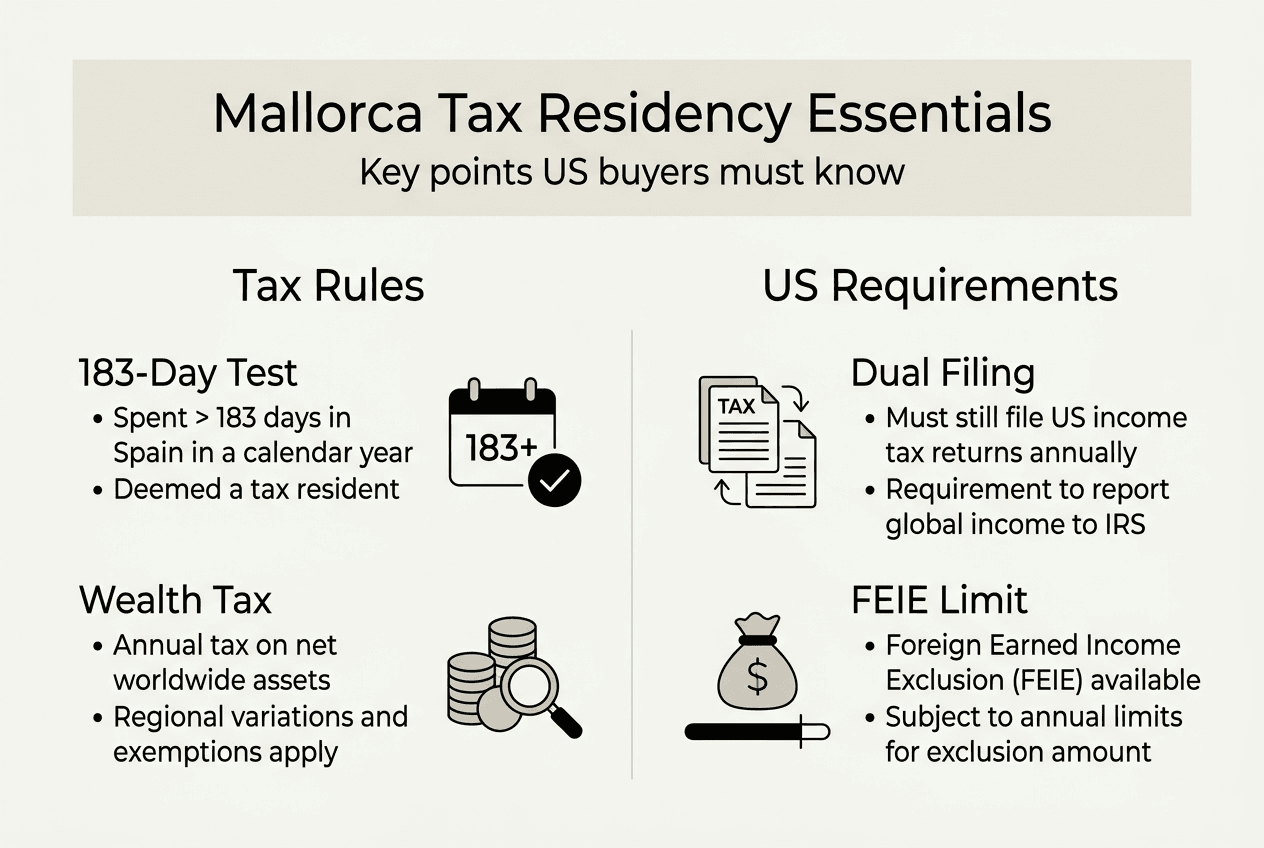
The 183-day test counts any day you’re physically present in Spain, even partial days. Economic center criteria examine where your main investments, business interests, or income sources originate. Family ties trigger residency if your spouse or minor children habitually reside in Spain, even if you spend fewer than 183 days there. These overlapping tests mean careful tracking of presence and economic activity prevents unintended tax residency.
US citizens face dual filing requirements under Citizenship-Based Taxation regardless of residence location. You must file annual US tax returns reporting worldwide income, even while paying Spanish taxes on the same income. The US-Spain Tax Treaty prevents double taxation through foreign tax credits and exclusions, but you generally pay the higher of the two countries’ rates on each income type.
Foreign Earned Income Exclusion (FEIE) allows excluding up to $126,500 of foreign earned income in 2026, reducing US tax on salary or self-employment income. Foreign Tax Credit (FTC) offsets US tax dollar-for-dollar with Spanish taxes paid on the same income. Strategic planning determines which mechanism optimizes your total tax burden, often requiring professional modeling of various scenarios.
Spanish wealth tax applies progressively based on net worldwide assets exceeding regional thresholds, typically €700,000 after a €300,000 primary residence exemption. Rates range from 0.2% to 3.5% depending on total net worth and autonomous community rules. The Balearic Islands, which includes Mallorca, maintains its own wealth tax schedule that differs from mainland regions, making location-specific advice essential.
Wealth tax calculations use the highest of official tax valuation, purchase price, or cadastral value for real estate, often exceeding actual market values during property booms. Personal property, investments, and business interests add to the taxable base, while mortgages and certain debts reduce it. Two identical asset portfolios can generate vastly different tax bills depending on ownership structures, timing of acquisitions, and regional variations.
Pro Tip: Roth IRA withdrawals, tax-free in the US, face Spanish taxation between 19% and 28% as ordinary income, significantly impacting retirement planning for Americans relying on Roth distributions.
Coordinating US and Spanish filings requires tracking foreign accounts for FBAR and FATCA reporting, claiming treaty benefits correctly, and timing income recognition to minimize total tax. Missteps trigger penalties from both jurisdictions, making professional cross-border tax advice non-negotiable for high-net-worth relocations. Review your Mallorca real estate tax obligations and property tax specifics before finalizing residence plans.
Buying luxury property in Mallorca: legal and tax considerations
Luxury property purchases in Mallorca involve strategic decisions around valuation, ownership structure, and timing relative to tax residency establishment. Property taxes base on the highest official valuation, purchase price, or cadastral value, creating situations where you pay wealth tax on amounts exceeding what you actually paid. Sophisticated buyers model these scenarios before signing purchase contracts.
Ownership structure dramatically impacts ongoing tax liabilities. Direct personal ownership subjects the property to wealth tax at individual rates with limited planning flexibility. Holding through Spanish or foreign entities can provide asset protection and succession benefits but may trigger higher transfer taxes or corporate tax obligations. Two identical portfolios generate different tax outcomes depending on regional rules and holding structures, making pre-purchase planning essential.
Timing your property acquisition relative to establishing tax residency creates opportunities. Purchasing before becoming a Spanish tax resident may allow different valuation treatments or avoid immediate wealth tax inclusion. Conversely, waiting until after residency establishment might qualify you for primary residence exemptions worth €300,000 against wealth tax calculations. These decisions require modeling your specific financial situation against Spanish tax rules.
Due diligence extends beyond typical property inspections. Verify cadastral records match physical property boundaries, confirm no outstanding debts or liens encumber the title, and review urban planning regulations affecting future development rights. Mallorca’s coastal and rural properties often face additional restrictions on renovations, extensions, or usage changes that impact long-term value and enjoyment.
Hiring an independent buyer agent protects your interests during negotiations and closing. Unlike seller’s agents who represent property owners, buyer agents work exclusively for you, identifying properties matching your criteria, negotiating favorable terms, and coordinating legal and tax advisors. Their local market knowledge prevents overpaying and uncovers off-market opportunities unavailable through standard listings.
Pro Tip: Schedule property acquisitions to close after securing your residence permit but before triggering tax residency, giving you legal status without immediate worldwide income tax obligations during the transition period.
Key steps include pre-purchase tax modeling with cross-border advisors, engaging independent legal counsel for contract review, coordinating notary appointments for deed execution, and registering ownership with the Property Registry. Each phase demands attention to Spanish legal formalities and tax optimization opportunities that preserve wealth over your ownership period. Explore safe property investment strategies that integrate legal compliance with financial efficiency.
How ULI & LISA can simplify your Mallorca relocation
Navigating Mallorca’s legal and tax landscape demands local expertise combined with understanding of US financial structures. ULI & LISA specialize in guiding high-net-worth American buyers through every relocation phase, from initial property search to final residence permit approval. Our independent buyer agent service ensures you make informed decisions that protect your interests and optimize tax efficiency.
We leverage AI-powered property search tools to identify luxury homes matching your specific criteria across Mallorca’s diverse regions, from coastal estates to mountain retreats. Our unbiased approach means we evaluate properties based solely on your needs, not commission incentives. This independence proves invaluable when assessing investment potential and negotiating purchase terms.
Our team coordinates with immigration attorneys, tax advisors, and notaries who understand cross-border complexities facing American buyers. We streamline document preparation, translation, and submission processes that often overwhelm newcomers unfamiliar with Spanish bureaucracy. By managing these details, we reduce delays and compliance risks that could derail your relocation timeline. Partner with our Mallorca property buying services to ensure your transition proceeds smoothly from initial planning through successful property ownership and secure investment execution.
What documents are essential for applying for a residence permit in Mallorca?
What documents are essential for applying for a residence permit in Mallorca?
Applicants need valid passport copies, proof of financial means exceeding IPREM thresholds, private health insurance certificates, criminal background checks with Apostille certification, and proof of accommodation in Mallorca. Depending on visa type, additional documents include employment contracts, university enrollment letters, or family relationship certificates. All foreign documents require sworn Spanish translation by certified translators recognized by Spanish authorities.
How long does residence permit processing typically take?
Initial processing ranges from three to six months depending on application volume at Palma’s Extranjería Office and document completeness. Incomplete applications face rejection and restart the timeline from zero. Consular processing for visa approvals before entering Spain adds another two to three months, making total timelines from application to approval span six to nine months for straightforward cases.
How does Spanish wealth tax affect luxury property owners?
How does Spanish wealth tax affect luxury property owners?
Wealth tax applies annually to net assets exceeding €700,000 after a €300,000 primary residence exemption, with progressive rates from 0.2% to 3.5%. Property valuation uses the highest of official tax value, purchase price, or cadastral value, often exceeding market prices. Strategic ownership structures and timing of acquisitions relative to tax residency establishment can significantly reduce ongoing wealth tax liabilities.
Can property ownership structure reduce wealth tax exposure?
Yes, holding property through Spanish or foreign entities may provide different tax treatments compared to direct personal ownership. However, corporate structures can trigger transfer taxes, ongoing corporate tax obligations, and compliance costs that offset wealth tax savings. Professional modeling of your specific asset portfolio and income sources determines optimal structures balancing tax efficiency with administrative complexity.
Can US retirees in Mallorca avoid double taxation?
Can US retirees in Mallorca avoid double taxation?
The US-Spain Tax Treaty prevents paying full tax to both countries on the same income through foreign tax credits and exclusions. However, you generally pay the higher of the two countries’ rates on each income type. US Citizenship-Based Taxation requires annual IRS filings regardless of residence, creating dual compliance obligations even when treaty provisions eliminate actual double taxation.
How are retirement account distributions taxed in Spain?
Traditional IRA and 401(k) distributions face Spanish income tax at progressive rates from 19% to 47%, with foreign tax credits offsetting US withholding. Roth IRA withdrawals, tax-free in the US, are taxed as ordinary income in Spain between 19% and 28%, significantly impacting retirement planning. Social Security benefits receive favorable treaty treatment, taxed only in your country of residence, providing some relief for retirees.
Recommended
- Buying Property in Mallorca: Key Steps for Americans - ULI & LISA Mallorca Property Blog
- Choosing the Right Area Mallorca: Guide for US Buyers - ULI & LISA Mallorca Property Blog
- How to Work With Real Estate Agents Mallorca for US Buyers - ULI & LISA Mallorca Property Blog
- Mallorca Real Estate Trends 2025 – What U.S. Buyers Need - ULI & LISA Mallorca Property Blog