
Mallorca’s luxury real estate market presents a compelling question for high-net-worth American investors: should you rent or buy? While many assume renting offers better flexibility, recent data reveals rising costs make buying more cost-effective in 94% of Spanish markets. This guide examines the financial realities, investment potential, and practical considerations of both options using current market data, helping you make an informed decision aligned with your wealth-building and lifestyle goals in this Mediterranean paradise.
Key Takeaways
| Point | Details |
|---|---|
| Luxury villa yields | Gross rental yields for luxury Mallorca villas average about 4 percent. |
| Renting advantages | Renting offers low upfront costs and flexibility to sample locations, but provides no property appreciation. |
| Buying benefits | Buying builds equity but requires substantial upfront investment and ongoing ownership costs. |
| License restrictions | Short term rental licenses are restricted in the Balearics, limiting income potential and complicating new investments. |
Understanding the Mallorca luxury property market
Mallorca’s luxury real estate landscape attracts sophisticated investors seeking both lifestyle enhancement and financial returns. The island’s property market shows strong fundamentals driven by limited supply, exclusive locations, and consistent international demand. Understanding current market dynamics helps you evaluate whether renting or buying aligns with your investment thesis.
Luxury villas in prime areas command premium prices, with properties in southwest coastal zones and historic Palma neighborhoods ranging from €2 million to €15 million. The rental market mirrors this exclusivity, with weekly rates for high-end villas reaching €5,000 to €20,000 during peak season. However, gross rental yields average 4% for luxury properties, considerably lower than mid-market residential units that achieve 4.68%. Properties with existing short-term rental licenses can generate 5-7% yields, but new ETV licenses face severe restrictions.
Regulatory changes significantly impact investment calculations. The Balearic government has frozen new short-term rental licenses in many municipalities, creating scarcity value for licensed properties but limiting income options for new buyers. This policy shift fundamentally alters the rent-versus-buy equation, particularly for investors counting on rental income to offset ownership costs.
Several factors drive Mallorca’s luxury property demand:
- Consistent tourism growth bringing affluent visitors year-round
- Limited developable land in premium coastal and mountain locations
- Growing interest from American buyers seeking European lifestyle assets
- Political stability and established legal frameworks protecting property rights
- Exceptional climate, infrastructure, and international school options
The market’s maturity means price appreciation tends toward steady rather than explosive growth. Recent years have seen 3-6% annual appreciation in luxury segments, though prime locations occasionally exceed these averages. This stability appeals to investors prioritizing wealth preservation over speculative gains.
Pros and cons of renting luxury properties in Mallorca
Renting offers distinct advantages for investors testing the Mallorca market or requiring maximum flexibility. The financial and lifestyle benefits make renting attractive for specific use cases, though significant drawbacks limit its appeal for long-term wealth building.
The primary advantage centers on minimal upfront capital commitment. Rental deposits and initial costs remain modest compared to property acquisition, typically requiring first month’s rent, last month’s rent, and a security deposit equivalent to one or two months. This preserves capital for other investments while providing immediate access to luxury accommodations.
Flexibility represents another compelling benefit. Renting allows you to experience different Mallorca regions before committing to a purchase location. You might spend winter months in Palma’s urban sophistication, then summer in a Deià mountain retreat, gathering firsthand knowledge about microclimates, community character, and lifestyle fit. This exploration phase proves invaluable for making informed purchase decisions later.
Renters avoid property management responsibilities entirely. Maintenance, repairs, community fees, property taxes, and insurance fall to the landlord. This hands-off approach suits investors focused on enjoying Mallorca rather than managing real estate logistics, particularly for those splitting time between continents.
Pro Tip: Rent in different areas for 3-6 month periods to identify your ideal microclimate and community before buying. Mallorca’s diverse regions offer dramatically different lifestyles within short distances.
However, renting presents substantial disadvantages for wealth-focused investors:
- Zero equity accumulation or capital appreciation benefits
- Rental payments represent pure expense with no asset-building component
- Potential for significant rent increases, especially in high-demand luxury segments
- Limited availability of long-term luxury rentals, with most properties targeting short-term tourist markets
- Difficulty securing favorable lease terms as a non-resident without local guarantors
- No control over property improvements, renovations, or personalization
Long-term luxury rentals remain scarce in Mallorca’s market. Most luxury property owners maximize returns through short-term tourist rentals rather than annual leases. This scarcity gives landlords pricing power and favorable terms, leaving renters with limited negotiating leverage.
Benefits and drawbacks of buying luxury real estate in Mallorca
Purchasing luxury property in Mallorca offers compelling advantages for investors with long-term horizons and sufficient capital. Ownership provides wealth-building opportunities and lifestyle stability, balanced against substantial upfront costs and ongoing responsibilities.

Equity building represents the primary financial advantage. Every mortgage payment increases your ownership stake while property values appreciate over time. Mallorca’s luxury properties show steady appreciation, typically 3-6% annually in established markets. This combination of principal reduction and appreciation creates meaningful wealth accumulation, particularly over 10-15 year holding periods.
Ownership provides complete control over your property. You can renovate to personal specifications, landscape grounds to your preferences, and make long-term improvements that enhance both enjoyment and resale value. This autonomy proves especially valuable for investors seeking a true second home rather than temporary accommodation.
Stability eliminates rent increase concerns. Your housing costs remain predictable, with only property taxes, insurance, and maintenance varying year to year. This certainty helps with long-term financial planning and protects against Mallorca’s rising rental costs.
Income potential exists through rental strategies, though regulatory restrictions require careful consideration. Properties with existing short-term licenses can generate attractive returns during periods you’re not using them. Long-term rentals provide steadier income with less management intensity. However, yields average around 4% for luxury villas, lower than many investors expect.
Pro Tip: Evaluate financing options carefully, considering both Spanish mortgage products and U.S.-based portfolio loans. Tax implications vary significantly between financing structures, so consult cross-border tax specialists before committing.
Buying requires substantial upfront investment:
- Down payment of 30-40% for non-resident buyers
- Property transfer tax of 8-11% depending on property value
- Legal fees, notary costs, and registration expenses totaling 2-3%
- Potential renovation or furnishing costs for older properties
- First year’s property insurance and community fees
Ongoing ownership costs include annual property tax (IBI) ranging from €2,000 to €10,000 for luxury properties, community fees in developments, maintenance and repairs, insurance, and utilities. These expenses can total €15,000 to €40,000 annually for high-end properties.
Market liquidity presents another consideration. Luxury properties take longer to sell than mid-market units, with average marketing periods of 6-18 months. This illiquidity matters if you need to access capital quickly or market conditions deteriorate.
| Consideration | Renting | Buying |
|---|---|---|
| Initial capital | €10,000-30,000 | €800,000-6,000,000+ |
| Monthly costs | €3,000-15,000 rent | €2,000-5,000 (taxes, fees, maintenance) |
| Flexibility | High, can relocate easily | Low, significant transaction costs |
| Equity building | None | Appreciates 3-6% annually |
| Income potential | Not applicable | 4% gross yield typical |
| Control | Limited by lease terms | Complete autonomy |
| Risk exposure | Minimal | Market volatility, regulatory changes |
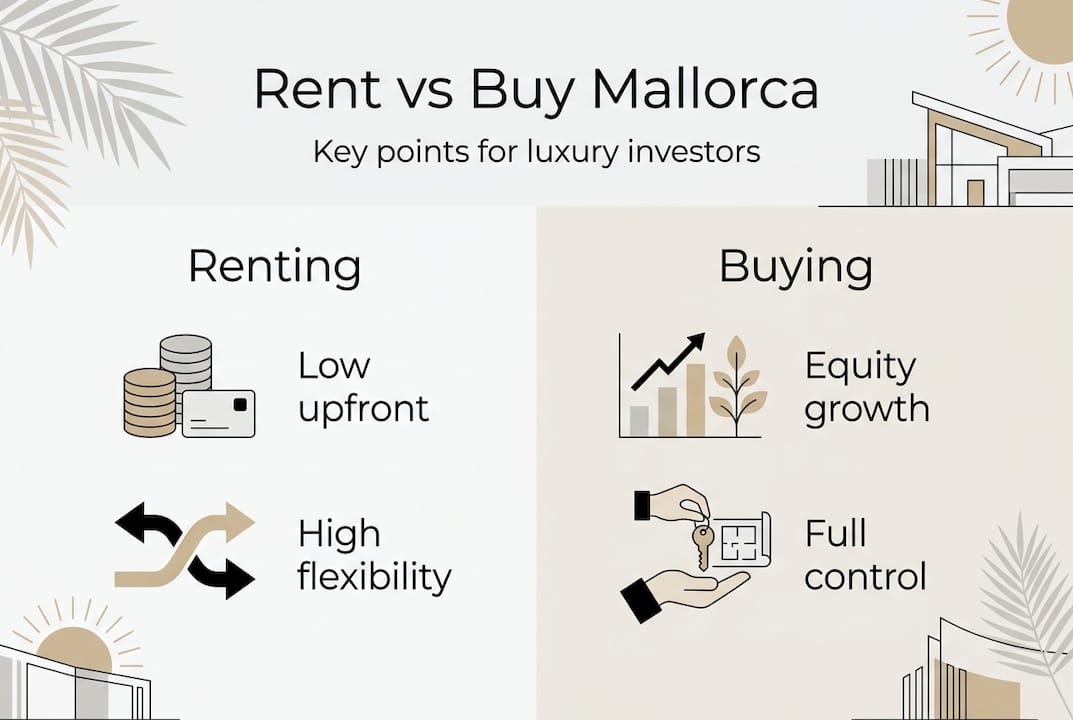
Making the right choice: practical considerations for high-net-worth investors
Choosing between renting and buying requires honest assessment of your investment objectives, financial capacity, and intended property use. The optimal decision varies based on individual circumstances rather than universal rules.
Define your primary objective clearly. If you’re seeking lifestyle flexibility while exploring Mallorca’s regions, renting provides lower-risk market entry. If you’re building a long-term wealth portfolio with tangible assets, buying offers superior returns through appreciation and equity accumulation. Mixed objectives, such as testing the market before eventual purchase, might justify 1-2 years of renting followed by strategic acquisition.
Financial readiness extends beyond down payment capacity. Can you comfortably absorb 40-50% of property value in upfront costs without compromising liquidity? Do you have reserves for unexpected repairs or market downturns? Safe property investment requires maintaining adequate cash reserves beyond purchase costs.
Rental license restrictions fundamentally impact income assumptions. Without existing short-term licenses, your rental income potential drops significantly. If offsetting ownership costs through rental income forms part of your investment thesis, verify license availability before purchasing. Properties with licenses command premium prices but offer superior income potential.
The rising cost environment in Spain increasingly favors buyers over renters. With rental costs outpacing ownership expenses in 94% of markets, the financial case for buying strengthens for investors planning 5+ year holding periods. This trend particularly impacts luxury segments where rental premiums continue escalating.
Key decision factors to evaluate:
- Investment horizon: buying makes sense for 7+ year timeframes, renting for shorter periods
- Annual usage: properties used 8+ weeks yearly justify ownership economics better than occasional visits
- Liquidity requirements: buying ties up significant capital with limited quick-exit options
- Tax situation: ownership creates tax obligations in Spain and potentially the U.S., requiring professional guidance
- Estate planning goals: real estate can complicate or enhance wealth transfer depending on structure
- Risk tolerance: property ownership concentrates wealth in single assets subject to market and regulatory risk
Consult with independent buyer agents who understand both Mallorca’s market dynamics and American investors’ unique needs. These professionals provide unbiased market analysis, identify properties matching your criteria, negotiate favorable terms, and coordinate legal and financial specialists. Their expertise proves especially valuable for navigating Spain’s regulatory environment and 2026 market conditions.
Work with independent buyer agents to navigate Mallorca real estate
ULI & LISA specialize in guiding American investors through Mallorca’s luxury property market, whether you’re evaluating rental options or ready to purchase. As independent buyer agents, we represent your interests exclusively, providing unbiased market analysis and property identification across the island’s diverse regions.
Our services address the unique challenges American investors face. We handle comprehensive market research, property due diligence, negotiation strategy, and coordination with legal and financial specialists. Our AI-powered search tools identify opportunities matching your specific criteria, while our local expertise ensures you understand regulatory requirements, tax implications, and market timing.
Working with dedicated buyer representation protects your interests throughout the transaction process. We negotiate from a position of knowledge, secure favorable terms, and ensure proper legal documentation. Our luxury real estate services cover everything from initial market exploration through closing and beyond.
Benefits of independent representation:
- Unbiased property recommendations focused solely on your objectives
- Deep knowledge of Mallorca’s microclimates, communities, and investment potential
- Expert negotiation achieving better prices and terms than buyers typically secure alone
- Coordination with English-speaking attorneys, tax advisors, and financial institutions
- Ongoing support for property management, renovations, and eventual resale
Whether you’re exploring Mallorca through strategic rentals or ready to acquire safe property investments, our team provides the expertise and support that transforms complex transactions into confident decisions. We help you navigate the rent-versus-buy decision with clarity, then execute your chosen strategy efficiently.
What are the key questions about renting vs buying luxury property in Mallorca?
Is renting luxury property in Mallorca more cost-effective than buying?
Renting proves more cost-effective for stays under 3-5 years or when you need maximum flexibility. However, rising rental costs now exceed ownership expenses in most Spanish markets, making buying financially superior for investors planning 7+ year holding periods with regular property use.
What are the typical upfront costs when buying luxury real estate in Mallorca?
Expect to pay 30-40% down payment plus 8-11% property transfer tax, 2-3% in legal and notary fees, and additional costs for insurance and initial furnishings. Total upfront investment typically reaches 45-55% of purchase price for non-resident buyers.
How do rental license restrictions affect income potential for owners?
New short-term rental licenses are frozen in most municipalities, limiting income options for new buyers. Properties with existing ETV licenses achieve 5-7% yields, while unlicensed properties must rely on long-term rentals generating lower returns around 3-4%.
Can non-residents easily secure long-term rental contracts in Mallorca?
Long-term luxury rentals remain scarce, as most owners prefer lucrative short-term tourist markets. Non-residents face additional challenges securing favorable lease terms without local guarantors, and landlords often prefer Spanish residents for annual contracts.
What financial and legal services should I engage when buying property in Mallorca?
Engage an independent buyer agent, Spanish property attorney, cross-border tax advisor familiar with U.S. and Spanish obligations, currency exchange specialist for large transactions, and potentially a mortgage broker if financing. These professionals protect your interests and ensure compliant, efficient transactions.
Recommended
- Renting Before Buying Mallorca – Maximize Investment Smartly - ULI & LISA Mallorca Property Blog
- Mallorca Luxury Property Guide: Everything You Need to Know - ULI & LISA Mallorca Property Blog
- How to Navigate Mallorca Real Estate Market: Luxury Buyer’s Guide - ULI & LISA Mallorca Property Blog
- 7 Expert Tips for Buying an Apartment in Mallorca - ULI & LISA Mallorca Property Blog
- How to Safeguard Rental Investment: A Step-by-Step Guide - Rental Income Insurance