
TL;DR:
- Managing Mallorca luxury villas requires understanding complex legal, tax, and operational requirements.
- Local professional management is essential for rental optimization and risk mitigation.
- Successful investment depends on hands-on local expertise to navigate regulations and protect assets.
Owning a luxury villa in Mallorca sounds like a dream, but the financial and legal realities can catch even experienced American investors off guard. Between non-resident tax filings, local registration requirements, tourist rental licensing, and the ever-present risk of property mismanagement from 4,000 miles away, the margin for error is slim. Get it right, and you’re looking at gross yields of 4% to 6% on a premium asset in one of Europe’s most desirable markets. Get it wrong, and you’re facing fines, vacant months, or worse. This guide walks you through every critical layer of managing a luxury property in Mallorca so you can protect your investment and maximize returns from day one.
Key Takeaways
| Point | Details |
|---|---|
| Legal compliance is key | Filing the correct taxes and following occupancy laws prevents costly legal issues for foreign property owners. |
| Professional management pays off | Using vetted local managers optimizes yield, maintains your property, and mitigates unique regional risks. |
| Dynamic rental strategies boost income | Applying dynamic pricing and high standards for guest vetting can increase rental yields by up to 45%. |
| Risk management is essential | Regular property checks and robust security measures protect your asset from squatters and legal pitfalls. |
| Local expertise beats remote control | Hands-on, in-market knowledge ensures your luxury property investment thrives in Mallorca’s unique landscape. |
Understanding the legal and tax landscape
For non-resident American owners, the tax picture in Mallorca has shifted meaningfully in recent years, and missing a deadline or filing incorrectly can result in automatic penalties. Understanding exactly what you owe, when, and how is non-negotiable.
Non-resident income tax (IRNR) is the primary tax you’ll encounter. Historically, non-EU residents like Americans paid a flat 24% on gross rental income, with no deductions allowed. But a landmark 2025 ruling changed that significantly. Non-resident Americans now benefit from 19% on net rental income after allowable deductions, bringing them in line with EU residents. That’s a meaningful difference on a villa generating €80,000 to €120,000 in annual rental revenue.
Even if you never rent your property, you still have a tax obligation. Spain imputes a rental income to vacant properties based on the cadastral value (the government’s official assessed value) of the home. You must file an annual Modelo 210 by December 31 of the year following the tax period. Skip it, and the Spanish tax authority (Agencia Tributaria) will find you eventually, often with interest and late fees attached.
Beyond income tax, you’ll need to register for and pay IBI (Impuesto sobre Bienes Inmuebles), which is the local property tax similar to U.S. property taxes. You’ll also need a Spanish NIE number (a tax identification number for foreigners), a local bank account for direct debits, and utility accounts registered in your name. Without these in place, routine bills pile up unpaid and can trigger service interruptions or local fines.
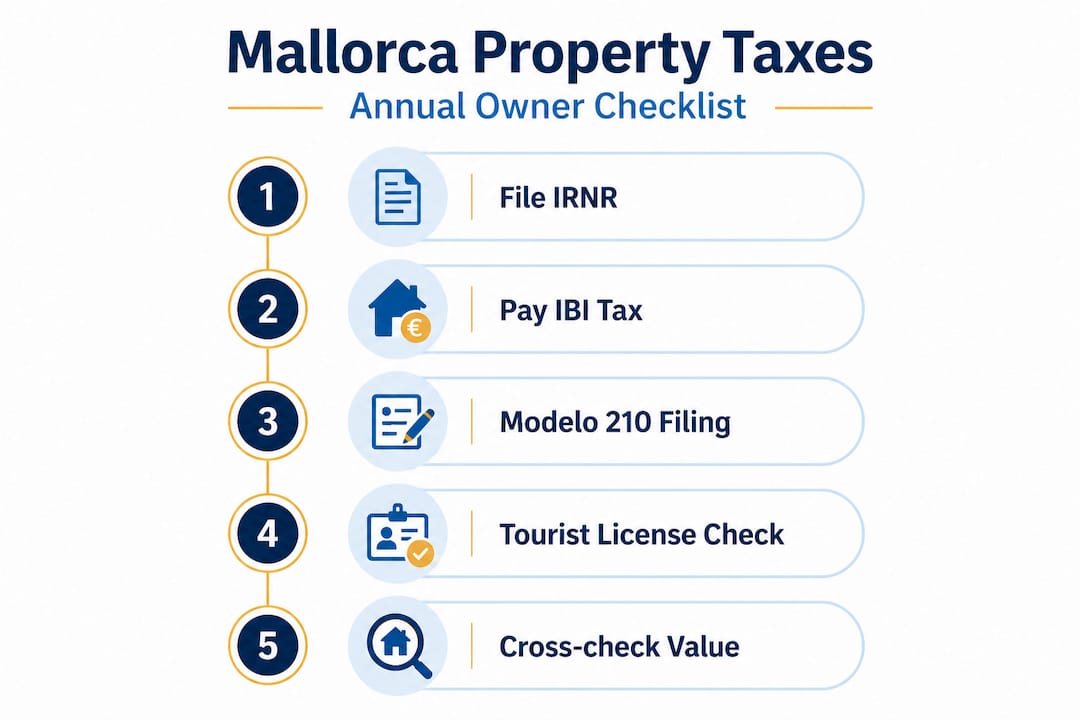
Key annual filings and deadlines
Here’s a simplified overview of your core annual obligations as a non-resident American owner:
| Filing | Purpose | Deadline |
|---|---|---|
| Modelo 210 (imputed income) | Tax on vacant property | December 31 |
| Modelo 210 (rental income) | Tax on rental earnings | Quarterly or annual |
| IBI payment | Local property tax | Set by municipality |
| Garbage collection tax | Local services | Annual |
| Wealth tax (if applicable) | On assets over threshold | June 30 |
Numbered steps to get compliant fast:
- Obtain your NIE number before or immediately after purchase.
- Open a Spanish bank account to handle direct debits and tax payments.
- Register utilities (electricity, water, internet) in your name.
- Hire a Spanish gestor (a licensed tax and administrative agent) to file your annual Modelo 210.
- Set up calendar reminders for all local deadlines, or delegate to your property manager.
If you’re still in the process of evaluating your first acquisition, the Mallorca luxury property guide walks through what to assess before you buy, including tax exposure and purchase costs.
Pro Tip: Ask your gestor to cross-reference your cadastral value with the actual market value annually. Discrepancies are common in luxury zones and can sometimes be challenged, reducing your imputed income tax burden.
Step-by-step: Setting up for efficient property management
Once the legal groundwork is in place, the practical question becomes: who runs everything when you’re in New York or Miami? This is where American investors often make their first costly mistake, underestimating how different the operational landscape is in Mallorca compared to home.

A professional property manager in Mallorca does far more than collect rent. Vetted local managers handle key holding, emergency response, utility management, contractor coordination, pre-arrival preparation, and post-departure inspections. The best ones employ in-house staff rather than outsourcing every task, which means faster response times, consistent quality, and fewer layers of miscommunication.
DIY management vs. professional services
| Factor | DIY (remote) | Professional manager |
|---|---|---|
| Response time to emergencies | Hours to days | Minutes to hours |
| Local contractor relationships | None | Established and vetted |
| Regulatory compliance | High risk of errors | Handled proactively |
| Rental listing management | Manual, time-intensive | Optimized and automated |
| Monthly cost | Low upfront, high in risks | Typically 10-20% of rental income |
| Peace of mind | Low | High |
The table makes it clear: remote DIY management is almost never worth the risk for a luxury asset worth €2 million or more. A single maintenance issue handled poorly, like a roof leak in winter or a pool system failure during peak season, can cost you far more than a year of management fees.
How to set up your management structure step by step:
- Interview at least three property management companies with verifiable client references in the luxury segment.
- Confirm they have in-house maintenance and cleaning teams, not just outsourced freelancers.
- Establish a SEPA direct debit mandate from your Spanish bank for utility and IBI payments.
- Define a maintenance budget (typically 1% to 2% of property value per year) for proactive upkeep.
- Schedule a formal property inspection report at least twice a year, with photos and written documentation.
- Request monthly financial statements from your manager, including occupancy data, rental income, and expense breakdowns.
Understanding how the local real estate market operates is equally important when evaluating managers. Agents who specialize in navigating the Mallorca market can often recommend trusted management firms they’ve seen perform well on behalf of international buyers.
Pro Tip: Look for property managers who are also registered as official tourism rental managers with the Balearic Islands government. This simplifies licensing renewals and reduces your personal administrative burden significantly.
Maximizing rental yields and occupancy
With your team in place, the priority shifts to performance. Mallorca’s luxury rental market is competitive but highly rewarding when managed strategically. Let’s talk real numbers.
Market snapshot for Mallorca luxury villas in 2026: Average daily rates (ADR) range from €650 to €800 per night for premium properties. Occupancy rates average around 65%, translating to gross yields between 4% and 6%. Properties using dynamic pricing tools see revenue increases of up to 45% compared to static pricing models.
That 45% uplift from dynamic pricing alone is striking. Tools like PriceLabs and Beyond Pricing analyze real-time market demand, local events, competitor rates, and historical booking patterns to adjust nightly rates automatically. A villa in Puerto Andratx priced statically at €700 per night might justify €950 during a major sailing regatta weekend in August and drop to €550 in early May to stimulate early bookings. That elasticity is where the real money is made.
For those tracking luxury property returns across different zones, it’s worth knowing that the southwest coast (Puerto Andratx, Camp de Mar) and the northwest (Deià, Valldemossa) consistently command the highest nightly rates but also have the most restrictive tourism rental licensing environments.
Best practices for maximizing occupancy
- Professional photography and videography: Non-negotiable at this price point. Drone footage adds significant perceived value.
- Multi-platform listing: List on Airbnb Luxe, Luxury Retreats, HomeAway, and direct booking channels simultaneously.
- Guest vetting: Require ID verification, damage deposits (often €3,000 to €10,000 for high-end villas), and signed rental contracts.
- Seasonal targeting: Focus U.S. market outreach for summer bookings. European markets dominate shoulder seasons.
- Concierge add-ons: Yacht charters, private chefs, and car rentals increase average booking value by 20% to 30% and enhance guest reviews.
- Review management: Consistently five-star-rated properties on major platforms command 15% to 25% premium pricing over comparable unlisted properties.
One often-overlooked revenue strategy is corporate or film production rentals. High-end villas in scenic locations are regularly sought by production companies and corporate retreat planners, often at above-market rates and with longer booking windows that reduce turnover costs dramatically.
Risk management: Avoiding pitfalls unique to Mallorca
While maximizing profit is essential, protecting your investment from common and costly local risks is equally vital. Mallorca has some property management challenges that simply don’t exist in the U.S. market, and ignoring them is expensive.
The most discussed risk in the Spanish property world right now is okupa, the colloquial term for squatters. Spanish squatter law is notoriously complex, and eviction timelines can stretch from months to over a year depending on how the case is handled legally. Vacant luxury villas are prime targets, particularly in the off-season when neighbors are scarce and patrols are infrequent. The financial and legal cost of reclaiming your property can easily reach €30,000 to €60,000 when legal fees and repairs are included.
“A luxury villa left unmonitored for even four to six weeks can become a target. Regular property checks, reinforced entry points, and a visible local presence are your best deterrents.” Property management specialist, Mallorca
Beyond squatter risks, lease categorization errors create serious legal exposure. In Spain, there are meaningful legal differences between short-term tourist rentals (requiring a Mallorca tourism license), medium-term contracts (91 days to 11 months), and long-term residential leases. Using the wrong contract type or renting without the correct tourist license exposes you to fines starting at €40,001 and potentially losing your rental operating rights entirely.
Key risk mitigation steps for Mallorca property owners
- Obtain and maintain a valid tourist rental license (Vivienda Vacacional) before listing your property anywhere.
- Install a monitored alarm system with remote access and camera coverage of entry points.
- Add anti-squat devices to doors and windows during extended vacancy periods.
- Purchase a specialist property owners insurance policy that covers okupa legal costs.
- Hire a local property manager to conduct physical inspections at least every two weeks when the property is unoccupied.
- Have your Spanish attorney review every lease agreement before it’s signed, regardless of rental type.
Buyers who are still evaluating properties should factor these risk profiles into their due diligence. Property viewing tips for Mallorca luxury buyers can help you identify properties with structural or location-specific vulnerabilities before committing.
Why luxury property management in Mallorca demands hands-on expertise
Here’s the uncomfortable truth most investment guides won’t tell you: the strategies that work brilliantly in the U.S. luxury rental market often fail quietly in Mallorca, not because the market is weak, but because the context is fundamentally different.
American investors frequently arrive with assumptions shaped by Miami Beach or the Hamptons. They expect smooth digital workflows, rapid legal processes, and property managers who think like asset managers. What they encounter instead is a market shaped by Spanish bureaucracy, Balearic-specific regulations, multilingual contractor relationships, and a culture where trust is built slowly over years, not in a first Zoom call.
Short-term yields are higher but require intensive management that non-residents simply cannot provide remotely. We’ve seen experienced investors lose 30% to 40% of their potential annual rental income simply by failing to maintain platform rankings, respond quickly to guest inquiries, or adapt pricing fast enough to capture peak-demand windows.
The learning curve is real. Local regulations around tourist licensing change regularly. The Balearic Islands government has been steadily tightening restrictions on new tourist rental licenses since 2017, and navigating renewals or license transfers on property purchases requires someone who understands the current regulatory mood, not just the written law. Climate-specific maintenance, from managing humidity damage in autumn to preparing pools and gardens for winter, requires contractors who know the island’s microclimates. These are not details you can manage effectively from across the Atlantic.
Our honest advice: don’t try to run this investment remotely without a deeply embedded local partner. The cost of expert hiring a Mallorca luxury agent who truly understands both the investment and the operational side pays for itself within the first rental season in most cases.
Expert help for seamless luxury property management in Mallorca
Having explored the practical realities of managing luxury property in Mallorca, the next step is partnering with professionals who specialize in exactly this kind of investment. At ULI & LISA, we work exclusively with international buyers, particularly American clients, who want to acquire and manage safe property investment in Mallorca with full confidence and local expertise behind them. Whether you’re still evaluating your first acquisition or refining the management structure of an existing asset, our luxury property management services are built to handle the legal, operational, and rental optimization layers on your behalf. We bring AI-powered property search tools, deep market knowledge, and vetted local partnerships together in one place. Visit ULI & LISA to connect with our team and take the first step toward a professionally managed, high-performing Mallorca property.
Frequently asked questions
What taxes must non-resident Americans pay on luxury property in Mallorca?
Non-resident Americans now pay 19% on net rental income after allowable deductions following the 2025 ruling, while vacant properties are taxed at 24% on imputed income calculated from the cadastral value.
Is annual tax filing required for properties not being rented?
Yes, even vacant properties require an annual Modelo 210 filing for imputed income, with the deadline falling on December 31 of the year following the relevant tax period.
What can I do to prevent squatters or unauthorized occupation of my property?
Schedule regular property checks every one to two weeks, install a monitored alarm system, use anti-squat security on doors and windows, and take out a specialist insurance policy that covers legal costs related to occupation disputes.
Should I opt for short-term rentals or long-term leases for best returns?
Short-term rentals yield 6% to 8% but demand intensive hands-on management, while long-term leases deliver lower but more predictable income with significantly less operational overhead, making the right choice dependent on your capacity for active involvement.
Recommended
- Mallorca Luxury Property Guide: Everything You Need to Know - ULI & LISA Mallorca Property Blog
- Mallorca Luxury Property Guide: Everything You Need to Know - ULI & LISA Mallorca Property Blog
- Mallorca Investment Property Checklist: Legal Essentials - ULI & LISA Mallorca Property Blog
- Mallorca Investment Tips: Maximize ROI and Navigate Rental Laws - ULI & LISA Mallorca Property Blog
- Top benefits of property management in Dubai: 2026 guide