
TL;DR:
- Buying luxury property in Mallorca involves navigating hidden tax traps, title issues, and cross-border compliance risks that most buyers overlook.
- Independent buyer representation ensures access to the full market, unbiased analysis, and professional support throughout the complex acquisition process.
Buying luxury property in Mallorca looks deceptively simple from the outside. Beautiful island, willing sellers, and money in the bank. But every high net worth buyer guide for Mallorca worth reading will tell you the same thing: the gap between signing a deal and signing a good deal is filled with tax traps, title complications, and cross-border compliance obligations that most buyers never see coming. Whether you’re an American investor diversifying into European real estate or an affluent family seeking a second home in the Mediterranean, the decisions you make in the first 90 days of your search will define your investment for decades.
Understanding Mallorca’s most exclusive luxury locations
To navigate Mallorca’s luxury market effectively, first grasp the distinctive characteristics of its prime locations. Not all prestigious addresses are created equal, and your lifestyle priorities should drive your location shortlist before price ever enters the conversation.
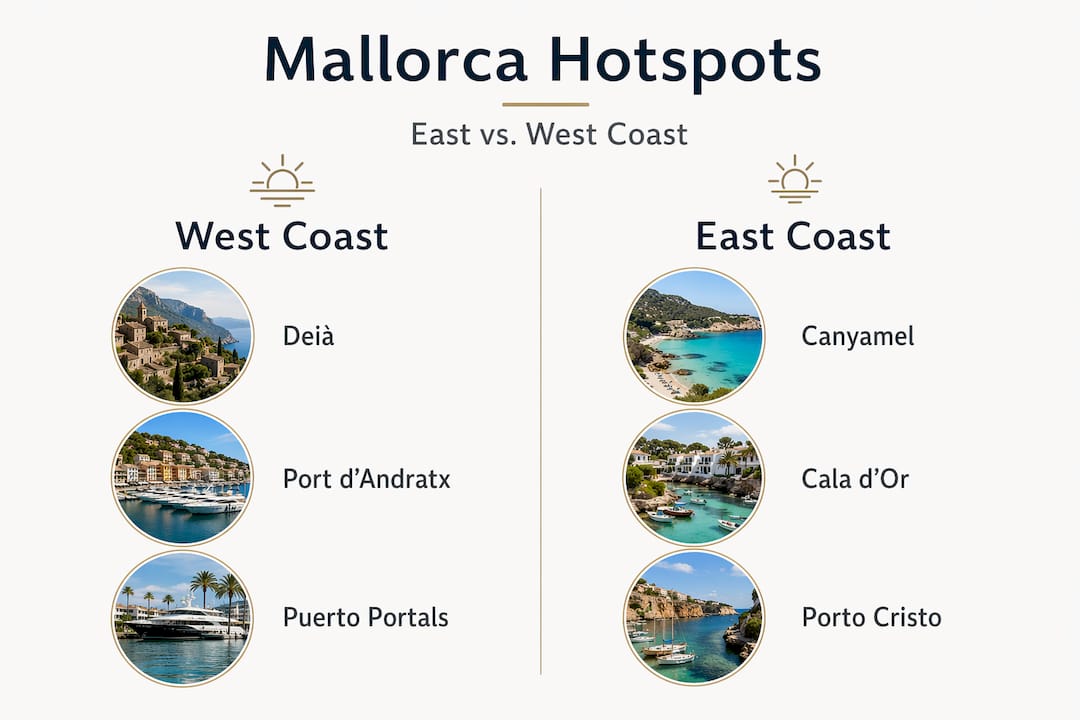
Son Vida, Deià, and Port Andratx are among the most exclusive luxury addresses on the island, each recognized for security, privacy, sea views, and architectural distinction. But each serves a very different buyer.
Here is a breakdown of the key areas and what makes each one distinct:
- Son Vida sits above Palma in a gated residential community with 24-hour security, two championship golf courses, and panoramic views across the Bay of Palma. It is the go-to choice for families who want world-class privacy without sacrificing quick access to Palma’s international airport, private schools, and city amenities. Think of it as the Beverly Hills of Mallorca.
- Deià is a UNESCO-protected village on the northwest coast that has attracted artists, writers, and old-money European families for generations. Properties here are stone fincas and restored manor houses woven into a terraced hillside above the sea. Supply is severely limited, which is exactly why buyers value it.
- Port Andratx caters to buyers who want their yacht in the marina and a social calendar to match. The waterfront villas here are some of the most photographed on the island, and the local restaurant and marina scene gives the area a year-round energy that quieter villages lack.
- Palma Old Town has emerged as a serious contender for urban luxury buyers. Renovated 16th-century palaces (known locally as palauets) with interior courtyards and rooftop terraces represent a genuinely rare asset class.
- Formentor and Bendinat round out the top tier, with Formentor delivering near-total seclusion at the island’s northern tip and Bendinat offering family-oriented villas within easy reach of the sea and international schools.
For a deeper look at how location intersects with property type and lifestyle, the Mallorca luxury property guide breaks down each zone by buyer profile.
The single most common mistake we see is buyers anchoring to a location based on a vacation memory rather than actual ownership requirements. Where you love to spend a week in August is not necessarily where you want to manage a €5 million asset year-round.
Financial and tax considerations for high-end property acquisitions
With prime locations identified, understanding the full financial commitment involved in acquisition is crucial for strategic buying. The sticker price is only the beginning.
Buyers targeting properties above €3M should budget an additional 13 to 15% beyond the purchase price to cover acquisition costs including transfer tax, legal and notary fees. On a €4 million property, that means setting aside an additional €520,000 to €600,000 before you move a single piece of furniture.
Here is a breakdown of the typical acquisition cost categories:
- Transfer tax (ITP): Approximately 8 to 11% of the declared purchase price, applied on resale properties. New builds are subject to VAT at 10% instead.
- Legal fees: Roughly 1% of the purchase price plus Spanish VAT (currently 21% on the fee itself), covering your independent lawyer’s full service.
- Notary and registry fees: Typically €2,000 to €5,000 depending on the property value and transaction complexity.
- Gestoria (administrative agent) fees: A smaller but real cost for handling bureaucratic registration steps.
| Cost component | Estimated range | Notes |
|---|---|---|
| Transfer tax (ITP) | 8 to 11% | Resale properties; graduated rate |
| VAT (new builds) | 10% | Replaces ITP for new developments |
| Legal fees | ~1% + VAT | Always use independent legal counsel |
| Notary and registry | €2,000 to €5,000 | Fixed scale based on property value |
| Gestoria | €500 to €1,500 | Administrative processing |
| Total additional costs | 13 to 15% | Budget this above your offer price |
Ongoing tax obligations matter just as much as the initial purchase. Non-resident owners must file annual income tax returns in Spain even if they do not rent the property. Spanish wealth tax, filed via Modelo 714 typically between April and June for the previous tax year, applies to non-residents whose Spanish assets exceed the exemption threshold.
The Mallorca real estate closing process guide walks through each stage of cost realization in detail, which is useful reading before you make an offer.
Pro Tip: Engage a cross-border tax advisor who is qualified in both US and Spanish tax law before you sign anything. The US-Spain tax treaty contains provisions that can significantly affect your net holding costs, and the structure you choose at acquisition (personal ownership vs. a Spanish SL company vs. an offshore holding entity) is very difficult and expensive to change afterward.
Navigating legal due diligence and title verification in Mallorca
Beyond financial planning, thorough legal due diligence is essential to secure clear and compliant property ownership. Mallorca has a well-developed property registry system, but irregularities still exist, particularly in older rural properties and fincas that have changed hands informally over generations.
The Nota Simple is where every serious buyer starts. The Nota Simple is an official extract from the Property Registry summarizing the property’s legal status, ownership details, and any encumbrances, and it typically costs €3 to €10 to obtain. It tells you who legally owns the property, whether there are mortgages or liens registered against it, and whether any legal proceedings affect the title.
Here is the five-step due diligence process every buyer should follow:
- Obtain the Nota Simple from the official Registro de la Propiedad. Do not accept a seller-provided copy as your primary source.
- Review all property documents with your lawyer. This includes the energy certificate, community of owners statutes if applicable, and any historic building permits.
- Check for encumbrances. Mortgages, easements, unpaid community fees, and tax liens can all attach to a property and transfer with ownership if not cleared at closing.
- Verify planning and licensing compliance. Rural properties in particular carry risk of illegal extensions or structures built without municipal permits. These can result in demolition orders.
- Finalize purchase contracts. Your lawyer should review the contrato de arras (deposit contract) before you commit any funds.
Pro Tip: Always request the Nota Simple yourself through the official Registro de la Propiedad online portal rather than relying on documents the seller’s agent provides. This guarantees authenticity and protects your personal data from being shared unnecessarily in the transaction chain.
Cross-border purchase process and compliance for US investors
Having covered legal verification, it is important to understand the specific compliance and procedural steps US buyers face during acquisition. American investors are welcome in the Spanish property market, but the paperwork requirements are non-negotiable and sequential.
Foreign buyers, including Americans, can buy property in Mallorca, but must obtain a Spanish NIE number (Número de Identificación de Extranjero) and should carefully consider visa options if they plan to stay longer than 90 days within any 180-day period under Schengen rules.
The standard purchase sequence for a US buyer looks like this:
- Obtain your Spanish NIE number. This can be done at a Spanish consulate in the US or in Mallorca with original passport documentation.
- Open a Spanish bank account. Required for fund transfers and ongoing tax filings.
- Conduct property viewings and identify your target property.
- Sign the contrato de arras (private purchase contract) and place the deposit, typically 10% of the purchase price.
- Complete due diligence during the agreed period before final signing.
- Sign the escritura pública (notarized public deed) before a Spanish notary, either in person or via a lawyer holding your Power of Attorney.
- Register the purchase at the Property Registry and pay applicable taxes.
Key additional points for US buyers:
- Power of Attorney allows your Spanish lawyer to handle signing and registration without you being physically present in Mallorca, which is genuinely useful for cross-border transactions.
- Escrow arrangements protect your deposit between private contract and final deed signing.
- Visa planning: The non-lucrative visa and the newer digital nomad visa both offer pathways for longer stays, each with distinct income and tax residency implications.
- FBAR and FATCA reporting: If you hold a Spanish bank account with more than $10,000 at any point in the year, US reporting obligations apply regardless of how the account is used.
To understand each step in more practical detail before your first viewing trip, the guide on how to navigate Mallorca real estate market covers the procedural landscape from a buyer’s perspective.
Maximizing investment value and lifestyle benefits in Mallorca
Beyond acquiring property, buyers seek to optimize their investment and lifestyle returns given Mallorca’s unique market characteristics. The good news: the fundamentals here are strong.
Mallorca’s luxury real estate has consistently outpaced mainland Spain in price appreciation and appeals to global buyers due to stable demand, lifestyle quality, and its reputation as a secure European asset. The island benefits from constrained supply (protected landscapes limit new development), strong international demand from northern Europe and increasingly from the US, and a 12-month-a-year operating economy that supports rental returns.
Here is how different property types compare for investment profile:
| Property type | Rental yield potential | Appreciation profile | Notes |
|---|---|---|---|
| Licensed finca (rural) | High, with tourism license | Steady | Tourism license dramatically increases income |
| Waterfront villa | Moderate to high | Premium appreciation | Peak lifestyle asset, strong resale demand |
| Urban penthouse (Palma) | Steady year-round | Reliable | Less seasonal, suits long-term tenancy |
| Village property (Deià/Valldemossa) | Limited by supply | Strong long-term | Scarcity drives values |
Key points worth understanding before you buy:
- Tourism licenses are the single biggest value lever. Properties with an existing Vivienda Turística license can generate 80 to 100% more annual rental income compared to unlicensed equivalents because they can be legally rented on short-term platforms. New licenses in many municipalities are no longer being issued, making licensed properties a genuinely scarce asset.
- Lifestyle returns are real financial returns. Access to elite international schools, low crime, Mediterranean climate, and a thriving expatriate community reduce the invisible costs of ownership (stress, security concerns, quality-of-life trade-offs) that buyers often leave out of their ROI calculations.
- Mallorca is not a flip market. The acquisition costs alone (13 to 15%) mean short-term speculation rarely pencils out. Buyers with a 7-to-10-year horizon are consistently rewarded.
For a full breakdown of why Mallorca’s high-end market holds value where others do not, the Mallorca luxury homes advantages article examines the structural reasons behind the island’s resilience.
Why independent buyer representation is critical for high net worth investors in Mallorca
Here is a truth the broader luxury real estate industry prefers you do not think about too hard: most agents in Mallorca represent the seller. Their fee is paid by the seller. Their loyalty, legally and financially, runs to the seller. When they tell you a property is priced fairly, they are not lying to you exactly. They are just answering a different question than the one you need answered.
This matters more in Mallorca than in most markets. The exclusive properties Mallorca market is not transparent. A significant portion of the best listings never appear on public portals. Pricing is inconsistent across agencies because the same property is often listed with multiple agents at different prices. Without independent representation, you are negotiating blind in a market designed for sellers.
Independent buyer agents like us at ULI & LISA work exclusively for the buyer. No seller contract, no commission conflict, no reason to steer you toward the property with the biggest fee attached. We access the full market including off-market inventory, conduct unbiased comparative analysis on pricing, and negotiate from a position of data rather than relationship pressure.
The real value, though, is not just in finding the property. It is in the 90 days after you find it. Cross-border tax structuring, due diligence coordination with Spanish legal counsel, compliance filing timelines, post-purchase registration: these are the areas where unrepresented buyers consistently lose money or create problems they spend years untangling. A good independent agent does not just hand you the keys. They make sure every professional in the transaction is genuinely working in your interest.
If you are spending north of €3 million on an asset in a foreign legal system with a different language, different tax regime, and different property law, independent representation is not a luxury. It is risk management.
How ULI & LISA supports your safe luxury property investment in Mallorca
Navigating safe property investment in Mallorca requires more than a good search portal. ULI & LISA offer fully independent buyer representation with access to the complete Mallorca market, including off-market properties that never reach public listings. We specialize in serving high net worth international buyers, with particular depth in US cross-border transactions, Spanish compliance requirements, and the nuances of Mallorca’s luxury segments. Our clients receive AI-powered market analysis, hands-on property sourcing, legal due diligence coordination, and full acquisition support from first inquiry to deed signing. As independent buyer agents for Mallorca, our only obligation is to you, not to any seller or developer. Explore our full range of services at ULI & LISA luxury real estate services and take the first step toward a secure, well-structured investment.
Frequently asked questions
Can non-EU citizens buy property in Mallorca?
Yes, non-EU citizens including Americans can buy property in Mallorca, but they must obtain a Spanish NIE number for the transaction and comply with Schengen visa limits for stays beyond 90 days within any 180-day period.
What are the total acquisition costs when buying a luxury property above €3 million in Mallorca?
Buyers should budget 13 to 15% above the purchase price to cover transfer tax, legal fees, notary charges, and other closing costs. On a €3 million property, that translates to an additional €390,000 to €450,000.
What is a Nota Simple and why is it important in property buying?
A Nota Simple is an official property registry extract showing current ownership, legal status, and any registered charges or liens. It is the foundational document for due diligence and should always be obtained directly from the official registry, not from the seller.
How do high net worth buyers benefit from using independent buyer agents in Mallorca?
Independent buyer agents represent only the buyer with full market access, providing unbiased pricing analysis, access to off-market listings, and professional coordination of legal and compliance requirements throughout the transaction.
Recommended
- How to Navigate Mallorca Real Estate Market: Luxury Buyer’s Guide - ULI & LISA Mallorca Property Blog
- How to Navigate Mallorca Real Estate Market: Luxury Buyer’s Guide - ULI & LISA Mallorca Property Blog
- Mallorca Luxury Property Guide: Everything You Need to Know - ULI & LISA Mallorca Property Blog
- Mallorca Luxury Property Guide: Everything You Need to Know - ULI & LISA Mallorca Property Blog