
Evaluating luxury properties in Mallorca presents unique challenges for international buyers. Complex legal frameworks, varied valuation methodologies, and dynamic market conditions can make accurate assessment difficult without local expertise. High-net-worth investors need reliable evaluation methods to identify properties that align with investment goals while ensuring legal compliance and fair pricing. This comprehensive guide walks you through preparation steps, proven valuation techniques, investment verification processes, and legal due diligence required for confident luxury property acquisition in Mallorca’s competitive market.
Key Takeaways
| Point | Details |
|---|---|
| Valuation methods threefold | Mallorca relies on comparison, cost, and income capitalization to triangulate accurate property values. |
| Legal due diligence | Comprehensive legal checks protect investment by verifying ownership, permits, and compliance with Spanish property law. |
| Local market trends | Tracking area specific trends in Palma, Port Andratx, and the northeast coast helps assess fair pricing and potential returns. |
| Preparation and experts | Starting with a standardized checklist and consulting local experts improves evaluation accuracy and outcomes. |
Preparing to evaluate Mallorca luxury properties
Successful property evaluation starts long before you view your first villa. You need solid groundwork covering market knowledge, legal requirements, and clear investment objectives. Gathering the right information upfront saves time and prevents costly mistakes during the evaluation process.
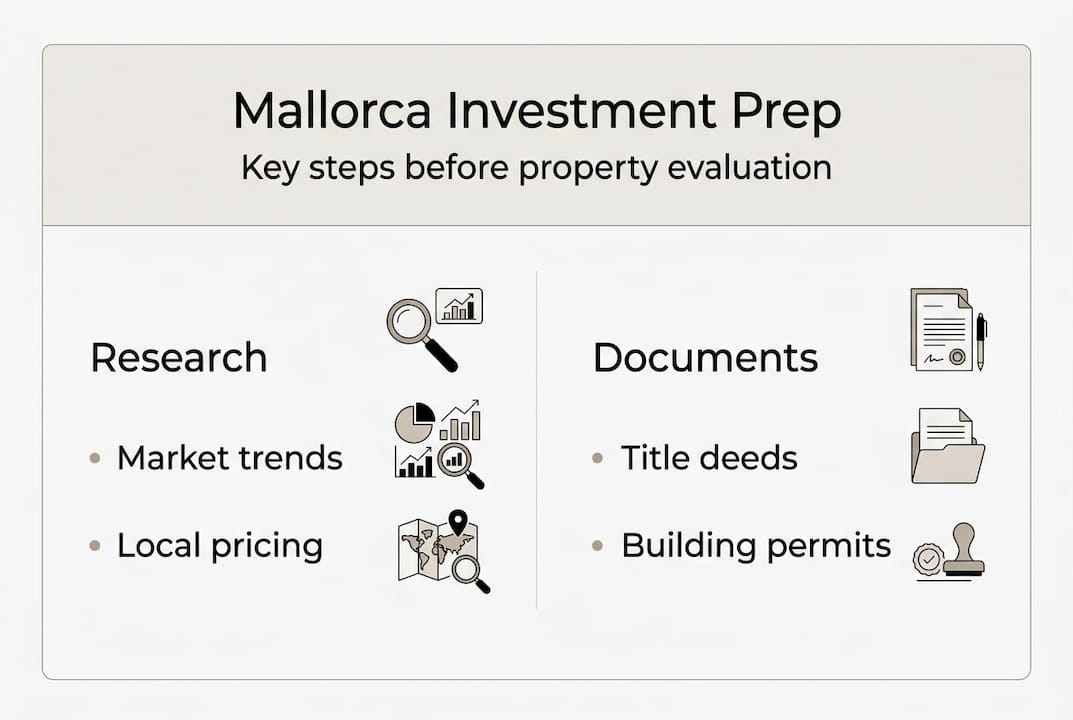
Start by researching current Mallorca luxury market trends. Understanding price movements in specific areas like Palma, Port Andratx, or the northeast coast helps you recognize fair market value. Foreign buyers face specific ownership rules and taxation requirements that differ from domestic purchases. You’ll need to familiarize yourself with NIE registration, transfer taxes ranging from 8-11%, and annual property taxes.
Document collection forms the foundation of thorough evaluation. Request property title deeds, cadastral certificates, building permits, and recent condition reports from sellers or their agents. These documents reveal ownership history, legal boundaries, permitted uses, and structural integrity. Missing or incomplete documentation often signals potential legal complications worth investigating before proceeding.
Define your investment goals clearly before evaluating properties. Are you seeking a primary residence, rental income property, or long-term appreciation asset? Each objective requires different evaluation criteria. Rental properties demand analysis of tourist demand and occupancy rates, while residence properties prioritize lifestyle amenities and accessibility. Resale-focused investments require understanding market liquidity and buyer demographics.
Consult local experts early in your evaluation journey. Independent buyer agents provide unbiased market insights specific to Mallorca without conflicts of interest. Legal advisors specializing in Spanish property law can review contracts and identify hidden liabilities. Tax consultants help structure ownership to optimize fiscal efficiency. These professionals catch issues you might miss and provide context that transforms raw data into actionable intelligence.
Pro Tip: Create a standardized evaluation checklist covering legal, financial, and physical criteria before viewing properties. This systematic approach ensures you collect comparable data across multiple properties and make objective comparisons rather than emotional decisions.
Gather information on neighborhood development plans and infrastructure projects. Upcoming improvements like new marinas, golf courses, or transport links can significantly impact property values. Conversely, planned commercial developments or regulatory changes might diminish appeal. Local municipal offices and regional planning departments publish this information, though navigating Spanish bureaucracy often requires local assistance.
Understand the complete valuation process used by professionals in Mallorca. This knowledge helps you recognize whether asking prices align with market reality and gives you negotiating leverage. Professional appraisers combine multiple methodologies to triangulate accurate values, and you should adopt similar rigor in your evaluation.
Executing valuation methods for Mallorca luxury properties
Three primary methodologies provide comprehensive property valuation: comparison, cost, and income capitalization. Each approach offers distinct advantages depending on property type and market conditions. Professional appraisers typically apply all three methods to cross-validate results and ensure accuracy.

The comparison approach analyzes recent sales of similar properties in the same area. You identify comparable properties matching your target in size, features, location, and condition. Adjust prices for differences like superior views, larger plots, recent renovations, or additional amenities. A beachfront villa with direct access commands premium pricing over inland properties, even with identical square footage. Pool quality, architectural style, and privacy levels also warrant price adjustments.
Executing comparison analysis requires accessing reliable sales data. Public registries in Spain don’t always reflect actual transaction prices, as buyers and sellers sometimes declare lower values to reduce transfer taxes. Independent agents with local networks provide more accurate recent sale information. Search for at least three comparable sales within the past 12 months and within 2 kilometers of your target property.
The cost method calculates land value plus construction costs minus depreciation. This approach works exceptionally well for unique villas lacking direct comparables. Start by determining land value through comparable vacant plot sales in the area. Add current construction costs for building an identical structure, typically ranging from €1,800 to €3,500 per square meter for luxury finishes in Mallorca. Subtract depreciation based on actual age, condition, and functional obsolescence.
Calculating accurate construction costs requires understanding local building standards and material prices. Luxury properties often feature imported materials, custom finishes, and advanced systems that exceed standard construction costs. Factor in specialized features like infinity pools, home automation, wine cellars, and high-end landscaping. Depreciation isn’t simply linear; a well-maintained 15-year-old villa might show less functional depreciation than a poorly maintained 8-year-old property.
Income capitalization estimates value based on rental income potential. Divide annual net operating income by the capitalization rate to determine property value. Net operating income equals gross rental income minus operating expenses like management fees, maintenance, utilities, insurance, and property taxes. Capitalization rates reflect market expectations and risk profiles, typically ranging from 4% to 7% for Mallorca luxury properties.
Pro Tip: Calculate both gross and net rental yields to understand true income potential. Gross yields might appear attractive at 6%, but after deducting 40-50% for expenses and vacancy, net yields often fall to 3-3.5% in prime areas.
Applying income capitalization requires realistic rental projections. Research actual rental rates for comparable properties on platforms like Airbnb and luxury villa rental agencies. Account for seasonal variations; summer weekly rates might be triple winter rates. Calculate occupancy rates conservatively, typically 60-70% for well-managed luxury rentals in desirable locations. Premium properties in sought-after areas like Deia or Port Andratx might achieve 75-80% occupancy.
| Valuation Method | Best For | Key Advantage | Main Limitation |
|---|---|---|---|
| Comparison | Standard luxury properties | Reflects current market reality | Requires sufficient comparable sales |
| Cost | Unique villas and new construction | Accounts for replacement value | Doesn’t reflect market demand |
| Income Capitalization | Rental investment properties | Focuses on income generation | Requires accurate rental projections |
Choose your primary valuation method based on property characteristics and investment goals. Use comparison for standard luxury homes in established markets with active sales. Apply cost methodology for architectural masterpieces or newly constructed villas lacking sales comparables. Rely on income capitalization when rental returns drive your investment decision. Combining all three methods provides the most reliable valuation by revealing whether asking prices align across different analytical frameworks.
Verifying investment potential and legal compliance
Valuation alone doesn’t guarantee sound investment. You must verify legal status, assess market outlook, and confirm rental potential before committing capital. This verification phase protects against legal complications and ensures properties deliver expected returns.
Legal due diligence starts with title verification. Obtain a nota simple from the Property Registry confirming current ownership, mortgages, liens, and easements. Cross-reference this with cadastral records to verify boundaries and built area. Discrepancies between registered and actual square footage are common in older properties and can affect valuation and future resale.
Check building permits and licenses for all structures and renovations. Many luxury properties in Mallorca underwent expansions or modifications without proper permits, creating legal vulnerabilities. Unpermitted construction can result in demolition orders, fines, or complications during resale. Request architect certificates confirming all work complies with current building codes and urban planning regulations.
Verify the property sits in legally buildable land classification. Some rural areas have protected status prohibiting construction or limiting modifications. Confirm water and utility connections have proper licenses. Illegal wells or unpermitted septic systems create liability and potential service interruptions.
Analyze local rental market dynamics if income generation matters to your investment thesis. Research actual gross rental yields of 3-5% typical in prime tourist areas. Lower yields reflect higher purchase prices and investor expectations for capital appreciation rather than immediate income. Calculate net yields after all expenses to understand true cash flow.
Examine rental regulations and licensing requirements. Mallorca implemented strict vacation rental rules requiring specific licenses that aren’t available in all areas. Some municipalities banned new vacation rental licenses entirely, while others impose occupancy limits and operational restrictions. Properties without proper rental licenses face substantial fines and rental income loss.
Evaluate macroeconomic and local market forecasts. Mallorca’s luxury market correlates with European economic health, interest rates, and international travel trends. Strong demand from German, British, and increasingly American buyers supports price stability. However, regulatory changes, environmental concerns, or economic downturns can impact values. Review expert market forecasts and trend analysis from reputable sources.
Assess property-specific appreciation potential. Proximity to planned infrastructure improvements, marina developments, or golf courses can drive value increases. Conversely, nearby commercial developments or increased tourist density might diminish residential appeal. Research municipal development plans and speak with local residents about neighborhood trajectory.
Investment Verification Checklist:
- Clear title with no liens, easements, or ownership disputes
- All structures and renovations have valid building permits
- Property located in legally buildable zone with proper classifications
- Water, electricity, and sewage connections properly licensed
- Rental license obtained if investment income is planned
- Market analysis supports projected appreciation rates
- Rental projections based on actual comparable property performance
- Legal advisor confirms compliance with all regulations
Common legal pitfalls include purchasing properties with undeclared previous owners, inheriting debts attached to the property, or buying land with building restrictions. Work with experienced legal counsel who reviews contracts before signing. Spanish property law differs significantly from American or British systems, and assumptions based on other jurisdictions can prove costly.
Understand the complete tax implications. Beyond initial transfer taxes, you’ll face annual property taxes, income taxes on rental earnings, and potential wealth taxes depending on total asset values. Non-resident owners encounter different tax treatment than residents. Structure ownership through appropriate entities if tax efficiency matters to your investment rationale for investing in Mallorca.
| Investment Criterion | Evaluation Method | Acceptable Range |
|---|---|---|
| Legal compliance | Document review and lawyer verification | 100% compliant |
| Gross rental yield | Income analysis vs purchase price | 3-6% for luxury properties |
| Net rental yield | Gross income minus all expenses | 2-4% after costs |
| Price vs market value | Multi-method valuation comparison | Within 5-10% of appraised value |
| Appreciation potential | Market trends and development analysis | Positive 5-year outlook |
Why choose ULI & LISA as your independent buyer agents in Mallorca
Navigating Mallorca’s luxury property market requires local expertise, legal knowledge, and unbiased guidance. Working with experienced independent buyer agents in Mallorca transforms complex evaluation processes into confident investment decisions. We provide personalized market insights tailored to your specific investment goals and risk tolerance.
Our AI-powered property search tools scan the entire Mallorca market, identifying opportunities that match your criteria before they become widely known. We perform comprehensive valuation analysis using all three methodologies, ensuring you pay fair market prices. Our legal network conducts thorough due diligence, uncovering potential issues before they become problems.
As independent agents, we represent your interests exclusively without conflicts from seller relationships. Our luxury real estate services include market analysis, property evaluation, negotiation support, and transaction coordination. We guide American and European buyers through every step, from initial search through final closing, ensuring safe property investment in Mallorca backed by expert knowledge and personalized attention.
FAQ
How can I verify the legal status of a Mallorca property?
You can verify legal status by obtaining title deeds and cadastral certificates from the Property Registry, then having legal professionals review them for liens, ownership disputes, or boundary discrepancies. Checking building permits with local municipal offices confirms all structures comply with regulations. Independent buyer agents coordinate these legal checks efficiently, ensuring comprehensive verification before purchase. This process protects against inheriting debts or legal complications that could jeopardize your investment and provides peace of mind for safe property investment in Mallorca.
What is the best valuation method for unique Mallorca villas?
The cost method works best for unique villas lacking comparable sales, combining land value with construction costs minus depreciation. This approach ensures precise valuation reflecting what it would cost to replace the property today. Architectural masterpieces, custom-designed homes, and newly constructed villas benefit most from cost methodology since comparison analysis struggles without similar recent sales. Professional appraisers often combine cost method with income capitalization for comprehensive assessment, and you can learn more about Mallorca property valuation methods to apply these techniques effectively.
How do rental yields affect investment decisions in Mallorca?
Rental yields provide direct measurement of income potential, influencing whether properties meet your return expectations and justify purchase prices. Typical gross yields of 3-5% in prime tourist areas reflect higher property values and investor focus on capital appreciation rather than immediate cash flow. Lower yields in luxury segments indicate strong demand and price appreciation potential, while higher yields might signal areas with less capital growth but better immediate income. Understanding yield dynamics helps you align property selection with your specific investment strategy and return requirements, as detailed in our guide on Mallorca property investment rationale.
What documents should I request during property evaluation?
Request title deeds showing ownership history, cadastral certificates confirming boundaries and built area, building permits for all structures, recent condition reports from structural engineers, and utility connection licenses. Ask for previous years’ property tax bills, community fees if applicable, and rental income records if the property generates revenue. Energy efficiency certificates and environmental assessments provide additional valuable information. These documents form the foundation for thorough evaluation and reveal potential issues before you commit to purchase.
How long does comprehensive property evaluation typically take?
Comprehensive evaluation typically requires four to six weeks from initial document request through final verification. Legal due diligence alone takes two to three weeks as lawyers obtain registry documents and verify permits. Valuation analysis requires one to two weeks for data gathering and comparable research. Physical inspections and condition assessments add another week. Rushing this process increases risk of missing critical issues, so plan adequate time for thorough evaluation before making purchase decisions.
Recommended
- How to Evaluate Mallorca Real Estate: A Comprehensive Guide - ULI & LISA Mallorca Property Blog
- 7 Key Investment Property Types in Mallorca Explained - ULI & LISA Mallorca Property Blog
- How to Invest in Mallorca Real Estate for Lasting Value - ULI & LISA Mallorca Property Blog
- Understanding the Investment Property Guide Mallorca - ULI & LISA Mallorca Property Blog