TL;DR:
- In Mallorca, urbanisation refers to both planned residential communities and the broader land conversion process from rural to developed areas.
- Rapid rural land loss and legal complexities highlight the importance of thorough due diligence and verification before property acquisition.
Mallorca is far more than a Mediterranean postcard. For investors, residents, and planners, understanding what is urbanisation in Mallorca is a prerequisite for any serious property decision on the island. The word means something very specific in a Spanish legal context, and it also describes a broader, accelerating process that is reshaping rural land at a pace most people have not tracked. Rural land conversion has surged 833% in rate between 2021 and 2024 compared to the prior six years. That number reframes everything.
Key Takeaways
| Point | Details |
|---|---|
| Two meanings matter | “Urbanisation” in Mallorca refers to both planned residential communities and the broader process of rural land conversion. |
| Legal land categories are critical | Buying on or near “suelo rústico” without expert verification exposes buyers to demolition orders and serious fines. |
| Rural loss is accelerating | Mallorca lost 15 km² of rural land to development between 2015 and 2024, with the pace sharply increasing. |
| Community fees carry hidden risks | Management committees in urbanisations control budgets, and poor oversight can trigger sudden fee increases for all owners. |
| Governance is shifting | Local municipalities like Sineu are reclaiming planning authority, signaling tighter and more localized oversight ahead. |
Defining urbanisation in Mallorca
The word “urbanisation” in Mallorca operates on two levels, and confusing them is one of the most common mistakes international buyers make.
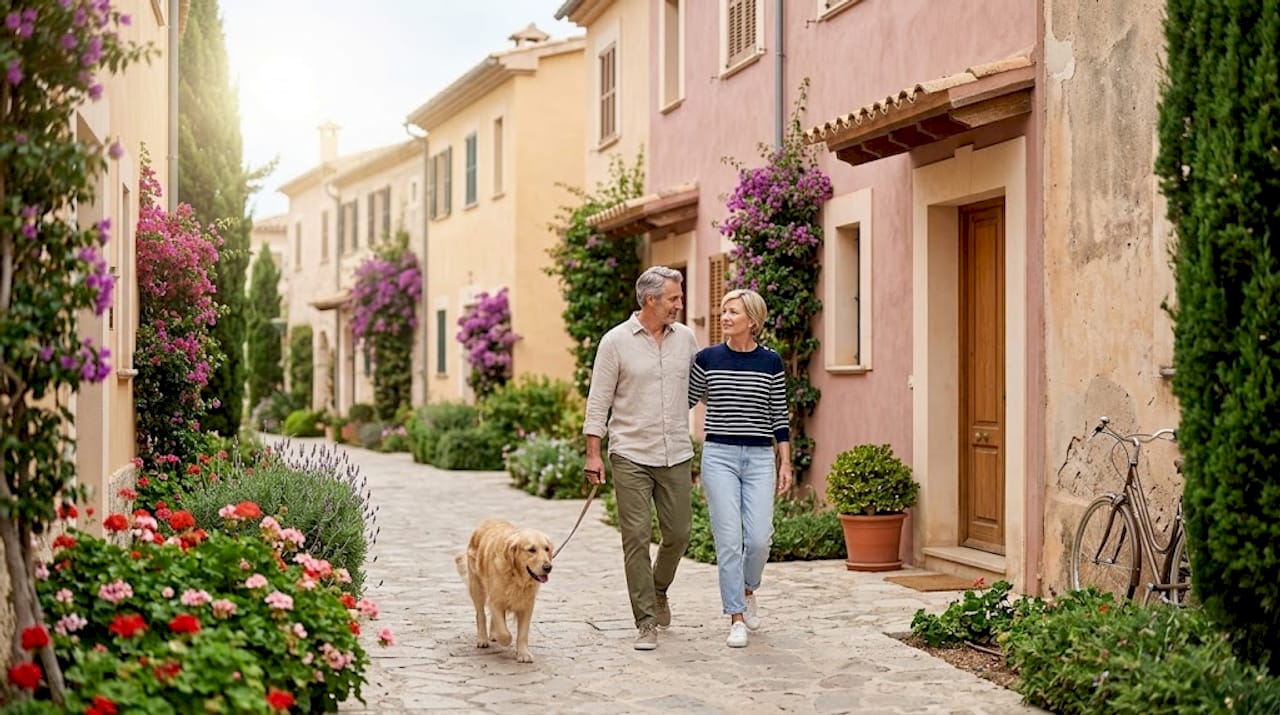
At the residential level, an urbanisation (or urbanización in Spanish) is a planned residential community with shared amenities, communal rules, and legally registered infrastructure. Think private roads, communal pools, security gates, and management committees. These developments were designed to function as self-contained neighborhoods, and they exist all across Mallorca, from the coastal strips of Calvià to the inland hills of Alaró.
At the territorial level, urbanisation refers to the process by which rural or agricultural land is converted into developed, artificial land. This is where the legal vocabulary becomes critical:
- Suelo urbano (urban land): Land that is legally classified for residential or commercial development. Building here with proper licenses is generally permitted.
- Suelo urbanizable (developable land): Land designated for potential future development, subject to planning approval and infrastructure investment.
- Suelo rústico (non-developable rural land): Land legally protected from most forms of development. Building here without specific exemptions carries serious legal consequences.
- Suelo rústico protegido (protected rural land): A stricter subcategory covering areas with ecological, agricultural, or landscape value. Development is almost entirely prohibited.
For buyers, distinguishing legal urban land from protected rural land is not a bureaucratic formality. It is the single most important compliance check before signing any purchase contract. A property advertised as a rural retreat may sit on land where the structure was never legally authorized. Verifying the land registry classification, building license, and certificate of occupancy before purchase is non-negotiable.
Pro Tip: Always request the certificado de compatibilidad urbanística from the local municipality before committing to a rural property purchase. It confirms whether a building’s use is legally consistent with its land classification.
Environmental and territorial impacts
The environmental costs of urban development in Mallorca are significant and, until recently, largely underreported.
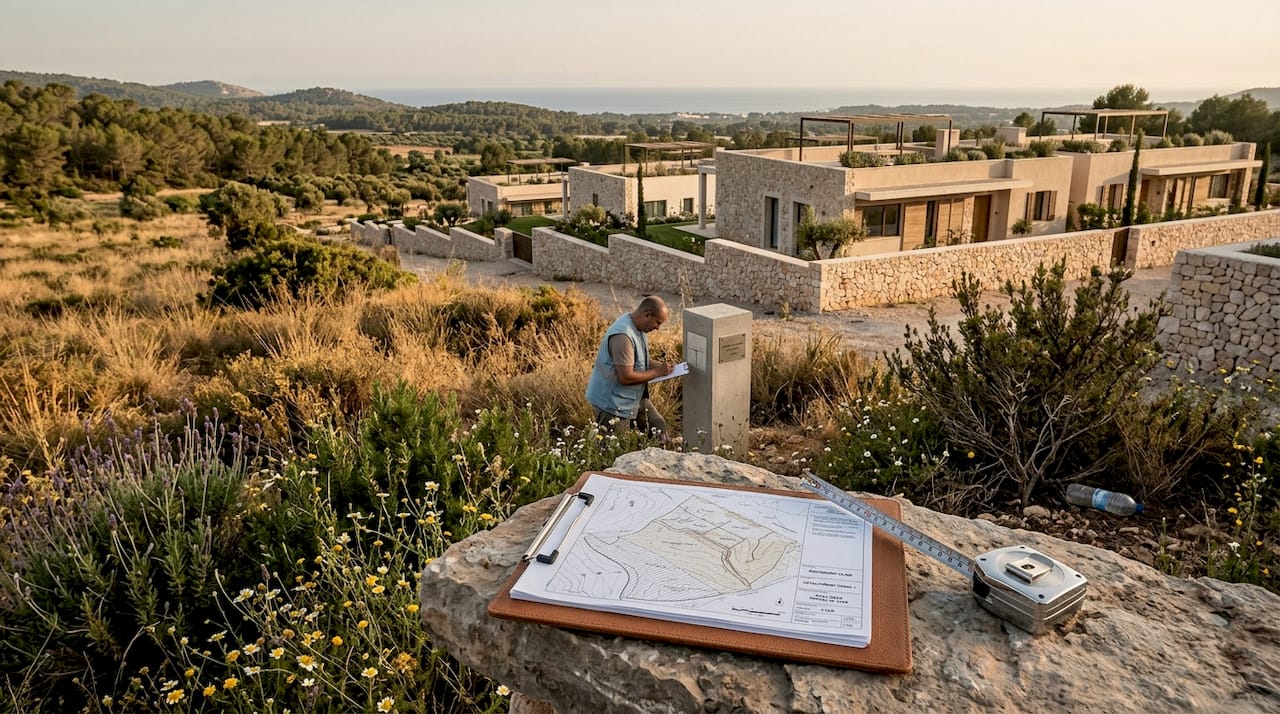
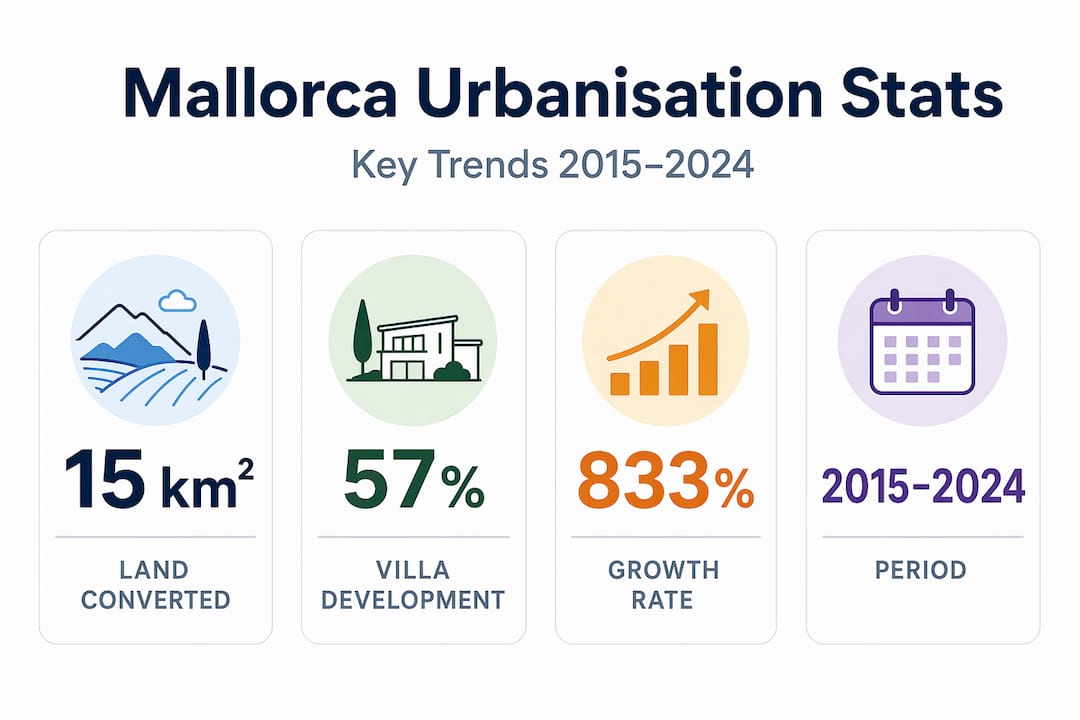
Between 2015 and 2024, Mallorca urbanized 15 km² of rural land, with 57% of that area consumed by villa development and 25% by photovoltaic installations. The environmental advocacy group Terraferida has called for a manifesto to halt the process, describing it as a structural threat to the island’s rural identity. Looking further back, artificial areas in the Balearic Islands grew 65% between 1990 and 2018, erasing agricultural land and fragmenting natural landscapes across the archipelago.
| Indicator | Data | Period |
|---|---|---|
| Rural land converted | 15 km² | 2015–2024 |
| Share used for villa development | 57% | 2015–2024 |
| Increase in destruction rate | 833% | 2021–2024 vs. 2015–2021 |
| Growth in artificial land area | 65% | 1990–2018 |
| STR beds in Mallorca | 104,131 | 2024 |
One of the most troubling patterns behind these numbers is what researchers call “green grabbing.” Wealthy individuals acquire rural land by registering as farmers, then exploit legal loopholes to gradually transform those holdings into luxury lifestyle estates. The result is that land nominally classified as agricultural is functionally serving as private leisure property, with irrigation pools, guest houses, and manicured grounds. Experts warn that this distorts rural land’s purpose from food and landscape production to private recreation, with no clear mechanism for reversal.
Tourism is the other accelerant. Mallorca recorded 104,131 short-term rental beds across the island in 2024, representing 26% of total accommodation capacity. That footprint extends deep into rural municipalities, where tourist accommodation expansion transforms rural economies and landscapes, displacing agricultural activity and fragmenting community structures.
“The rural territory is not an infinite resource. Once you build on it, the loss is permanent. The 833% acceleration in land destruction is not a statistic. It is an alarm.” — Terraferida, manifesto statement, 2024
Pro Tip: If you are buying in or near a rural area, check whether adjacent parcels carry active agricultural exemptions or tourist license applications. Either can affect the character and legal environment of the land you are buying into.
Urban planning regulations and legal risks
Spain’s urban planning framework is detailed, and in the Balearic Islands it carries extra layers of regional law that any buyer must understand before purchasing property in Mallorca.
Here is how the legal hierarchy works in practice:
- National law provides the foundational framework for land classification and development rights across all of Spain.
- Balearic Islands regional law adds specific protections for natural areas, coastal zones, and rural land through instruments like the PTI (Plan Territorial Insular) and the PORN (Plan de Ordenación de los Recursos Naturales).
- Municipal urban planning (PGOU, or Plan General de Ordenación Urbana) determines what can be built on each specific parcel within a given municipality.
- Building licenses issued by the municipality confirm that a specific project is consistent with all three levels above.
Urban planning infractions in Mallorca range from minor violations to very serious offenses. Building without authorization on protected rural land falls into the most severe category and can lead to substantial fines, forced restoration of the land, and in some cases, demolition orders. These penalties are not theoretical. Enforcement has increased alongside public pressure from advocacy groups and media coverage of illegal rural development.
Legal advice is strongly recommended for any transaction involving land near classification boundaries or rural properties with recent construction. Buyers who skip this step sometimes discover that the “charming finca” they purchased has rooms or extensions built without licenses that the seller chose not to disclose.
A particularly instructive case involves the municipality of Sineu. In 2026, Sineu regained control over urban planning licenses for its historic center after 16 years under regional oversight. This shift reflects a broader tension between local knowledge and centralized control, and signals that Mallorca urban planning challenges are increasingly being resolved at the municipal level. What is permitted in one municipality may face very different scrutiny in another. Reviewing the Mallorca property due diligence process thoroughly before signing is the baseline expectation for any serious buyer.
Investing and living in Mallorca urbanisations
Once you understand the legal framework, the practical question becomes: what is it actually like to own property inside a Mallorca urbanisation?
Spanish urbanisations typically feature communal pools, private access roads, security infrastructure, gardens, and sometimes tennis courts or club facilities. The lifestyle appeal is real, particularly for international families seeking safety, privacy, and maintained surroundings. Many of Mallorca’s most sought-after luxury developments operate under exactly this model.
However, the financial and community dynamics deserve serious scrutiny:
- Annual service charges cover maintenance of communal areas, security, landscaping, and infrastructure. These vary widely and can run from a few hundred euros to several thousand euros per year depending on the development’s size and amenities.
- Management committees hold significant power. Poor committee management can result in deferred maintenance, unexpected special assessments, or sudden fee increases if a significant number of owners have outstanding debts.
- STR regulations have tightened considerably. Mallorca has frozen new short-term rental licenses in many zones, and properties within urbanisations may be subject to additional community rules prohibiting tourist lettings regardless of public licensing.
- Inherited debts: Under Spanish law, property debts related to community fees can transfer to a new buyer. Auditing payment histories before purchase is a legal and financial necessity.
Reviewing the top mistakes foreign buyers make in Mallorca consistently reveals that community fee issues and undisclosed STR restrictions rank among the most expensive surprises buyers encounter post-purchase.
Future trends and sustainable development
Mallorca’s urban development trajectory is not fixed. Governance is shifting, and several forces are converging that will shape what the island looks like over the next decade.
The population pressure is real. Mallorca hosts one of Spain’s most active real estate markets, driven by demand from Northern European and American buyers seeking second homes and relocation destinations. That demand does not disappear. It redirects. When coastal zones become legally restricted, pressure moves inland and into rural areas, which accelerates exactly the kind of land conversion that environmental groups have been documenting.
The STR license freeze introduced in Mallorca is one of the most significant regulatory moves in recent years. By capping tourist bed capacity, authorities are trying to rebalance the ratio of tourist to residential use without curbing investment outright. The effect on rural urbanisation is indirect but real. Properties that cannot generate rental income revert to pure residential or investment status, changing the calculus for buyers and developers alike.
The shift of planning authority back to municipalities like Sineu points toward a more decentralized model of Mallorca urban planning challenges being resolved locally. This is double-edged. Local control can mean more responsive governance and faster decisions tailored to community needs. It can also mean greater inconsistency between municipalities and more opportunities for politically connected developers to navigate approvals.
“Sustainable development in Mallorca is not a philosophical ideal. It is a regulatory direction. The question is whether the tools match the ambition.” — Urban planning expert, Balearic Islands governance forum, 2025
Investors who prioritize legally secure, compliance-verified properties in established urbanisations are best positioned in this environment. The Mallorca real estate market forecast increasingly reflects these regulatory pressures, with premium pricing on properties that carry clean legal histories and existing licenses.
My perspective on urbanisation and ethical investment
I have spent years working directly in Mallorca’s property market, and what I see in the urbanisation conversation frustrates me more than almost anything else in this business.
The “green grabbing” phenomenon is not a gray area. It is a pattern of deliberate legal arbitrage, where capital exploits classification rules that were designed to protect rural land and instead uses them as a vehicle for private gain. I have seen buyers walk away from stunning rural properties with genuine regret because the due diligence revealed construction that was never authorized. Those buyers made the right call. The ones who did not often face years of legal exposure.
What I believe, from everything I have observed, is that informed investment and environmental responsibility are not in conflict. Buying within a legally verified urbanisation, with clean title, proper licenses, and a functioning management committee, is not a compromise. It is the only rational approach in a market where enforcement is tightening and the regulatory environment is becoming more complex by the year.
The island deserves buyers who ask the hard questions before they sign. That is not a moral statement. It is a practical one.
— Uli
How Uli-lisa helps you buy safely in Mallorca
Understanding urbanisation in Mallorca is one part of the picture. Acting on that knowledge with the right representation is another. At Uli-lisa, we work exclusively as independent buyer agents in Mallorca, meaning we represent your interests and no one else’s. Our property searches span the full market, including developments that are not publicly listed, and every property we present has been screened for land classification, licensing, and community compliance. For buyers who want the security of a legally sound acquisition in a complex regulatory environment, our safe property investment service provides the structured due diligence and personalized guidance that complex markets require.
FAQ
What does “urbanisation” mean in Mallorca specifically?
In Mallorca, “urbanisation” refers to a legally planned residential community with shared infrastructure and communal rules. It also describes the broader process of converting rural land into developed, artificial land. Both meanings are relevant for property buyers.
Is it legal to build on rural land in Mallorca?
Building on suelo rústico (rural land) is heavily restricted. Unauthorized construction on protected rural land is a serious infraction that can result in large fines, forced land restoration, and demolition orders under Balearic Islands planning law.
What are the main risks of buying in a Mallorca urbanisation?
Key risks include undisclosed community fee debts that transfer to the buyer, poor management committee governance, STR licensing restrictions that may not be disclosed by the seller, and hidden structures built without proper licenses.
How fast is Mallorca losing rural land to development?
Mallorca urbanized 15 km² of rural land between 2015 and 2024, with the rate of land destruction increasing by 833% between 2021 and 2024 compared to the previous six-year period.
What should I verify before buying a property in a Mallorca urbanisation?
Verify the land classification against the municipal PGOU, confirm all building licenses and certificates of occupancy are in order, audit the community fee payment history, and check whether STR licenses are active or transferable. A local independent buyer agent can coordinate all of these checks before you commit.
Recommended
- How to Navigate Mallorca Real Estate Market: Luxury Buyer’s Guide - ULI & LISA Mallorca Property Blog
- How to Navigate Mallorca Real Estate Market: Luxury Buyer’s Guide - ULI & LISA Mallorca Property Blog
- Mallorca property types explained: luxury buyer’s guide - ULI & LISA Mallorca Property Blog
- Mallorca Property Viewing Guide for Luxury Buyers - ULI & LISA Mallorca Property Blog