
TL;DR:
- Mallorca’s luxury property market is under pressure due to a 75% drop in rental supply and a 70% price surge since 2020. International demand and limited land supply drive rapid growth, but political, legal, and regulatory risks require diligent analysis and expert guidance. Strategic investors prioritize thorough due diligence, ongoing market monitoring, and professional support to navigate these evolving conditions successfully.
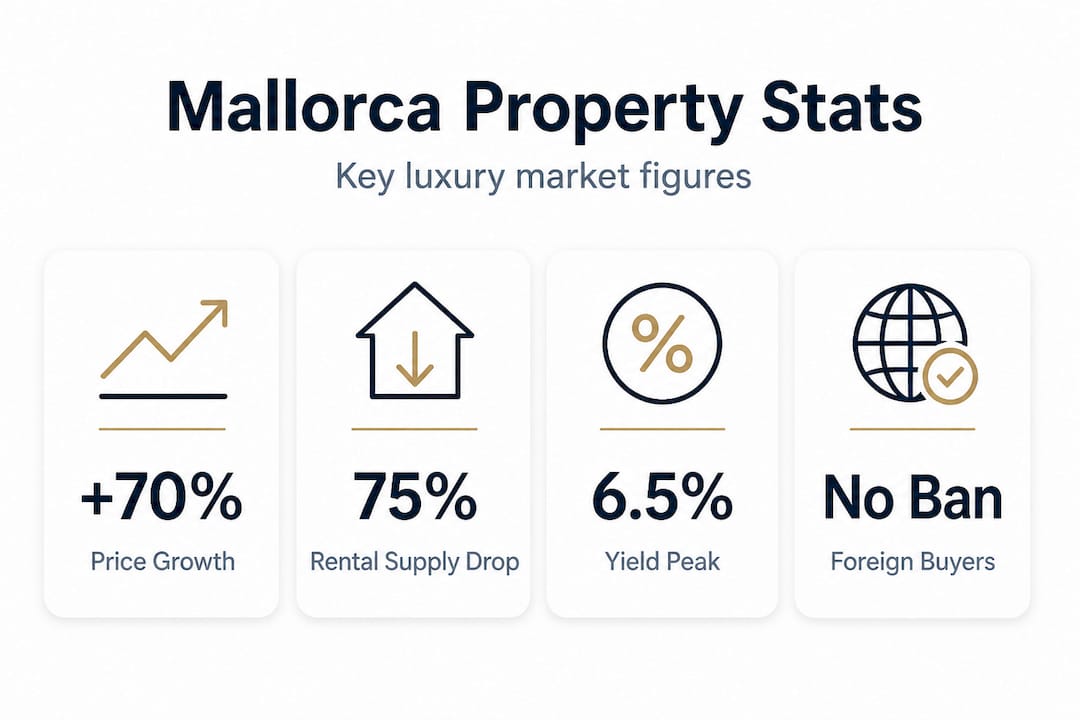
Mallorca’s luxury property market has a reputation for stability and prestige, but that reputation can lull buyers into a false sense of security. Rental supply has dropped 75% in Palma while prices have surged 70% since 2020, and institutional investors now account for 15% of high-end transactions. These aren’t just impressive statistics. They’re signals of a market under pressure, shifting faster than many buyers realize. If you’re a high-net-worth buyer looking to invest in Mallorca, thorough market analysis isn’t optional. It’s the foundation of every smart decision you’ll make.
Key Takeaways
| Point | Details |
|---|---|
| Rapid price growth | Mallorca luxury property values rose 70% since 2020 due to surging demand and supply constraints. |
| Supply-crunch risks | A 75% drop in available rentals signals both opportunity and higher regulatory risk. |
| Analysis is critical | Sound market analysis helps investors navigate volatility and protect capital in Mallorca. |
| Local expertise matters | Working with experienced agents and legal advisors is essential for compliance and asset safety. |
Understanding the luxury property landscape in Mallorca
These numbers tell only part of the story. To navigate investment opportunities intelligently, you must understand what’s fueling the market’s remarkable but volatile growth.
Mallorca’s appeal is not accidental. The island combines a Mediterranean lifestyle with genuine scarcity. You can’t build new coastline. Land is finite, regulations increasingly restrict new development in desirable zones, and the pool of buyers continues to grow year over year. International demand, particularly from Germany, the UK, Scandinavia, and increasingly the United States, has pushed the luxury property market into genuinely competitive territory.
What makes the current moment different is the acceleration. Luxury property prices have surged 70% since 2020, driven by both individual buyers seeking lifestyle assets and institutional investors treating Mallorca as a portfolio play. That institutional presence, now around 15% of high-end purchases, signals something important: sophisticated money sees long-term value here. But it also means you’re competing with entities that have substantial capital and professional market intelligence.
At the same time, a 75% drop in rental supply has tightened the market even further. Fewer available properties to rent means more pressure on buyers who need flexibility, and it creates a feedback loop where purchase demand intensifies because renting is no longer a viable short-term alternative for many relocating professionals or seasonal residents.
Key forces driving the market right now:
- Finite land supply in coastal and premium inland zones
- Strong international buyer demand from Europe and the United States
- Institutional investment accounting for roughly 15% of luxury transactions
- Collapse of the rental market pushing more people toward purchasing
- Lifestyle and climate appeal that remains difficult for competing markets to match
“Mallorca’s luxury property boom isn’t just a post-pandemic bounce. It reflects deep structural supply constraints meeting persistent global demand.”
Understanding these forces is what separates reactive buyers from strategic ones. If you’re new to the market, our luxury real estate explained resource offers a solid grounding before you start evaluating specific properties. For those already considering options, reviewing the investment benefits in Mallorca helps frame how lifestyle value and financial return interact.
Key metrics and indicators for market analysis
With this landscape in mind, let’s look at the numbers and trends that define opportunity and risk for buyers.
Market analysis for luxury property in Mallorca means tracking more than just asking prices. You need to monitor several data streams simultaneously to build an accurate picture of where the market is heading.
Core metrics to track:
- Price per square meter in target zones (Southwest coast, Palma, Serra de Tramuntana foothills)
- Days on market for comparable properties (falling days on market = tightening supply)
- Rental yield trends by property type and location
- Buyer nationality composition to understand demand resilience
- New build permits as a forward indicator of future supply
- Vacancy rates in the short-term rental segment
Here’s a snapshot of where key indicators currently stand:
| Metric | Recent trend | Investor implication |
|---|---|---|
| Luxury price growth since 2020 | +70% | Higher entry costs, strong appreciation history |
| Palma rental supply change | -75% | Reduced competition, reduced rental flexibility |
| Institutional buyer share | ~15% | Market legitimization, tighter competition |
| Average days on market (luxury) | Declining | Act quickly or lose targeted properties |
| New coastal build permits | Very limited | Long-term supply constraint intact |
Palma’s rental supply has plummeted 75% while purchase prices climbed steeply, which compresses the options for anyone who wants to test the market before committing. For buyers, this means the traditional strategy of “rent first, then buy” is increasingly impractical in the premium segments.
Rental yield analysis deserves specific attention. In some parts of Mallorca, gross yields on luxury vacation rentals range between 4% and 6%, which compares favorably to prime markets in London or Paris. However, regulatory changes to short-term rental licensing can materially affect this figure. You need to verify licensing status on any property before pricing in rental income. Our Mallorca market forecast breaks down these yield dynamics in detail.
Understanding what drives institutional buying behavior also matters. These entities typically model 10-year return scenarios based on conservative regulatory assumptions. If institutional buyers are still active despite potential regulatory risk, it tells you something about their confidence in the underlying fundamentals. But it also tells you that you’re competing against well-capitalized players with fast decision-making capabilities. For a deeper breakdown of why this market continues to attract global capital, the reasons to invest in Mallorca page is a useful reference.
Pro Tip: Don’t rely solely on advertised listing prices to assess market value. Request data on completed transactions from the Registro de la Propiedad (Spain’s property registry) and compare against listing prices to understand where actual deals are closing.
Risks and regulatory challenges: what buyers need to know
Just as data uncovers opportunity, it also spotlights risk. Understanding the evolving political and legal landscape in Mallorca is as critical as understanding price trends.
Mallorca is not a risk-free market. The same supply constraints and high prices that create investment upside also fuel local frustration. Residents are being priced out. Housing availability for working locals has deteriorated significantly. This social tension is real, and it has political consequences.
Growing local tension over rental constraints has already prompted policy discussions at both the regional Balearic government level and Palma’s municipal level. No major new restrictions targeting foreign buyers or luxury property specifically have taken effect as of 2026, but the direction of political discourse is worth watching carefully.
Here’s a comparison of the regulatory risk scenarios buyers should model:
| Risk scenario | Likelihood | Potential impact |
|---|---|---|
| Tighter short-term rental licensing | Moderate to high | Reduced rental income potential |
| Foreign buyer purchase restrictions | Low to moderate | Market access complications |
| Higher luxury property transfer taxes | Moderate | Increased acquisition cost |
| Stricter renovation/build permits | High | Longer timelines, higher development costs |
| Overtourism zoning restrictions | Moderate | Limits on certain property uses |
The Spanish government and regional Balearic authorities have both signaled interest in housing affordability measures. Portugal and the Canary Islands have already introduced restrictions that directly affect foreign buyers. Mallorca investors should treat those precedents as warning signals, not isolated cases.
Practical steps to reduce regulatory risk:
- Verify all rental licenses before purchase. Existing licenses are often grandfathered under new rules, making licensed properties significantly more valuable than unlicensed ones.
- Consult a local attorney specializing in Balearic property law before signing any purchase agreement.
- Monitor Palma municipal planning updates quarterly, particularly in high-density tourism zones.
- Understand the difference between tourist license types (vacation rental, agrotourism, hotel classification) and which applies to your target property.
- Factor potential regulatory costs into your 5-year financial model, not just current conditions.
Pro Tip: In Mallorca, a property’s current rental license status is one of the most important due diligence items. Unlicensed properties cannot legally generate short-term rental income under current law, and obtaining a new license is extremely difficult in most areas.
Our detailed Mallorca luxury real estate guide covers the legal framework in depth, including how to structure purchases to minimize exposure to future regulatory shifts.
Applying market analysis: actionable steps for investors
Armed with this information, it’s time to outline how you can translate these insights into intelligent, secure investment decisions.
Understanding supply versus demand dynamics and the role of institutional buyers is foundational to strategy. Once you accept that Mallorca’s market is structurally tight and getting tighter, your decision framework changes. You stop waiting for a price correction that structural forces suggest may never come in the premium segment, and you start focusing on finding the right asset at the right terms.
Here’s a practical action sequence for serious investors:
- Define your investment thesis clearly. Are you buying for lifestyle use with rental income offset, pure capital appreciation, or yield-focused returns? Each thesis leads to different property types and locations.
- Build a comparable market analysis (CMA) for your target zones. Pull data on completed sales from the last 18 months, not listings. Focus on price per square meter for properties with similar specifications.
- Assess rental potential before making any offer. If the property has an active tourist license, verify it’s transferable and check the rental income history from the past two to three seasons.
- Engage an independent buyer’s agent. This is not optional in Mallorca. Listing agents legally represent the seller. You need someone whose fee structure aligns with your interests. More on this below.
- Build a risk-adjusted financial model. Model three scenarios: base case (current regulatory environment), downside (rental licensing tightened), and stress case (foreign buyer restrictions introduced). If the investment only works in the base case, reconsider.
- Move decisively when the right property is identified. In the premium segment, prime properties typically receive competing interest within days. Lengthy deliberation leads to missed opportunities.
- Set up ongoing market monitoring. The market that exists when you buy is not the market that will exist in three years. Establish quarterly review checkpoints with your advisor.
The Mallorca property market rewards buyers who combine thorough preparation with the ability to act quickly. The combination is rare, which is why working with experienced professionals is not just convenient but genuinely value-adding. Our Mallorca luxury property guide provides additional frameworks for structuring your property search from first contact to closing.
Pro Tip: Avoid using the same legal advisor as the seller or the listing agent’s recommended notary. In Mallorca, it’s legally and practically common practice for buyers to engage independent legal counsel who reviews contracts purely in your interest.
Why reading the market right matters more than ever
With steps in hand, here’s an honest perspective on why deep market analysis matters more than experience, instinct, or reputation alone.
The luxury real estate world has a persistent myth: premium properties in desirable locations are always safe. That assumption has caused real losses for investors who bought at the wrong point in a regulatory cycle, overpriced a property’s rental income potential, or failed to account for shifts in buyer nationality composition.
Mallorca is genuinely attractive. The fundamentals, scarcity, lifestyle premium, international demand, are not invented. But sudden regulation or local opposition could quickly alter the risk-reward profile, even in a market with strong underlying supply-demand dynamics. Investors who entered Lisbon’s luxury market in 2019 expecting the Golden Visa program to remain unchanged found out the hard way that political sentiment moves faster than property valuations.
What I find most buyers underestimate is how quickly a market narrative can shift. Mallorca went from post-pandemic boom story to a market with genuine overtourism and housing affordability headlines within 24 months. The smart money doesn’t ignore that shift. It builds it into the model.
Long-term resilience in Mallorca property investment comes from two disciplines. First, doing rigorous upfront analysis before committing capital. Second, updating that analysis regularly after you own the asset. Markets don’t stop changing because you’ve already closed the deal. Understanding the luxury market’s evolving dynamics is an ongoing practice, not a one-time exercise.
The buyers who outperform in Mallorca are not necessarily the ones who paid the least. They’re the ones who understood what they were buying, structured it correctly, and monitored it actively.
Partner with experts for secure Mallorca investments
No matter how well you analyze the market, expert support can make all the difference between a smooth acquisition and a costly mistake. As independent buyer agents in Mallorca, ULI & LISA work exclusively for you, not sellers, with advanced AI-powered tools that scan the entire market for properties matching your investment criteria. We provide full support from initial search through due diligence, compliance review, negotiation, and ongoing asset management. Explore our full range of luxury property services designed for international buyers, or learn how we structure safe property investment processes that protect your capital at every step.
Frequently asked questions
What makes Mallorca’s luxury property market so different from other regions?
Mallorca combines severe supply constraints with persistent international demand and unique regulatory pressures. Rental supply has dropped 75% and prices have risen 70% since 2020, creating conditions rarely seen in other comparable European markets.
How do recent price trends affect new property investors?
New investors face significantly higher entry costs than buyers from just a few years ago, but luxury prices up 70% since 2020 also demonstrates the strength of scarcity-driven appreciation for those who buy strategically with solid market analysis.
Are there restrictions on foreign buying or luxury property investment in Mallorca?
Currently there are no direct restrictions on foreign buyers, but potential luxury regulation remains an active topic in local policy discussions, making legal and regulatory monitoring an essential part of any investment plan.
How can investors protect themselves from unexpected market changes?
Thorough due diligence, verified rental licenses, independent legal counsel, and active monitoring of policy developments are the key defenses. Institutional tensions and local sentiment are already reshaping the risk profile, making continuous market review non-negotiable for serious investors.
Recommended
- How to Navigate Mallorca Real Estate Market: Luxury Buyer’s Guide - ULI & LISA Mallorca Property Blog
- Mallorca Luxury Property Guide: Everything You Need to Know - ULI & LISA Mallorca Property Blog
- Understanding Mallorca Luxury Real Estate Guide - ULI & LISA Mallorca Property Blog
- How to Navigate Mallorca Real Estate Market: Luxury Buyer’s Guide - ULI & LISA Mallorca Property Blog
- Leverage market insights for smarter yacht buying decisions
- Private excursions in Sardinia: 63% luxury growth