TL;DR:
- Mallorca’s luxury property market presents legal risks like hidden debts and illegal structures that require thorough due diligence.
- Hiring an independent local lawyer, accredited buyer’s agent, and gathering essential documents are critical for a safe transaction.
- Post-purchase, buyers must consider residency, taxes, and inheritance planning to avoid costly legal pitfalls.
Buying luxury property in Mallorca is one of the most rewarding investments you can make, but it comes with legal traps that catch even experienced international buyers off guard. Inherit a seller’s unpaid debt, purchase a finca with an illegal extension, or skip proper zoning checks, and you could face fines, forced demolition, or a frozen asset worth millions. The good news is that these risks are entirely avoidable when you follow the right legal roadmap. This guide walks you through every critical step, from pre-purchase due diligence and assembling your legal team to tax planning, residency rules, and securing rental licenses.
Key Takeaways
| Point | Details |
|---|---|
| Foreign buyers pay premiums | Americans and affluent Europeans face higher prices and must prepare for additional legal and tax steps when buying in Mallorca. |
| Independent legal support required | Hiring an English-speaking lawyer and accredited buyer agent protects against hidden property risks. |
| Verify details before purchase | Check for seller debts, lawful build status, and renovation rights to ensure your investment is safe. |
| Plan for taxes and residency | Understand the new residency laws, income tax obligations, and inheritance strategies for luxury real estate in Mallorca. |
Understand the purchase landscape: Mallorca market overview
Mallorca’s luxury property market is not like other European destinations. Demand is fierce, inventory of high-end properties is limited, and foreign buyers are a dominant force. Foreigners account for roughly 30% of all Balearic property purchases in 2025, with American buyers paying some of the highest prices per square meter on the island, around €3,390/m² compared to the €2,362 foreign buyer average. That premium reflects both the desirability of the market and the purchasing power American buyers bring. It also means you are often competing hard for properties that may carry hidden legal complications.
Common risks in Mallorca’s luxury segment include:
- Hidden debts: Unpaid mortgages, community fees, or utility bills attached to the property
- Illegal structures: Extensions or outbuildings built without permits, especially on rustic land
- Zoning restrictions: Rustic land classification limits what you can build, renovate, or even demolish
- Tourist rental license issues: Licenses are not automatically transferable and are increasingly hard to obtain
- Unclear title history: Older fincas may have ownership disputes or unregistered heirs
The table below gives you a quick snapshot of how Mallorca compares to broader Spanish market norms:
| Factor | Mallorca luxury market | Broader Spanish market |
|---|---|---|
| Avg. price (American buyers) | ~€3,390/m² | ~€2,362/m² (foreign avg.) |
| Foreign buyer share | ~30% of purchases | ~15% nationally |
| Rental license availability | Highly restricted | Varies by region |
| Rustic land complexity | Very high | Moderate |
Pre-purchase due diligence is not optional here. It is the foundation of every safe transaction. Many buyers rush the process because they fall in love with a property, but skipping verification steps is how expensive problems begin. For buyers who are new to the Spanish system, reviewing first-time buyer tips before approaching the market can save significant time and money.

Having set the stage with market realities, let’s move to the legal team essentials you need.
Build your legal team and tools: Essential professionals and documents
The single most important decision you will make before signing anything is who represents you. In Mallorca, it is absolutely critical to hire an independent, English-speaking lawyer who works exclusively for you, not the seller or the developer. This protects you from hidden debts or illegal structures that are especially common in older or rustic luxury fincas. Spanish property law is complex, regional rules in the Balearics add another layer, and many standard contracts heavily favor sellers.
Here is the core team you need to assemble:
- Independent Spanish lawyer (abogado): Verifies title, checks for debts, reviews all contracts, and handles notary coordination
- Accredited buyer’s agent: Provides unbiased property searches and negotiation support without conflicts of interest
- Tax advisor: Handles NIE (Número de Identificación de Extranjero, your Foreigner ID) setup, non-resident tax registration, and annual compliance
- Certified surveyor (optional but recommended): For older fincas or rural properties, a structural survey is worth every euro
Pro Tip: Never use the seller’s recommended lawyer. That professional’s loyalty is unclear at best. Your lawyer must be independent and retained only by you.
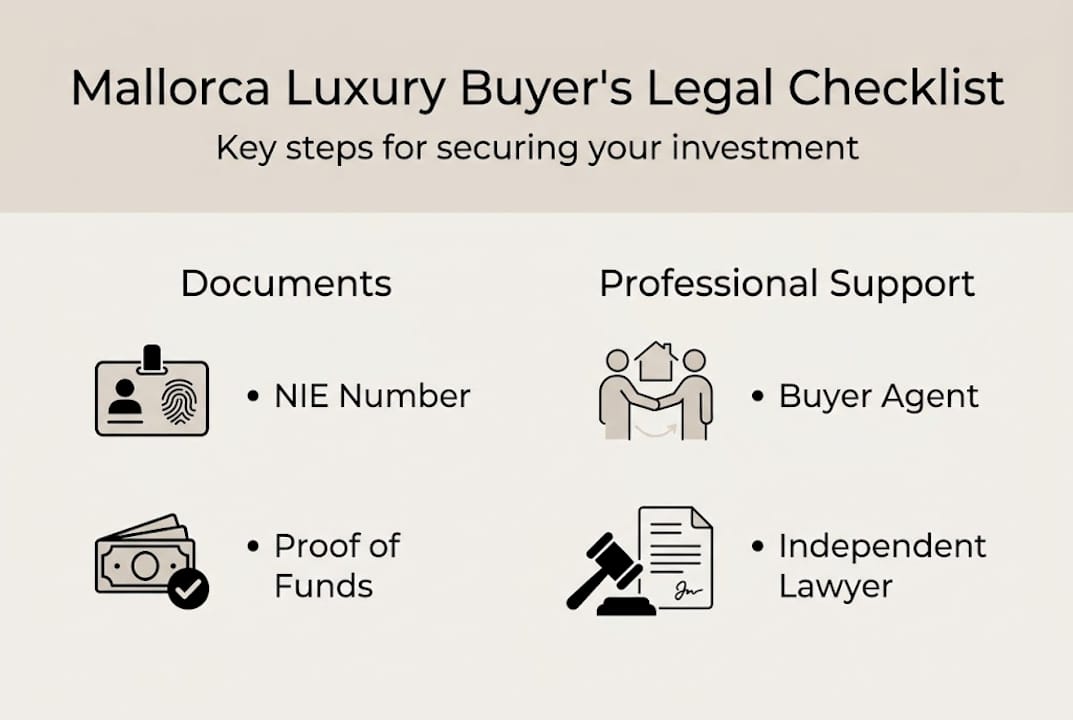
Beyond your team, you need to gather the right documents before any contract is signed. The essential checklist looks like this:
| Document | Purpose |
|---|---|
| NIE (Foreigner ID) | Required for any property purchase in Spain |
| Proof of funds / AML documentation | Anti-money laundering compliance |
| Nota Simple (property registry extract) | Confirms ownership, debts, and legal status |
| Past utility bills and IBI (property tax) receipts | Verifies no outstanding payments |
| Zoning certificate (urban vs. rustic) | Defines what you can legally build or renovate |
| Community of owners certificates | Confirms no unpaid community fees |
Understanding why a buyer agent is essential in this market is critical. They know which documents to request, which sellers are flexible, and where legal red flags tend to hide. For a broader picture of what makes a safe property investment in Mallorca, independent representation is the single biggest factor.
Now that you know who you need by your side, let’s walk step-by-step through the actual purchase process.
Execute the purchase: Step-by-step legal process
The Spanish property purchase process follows a defined sequence. Skipping or rushing any step creates legal exposure that is expensive to fix after the fact.
- Reserve the property: A reservation contract (contrato de reserva) with a deposit (typically €6,000 to €30,000) takes the property off the market. This is not legally binding in the same way as later contracts, but losing your deposit for backing out is real.
- Due diligence period: Your lawyer orders the Nota Simple, verifies debts, checks planning permissions, confirms the legal build status of all structures, and reviews any rental licenses attached to the property.
- Private purchase contract (Contrato de Arras): A formal pre-sale agreement. Typically 10% of the purchase price is paid here. If the seller withdraws, they owe you double. If you withdraw, you lose the deposit.
- Notary signing (Escritura de Compraventa): The full sale is executed before a Spanish notary. The remaining balance is paid, and legal ownership transfers.
- Land Registry registration: Your lawyer registers the new title in your name. Until this is complete, the transaction is not fully protected.
Pro Tip: Always verify at the notary stage that the seller’s existing mortgage is formally cancelled, not just verbally promised. Closing process details matter enormously here.
Critical warning: If seller debts, illegal extensions, or unpermitted structures are not resolved before signing, you inherit them. Rustic zoning limits future renovations. Illegal builds risk fines and forced demolition. Tourist rental licenses are rarely transferable and nearly impossible to obtain in new applications under current Balearic policy.
Your buyer agent guide can walk you through how a professional advocate coordinates each of these steps on your behalf. Do not treat this process as a DIY project.
With the purchase steps complete, understanding your ongoing legal and tax obligations is crucial.
Verify and plan: Residency, taxes, and long-term legal strategy
Once you own property in Mallorca, your legal obligations do not end. They actually begin. The tax and residency landscape for American and EU buyers involves important differences that directly affect your cost of ownership.
Key facts every buyer must understand:
- Non-resident income tax: US buyers pay 24% on imputed rental income or actual rental income, while EU citizens pay 19%
- Stay limits: Both US and EU buyers are limited to 90 days within any 180-day period without a Spanish visa or residency permit
- Golden Visa: Spain ended the Golden Visa program in 2025, removing the path to residency through property investment. Alternative visa options now require non-passive income or active business presence
- Property ownership rights: There is no legal difference between US and EU buyers in terms of what you can own or how you can buy
- Annual IBI tax: All property owners pay this local property tax regardless of residency status
Inheritance planning is where many buyers leave significant money on the table. The Balearic Pacto Sucesorio (succession pact) allows close family members to inherit up to 100% exempt from Balearic inheritance tax when structured correctly. This is a powerful tool for buyers passing property to children or spouses and should be part of your purchase planning from day one, not an afterthought.
For American buyers specifically, understanding property taxes for US buyers in Mallorca helps you budget accurately and avoid annual compliance surprises. Reviewing the residency rules for buyers is equally important if you plan to spend extended time on the island.
Let’s step back and examine some lessons and misconceptions in navigating Mallorca’s legal landscape.
Our take: The overlooked mistakes and how expert support changes outcomes
After working with American and European luxury buyers across Mallorca, the pattern that surprises us most is how often informed, financially savvy people underestimate edge-case risks. They read the standard purchase checklist, they hire a lawyer, and they still get caught off guard. Why? Because the real risks are not in the obvious places.
The biggest mistakes we see are trusting the seller’s agent for property information, assuming a property with a pool and a rental history automatically has valid licenses, and ignoring rustic land classification until renovation plans hit a wall. Anti-overtourism policy in the Balearics is tightening, and properties that seem like strong rental investments today may face significant restrictions tomorrow. That is not a reason to avoid the market. It is a reason to buy smarter.
Local anti-overtourism sentiment has already reshaped what rental licenses are available. Independent legal guidance is no longer just protection against fraud. It is your competitive advantage in a market where prepared buyers win and unprepared buyers pay. Working with an independent buyer agent who knows the local regulatory landscape gives you a real edge in identifying properties with clean legal histories and genuine long-term value.
Connect with trusted buyer agents for a secure investment
A secure transaction in Mallorca starts with the right team behind you. At ULI & LISA, we specialize in guiding American and European luxury buyers through every stage of the Mallorca property process, from the first property search to final registration. Our AI-powered tools provide access to the full Mallorca market without conflicts of interest, and our network of independent legal experts, tax advisors, and notaries ensures every step is protected. Whether you are buying a coastal villa, a historic finca, or a modern investment property, explore our independent buyer agents and real estate services to get personalized guidance, or learn more about how we deliver a safe property investment in Mallorca.
Frequently asked questions
What are the main legal risks when buying property in Mallorca?
Buyers risk inheriting seller debts, purchasing properties with illegal structures, and facing renovation restrictions due to rustic or urban zoning classification. Each of these risks is avoidable with proper due diligence before signing any contract.
Does being a U.S. or EU citizen affect my property rights?
Property ownership rights are identical for US and EU buyers, but US buyers pay 24% non-resident income tax compared to 19% for EU citizens, which meaningfully affects net rental returns.
Is the Golden Visa program still available for Mallorca property buyers?
No. Spain ended the Golden Visa in 2025, meaning buyers can no longer obtain residency simply through property investment. You will need to explore alternative visa categories based on income or business activity.
What documents do I need before purchasing a property in Mallorca?
You need a NIE (Foreigner ID), proof of funds, a Nota Simple from the land registry, past utility and IBI tax receipts, and a zoning certificate confirming whether the property sits on rustic or urban land.
How can I avoid inheritance and income tax pitfalls for Mallorca property?
Work with a Balearic tax specialist to structure ownership using tools like the Pacto Sucesorio, which can make close family inheritance up to 100% exempt from regional tax. Also budget for the 24% non-resident tax rate if you are an American buyer holding property without Spanish residency.
Recommended
- 7 Steps for a Successful Mallorca International Buyer Checklist - ULI & LISA Mallorca Property Blog
- How to Navigate Mallorca Real Estate Market: Luxury Buyer’s Guide - ULI & LISA Mallorca Property Blog
- How to Navigate Mallorca Real Estate Market: Luxury Buyer’s Guide - ULI & LISA Mallorca Property Blog
- Steps to Buy Property Mallorca: Your Luxury Guide - ULI & LISA Mallorca Property Blog
- Dubai real estate due diligence checklist: secure your investment