
TL;DR:
- US buyers in Mallorca must carefully navigate Spanish tax laws, valuation, and cross-border compliance.
- Independent appraisal and legal review are crucial to prevent overpaying taxes and legal issues.
- A defense-first approach ensures accurate valuation, legal standing, and optimized tax planning before purchasing.
Buying luxury property in Mallorca without a clear valuation roadmap is one of the most expensive mistakes American buyers make. The Spanish system operates on rules that catch even experienced US investors off guard: cadastral reference values that override your purchase price for tax purposes, cross-border reporting obligations under FATCA, and transfer taxes that can reach 13% if you misread the numbers. Without a structured, defense-first approach, you risk overpaying on taxes, missing legal encumbrances, and facing compliance headaches on both sides of the Atlantic. This guide walks you through every critical step, from legal preparation through appraisal and cross-border compliance, so you can buy with confidence.
Key Takeaways
| Point | Details |
|---|---|
| Prepare expert advisors | Engage a local lawyer, tax expert, and gestor before starting the valuation process. |
| Verify each value metric | Always cross-check cadastral, market, and bank values to avoid overpaying taxes or purchase price. |
| Understand cross-border taxes | US buyers must fulfill FATCA, Modelo 720, and local wealth tax obligations for all Mallorca holdings. |
| Defend your valuation | Challenge the cadastral value with independent appraisals if it exceeds market reality. |
| Seek layered protection | Use legal and tax planning along with market comps for a defendable, efficient transaction. |
Key prerequisites: Legal, tax, and market realities for US buyers
Before you view a single property in Mallorca, you need the right professional team in place. This is not optional. US HNWIs must consult legal and tax advisors early for cross-border compliance, FATCA, and Spanish reporting requirements. Getting this wrong at the start creates problems that are far harder to fix once you are under contract.
Here is what you need to understand before you start searching:
- Independent Spanish lawyer: Separate from the seller’s representation. Your lawyer reviews the nota simple, checks for liens, and confirms legal standing of the property.
- Gestor or tax advisor: Handles Spanish tax filings, wealth tax calculations, and cross-border reporting obligations.
- FATCA compliance: As a US person, you must report foreign financial accounts and assets to the IRS regardless of where you reside.
- Modelo 720: If you become a Spanish tax resident, assets over €50,000 held abroad must be declared annually.
- Cadastral vs. market value: The cadastral reference value is a government-assigned figure that sets the minimum tax base. It can differ significantly from what you actually pay.
Understanding Mallorca tax basics before you bid protects you from surprises at the notary. For a broader overview of what first-time international buyers face, the first-time buyer essentials guide covers the full picture.
| Factor | Detail | Impact on US buyer |
|---|---|---|
| Transfer tax (ITP) | 8-13%, progressive | Major acquisition cost |
| Wealth tax exemption | €3M in Balearics | Reduces annual liability |
| Mortgage LTV | Up to 70% for non-residents | Limits financing options |
| Cadastral reference value | Sets minimum tax base | Can inflate ITP if above price |
Pro Tip: Secure your legal and tax team before you view any property. Decisions made without this team in place, even casual verbal offers, can create binding obligations under Spanish law.
Step-by-step process to valuing luxury property in Mallorca
Having set your legal and financial foundation, you are ready for the precise steps of property valuation. This is where US buyers often default to instinct or US-market comparables. Neither works reliably in Mallorca’s luxury segment.
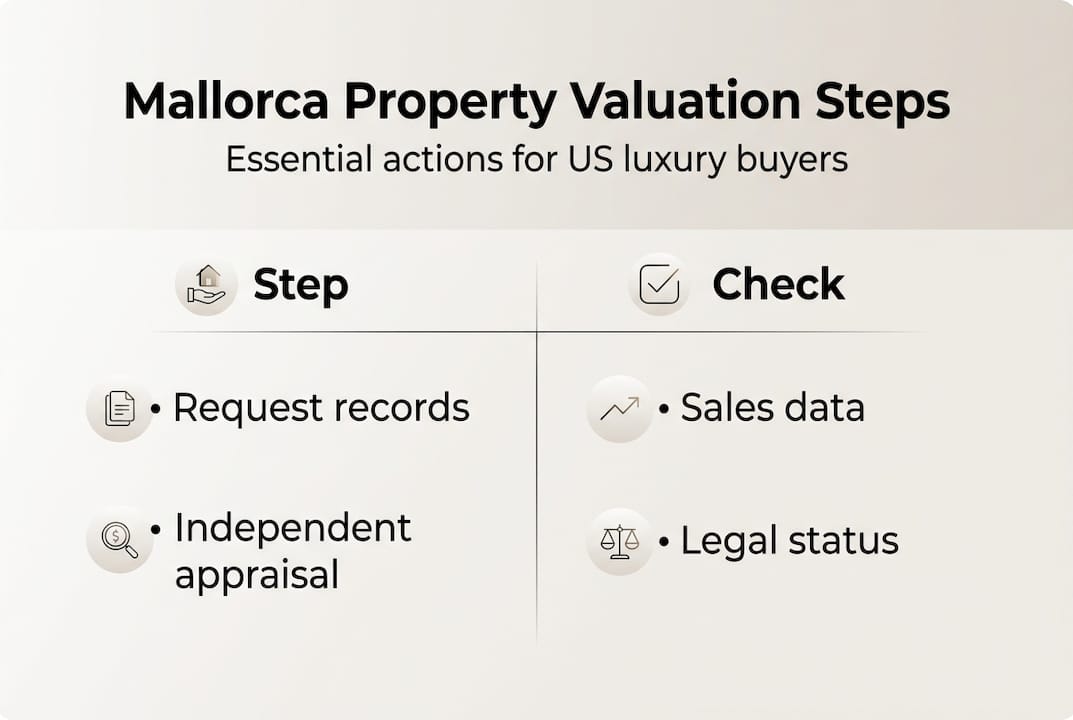
Step 1: Gather official records. Request the cadastral data sheet and the nota simple from the Property Registry. The nota simple reveals ownership, surface area, any mortgages, easements, and outstanding charges. This is your starting point, not an afterthought.
Step 2: Commission an independent appraisal. For luxury assets, use a RICS-accredited (Royal Institution of Chartered Surveyors) valuer or a certified Spanish tasador. This produces a defensible market value figure that banks and tax authorities respect.
Step 3: Cross-check with recent comparable sales. Mallorca’s luxury market is thin at the top end. Comparable sales data for properties above €3M can be limited, so your appraiser must adjust carefully for location, views, pool, and plot size.
Step 4: Identify legal limitations. Check land use classifications, any renovation permits outstanding, and whether the property has a tourist rental license if that is part of your investment thesis. These factors directly affect value.
The property valuation process in Mallorca involves more layers than most US buyers expect. For a deeper look at the methodology, assessing property value covers the technical side in detail.
| Value type | What it measures | When it matters |
|---|---|---|
| Cadastral reference value | Government-assigned minimum | Sets ITP tax base |
| Market value (appraisal) | Independent expert opinion | Mortgage, challenge, negotiation |
| Bank mortgage valuation | Lender’s risk assessment | Determines loan amount |
The cadastral reference value sets the tax base minimum and is legally challengeable through expert appraisal if defective or inaccurate. This matters enormously for a €4M purchase where even a 1% tax miscalculation costs €40,000.
Pro Tip: Always request and analyze the nota simple yourself, even if your lawyer has reviewed it. Understanding what you own, and what encumbrances exist, is non-negotiable at this price point.
Legal frameworks: Cadastral reference value, transfer tax, and defending your valuation
Understanding and justifying your market value estimate is only part of the legal picture. The Spanish tax framework and public value registries can impact your costs and options in ways that surprise even experienced international buyers.
The cadastral reference value sets the transfer tax base minimum. If the cadastral value is higher than your agreed purchase price, the Spanish tax authority will use the cadastral figure to calculate your ITP, not the price you actually paid. This is a critical distinction.
“The cadastral value can dramatically exceed actual market value, inflating tax bills for buyers who do not challenge it proactively.”
For a €4M luxury property, here is how the three value types can diverge:
| Value type | Example amount | Tax/legal consequence |
|---|---|---|
| Purchase price | €4,000,000 | Declared at notary |
| Cadastral reference value | €4,600,000 | Sets ITP base if higher |
| Market appraisal | €3,900,000 | Used to challenge cadastral |
If the cadastral value exceeds your purchase price, you have the right to challenge it. Here is how:
- Commission a certified appraisal showing market value or property defects that justify a lower figure.
- File a formal objection with the regional tax authority (Agencia Tributaria Balear) within the statutory period.
- Submit supporting documentation: appraisal report, comparable sales data, and any evidence of structural issues or legal limitations.
- Timeline: Challenges typically take 3 to 12 months. You may pay under protest and seek a refund if successful.
For a full breakdown of how to evaluate Mallorca real estate within this legal context, including how appraisals are structured for tax defense purposes, that resource covers the mechanics in depth.
Cross-border essentials: US compliance, wealth tax, and mortgage implications
With valuation mechanics and Spanish legal frameworks covered, the final layer is the compliance, tax, and financing rules American buyers must integrate into their value assessments. These are not afterthoughts. They change the total cost of ownership materially.
Key obligations and considerations for US buyers in 2026:
- FATCA reporting: US persons must report foreign financial accounts annually. Owning Spanish property through a foreign entity adds reporting layers.
- Modelo 720: Spanish tax residents with foreign assets over €50,000 must file this declaration. Penalties for non-compliance are severe.
- Spanish wealth tax: Non-residents pay wealth tax only on Spanish-held assets. The Balearic Islands offer a €3M exemption for non-residents, which changes the math significantly on high-value acquisitions.
- Mortgage LTV: Mortgages of 60-70% LTV are possible for non-resident buyers, but banks will require a full appraisal, proof of income, and often a longer approval timeline than US buyers expect.
- Loan declaration: The declared mortgage amount becomes part of the tax record and affects how the property’s acquisition value is assessed.
For US buyers considering relocation rather than a pure investment hold, the Beckham Law (Ley Beckham) offers a flat 24% income tax rate for up to six years. This can significantly improve total tax efficiency. Your Mallorca residency and reporting obligations shift substantially if you activate this regime, so model both scenarios before deciding on ownership structure.
Pro Tip: Run a full 10-year cost-of-ownership model before committing. Include ITP, annual wealth tax (if applicable), community fees, property tax (IBI), and US reporting costs. The sticker price is only the beginning.
A unique perspective: Why US luxury buyers in Mallorca need a layered, defense-first valuation approach
Most US buyers arrive in Mallorca with a mindset shaped by the American market: find a property you love, negotiate hard on price, and close fast. That approach works in Miami or Los Angeles. In Mallorca, it can cost you hundreds of thousands of euros.
The single biggest mistake we see is buyers treating valuation as a formality rather than a defense mechanism. Your appraiser, lawyer, and gestor are not support staff. They are your first line of protection against a system that, if you do not engage it correctly, will charge you the maximum it legally can.
A defense-first approach means you confirm legality before you fall in love with a property, prove valuation before you negotiate price, and finalize your tax and ownership structure before you sign anything. In that order. Every time. Working with a buyer agent in Mallorca who understands both the Spanish system and the US buyer’s perspective is the most efficient way to execute this sequence without missing a step.
Expert guidance for stress-free property buying in Mallorca
For buyers ready to take the next step, expert representation can turn complexity into seamless security. Navigating Mallorca’s luxury market as a US buyer means managing Spanish legal requirements, cross-border tax obligations, and a valuation process that operates on entirely different rules from what you know at home. Working with independent buyer agents in Mallorca who specialize in international acquisitions means every step, from the first property search through appraisal, legal review, and closing, is handled with your interests as the only priority. If you want a safe Mallorca investment that holds its value and avoids costly surprises, ULI & LISA are ready to guide you through every layer of the process in 2026.
Frequently asked questions
What documents are essential for accurate property valuation in Mallorca?
Valuation begins with the cadastral record and independent expert appraisal. You also need the nota simple, any existing appraisal reports, and recent comparable sales data for the specific area and property type.
Can US buyers get mortgages for luxury property in Mallorca?
Yes. Mortgages of 60-70% LTV are available for non-resident buyers, though Spanish banks will conduct thorough income verification and require a certified property appraisal before approving any loan.
How does the cadastral value affect my tax bill as a US investor?
The cadastral reference value sets the transfer tax base if it exceeds your purchase price, meaning you pay ITP on the higher government-assigned figure rather than the price you actually negotiated.
What is the Spanish wealth tax rule in the Balearics for US non-residents?
Wealth tax applies only to Spanish-held assets for non-residents, with a €3 million exemption in the Balearic Islands, making high-value Mallorca acquisitions more tax-efficient than many buyers initially assume.
Recommended
- How to Assess Mallorca Property Value for Americans - ULI & LISA Mallorca Property Blog
- How to Evaluate Mallorca Real Estate: A Comprehensive Guide - ULI & LISA Mallorca Property Blog
- How to Evaluate Mallorca Real Estate: A Comprehensive Guide - ULI & LISA Mallorca Property Blog
- Property Valuation Process Mallorca: Key Factors for U.S. Buyers - ULI & LISA Mallorca Property Blog