TL;DR:
- Relocating to Mallorca requires careful sequence planning, starting with obtaining an NIE before housing or bank setup.
- Proper municipal registration, or empadronamiento, is essential for accessing schools, healthcare, and local services, and must follow NIE approval.
Most people planning a move to Mallorca picture the property search as the hard part. The reality is different. The guide to relocating to Mallorca that actually prepares you covers something far less glamorous: a sequential chain of legal and administrative steps that, if done out of order, can delay your banking, your housing contract, and your children’s school enrollment by weeks or months. This article walks you through that chain, from your first identification document to community integration, so you arrive with a plan rather than a pile of surprises.
Key Takeaways
| Point | Details |
|---|---|
| Sequence your documents | Obtain your NIE before attempting banking, contracts, or property purchase to prevent cascading delays. |
| Register with your municipality | Empadronamiento unlocks healthcare, education, and local services; complete it as soon as you have a confirmed address. |
| Apply for schools early | Mallorca’s 2026–2027 zona única system is largely telematic; missing the application window can cost your child a full academic year. |
| Rent before you buy | Spending six months in your target neighborhood before purchasing gives you irreplaceable market knowledge. |
| Use professional support | A local gestoría or independent buyer agent reduces administrative errors and appointment delays significantly. |
The real guide to relocating to Mallorca starts with your documents
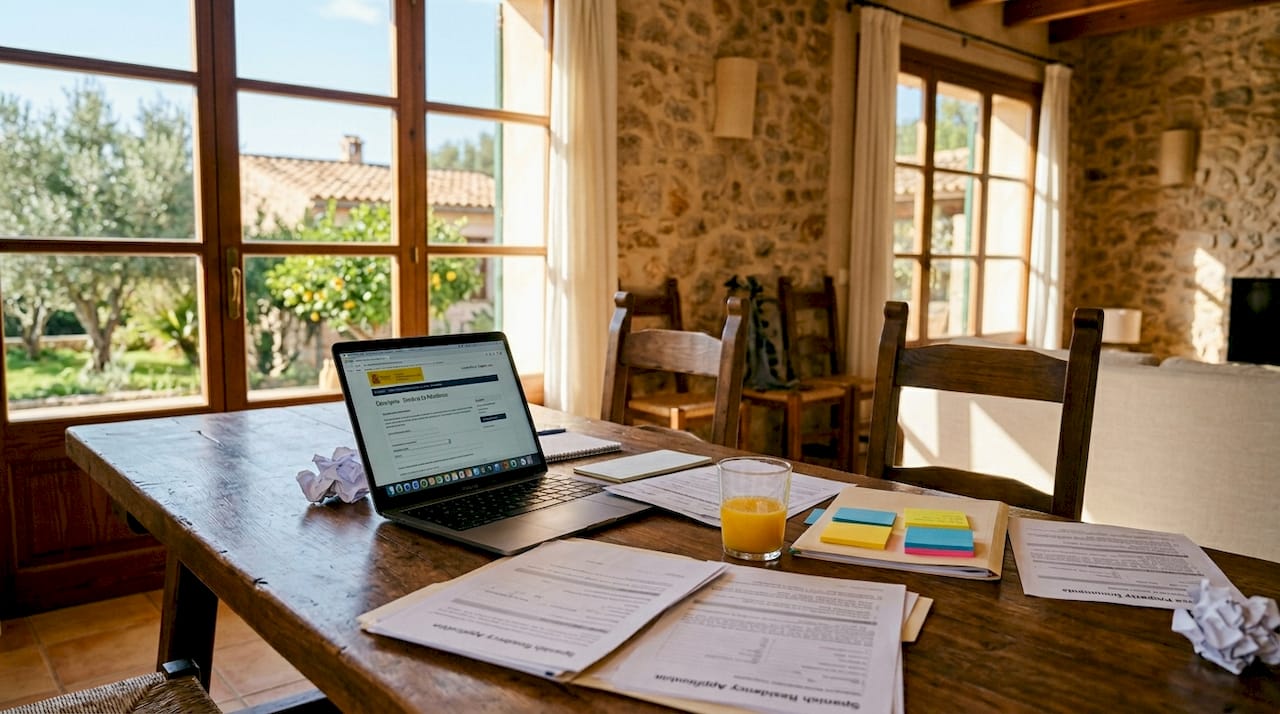
Most people arrive thinking they need to find a house first. What they actually need first is a Número de Identificación de Extranjero, commonly called the NIE. This is not a residency document. It is a tax and identification number, and NIE precedes nearly every administrative step you will take in Spain, including opening a bank account, signing a lease, and completing a property purchase.
The NIE and the TIE are two documents that people routinely confuse, and the distinction between NIE and TIE matters practically. The NIE is your permanent identification number. The TIE (Tarjeta de Identidad de Extranjero) is the physical residency card issued after your residency application is approved. You can hold an NIE without being a formal resident. You cannot get a TIE without first having an NIE.
How to apply for your NIE
You can apply from outside Spain at a Spanish consulate in your home country, or from within Spain at a Comisaría Nacional de Policía or immigration office. The application requires:
- Completed EX-15 form
- Valid passport plus a photocopy
- Justification letter explaining why you need the NIE (property purchase, employment, relocation)
- Payment of the Tasa 790 administrative fee
NIE appointment delays are common, especially in high-demand seasons. Apply from your home country before arrival if at all possible. Many families have lost four to six weeks because they underestimated the NIE timeline and arrived expecting to handle it in a day.
Pro Tip: Hire a local gestoría to manage your NIE and TIE applications. A gestoría is a licensed administrative agent who can represent you at appointments and submit paperwork on your behalf, cutting processing time and reducing the chance of incomplete applications.
Once you have your NIE and a confirmed address, municipal registration comes next. The empadronamiento is your formal declaration of residence with your local town hall (Ayuntamiento). Proof of housing and official ID are the core requirements, meaning a lease contract, property deed, or written authorization from your landlord. This registration is not optional. Failing to register promptly delays school enrollment, health card issuance, and access to municipal benefits. The correct order is: NIE first, then empadronamiento, then everything else. Skipping or overlapping these steps creates costly setbacks that are entirely avoidable.
Housing options: renting, buying, and choosing where to live
The question of where to live in Mallorca is more consequential than it seems, because your municipality of registration directly affects which schools your children can access and how quickly you receive local services. Choosing a neighborhood is not purely a lifestyle decision.
Popular areas for expat families
Mallorca has distinct zones that attract different profiles of international buyers and renters:
- Southwest Palma and Santa Catalina: Urban living with walkable streets, restaurants, and strong public transport links
- Son Vida: A quiet residential enclave above Palma, popular with families seeking privacy and larger properties
- Alcúdia and Puerto Pollença: Northern coastal towns favored for their calmer pace, good international schools, and strong community feel
- Andratx and Camp de Mar: The southwest corner, known for luxury villas, marina access, and a well-established expat network
Renting vs. buying during your move
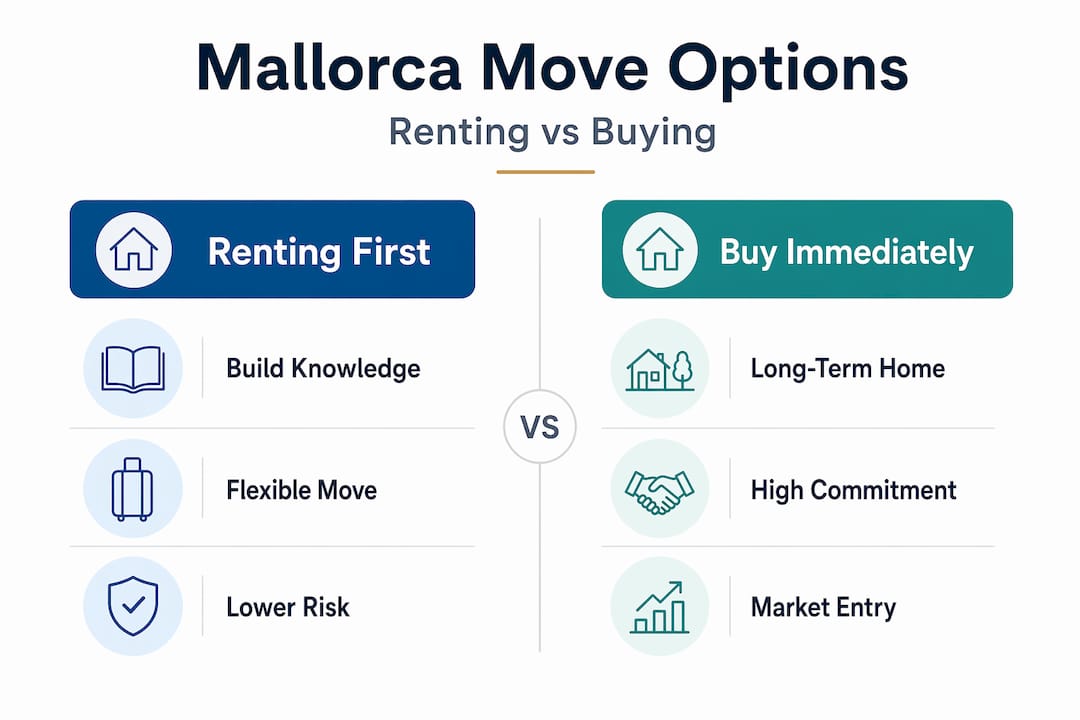
| Factor | Renting first | Buying immediately |
|---|---|---|
| Market knowledge | Builds it before committing | Requires advance research |
| Administrative flexibility | Address change is easy | Address locked in early |
| Financial exposure | Lower short-term commitment | Higher upfront costs |
| Empadronamiento | Works with a valid lease | Works with deed |
| Ideal for | First-year arrivals | Buyers with prior Mallorca experience |
For most families relocating without prior local knowledge, renting for six to twelve months before purchasing is the smarter path. It gives you time to assess schools, commute patterns, and neighborhood fit before committing to a property.
When you are ready to buy, the Mallorca property market has no restrictions on foreign buyers, which makes it accessible for Americans and other non-EU nationals. You will need your NIE and a Spanish bank account. Budget for purchase taxes and fees of approximately 8 to 11% on top of the purchase price, covering transfer tax (ITP) or VAT on new builds, notary fees, and registry costs. For families looking at the Mallorca buying process in detail, breaking costs down before you view properties prevents late-stage financial surprises.
Enrolling children in Mallorca’s schools
School enrollment is where families most often make avoidable mistakes, typically by starting the process too late or without completing empadronamiento first.
For the 2026–2027 academic year, most municipalities across Mallorca operate on a zona única admissions system, which gives parents freedom to apply to schools outside their immediate neighborhood zone. This is good news for flexibility. The process itself is primarily telematic, meaning applications are submitted online through the Govern de les Illes Balears education portal.
Here is the standard enrollment sequence for families:
- Complete empadronamiento at your Ayuntamiento with your lease or deed and passport
- Gather required documents, including birth certificates (translated and apostilled if necessary), vaccination records, and any medical certificates
- Submit the telematic application during the designated admissions window, typically in March and April for the following school year
- Await placement confirmation and respond within the stated deadline to secure the spot
- Present originals at the school office before term begins
One genuinely useful provision for the 2026–2027 cycle: families expecting a child can apply for 0 to 3 year places before the baby is born, provided they submit a medical certificate confirming the pregnancy. This provision applies specifically to the infant stage (0 to 3 years). If you are expecting and planning to relocate, this window is worth using.
Pro Tip: School admissions depend heavily on correct and current empadronamiento. If your registered address changes after you apply, update your registration immediately or your application may be invalidated.
Building your life: integration and daily living
Getting registered and enrolled is the foundation. Actually settling in is the layer that determines whether your move feels like home or feels like an extended stay.
Healthcare is your first practical priority after empadronamiento. Registration with your municipality entitles you to apply for a Tarjeta Sanitaria (public health card), which gives you access to Mallorca’s public health centers (centros de salud). Many international families supplement this with private health insurance for faster specialist access and English-speaking care. Private policies in Mallorca are competitively priced compared to other Western European markets, and having both public and private coverage is common.
For day-to-day movement, Mallorca’s public transport network connects Palma to most major towns efficiently via TIB and EMT buses and a rail line. The Intermodal Card halves standard fares and is available to registered residents. For families living outside Palma, a car is typically more practical than relying on buses, particularly for school runs and weekend access to rural areas.
On language: while English is widely spoken in tourist and expat circles, your quality of daily life improves noticeably with conversational Spanish, and in some inland communities, basic Catalan is appreciated. Signing up for Spanish classes within your first month signals engagement to your new community and accelerates integration in ways that no amount of relocation admin can replicate.
The single most common mistake I see is treating the relocation process as a parallel checklist rather than a sequential one. People try to book viewings, open bank accounts, and register with the municipality simultaneously. Each step unlocks the next. Respect the sequence, and the whole process becomes predictable.
My honest take on making this move work
I have walked through this process with enough international families to know where it breaks down. Almost every delay I have seen traces back to one of two causes: starting the NIE too late, or choosing a neighborhood before understanding what that address means for school options and municipal services.
What genuinely works is preparation before arrival. If you are planning to move in late summer to catch the school year, your NIE application should already be in progress six months before your move date. Identifying your target municipality in advance, and aligning your housing search to that municipality, removes the scrambling that happens when people fall in love with a property in one town while their children’s school preference is in another.
I have also seen families benefit enormously from engaging a local gestoría early. The time saved on appointments alone is worth the cost. And from a property perspective, working with an independent buyer agent rather than an agency-aligned agent gives you access to the full market and representation that is genuinely on your side. The Mallorca property search is competitive in the segments most international families target, and having someone who knows which properties are fairly priced is a real advantage.
The families who move here smoothly are not the ones with the biggest budget. They are the ones who treated the administrative process as seriously as the property search.
— Uli
How Uli-lisa helps families relocate and buy with confidence
Relocating to Mallorca while simultaneously navigating a property purchase is a lot to manage. Uli-lisa works exclusively as an independent buyer agent, representing only the buyer with full access across all Mallorca agencies and listings. That means no conflicts of interest and no hidden incentives to steer you toward any particular property or area.
For international families, Uli-lisa combines AI-powered market search with personalized guidance on the legal and financial steps that define a secure purchase. From neighborhood selection to understanding purchase taxes and financing, the approach is built around your specific situation. If you want to explore Mallorca property financing or understand what a safe, well-structured acquisition looks like, connect with Uli-lisa directly for a consultation built around your timeline and goals.
For buyers prioritizing security in an uncertain global environment, start here: safe property investment in Mallorca.
FAQ
What documents do I need first when relocating to Mallorca?
Your NIE (Número de Identificación de Extranjero) is the first document to obtain, as it is required for banking, contracts, and property purchases. Apply before arrival at a Spanish consulate if possible to avoid delays.
What is empadronamiento and why does it matter?
Empadronamiento is formal municipal registration at your local town hall, and it unlocks access to healthcare, school enrollment, and local services. You need proof of your address and a valid ID to register.
Can my child start school in Mallorca if I relocate mid-year?
Yes, but the main admissions window for the following year typically runs in March and April. Arriving without prior enrollment may require a direct application to the school or education authority for an available place.
Do I need to be a Spanish resident to buy property in Mallorca?
No. Foreign nationals, including Americans, can purchase property with only an NIE and a Spanish bank account. Residency is not required, though purchase taxes and fees of approximately 8 to 11% apply to the transaction price.
How long does the full relocation process take?
Realistically, plan for three to six months from NIE application to full registration and school placement. Families who start the NIE process before leaving their home country consistently experience the smoothest transitions.
Recommended
- 8 Top Real Estate Tips for 2025 in Mallorca - ULI & LISA Mallorca Property Blog
- 8 Top Real Estate Tips for 2025 in Mallorca - ULI & LISA Mallorca Property Blog
- 7 Key Property Market Trends Mallorca 2025 You Must Know - ULI & LISA Mallorca Property Blog
- Moving from Canada to Mallorca: The Complete Relocation Guide - ULI & LISA Mallorca Property Blog