
Choosing the right luxury villa in Mallorca in 2025 is about more than location or stunning views. High-net-worth American retirees face new market realities shaped by global economic uncertainty, evolving buyer expectations, and complex legal compliance requirements. For those seeking a secure, high-value investment in Spain, understanding these trends and cross-border transaction needs will help you avoid costly mistakes and ensure that your dream property truly delivers lasting value.
Key Takeaways
| Point | Details |
|---|---|
| Market Trends | Mallorca’s real estate market in 2025 is influenced by global economic uncertainty, buyer expectations, and structural changes prioritizing sustainability and technology. |
| Investment Strategy | Buyers must evaluate properties based on legal compliance, rental potential, and neighborhood dynamics to avoid overpaying for undervalued assets. |
| Luxury Demand Drivers | High-income American retirees prioritize unique, high-quality properties that provide genuine lifestyle experiences, not just investment opportunities. |
| Cross-Border Compliance | U.S. buyers need to navigate complex legal and tax obligations when purchasing in Spain to avoid costly mistakes and ensure smooth ownership. |
Defining 2025 Mallorca Real Estate Trends
Mallorca’s real estate market in 2025 stands at a critical inflection point. After years of steady appreciation and increased international interest, the market is now shaped by forces that go far beyond simple supply and demand. Global economic uncertainty, shifting investment priorities, and evolving buyer expectations are redefining what success looks like for property investors and homebuyers. Understanding these trends isn’t about predicting the future with certainty, it’s about recognizing the structural changes that will determine which properties appreciate, which neighborhoods strengthen, and which investment strategies actually deliver returns.
The 2025 Mallorca market reflects broader transformation rippling through real estate globally. Structural demands like sustainability and digitalization are no longer luxury amenities, they’re baseline expectations from the American and Northern European buyers who drive Mallorca’s premium segment. Buyers aged 50-65 seeking €1.5 million to €3 million villas are increasingly asking about energy efficiency ratings, smart home integration, and long-term property resilience. They’re not just purchasing a home, they’re acquiring a lifestyle platform that needs to function reliably, perform financially, and deliver genuine livability year-round. This shift explains why properties in certain areas command premiums while others stagnate, regardless of location appeal.
The defining characteristic of 2025 is pragmatism replacing exuberance. Investors are moving past the assumption that Mallorca real estate automatically appreciates. Instead, they’re scrutinizing rental license potential, local regulatory changes affecting short-term letting, renovation costs, and the specific neighborhood trajectory. Properties in Palma’s established neighborhoods with proven rental demand tell a different story than comparable villas in newer developments still seeking market traction. Additionally, real estate’s transformation toward liveability, resilience, and technology integration is creating opportunities for properties that align with these priorities and challenges for those that don’t. The buyers winning in 2025 Mallorca are the ones who understand that quality of location, property condition, legal documentation, and investment positioning matter more than ever.
These market shifts create both risk and opportunity. Buyers without deep market knowledge can easily overpay for properties that appear attractive on the surface but lack genuine income potential or appreciation drivers. Conversely, those who understand the specific trends within Mallorca’s segments—luxury oceanfront villas, Palma urban residences, rural estates—can identify properties positioned to perform. The difference between a property that generates consistent rental income with clean ETV licensing and one that sits vacant is enormous, and 2025 is the year when that difference becomes financially impossible to ignore.
Here is a comparison of Mallorca’s main property segments and their investment characteristics for 2025:
| Property Segment | Appreciation Potential | Rental Income Opportunity | Key Buyer Expectations |
|---|---|---|---|
| Luxury oceanfront villas | High with scarcity | Strong, licensed rentals | Energy-efficient, unique design |
| Palma urban residences | Moderate to high | Year-round demand | Central location, smart features |
| Rural estates | Variable, location-driven | Seasonal, limited | Land privacy, resilience |
Pro tip: Before evaluating any property, determine whether your primary goal is personal residence, long-term appreciation, or rental income, then assess how current 2025 trends specifically impact that objective for that particular property type and location.
Luxury Villa Demand and Market Drivers
Luxury villa demand in Mallorca isn’t random. It flows from concrete economic realities and shifting lifestyle priorities among American and Northern European affluent buyers. Spain’s position as a global tourism leader directly fuels this market. High-spending visitors arrive year-round, drawn by cultural attractions, Mediterranean climate, and premium infrastructure. That consistent flow of international visitors who fall in love with the island translates into genuine demand for permanent residences. For American buyers aged 50-65 considering a €2 million villa purchase, this reality matters: properties in tourist-strong zones with proven rental appeal hold their value differently than comparable homes in quieter, less-developed areas. Tourism strength isn’t just about lifestyle, it’s an economic anchor that supports property values.
The economics of luxury villa demand reveal something crucial that many first-time Mallorca buyers miss. Luxury goods like high-end villas exhibit inelastic demand, meaning affluent buyers prioritize uniqueness, design quality, and location prestige over price sensitivity. During market downturns when mid-market properties stagnate, luxury villas with genuine distinction often continue appreciating. This happens because wealthy buyers are purchasing exclusivity and status, not just square meters. A perfectly renovated oceanfront villa with clean legal documentation and strong design appeal attracts motivated buyers regardless of economic cycles. Conversely, a basic villa without distinctive features gets caught in competitive pricing pressure. The differentiation between “luxury property” and “luxury location with a property on it” determines whether 2025 becomes a wealth-building year or a regret-inducing experience.
Three specific market drivers shape 2025 demand for luxury villas in Mallorca. First, rising incomes among American retirees and successful entrepreneurs continue creating a buyer pool with available capital. Second, experiential preferences have shifted dramatically. Buyers no longer want just a vacation home, they want a lifestyle platform offering authentic Mediterranean living with world-class amenities nearby. Third, exclusivity itself has become the primary commodity. Properties offering genuine scarcity, whether through location, architectural uniqueness, or established prestige neighborhoods, command stronger positions. Understanding these drivers helps you evaluate whether a specific property aligns with actual market momentum or simply benefits from marketing hype.

The distinction between properties riding genuine demand waves versus those fighting against market currents shapes investment outcomes. A villa in an established luxury neighborhood like Deya or Son Vida with proven rental demand and strong architectural pedigree occupies an entirely different market reality than a comparable villa in a newer development still seeking identity. The former attracts multiple motivated buyers. The latter fights for attention. Buyers who understand these demand drivers can identify which properties will appreciate and which will require aggressive pricing to sell within five to ten years.
Pro tip: Request historical sales data for comparable properties in your target neighborhood over the past three years, then evaluate whether demand is strengthening or becoming more competitive before committing capital.
AI-Powered Property Searches and Insights
Finding the right luxury villa in Mallorca used to mean hiring an agent, flying to the island, and viewing properties in person. That approach still exists, but 2025 buyers have a competitive advantage: AI-powered search tools that filter thousands of listings, identify hidden opportunities, and provide market intelligence in seconds. These tools aren’t replacing human expertise, they’re augmenting it. A properly trained AI system can scan 35,000 listings across Mallorca’s market, identify which neighborhoods have appreciation momentum, flag properties with clean legal documentation, and highlight villas with strong rental income potential. For American buyers managing this search from across the Atlantic, this capability changes everything. You can now eliminate unsuitable properties before scheduling viewings, understand pricing patterns by neighborhood, and make data-informed offers instead of gut-based decisions.
AI-powered search systems integrate large language models to enhance property discovery precision and relevance. Rather than scrolling through endless listings, these tools filter vast datasets based on your specific criteria: property type, price range, location preferences, rental potential, and legal status. The technology identifies properties matching your investment thesis without requiring you to manually evaluate hundreds of options. More importantly, AI systems provide transparency about data sources and property history, helping you avoid misinformation and recognize red flags early. A villa listed as “fully licensed for short-term rental” but lacking proper ETV documentation gets flagged. A property in an appreciating neighborhood gets contextualized within market trends. This intelligence layer prevents costly mistakes that plague first-time Mallorca buyers.
The real power of AI in Mallorca real estate emerges when you combine technology with human expertise. Trusted AI partnerships enhance market analytics while maintaining transparency about data reliability and decision-making processes. This means using AI tools that show you exactly how properties were evaluated and why certain recommendations were made. You gain confidence that recommendations flow from algorithms trained on actual Mallorca market data, not generic real estate assumptions. When an AI tool flags a villa in Palma’s old town as having strong appreciation potential based on five years of comparable sales data and neighborhood development trends, that insight carries weight. It’s not opinion, it’s pattern recognition backed by thousands of transactions.
The practical advantage surfaces when comparing property options. One villa might appear identical to another on basic criteria but differ fundamentally in market position. AI analysis reveals neighborhood-specific factors: which areas attract rental demand, which are appreciating fastest, which carry regulatory risks. American buyers aged 50-65 evaluating multiple million-dollar properties can now compare not just features but actual investment positioning. This shifts the conversation from “I like this villa” to “This villa outperforms because it sits in a neighborhood with proven rental demand and historical 8 percent annual appreciation.” That’s the difference between purchasing a home and making an investment.
Pro tip: Use AI property search tools to pre-qualify neighborhoods and properties before engaging with agents, then leverage that market intelligence when negotiating price and terms with sellers.
Legal Compliance for U.S. Buyers in Spain
Buying a villa in Mallorca triggers legal obligations that extend far beyond Spain’s borders. As an American citizen, you remain subject to U.S. tax law, reporting requirements, and financial disclosure rules even while owning Spanish real estate. Many first-time international buyers discover this reality after purchase, creating expensive complications that proper planning would have prevented. Understanding the legal landscape before committing capital isn’t bureaucratic busy work, it’s the difference between smooth ownership and years of compliance headaches. Spain’s property law system differs fundamentally from American real estate, and those differences matter. Real property law governs ownership rights, land transfers, and disclosure requirements, and Spain’s approach creates obligations that American buyers must respect.
Spanish property acquisition requires navigating specific legal frameworks that protect both buyer and seller. Property rights, land use regulations, and transfer procedures differ substantially from U.S. conventions, and this distinction creates both risk and opportunity. When you purchase a villa, you’re not just signing papers, you’re entering Spanish property law systems that define your ownership rights, your ability to modify the property, your rental license eligibility, and your tax obligations. A villa that appears identical to its neighbor might carry entirely different legal positioning based on zoning designation, environmental protection status, or historical preservation requirements. One property might qualify for ETV tourism license approval while an adjacent villa cannot. These distinctions matter profoundly and require professional legal review before purchase.
Three critical compliance areas demand attention. First, title verification and acquisition. Spanish properties transfer through a complex notarization process requiring certified title searches, municipal records review, and proof that no liens or encumbrances exist. Second, U.S. tax reporting. American property owners must file FBAR and FATCA disclosures with the IRS, report worldwide income including rental revenue, and potentially manage foreign tax credits to avoid double taxation. Third, Spanish residency and property licensing. Depending on your residency status and property use, you may require specific permits, registrations, or licenses. Rental properties demand particular attention because ETV licensing rules, occupancy regulations, and tourist season restrictions carry legal penalties if violated.
The practical reality is this: professional legal guidance during the purchase process costs thousands of dollars and saves tens of thousands in future complications. A Spanish property lawyer conducts due diligence that American real estate agents simply cannot perform. They verify clear title, identify regulatory restrictions, ensure proper transfer documentation, and coordinate with Spanish tax authorities. An American tax accountant specializing in international property ownership helps you understand FBAR filing obligations, currency reporting requirements, and strategies to minimize double taxation. This isn’t excessive caution, it’s competent international property ownership. Buyers who skip this step inevitably face unexpected costs, regulatory violations, or compromised ownership positions that could have been resolved preemptively.
Pro tip: Engage both a Spanish property lawyer and a U.S. tax accountant with cross-border real estate experience before signing any purchase agreement, then coordinate their reviews to ensure comprehensive legal and tax compliance.
Cross-Border Payment and Tax Considerations
Wiring €2 million to Spain for a villa purchase feels straightforward until you encounter currency exchange rates, banking fees, tax reporting requirements, and compliance procedures that transform a simple transaction into a multi-step process. American buyers aged 50-65 are accustomed to domestic real estate closings where funds transfer domestically and tax reporting stays simple. International property acquisition operates differently. Your payment triggers U.S. tax reporting obligations, Spanish acquisition taxes, currency conversion costs, and potential U.S. estate tax implications that require careful planning. The difference between a well-structured payment and a poorly executed one can easily cost tens of thousands of dollars in unnecessary taxes and fees. Before initiating any wire transfer, you need to understand how cross-border payments actually work and what tax consequences follow.
The payment structure itself matters enormously. When purchasing a Spanish property, you typically wire funds to a Spanish notary’s escrow account before closing. This triggers currency conversion at your bank’s exchange rate, international wire fees, and potentially beneficial currency timing if you understand market conditions. More importantly, your payment creates documentation that U.S. tax authorities track. The United States maintains income tax treaties with Spain that regulate cross-border transactions and reduce double taxation risks, but these benefits only apply if you understand and leverage them correctly. Many American buyers fail to structure payments in ways that utilize available treaty protections, resulting in unnecessary withholding taxes or reporting complications. The timing of your payment, the currency used, and the entity receiving funds all influence your ultimate tax position.
Spanish acquisition taxes compound the financial equation. When you purchase a villa, Spain charges transfer tax ranging from 6 to 11 percent depending on region and property type. Mallorca applies specific rates that your Spanish lawyer must calculate precisely. Additionally, you become liable for Spanish property tax (IBI) going forward, which varies by municipality but typically ranges from 0.4 to 1.1 percent of cadastral value annually. Rental income, if you pursue licensing, gets taxed by Spain at rates applicable to non-residents. Simultaneously, the U.S. IRS requires you to report worldwide income including Spanish rental revenue, potentially creating double taxation scenarios where both countries claim tax rights. Understanding taxation of cross-border investments and available treaty protections becomes essential for optimizing your actual tax burden. Without proper planning, you could pay significantly more tax than necessary.
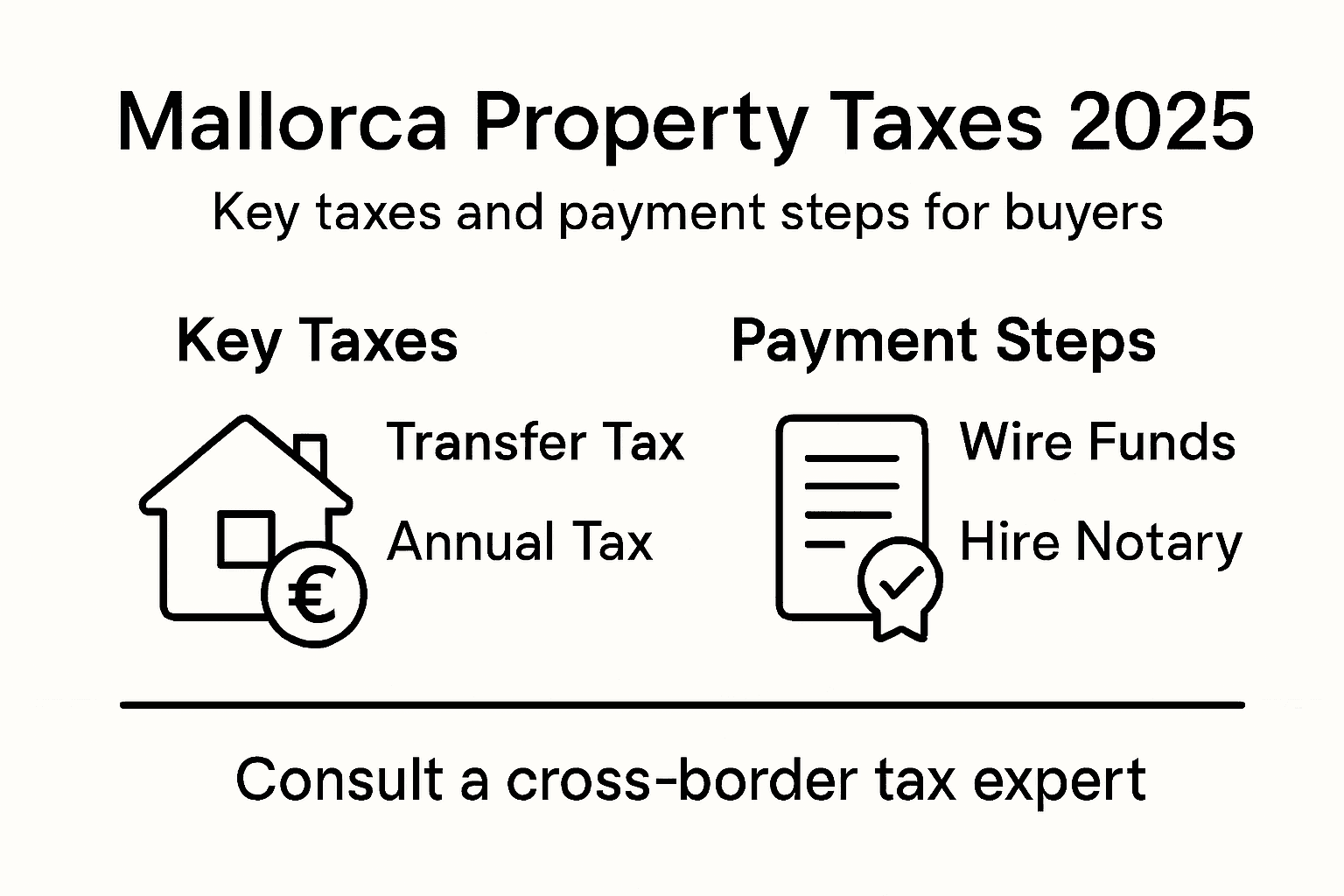
The practical solution requires coordinating payments with professional guidance. Work with a Spanish notary who understands international closings and can structure your escrow arrangement efficiently. Simultaneously, engage a U.S. tax accountant specializing in international real estate before your purchase closes. They can review your purchase agreement, payment structure, and anticipated rental income to identify tax optimization strategies available under the Spain-U.S. tax treaty. They’ll ensure your FBAR filing, FATCA reporting, and rental income declarations align properly, maximizing available credits and deductions. Currency exchange timing can also matter. If you’re holding U.S. dollars and the euro strengthens against the dollar before closing, waiting costs you money. A currency specialist can identify optimal conversion windows. These coordination costs are minimal compared to tax inefficiencies that result from uncoordinated payments.
Below is a summary of cross-border payment challenges and professional coordination strategies:
| Challenge | Financial Impact | Professional Solution |
|---|---|---|
| Currency conversion | Loss from poor exchange rate | Currency specialist advice |
| Double taxation | Higher overall tax burden | Tax accountant coordination |
| Wire/escrow complexity | Delays, additional fees | Spanish notary guidance |
| Treaty benefits usage | Reduces unnecessary taxes | Pre-close legal/tax review |
Pro tip: Structure your payment timing and currency conversion in coordination with your tax accountant, not just your real estate agent, to maximize available treaty benefits and minimize cross-border tax inefficiencies.
Navigate 2025 Mallorca Real Estate Trends with Expert Guidance
Understanding Mallorca’s evolving market requires more than just seeing property listings. You face challenges like verifying legal compliance, assessing rental license potential, and decoding true neighborhood appreciation—all critical for American buyers seeking luxury villas or investment properties. These details determine if a property is a genuine lifestyle platform or an overlooked risk. With rising importance placed on energy efficiency, market pragmatism, and AI-powered insights, having trusted partners by your side is essential.
At ULI & LISA, we specialize in helping international buyers, especially from the United States, cut through the complexity with AI-enhanced searches and personalized advice. We streamline your property discovery by filtering listings to match your goals—whether for personal residence, rental income, or long-term appreciation. Our deep market knowledge ensures you avoid costly pitfalls in legal compliance and cross-border tax considerations. Start your journey now by exploring how we make Mallorca’s market transparent and accessible: visit our main page and experience buying with confidence. Don’t wait as 2025’s market demands smart, informed decisions that can protect your investment and unlock your dream property.
Frequently Asked Questions
What are the key trends shaping the 2025 real estate market?
The 2025 real estate market is primarily shaped by global economic uncertainty, shifting investment priorities, and evolving buyer expectations, focusing on sustainability, digitalization, and genuine livability.
How do buyer expectations differ for luxury villas compared to urban residences?
Buyers of luxury villas typically prioritize energy efficiency, unique design, and strong rental income potential, while urban residence buyers are more interested in central locations and smart home features.
What factors should investors consider before purchasing property in the 2025 market?
Investors should evaluate rental license potential, local regulatory changes, property condition, neighborhood trends, and overall investment positioning to avoid overpaying and ensure future appreciation.
How can AI technology aid in the property search process?
AI technology offers tools that filter listings, identify investment opportunities, and provide market intelligence, allowing buyers to make informed decisions and avoid costly mistakes during the property selection process.
Recommended
- Mallorca Real Estate Market Forecast 2025 - ULI & LISA Mallorca Property Blog
- Mallorca Real Estate Market 2025 – Key Trends for U.S. Buyers - ULI & LISA Mallorca Property Blog
- Mallorca Real Estate Market 2025 – Key Trends for U.S. Buyers - ULI & LISA Mallorca Property Blog
- Mallorca Real Estate Market 2025 – Key Trends for U.S. Buyers - ULI & LISA Mallorca Property Blog