
TL;DR:
- A buyer’s agent in Spain works exclusively for the purchaser, providing legal due diligence, market access, and negotiation support. Most Spanish agents represent sellers, making independent buyer representation essential to avoid legal, financial, and market-related pitfalls. Leveraging a buyer’s agent ensures access to off-market inventory, reduces risks, and protects buyers throughout the transaction process.
A buyer’s agent in Spain is a real estate professional who works exclusively for the purchaser, with no financial obligation to the seller, making this role the single most important protection an American investor can secure before buying property in Spain. Most US buyers arrive assuming the local agent showing them properties is working in their interest. That assumption is wrong and expensive. In Spain’s fragmented, seller-focused market, understanding why hire a buyer’s agent in Spain is not a procedural question. It is a financial and legal one. Uli-lisa works exclusively with buyers in Mallorca, and the patterns we see repeat themselves: buyers who skip independent representation pay more, close slower, and inherit problems that proper due diligence would have caught.
Why does the Spanish real estate market require a buyer’s agent?
The structure of Spain’s property market is fundamentally different from the US system, and that difference puts unrepresented American buyers at a serious disadvantage. Most Spanish agents work exclusively for sellers, with their primary legal and financial obligation running to the person paying their commission. That person is the seller. This is not a minor technicality. It means the agent showing you a property in Mallorca, Marbella, or Barcelona is legally incentivized to maximize the seller’s outcome, not yours.

Spain also lacks a centralized Multiple Listing Service comparable to the US MLS. Properties are listed across dozens of competing portals including Idealista, Fotocasa, and agency-specific websites, with no single authoritative source. The same property often appears under different prices across different platforms, creating confusion that benefits sellers and informed local agents, not buyers searching from abroad.
Zombie listings compound this problem significantly. These are properties already sold or under contract that remain active on portals to generate buyer inquiries and build agent databases. An American spending weeks researching listings from New York or Los Angeles may be pursuing properties that have not been available for months. A buyer’s agent filters these out immediately, saving weeks of wasted effort.
The advantages of using a buyer’s agent extend beyond filtering bad listings. Access to off-market inventory is one of the most concrete benefits. Experienced buyer’s agents maintain personal networks with selling agents across the market, giving their clients first access to properties before they appear on any public portal. In Mallorca’s luxury segment, where the best properties at the €1M+ level often sell quietly, this network access is not a bonus feature. It is the primary channel.
Pro Tip: Ask any agent you are considering whether they have sold properties to buyers in the past 12 months. If yes, they are a selling agent, not a buyer’s agent, regardless of what they call themselves.
- Seller’s agents in Spain have no legal duty to disclose defects that harm the buyer’s position
- Multiple listings for the same property create artificial price confusion
- Zombie listings waste buyer time and create false urgency
- Off-market properties represent the highest-quality inventory in premium markets
- Buyer’s agents provide a filtered, verified shortlist rather than a raw portal dump
What legal protections does a buyer’s agent provide in Spain?
Legal due diligence in a Spanish property transaction is not optional. It is the difference between a secure investment and a costly legal dispute that can take years to resolve in Spanish courts. Buyer’s agents coordinate full legal teams including solicitors, notaries, and surveyors, and they manage the document verification process that most American buyers do not know to request.
The core legal document in any Spanish property transaction is the Nota Simple, a registry extract from the Registro de la Propiedad that confirms ownership, describes the property boundaries, and lists any debts, mortgages, or liens attached to the title. A buyer’s agent obtains and interprets this document before any offer is made. Without it, a buyer can unknowingly purchase a property with an outstanding mortgage that transfers with the title.
Beyond the Nota Simple, a thorough buyer’s agent verifies planning permissions, the Licencia de Primera Ocupación (license of first occupancy), and compliance with local urban planning regulations. Properties in Spain, particularly in coastal areas and rural zones, sometimes have illegal extensions or structures built without permits. Purchasing one of these properties can result in demolition orders or fines that fall entirely on the new owner.
The following checks represent the minimum standard of due diligence a qualified buyer’s agent should coordinate:
- Obtain and review the Nota Simple from the Registro de la Propiedad
- Verify the Licencia de Primera Ocupación or equivalent occupancy certificate
- Confirm no outstanding community fees, IBI (property tax), or utility debts
- Check for any planning violations or unauthorized construction
- Review the Arras contract (preliminary deposit agreement) before signing
- Confirm the property’s cadastral reference matches the physical boundaries
- Coordinate an independent structural survey for properties over 15 years old
| Document | What it confirms |
|---|---|
| Nota Simple | Ownership, title debts, and liens |
| Licencia de Primera Ocupación | Legal right to inhabit the property |
| Certificado de Eficiencia Energética | Energy rating required for all sales |
| IBI receipts | Confirms property tax is current |
| Community fee statements | Confirms no outstanding HOA-equivalent debts |
Pro Tip: Never sign an Arras contract without your own legal counsel reviewing it first. This deposit, typically 10% of the purchase price, is non-refundable if you withdraw without a legally valid reason.
The Mallorca property due diligence process is more complex than most Americans anticipate, particularly for rural properties or those with recent renovations. A buyer’s agent who has completed dozens of these transactions knows exactly which questions to ask and which answers to distrust.
What unique challenges do American buyers face in Spain?
American buyers face a specific set of obstacles in Spain that go beyond the general complexity of international real estate. Language is the most visible barrier, but it is not the most dangerous one. Buyer’s agents bridge language and cultural gaps ensuring buyers understand not just the translation of a contract but the legal implications of each clause under Spanish law. A direct translation of a Spanish purchase agreement does not convey the same meaning as a proper legal explanation of what each term obligates the buyer to do.
Currency risk is a concrete financial threat that many US buyers underestimate. A property priced at €1.2 million can cost significantly more or less in US dollars depending on EUR/USD movements between the offer date and the closing date. Currency fluctuations and financing terms are documented hurdles for US buyers, and a buyer’s agent can connect clients with currency specialists who lock in favorable exchange rates through forward contracts.
The Arras deposit system also catches American buyers off guard. Unlike a US earnest money deposit, which is typically refundable under most contingencies, the Spanish Arras Penitenciales contract is a bilateral commitment. If the buyer withdraws without legal cause, they lose the deposit. If the seller withdraws, they must return double the deposit. Understanding this structure before signing is not optional. It is the point at which many uninformed buyers make their most expensive mistake.
- Spanish mortgage terms for non-residents differ substantially from US lending norms, with lower loan-to-value ratios typically capped at 60 to 70%
- NIE (Número de Identificación de Extranjero) registration is required before any property purchase and takes time to obtain
- Spanish notaries represent the state, not the buyer or seller, so they do not provide legal advice to either party
- Regional laws in the Balearic Islands, including Mallorca, differ from mainland Spanish property regulations in several important respects
- Agents familiar with American buyers understand these friction points and resolve them before they become delays or losses
How to choose a trustworthy buyer’s agent in Spain
Selecting the right buyer’s agent is itself a due diligence exercise. The most important criterion is exclusivity. The agent must represent only buyers, with no financial relationship to any seller or selling agency. Most Spanish agents earn commission from sellers, which creates a structural conflict that no amount of goodwill can fully eliminate. Dual agency, where one agent represents both parties, is legal in Spain but serves neither party well.
Transparency in fee structure is the second criterion. A genuine buyer’s agent charges the buyer directly, either as a fixed fee or a percentage of the purchase price, and discloses this clearly before engagement. If an agent claims to represent you for free while also collecting a commission from the seller, they are a selling agent with a marketing problem, not a buyer’s advocate.
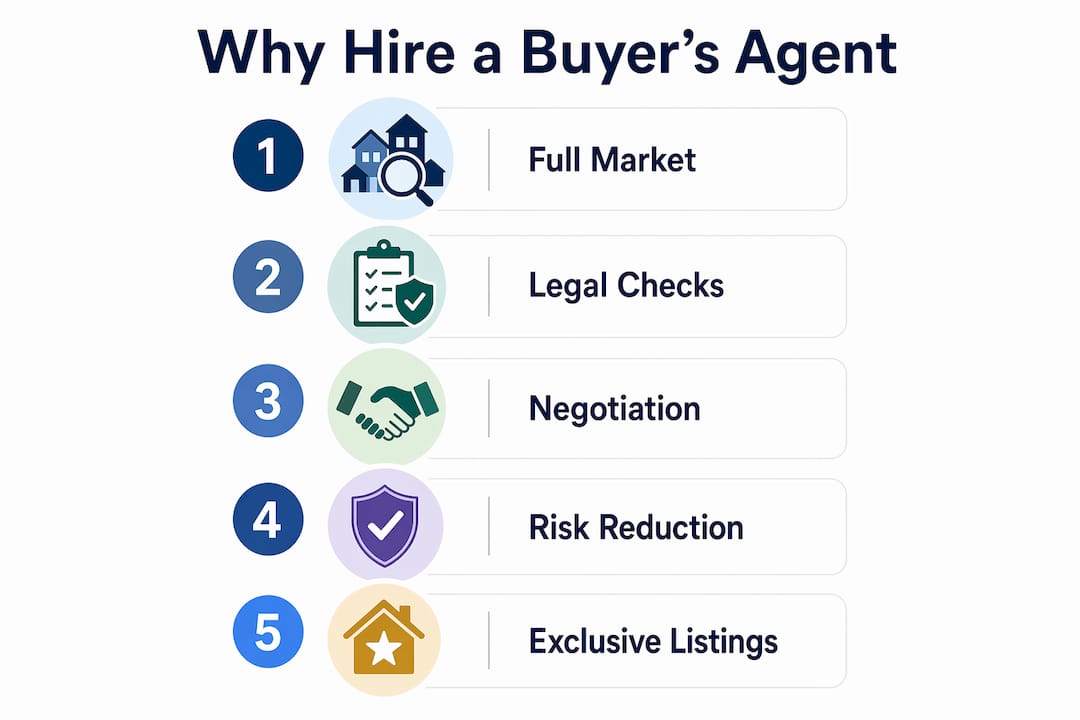
Experienced buyer’s agents maintain personal local networks that uncover exclusive listings and negotiate effectively on the buyer’s behalf. Ask any prospective agent how many off-market properties they accessed for clients in the past year. The answer tells you whether their network is real or theoretical.
A critical quality indicator is willingness to advise against a deal. Quality buyer’s agents advise clients to walk away from transactions with unacceptable risk, even when walking away means no commission. An agent who has never recommended a client decline a property is either very lucky or not doing their job. This willingness to protect capital over closing a deal is the clearest signal of genuine buyer advocacy.
The differences between Spanish buyer’s agents and US realtors are significant enough that American buyers should not assume the roles are equivalent. The regulatory environment, fiduciary standards, and market structure are all different.
Key takeaways
Hiring an independent buyer’s agent in Spain is the most effective way for American investors to access the full market, avoid legal pitfalls, and negotiate from a position of informed strength.
| Point | Details |
|---|---|
| Seller-focused market structure | Most Spanish agents represent sellers, not buyers, making independent representation essential. |
| Legal due diligence is non-negotiable | Buyer’s agents verify Nota Simple, liens, planning compliance, and occupancy licenses before any offer. |
| American-specific risks are real | Currency exposure, Arras deposit terms, and NIE requirements catch US buyers unprepared without guidance. |
| Exclusivity defines a true buyer’s agent | Only agents who charge buyers directly and have no seller relationships provide genuine advocacy. |
| Off-market access drives value | The best Mallorca properties at the €1M+ level often sell before reaching public portals. |
Why I tell every American client the same thing before we start
The question I hear most often from American buyers is whether they really need a buyer’s agent or whether a good lawyer is enough. My answer is always the same: a lawyer protects you after you have chosen a property. A buyer’s agent protects you before, during, and after.
I have seen buyers fall in love with a property in Mallorca and sign an Arras contract within 48 hours of viewing it, without any legal review, because the selling agent created urgency. In two of those cases, the properties had unresolved planning violations. The buyers lost their deposits when they tried to exit. A buyer’s agent would have caught both issues in the first document review.
The value of independent representation is not primarily about finding properties. It is about emotional distance and legal clarity at the moment when buyers are most vulnerable to making expensive decisions. Emotional attachment without legal clarity leads to risky purchases, and I have watched that pattern play out enough times to consider it a rule rather than an exception.
What makes Mallorca specifically compelling right now is the combination of legal security, stable property values, and genuine scarcity of quality inventory. That scarcity means the best properties require network access, not portal searches. It also means that when you find the right property, the transaction needs to move with precision. That precision requires a team that has done it before, in this market, with buyers who have the same priorities you do.
— Uli
Work with Uli-lisa: buyer-only representation in Mallorca
Uli-lisa represents only buyers. No seller relationships, no dual agency, no commission conflicts. For American investors targeting Mallorca’s luxury and investment property market, this means access to the full market including off-market inventory, coordinated legal due diligence, and a team that has navigated the specific challenges US buyers face in Spain. Whether you are purchasing a €1.5M villa or a €3M waterfront property, the transaction requires local expertise and independent advocacy. Explore secure property investment in Mallorca with a team that works exclusively for you.
FAQ
What does a buyer’s agent in Spain actually do?
A buyer’s agent in Spain searches the full market on the buyer’s behalf, coordinates legal due diligence, negotiates the purchase price, and manages the transaction from offer to closing. Unlike selling agents, their legal and financial obligation runs entirely to the buyer.
How is a Spanish buyer’s agent different from a US realtor?
Spanish buyer’s agents and US realtors operate under different regulatory frameworks, with Spain lacking a centralized MLS and having distinct fiduciary standards. Most Spanish agents represent sellers by default, making explicit buyer-only representation a deliberate and necessary choice.
Do buyer’s agents in Spain charge the buyer directly?
A genuine buyer’s agent charges the buyer a fee, either fixed or percentage-based, and does not collect commission from the seller. Any agent claiming to represent you for free while earning a seller’s commission has a conflict of interest that compromises their advice.
What is the biggest legal risk for Americans buying property in Spain without a buyer’s agent?
The most common legal risk is purchasing a property with undisclosed debts, planning violations, or missing occupancy licenses. These issues transfer to the new owner and can result in fines, demolition orders, or title disputes that take years to resolve in Spanish courts.
Is hiring a buyer’s agent worth the cost for a luxury property purchase?
Professional representation cost is a worthwhile investment for most international buyers compared to the risk of legal or transactional pitfalls. On a €1M+ purchase, a buyer’s agent fee is a small fraction of the financial exposure created by a single missed legal issue or a poorly negotiated price.
Recommended
- Buyer Agents in Spain vs U.S. Realtors – Key Differences - ULI & LISA Mallorca Property Blog
- Why Hire a Buyer’s Agent: Complete Expert Guide - ULI & LISA Mallorca Property Blog
- Why Hire a Buyer’s Agent: Complete Expert Guide - ULI & LISA Mallorca Property Blog
- Benefits of Using a Buyer Agent: Complete Guide - ULI & LISA Mallorca Property Blog