
TL;DR:
- Mallorca is the top Mediterranean destination for American retirees seeking a high-quality lifestyle, reliable healthcare, and long-term property security in Europe. The island offers over 300 days of sunshine, an established expat community, and direct flights to major European cities, but rising living costs now favor wealthier retirees with substantial financial resources. Careful planning of budgets, location choices, and legal documentation is essential for a successful long-term retirement in Mallorca.
Mallorca is the most compelling Mediterranean retirement destination for American expats seeking a combination of climate, lifestyle, and long-term property security in Europe. The island delivers over 300 days of sunshine annually, a mature international community, and direct flights to major European hubs, making it far more accessible than most comparable destinations. Retiring in Mallorca means trading the unpredictability of US healthcare costs and weather extremes for a structured, high-quality European lifestyle. A realistic monthly budget for comfortable retirement in Palma sits at approximately €3,200, or roughly $3,715, which is the starting point every American considering this move should know.
Why choose mallorca for retirement over other european destinations
Mallorca offers a combination of factors that no single mainland European city replicates at the same level. The Mediterranean climate produces mild winters averaging 12°C (54°F) and warm, dry summers, supporting year-round outdoor activity. That matters for retirees because consistent outdoor living directly correlates with better physical and mental health outcomes over time.
The island’s expat community is one of the most established in southern Europe. Germans, British, Scandinavians, and a growing number of Americans have built permanent lives here, creating a social infrastructure that new arrivals can plug into immediately. Cultural events, English-language services, international schools, and multilingual medical professionals are standard features of life in Palma and the surrounding areas.
Healthcare access is a defining advantage of retiring in Mallorca. Spain’s public health system ranks among the best in Europe, and private clinics in Palma, such as Clinica Juaneda and Hospital Quironsalud, offer English-speaking specialists with short wait times. Private health insurance, which is required for Spain’s non-lucrative visa, typically costs between €80 and €200 per month for retirees, depending on age and coverage level.
- Climate: Over 300 sunny days per year with mild winters and warm summers
- Healthcare: World-class public and private medical facilities in Palma
- Community: Established international expat networks across the island
- Connectivity: Direct flights from Palma Airport to New York, London, Frankfurt, and Amsterdam
- Culture: Festivals, Michelin-starred dining, art galleries, and UNESCO-listed architecture in Palma’s Old Town
Pro Tip: Register with a private GP in Palma before your non-lucrative visa application is finalized. Having a documented healthcare provider strengthens your application and gives you immediate medical access upon arrival.
How does the cost of living affect retirement in mallorca today?
The honest answer is that Mallorca has become significantly more expensive over the past five years, and any American planning a move here needs to account for that shift. Housing prices have risen 25–50% and food prices by 30–40% since the early 2020s. That trajectory means the island now attracts primarily wealthier retirees with stronger financial foundations.
The recommended monthly budget of €3,200 includes a 15% buffer for variable costs. That buffer covers seasonal utility spikes in summer, visa renewal fees, document translation costs, and other irregular expenses that catch retirees off guard. Skipping that buffer is the most common financial mistake new arrivals make.
| Expense Category | Moderate Budget | Luxury Budget |
|---|---|---|
| Rent (Palma apartment) | €1,200–€1,600/month | €2,000–€3,000/month |
| Groceries and dining | €600–€800/month | €1,200+/month |
| Private health insurance | €80–€150/month | €200+/month |
| Utilities and internet | €150–€200/month | €300+/month |
| Transportation | €100–€150/month | €300+/month |
| Total estimate | €2,130–€2,900/month | €4,000+/month |
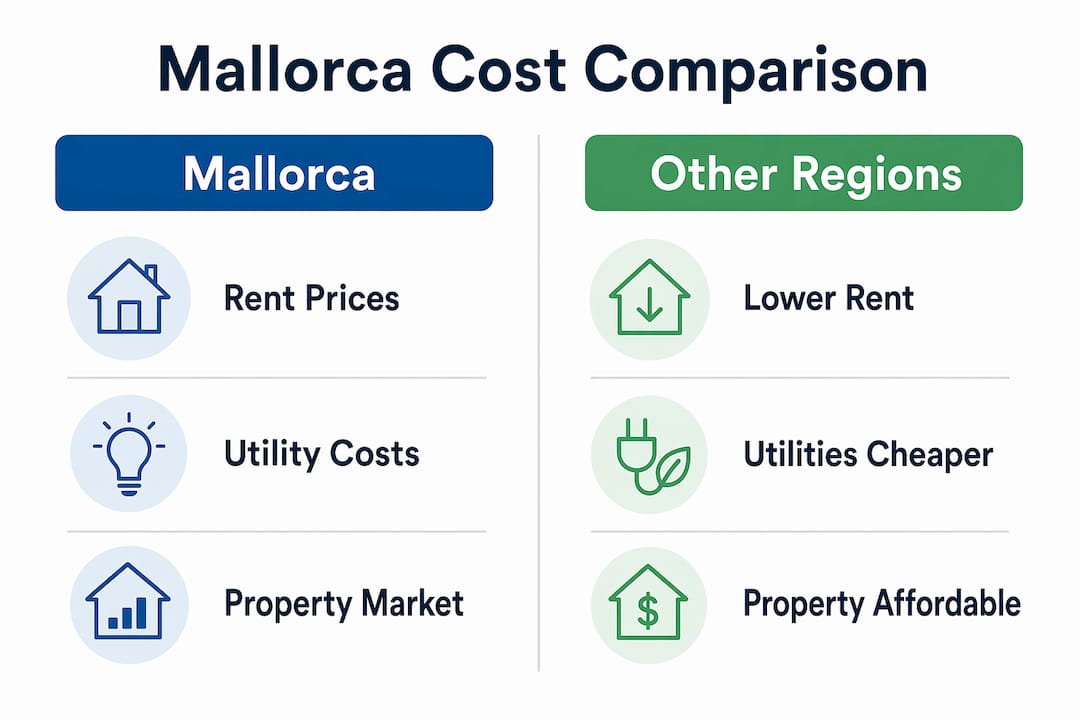
Comparing Mallorca to other Spanish regions, the island runs 20–30% more expensive than Valencia or Murcia for equivalent housing. Against US retirement destinations like Scottsdale or Naples, Florida, Mallorca is competitive on healthcare costs but higher on rental prices. The cost of living increase has outpaced most other European countries, which is a fact worth sitting with before committing.
For retirees considering property purchase rather than renting, the Mallorca property market forecast shows continued price appreciation, making ownership a stronger long-term financial position than renting in most scenarios. A luxury retirement in Palma allows for premium apartment rentals at €2,000–€3,000 monthly with private healthcare and access to Michelin-starred restaurants, but that lifestyle requires a total monthly budget well above €5,000.
Pro Tip: Build a 12-month rolling expense tracker before you move. Track every irregular cost, from notary fees to summer air conditioning bills, for a full calendar year. That data becomes your real budget, not an estimate.
Which areas of mallorca are best for retirees?
Location choice inside Mallorca is one of the most consequential decisions a retiree makes, and most people underestimate it. The island divides broadly into Palma, the coastal resort towns, and the inland villages. Each delivers a fundamentally different retirement experience.
Palma is the clear first choice for retirees who want year-round social connectivity. The city has a permanent population of over 400,000, walkable neighborhoods like Santa Catalina and El Terreno, and a full range of urban amenities operating 12 months a year. Renting in Palma gives retirees access to walkable neighborhoods with community amenities, reducing the maintenance burden that comes with owning a rural property.

| Location Type | Pros | Cons |
|---|---|---|
| Palma (urban) | Year-round community, walkability, full services | Higher rental costs, urban noise |
| Coastal resorts (Port d’Andratx, Puerto Pollensa) | Scenic beauty, expat community in summer | Seasonal isolation in winter months |
| Inland villages (Soller, Arta) | Authentic local character, quieter pace | Requires car, deeper language integration needed |
The seasonal isolation problem is real and underreported. Many retirees choose a scenic coastal resort based on a summer visit, then discover that restaurants, shops, and neighbors disappear from october through march. Choosing Palma or towns with year-round communities is the proven way to avoid that trap. Towns like Soller and Alcudia maintain more year-round activity than pure resort areas, but neither matches Palma for consistent social infrastructure.
Practical steps to avoid seasonal isolation:
- Visit your target area in january or february before committing to a lease
- Join expat Facebook groups specific to your target town and ask about winter activity levels
- Prioritize towns with permanent Spanish resident populations, not just expat communities
- Confirm that your preferred medical clinic, pharmacy, and grocery store operate year-round
What do american retirees need to plan before moving to mallorca?
The administrative and financial preparation for retiring in Mallorca is more demanding than most Americans expect. Spain’s non-lucrative visa is the standard entry route for retirees, and it carries specific financial requirements that eliminate candidates who are not financially prepared.
-
Confirm your income threshold. Spain’s non-lucrative visa requires demonstrating income of at least €2,400 per month, or approximately $2,588, for a single applicant. That figure rises for couples and dependents. Social Security income, pension distributions, and investment income all count toward this threshold.
-
Secure private health insurance before applying. The visa application requires proof of comprehensive private health insurance with no coverage gaps. Policies must cover the full duration of your initial visa period, typically one year.
-
Decide between renting and buying early. Renting first is the lower-risk approach for most first-year retirees. It allows you to test neighborhoods before committing capital. Buying, however, locks in your cost base and builds equity in a market that has appreciated consistently. For retirees with sufficient capital, purchasing a property through an independent buyer agent gives you full market access and legal protection.
-
Build a financial buffer into your plan. A 15% financial buffer above your estimated monthly expenses is the professional recommendation. This covers visa renewals, notary fees, document translations, and seasonal utility costs that arrive unpredictably.
-
Engage a tax advisor familiar with US-Spain tax treaties. The US-Spain tax treaty affects how your Social Security, IRA distributions, and investment income are taxed in both countries. Getting this wrong in year one creates problems that take years to resolve.
The Mallorca retirement property guide covers budgeting frameworks and seasonal cost planning in detail, which is a useful starting point before engaging legal or financial advisors.
Pro Tip: Apply for your Spanish NIE (tax identification number) before you arrive. You need it for almost every financial transaction in Spain, including opening a bank account and signing a lease. Many US-based Spanish consulates process NIE applications, which saves weeks of waiting after arrival.
Key takeaways
Mallorca delivers an exceptional retirement lifestyle, but financial readiness and location choice determine whether that lifestyle is sustainable long-term.
| Point | Details |
|---|---|
| Budget realistically | Target €3,200/month including a 15% buffer for irregular costs like visa renewals and utilities. |
| Rising costs are real | Housing prices rose 25–50% and food prices 30–40% since 2020, making Mallorca best suited for well-funded retirees. |
| Location determines lifestyle | Palma and year-round towns prevent seasonal isolation; coastal resorts can feel empty from october through march. |
| Visa income threshold matters | Spain’s non-lucrative visa requires at least €2,400/month in demonstrable income for a single applicant. |
| Independent buyer advice pays off | Working with an independent buyer agent gives retirees full market access and legal protection when purchasing property. |
What i’ve learned after years in mallorca’s property market
The retirees who thrive here are not the ones who fell in love with the island on a summer vacation. They are the ones who did the math, visited in january, and still said yes. That distinction matters more than any lifestyle brochure.
Mallorca’s cost increases since 2020 have genuinely changed who can retire here comfortably. The island is no longer a budget-friendly alternative to Florida or Portugal. It is a premium destination that rewards financial preparation and punishes wishful thinking. I have watched American clients arrive with a €2,500 monthly budget, discover the real cost of renting in Palma, and either scramble to adjust or leave within a year.
What I tell every client: the lifestyle quality here is real, and the property market remains one of the most stable in southern Europe. But you need to arrive with your finances structured correctly, your visa documentation in order, and a clear-eyed view of where you want to live through the winter months. The island rewards people who treat this as a serious financial and lifestyle decision, not a romantic escape. Those who do the work upfront tend to stay for decades.
— Uli
How Uli-lisa helps american retirees invest safely in mallorca
Buying property in Mallorca as an American retiree involves navigating a competitive market, foreign legal systems, and a wide range of agencies each representing their own listings. Uli-lisa operates exclusively as an independent buyer agent, representing only the buyer with full access to Mallorca’s entire property market across all agencies. That independence means no conflicts of interest and no pressure toward any single listing. For retirees seeking safe property investment in a market that has appreciated 25–50% in recent years, having an advisor who works only for you is not optional. Contact Uli-lisa for a personalized property search and buyer representation that covers every step from initial search to legal completion.
FAQ
What is the minimum income to retire in mallorca?
Spain’s non-lucrative visa requires a minimum income of €2,400 per month for a single applicant. Couples and dependents require higher thresholds.
How much does it cost to live comfortably in palma?
A comfortable retirement in Palma requires approximately €3,200 per month, including a 15% buffer for variable and seasonal expenses.
Is mallorca still affordable for american retirees?
Mallorca is no longer a budget destination. Housing and food prices have risen sharply since 2020, making it most suitable for retirees with strong pension income or investment assets.
Which part of mallorca is best for year-round living?
Palma is the strongest choice for year-round community and services. Seasonal resort towns can feel isolated during winter months when businesses close and expat neighbors return home.
Should i rent or buy property when retiring in mallorca?
Renting first lets you test neighborhoods without committing capital. Buying locks in your cost base and builds equity in a market with consistent long-term appreciation, making it the stronger financial position for retirees with sufficient funds.
Recommended
- Advantages of living in Mallorca for luxury buyers 2026 - ULI & LISA Mallorca Property Blog
- Mallorca luxury vacation homes: investment advantages in 2026 - ULI & LISA Mallorca Property Blog
- Mallorca Investment Tips: Maximize ROI and Navigate Rental Laws - ULI & LISA Mallorca Property Blog
- Choosing the Right Area Mallorca: Guide for US Buyers - ULI & LISA Mallorca Property Blog