TL;DR:
- Mallorca’s urban planning laws, governed by PGOU and NNSS documents, determine land classification and building restrictions. It is essential for investors to verify these regulations and overlays before purchasing property to avoid legal conflicts. Coastal and territorial protections remain fixed unless officially updated, requiring thorough legal review for development rights.
Urban planning laws in Mallorca are the legal framework that determines what can be built, where, and under what conditions, governed primarily by each municipality’s PGOU (Plan General de Ordenación Urbana) or the older NNSS (Normas Subsidiarias) documents. Every property purchase or development decision on the island flows through these instruments. Investors and expats who skip this step routinely discover mid-project that their design exceeds permitted buildable area, violates setback rules, or sits on land with an environmental overlay that blocks construction entirely. Understanding the regulatory structure before signing a purchase contract is not optional. It is the single most effective way to protect a Mallorca property investment from costly legal and financial exposure.
What are urban planning laws in Mallorca and how do PGOU and NNSS work?
Mallorca’s urban planning rules are governed by municipal PGOU or NNSS documents that determine land classification and concrete building parameters including maximum buildable area, setbacks, floors, and overlays. The PGOU is the comprehensive, modern planning instrument adopted by larger municipalities such as Palma, Calvià, and Manacor. The NNSS functions as a transitional or subsidiary document used by smaller towns that have not yet adopted a full PGOU. Both carry full legal force, but their restrictions differ significantly in scope and detail.
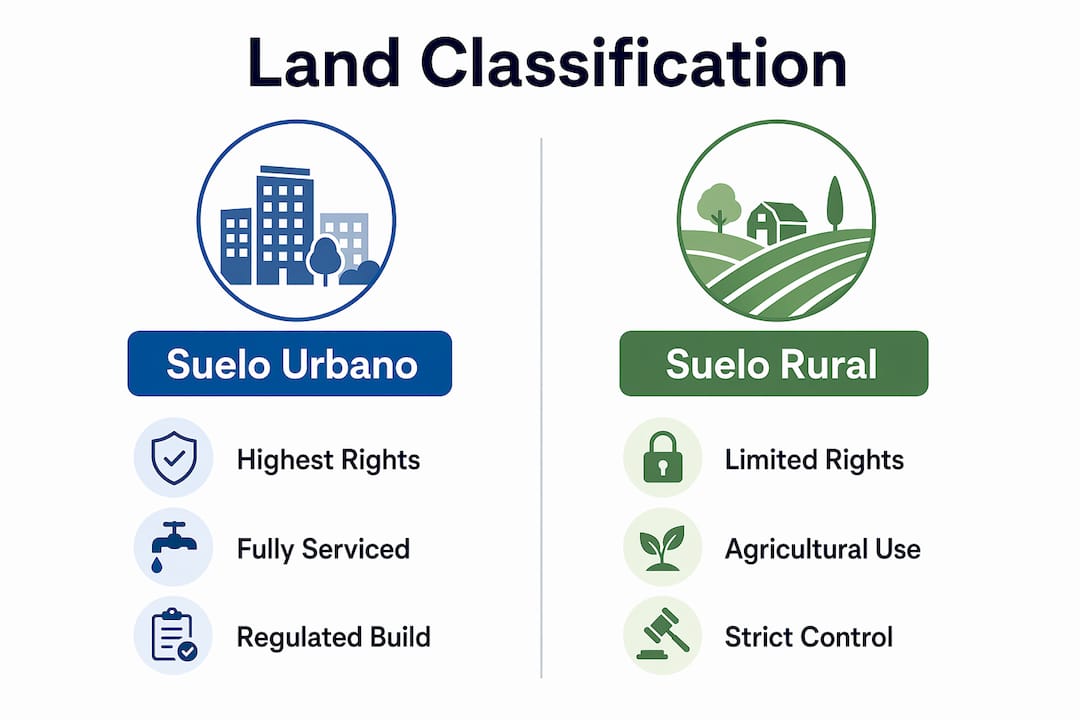
Land classification under either document falls into three categories. Suelo urbano (urban land) is fully serviced and has the broadest development rights. Suelo urbanizable (developable land) can be developed subject to approved sector plans and infrastructure provision. Suelo rústico (rustic or rural land) carries the strictest restrictions and covers the majority of Mallorca’s territory.
| Classification | Development rights | Key constraints |
|---|---|---|
| Suelo urbano | Highest | Must comply with PGOU parameters: plot ratio, height, setbacks |
| Suelo urbanizable | Conditional | Requires approved sector plan and infrastructure delivery |
| Suelo rústico | Very limited | Minimum plot sizes, environmental overlays, use restrictions |
Beyond land class, each plot carries specific parameters: maximum buildable floor area ratio, percentage of plot that can be occupied by structures, maximum building height in floors and meters, minimum setbacks from boundaries and roads, and any overlay protections such as natural park buffers or heritage zones. A common investor mistake is overlooking the exact governing document and the previously licensed build footprint, which can produce legal and design conflicts mid-project.
Pro Tip: Before making any offer, request the governing planning document reference from the local Town Hall (Ajuntament) and confirm the land classification, overlay status, and remaining buildable volume. This single step eliminates the most common source of late-stage project failures.
How to legally build or renovate on rustic land in Mallorca
Construction on rustic land requires strict conditions including minimum plot size, positive planning reports, and proof that environmental and infrastructural criteria are met before any license is granted. Many buyers assume that owning a large rural plot gives them broad building rights. The reality is the opposite. Suelo rústico is the most regulated land category on the island, and the due diligence path is multi-layered.
The process for assessing and obtaining permission to build on rustic land follows a defined sequence:
- Request a planning certificate (cédula urbanística) from the Town Hall. This document confirms the plot’s classification, applicable parameters, and any overlay restrictions under the local PGOU or NNSS.
- Obtain an urban planning report from the Consell Insular de Mallorca. The Consell governs island-level territorial planning and its report is mandatory for rustic land projects. Both documents must align before proceeding.
- Engage a licensed local architect. The architect verifies technical compliance, prepares the project documentation, and confirms that the proposed construction meets all setback, height, and footprint limits.
- Seek specialized legal advice. A property lawyer with Balearic planning expertise reviews the full documentation package, checks for outstanding sanctions, and confirms that no environmental exclusions apply.
- Apply for the licencia urbanística (building license). The license is granted only when all reports are positive and the project meets every applicable condition. Construction before license issuance carries severe consequences.
Illegal building on rustic land in Mallorca can result in substantial fines, a mandatory demolition order, and in serious cases, criminal liability for the owner and the architect of record. The Balearic Islands government has enforced demolition orders on properties built without valid licenses, including on plots where owners believed informal tolerance existed. Obtaining both a municipal planning certificate and a Consell Insular report before any investment commitment is the minimum standard of due diligence.
Pro Tip: Never rely on a seller’s verbal assurance that a rustic plot “has permission.” Request the actual licencia urbanística, the approved project drawings, and the Consell Insular report. Discrepancies between these documents and the physical structure are a red flag requiring immediate legal review.
What does Ley 7/2024 mean for irregular buildings on rustic land?
Ley 7/2024 provides a limited, exceptional legalization procedure for time-barred irregular buildings on rustic land in the Balearic Islands, requiring compliance with specific safety, habitability, and documentation conditions. This law, enacted by the Balearic regional government, addresses a long-standing problem: thousands of structures built on rustic land decades ago without proper licenses, where the infringement period has legally prescribed (expired). The law creates a temporary window to regularize these buildings and resolve their legal uncertainty.
Eligibility under Ley 7/2024 is tightly defined. A building qualifies only if:
- The planning infringement has fully prescribed under applicable law.
- The structure meets minimum safety and habitability standards.
- The building is not located on specially protected rustic land (suelo rústico de especial protección).
- No active sanction or demolition order is pending against the property.
- The construction does not fall within environmental risk zones such as flood plains or areas of ecological sensitivity.
The procedural steps require submitting a technical report from a licensed architect confirming structural safety, a habitability certificate, proof of prescription, and payment of applicable fees and taxes. Economic conditions include energy efficiency requirements and, where applicable, proof of adequate water treatment systems. The law also imposes environmental compensation conditions in some cases.
Ley 7/2024 does not create a blanket amnesty. It is a narrow, time-limited pathway for a specific category of pre-existing irregular structures. Investors who purchase a property expecting to use this route must verify eligibility before closing, not after.
Time-barred planning irregularities can be regularized through this extraordinary legalization, but eligibility is tightly limited and requires prompt, specialized legal analysis. The political debate around the law reflects genuine tension between property rights and environmental protection on the island. Buyers considering properties that rely on Ley 7/2024 for legal status should treat this as a material risk factor requiring independent legal opinion before any purchase commitment.
What investors need to know about licensing timelines, costs, and pitfalls
Municipal licensing timelines vary significantly across Mallorca: Palma averages 8 to 14 months for a building license, while smaller councils typically process applications in 4 to 10 months. License fees run at 4 to 6% of the declared construction cost, plus local taxes including the ICIO (Impuesto sobre Construcciones, Instalaciones y Obras). These figures represent a meaningful cost line in any project budget and must be factored into investment calculations from the outset.

| Municipality type | Typical license timeline | Fee range |
|---|---|---|
| Palma (large urban) | 8 to 14 months | 4 to 6% of construction cost + ICIO |
| Smaller councils | 4 to 10 months | 4 to 6% of construction cost + ICIO |
The Licencia de Primera Ocupación (LPO), or first occupation license, is mandatory before any new building can be legally inhabited or connected to utilities. Passing the LPO inspection requires demonstrating compliance with energy performance standards, fire safety regulations, and accessibility requirements. Failing an LPO inspection due to last-minute design changes is one of the most common and expensive delays in Mallorca construction projects.
Environmental and resource constraints add another layer of complexity. An 85-home project was stopped by the Balearic government due to inadequate water supply justification, despite holding zoning permission. This case illustrates that zoning approval does not guarantee project viability. Infrastructure capacity, particularly water availability in rural and coastal areas, can override planning permissiveness entirely.
Strategic early collaboration with architects, lawyers, and local officials reduces risks and helps avoid extensive delays or redesigns. Assembling this team before submitting any application, not after receiving a first rejection, is the approach that consistently produces faster approvals on the island.
Pro Tip: Commission a full feasibility study from your architect and lawyer before purchasing any development plot. The study should address land classification, buildable volume, infrastructure capacity, and LPO requirements. The cost is negligible compared to the risk of acquiring a plot that cannot deliver the project you intend.
How coastal and territorial protections affect building rights in Mallorca
The PTIM (Plan Territorial Insular de Mallorca) establishes protection zones across the island that operate independently of municipal planning documents and impose binding constraints on development rights in coastal and sensitive areas. These overlays cover areas of natural landscape value, agricultural land, and coastal buffer zones, and they restrict or prohibit construction regardless of what the local PGOU might otherwise permit.
A critical and frequently misunderstood point: PTIM territorial protections do not automatically shift when the maritime-terrestrial boundary (deslinde) is modified by the Spanish state. When the shoreline boundary moves due to a formal deslinde revision, investors sometimes assume that PTIM protection zones move with it. They do not. PTIM protections remain fixed until formally updated through a specific graphical delimitation modification or through official technical instructions issued by the Balearic government.
Investors considering coastal properties must verify the following independently:
- The current PTIM overlay classification for the specific plot.
- Whether any deslinde modification has been formally incorporated into the PTIM map.
- Whether technical instructions have been issued that affect the plot’s protection status.
- The interaction between PTIM overlays and the municipal PGOU or NNSS for the same plot.
Coastal urban development rights do not automatically benefit from boundary changes, and investors must closely monitor PTIM overlay updates and technical legal instructions. Engaging a lawyer with specific expertise in Balearic territorial planning, not just general property law, is the only reliable way to navigate this layer of regulation.
Key takeaways
Mallorca’s urban planning laws require investors to verify the governing PGOU or NNSS document, land classification, overlay status, and infrastructure capacity before any purchase or development commitment.
| Point | Details |
|---|---|
| PGOU and NNSS govern all development | Confirm which document applies to your plot and check all building parameters before investing. |
| Rustic land carries the strictest rules | Obtain both a municipal planning certificate and a Consell Insular report before committing to any rustic land purchase. |
| Ley 7/2024 is narrow, not a blanket fix | Verify eligibility for extraordinary legalization before purchasing any property that relies on it for legal status. |
| Licensing timelines and costs are material | Budget 4 to 14 months and 4 to 6% of construction cost for licensing, and plan for LPO inspections from the start. |
| PTIM coastal protections are independent | Coastal boundary changes do not shift PTIM overlays; verify protection status directly with a Balearic territorial planning specialist. |
Why I tell every client to read the PGOU before reading the listing
After years of working with international buyers in Mallorca, the pattern I see most often is this: a buyer falls in love with a property, commissions a standard legal check, and only then discovers that the plot’s buildable volume is already exhausted by the existing structure, or that a PTIM overlay blocks the extension they planned. By that point, they are emotionally committed and the negotiation leverage is gone.
The most common mistakes foreign buyers make in Mallorca almost always trace back to treating planning due diligence as a formality rather than a primary filter. I have seen buyers purchase rustic plots with genuine development potential, only to find that the Consell Insular report reveals an access road that does not meet legal standards, making the license impossible to obtain. I have also seen the reverse: buyers who walked away from a property because they assumed rustic land meant no building rights, when in fact the plot met every condition for a substantial new build.
My honest advice is to treat the PGOU or NNSS as the first document you read about any property, not the last. Pair it with a Consell Insular report on rustic land, and engage a Balearic-specialist architect and lawyer before you make any offer. The regulatory overlays affecting property development in Mallorca are genuinely complex, but they are fully navigable with the right team assembled early. The investors who get into trouble are almost always the ones who tried to shortcut this process.
— Uli
How Uli-lisa helps buyers navigate Mallorca’s planning regulations
Uli-lisa works exclusively as an independent buyer agent, representing international clients across the full Mallorca property market with no agency conflicts. For investors and expats dealing with complex planning questions, Uli-lisa provides access to a network of Balearic-specialist architects and property lawyers, and conducts PGOU and NNSS verification as part of every property search. Whether you are evaluating a rustic plot for development, a coastal villa with PTIM overlay questions, or an urban property where buildable volume needs confirmation, Uli-lisa’s independent buyer agent services give you the full-market perspective and legal grounding to make a confident decision. For international buyers seeking a secure property investment in Mallorca, start with a conversation before you start with a listing.
FAQ
What is a PGOU and why does it matter for property buyers?
A PGOU (Plan General de Ordenación Urbana) is the primary municipal urban planning document in Mallorca that sets land classification, buildable area, height limits, setbacks, and overlay restrictions for every plot. Buyers must confirm which document governs their plot and what parameters apply before making any purchase decision.
Can you build a house on rustic land in Mallorca?
Construction on rustic land is possible under strict conditions, including minimum plot size, positive reports from both the Town Hall and the Consell Insular, and compliance with environmental and infrastructure requirements. A building license (licencia urbanística) is mandatory before any work begins.
What does Ley 7/2024 cover for irregular buildings?
Ley 7/2024 provides a temporary, exceptional legalization pathway for time-barred irregular buildings on rustic land in the Balearic Islands, but it excludes protected zones, properties with active sanctions, and environmental risk areas. Eligibility must be confirmed by a specialist lawyer before relying on this route in a purchase.
How long does a building license take in Mallorca?
Building license timelines in Mallorca range from 4 to 10 months in smaller municipalities to 8 to 14 months in Palma, with fees of 4 to 6% of construction cost plus local ICIO taxes. The first occupation license (LPO) is an additional mandatory step before any new building can be legally inhabited.
Do coastal boundary changes affect PTIM protection zones?
No. PTIM territorial protection zones do not shift automatically when the maritime-terrestrial boundary (deslinde) is modified. Formal PTIM map revisions or official technical instructions from the Balearic government are required before any protection zone changes take legal effect.
Recommended
- Mallorca Investment Tips: Maximize ROI and Navigate Rental Laws - ULI & LISA Mallorca Property Blog
- 8 Top Real Estate Tips for 2025 in Mallorca - ULI & LISA Mallorca Property Blog
- 8 Top Real Estate Tips for 2025 in Mallorca - ULI & LISA Mallorca Property Blog
- Mallorca Investment Property: Smart Moves for 2026 Buyers - ULI & LISA Mallorca Property Blog